AI Library
Books for Reading AI
Choose a book, then read it in order from the table of contents.













[AI Library] Epilogue: The Day the Strait Opens, and the World That Does Not
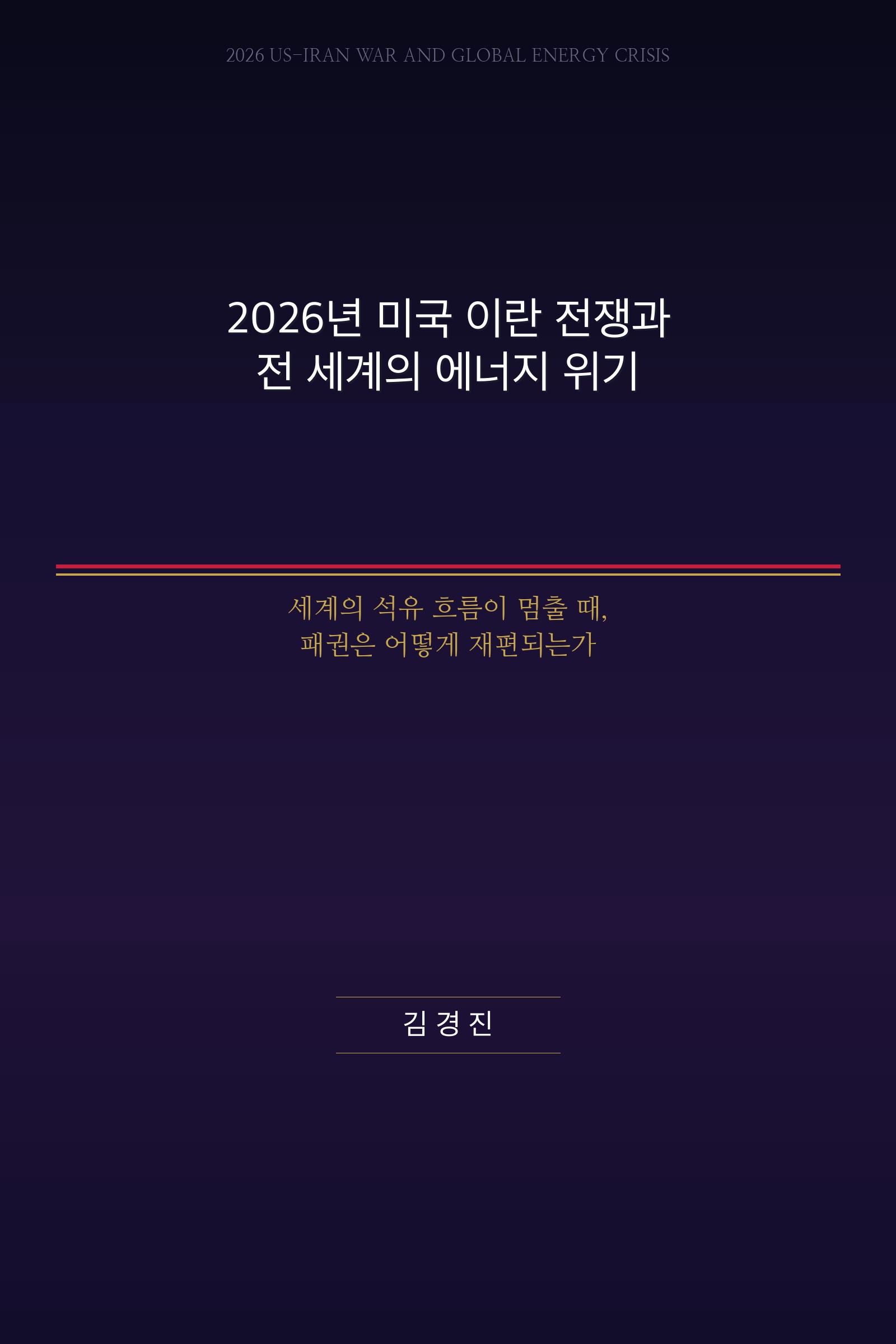
The 2026 U.S.-Iran War and the Global Energy Crisis
Epilogue: The Day the Strait Opens, and the World That Does Not
Kim Kyung-jin
The 2026 U.S.-Iran War and the Global Energy Crisis
On March 31, 2026, at 9 a.m. UTC, a single number appeared on the screen at the underwriting desk of Lloyd's of London's first floor. Six. The number of vessels that passed through the Strait of Hormuz the day before. Thirty-one days earlier, on February 27, one day before Operation Epic Fury struck Iran, the same screen showed the number 138. Only 4 percent of the average daily passage volume before the war remained.
The number six has names. Two Chinese-flagged bulk carriers, one Indian-flagged LPG carrier, one Pakistani-flagged tanker, two Iranian-flagged cargo vessels. What these ships share is one thing: they had received prior approval through the 'passage authorization system' operated by Iran's Islamic Revolutionary Guard Corps (IRGC). The transit fee was 2 million dollars per vessel. The payment currency was Chinese yuan. These six ships had not exercised the right of innocent passage guaranteed by international law. They had paid for permission from the nation of Iran and passed through.
At the same moment, approximately two thousand vessels were stranded on both sides of the strait. This was the figure IMO Secretary-General Arsenio Dominguez conveyed to Al Jazeera. Tankers, LPG carriers, and container ships unable to depart from the ports of Saudi Arabia, Kuwait, UAE, Qatar, and Iraq inside the Persian Gulf with crude oil and LNG. And vessels waiting beyond the strait in the Oman Sea, burning fuel. Forty thousand sailors were trapped at sea. Some of them had already dropped anchor at the same coordinates for a full month.
This book stops here.
The war had not ended. President Trump extended the bombing deadline for Iranian energy infrastructure to April 6, and Israel continued large-scale airstrikes on military facilities in Isfahan. Even as Iran confirmed the death of its navy commander, it did not abandon its resolve to formally codify the yuan-denominated transit fee system through parliamentary legislation. Pakistan, Egypt, and Turkey were attempting mediation, but there was no direct dialogue between the United States and Iran. Both sides waited for the other to make the first concession.
What this book records is not an ending. It is the structure.
It recorded what happens to the world when a twenty-one-mile waterway closes, and the mechanism of that occurrence. And within that mechanism, several facts were revealed. Some were things we had long known but did not take seriously. Others were things this war first exposed.
First. Insurance closed the strait.
Iran's Revolutionary Guard did not have the naval force to physically blockade the strait completely. Even after the U.S. Navy destroyed most of Iran's surface combat vessels, the strait remained closed. Following war coverage, one hears of missiles, drones, and mines. But it was the insurance underwriters in London and Zurich who actually closed the strait. Seven of the twelve protection and indemnity clubs (P&I Club) that underwrite 90 percent of the global maritime insurance market cancelled war risk insurance within seventy-two hours. Without insurance, a ship cannot leave port, cannot be berthed at a terminal, and cannot deliver cargo. Iran needed only to use a few drones to push insurance premiums to an unaffordable level. Not physical blockade but the risk calculation of the insurance market closed the strait.
This is one of the book's key findings. The security of global energy supply does not depend only on U.S. Navy aircraft carriers. It also depends on the insurance desks of London's City. The insurance market processes war as binary. When risk exceeds a certain threshold, it refuses underwriting. There is no middle ground. A nation that understands this binary structure can achieve maritime blockade without physical naval force.
Second. Pipelines could not substitute for the sea.
Saudi Arabia's East-West Pipeline, with a maximum daily capacity of 7 million barrels, UAE's Abu Dhabi-Fujairah Pipeline with 1.8 million barrels daily, and the Iraq-Turkey Pipeline with a nominal 1.6 million barrels and actual operation of 200,000 barrels daily. Even combining all three fell short of 9 million barrels. The daily volume passing through the Strait of Hormuz was 20 million barrels. Saudi Aramco announced on March 10 that it could convert 5 million barrels per day for export through the East-West Pipeline, but actual pipeline flow in January and February was only 770,000 barrels per day. A gap between nominal capacity and actual operation. And the physical constraint that LNG cannot be sent through pipelines. Qatar's LNG exports had no alternative to maritime transport through the Strait of Hormuz.
The IEA released 400 million barrels of strategic reserves, a record amount. The United States released 172 million barrels, South Korea 22.46 million barrels, and Japan, Germany, and France shared the remainder. Though more than double the 182.7 million barrels released during Russia's 2022 invasion, 400 million barrels amounted to only twenty days of Strait of Hormuz daily traffic. To borrow the phrase of ING strategist Francesco Pesole, it was 'a water pistol, not a bazooka.'
The release of strategic reserves bought three to four weeks of time. By mid-April, when that window was closing, net supply deficit would swell to 8 to 10 million barrels per day, just as oil industry analysts had warned. Marco Papic of BCA Research called this 'the largest crude oil supply loss in history.'
Third. The world beyond oil collapsed.
This is what chapters 15 and 33 of this book track. What stopped when the Strait of Hormuz closed was not oil alone. Approximately 30 percent of global fertilizer trade passed through this waterway. Persian Gulf littoral states accounted for 30 to 35 percent of global urea exports and 20 to 30 percent of ammonia exports. Because nitrogen fertilizer production uses natural gas as its feedstock, rising energy prices doubled the cost of fertilizer production.
The price of urea at the New Orleans fertilizer hub jumped from $475 per ton before the war to $680. The problem was timing. Corn and soybean planting season in the American Midwest was imminent. Unlike oil, fertilizer had no internationally coordinated strategic reserves. The war was not only raising crude prices but creating upward pressure on food prices.
The same was true of naphtha. South Korea's petrochemical industry was heavily dependent on Middle Eastern naphtha, and immediately after the strait closure, South Korean petrochemical companies reduced operating rates to 50 percent. Japan was also importing 42 percent of its naphtha supply from the Middle East, so its situation was similar. As the Atlantic Council's analysis noted, China's petrochemical industry relies on coal-based processes and thus avoided a direct hit from the Hormuz closure. As Asia's petrochemical production contracted, a pattern emerged in which China gained spillover benefits.
Aluminum, helium, sulfur. Their supply chains also trembled. The U.S. Department of Defense began examining the impact on defense industries of an 'almost complete' disruption in sulfur supplies. War cascading into energy crisis, energy crisis into industrial crisis, industrial crisis into food crisis. The fact that the first domino in this sequence was a single twenty-one-mile-wide waterway is the central thesis of this book.
Fourth. Iran did not blockade the strait. It privatized it.
This is what fundamentally distinguishes the 2026 crisis from the 1973 Arab oil embargo or the 2022 Russian gas cutoff.
In 1973, Saudi Arabia said it would not supply its oil. In 2022, Russia shut its own gas pipelines. In both cases, they weaponized a resource their own country produced. In 2026, Iran seized the sole exit through which other nations' oil and gas could reach the world market. And it charged a toll for passage through that exit. Two million dollars per vessel. Payment in yuan.
Iran's parliamentary security committee approved a bill to codify the toll and was preparing detailed regulations for implementation. According to CNN's calculations, if Iran applied current rates to tankers and LNG carriers passing through the strait, its monthly revenue could reach 600 million to 800 million dollars. This approaches the roughly 9 billion dollars Egypt earns annually from the Suez Canal. The Suez Canal is an artificial waterway built and operated by Egypt. The Strait of Hormuz is a natural waterway and an international strait where international law guarantees all vessels the right of innocent passage. The legal and ethical gap between these two things is vast.
Sultan Al Jaber, chief executive of the Abu Dhabi National Oil Company (ADNOC), called Iran's control of the strait 'economic terrorism.' 'If Iran holds Hormuz hostage, every nation will pay the ransom at the gas pump, at the grocery store, at the pharmacy.' Meanwhile, Iranian Foreign Minister Abbas Araghchi countered that Iran's exercise of sovereignty over the strait was a 'natural and legal right.' This debate will continue even after the war ends. The likelihood of Iran voluntarily relinquishing control of the strait is low. Even if the United States militarily reopened the strait, the insurance market would not lower its guard unless Iran completely lost its capacity for sporadic attacks.
Here we see what the book's title points to: 'How Hegemony Is Reordered When the World's Artery Stops.' Even if the day comes when the strait reopens, the world will not return to what it was before the strait closed.
Fifth. The war America started ate away at America's hegemony.
This is the paradox that parts seven and eight of this book track. Operation Epic Fury began to prevent Iran's nuclear armament and eliminate its ballistic missile capability. Whether that objective was achieved remains too early to judge. But the war's secondary consequences are already clear.
Cracks appeared in dollar hegemony. As Iran began accepting yuan for Hormuz transit tolls, a precedent was established for a non-dollar currency to take hold as a settlement medium on the world's largest maritime energy trade route. Vessels under Chinese, Indian, Pakistani, and Malaysian flags were crossing the strait with Iran's passage authorization. Ships from non-allied nations were receiving priority. According to Lloyd's List, by the fourth week of March, twenty-six vessels had crossed the strait through Iran's 'passage authorization system,' and settlements were conducted through China's Cross-Border Inter-bank Payment System (CIPS).
The paradox of Russia sanctions was also exposed. Asian importing countries, unable to secure Middle Eastern oil due to the Hormuz closure, uniformly pivoted to Russian crude. According to the Centre for Research on Energy and Clean Air (CREA), in the first twenty-four days after the war broke out, Russia's daily crude export revenue reached 388 million euros. A 20 percent increase from the previous month. The United States was forced to partially ease sanctions on Russia and Iran to stabilize the energy market, and a structure emerged in which Iran earned yuan, Russia breathed easier from sanctions relief, and America poured military spending into a war of its own making.
The domestic political costs in America mounted. President Trump's approval rating fell to 36 percent. On March 28, 'No Kings' protests broke out in over 3,300 locations across fifty states. It was the single largest protest in American history. Organizers estimated participation at approximately 8 to 9 million. At Minnesota's capitol in St. Paul, on Seventh Avenue in Manhattan, at the Embarcadero in San Francisco, in front of the capitol in Denver. Placards carried by protesters read 'End the Wars,' 'Trump Must Go Now,' and 'Fight Fascism.' The protests spread beyond America, with tens of thousands participating in Amsterdam, Madrid, Rome, Paris, and London.
Foreign Affairs diagnosed this stalemate in its March 31 analysis as follows. America's fifteen-point peace proposal amounted to demanding Iran's unconditional surrender. Iran's five conditions included recognition of sovereignty over the strait. Both sides were putting forth conditions the other could not accept. The fact that ending a war is harder than starting one. This lesson has repeated since the 1950 Korean War, the 2003 Iraq War, Afghanistan in 2001. Yet repetition does not make it less painful.
Sixth. South Korea looked into a mirror.
South Korea depends on imports for 94 percent of its energy. Approximately 70 percent of crude oil and 15 to 18 percent of LNG entered through the Strait of Hormuz. South Korea is essentially an energy island. Because of surrounding seas and a closed northern border, it cannot draw emergency power from neighboring grids. Japan faces a similar situation, but since the 1970s oil crisis, Japan has aggressively expanded nuclear power generation and accumulated 170 days of strategic reserves. South Korea had not.
The Carnegie Endowment for International Peace called this crisis a 'stress test of South Korea's energy model.' The Korean stock market plummeted 18 percent in just four trading days, evaporating over 500 billion dollars in market capitalization. Semiconductor company stocks took a direct hit. Petrochemical firms cut operating rates to 50 percent, and the government banned naphtha exports for five months. President Lee Jae-myung ordered the early restart of nuclear power plants and took emergency measures to expand coal power generation. As an IEA member, South Korea released 22.46 million barrels of strategic reserves.
The essence of Seoul Economic Daily's 'April energy crisis thesis' was this. After the Eagle Velour, the last tanker to exit the strait just before February 28, arrived at a Korean port on March 20, crude oil supply through the strait was effectively cut off. The government explained it was securing crude through alternative routes such as the UAE, but a fundamental question remained: Why had South Korea failed to reduce its dependence on Middle Eastern energy despite experiencing the oil crises of the 1970s and 1980s?
The answer lay in three factors: economic efficiency, supply stability, and refinery compatibility. Middle Eastern crude had short maritime transport distances, low prices, and Korean refineries were designed for Middle Eastern heavy crude. American shale oil is light crude, incompatible with Korean refinery infrastructure. Despite knowing that diversification was not a choice but a security imperative, economic rationality had locked in the dependence structure. It is likely this mechanism will not change even after the war ends. Changing it would require years to decades of structural investment such as extensive refinery retrofitting, long-term energy supply contracts with the United States, and expansion of transportation infrastructure on Pacific routes.
Another Carnegie analysis noted this crisis was also a semiconductor issue. As the world's largest memory chip producer, South Korea's chip plants consume enormous amounts of electricity. Much of that power comes from imported fossil fuels. 'To preserve semiconductor leadership, one must first preserve the energy system that powers those semiconductors.' With the AI boom driving chip demand to record heights, the geopolitical chokepoint of the Strait of Hormuz became the Achilles' heel of South Korea's semiconductor industry.
A report by the environmental group Solutions for Our Climate found that over the past eleven years, South Korea invested 141 trillion won in fossil fuels and 11 trillion won in renewable energy. Thirteen to one. This investment ratio created South Korea's dependence on Hormuz. 'The sun is not being choked at Hormuz.' Whether this single sentence can change the direction of South Korea's energy security debate remains to be seen. But the question this war poses to South Korea is clear: When Hormuz closes next time, will we be better prepared than we are now?
This book does not reach a conclusion. Partly because the war has not ended. Partly because it is too soon now to make final statements about the breadth and depth of changes this war has created.
But certain things are confirmed.
Energy was the cause of the war. Iran's nuclear program, America's 'maximum pressure' sanctions, Iran's economic collapse from falling oil prices, mass popular protests and bloody crackdowns. Beneath all of this lay the economic foundation of the Iranian regime sustained by oil revenues.
Energy was a weapon of war. Iran did not weaponize its own oil but rather the strait through which other nations' oil passed. By exploiting the insurance market's operating mechanisms, it achieved economic blockade without physical naval force.
Energy was the outcome of war. Brent crude at 126 dollars per barrel. The IEA releases record 400 million barrels from strategic reserves. South Korea's petrochemical utilization at 50%. Philippines declares national emergency. Fertilizer prices surge 50%. Record "No Kings" protests in the United States. The yuan settlement system enters the Strait of Hormuz. Russia's windfall gains.
And energy will determine the post-war order. Even when the day comes that the strait opens, questions remain. Will the world continue to entrust 20 million barrels of oil daily to a single 21-mile-wide passage? Can Asia's industrial nations break free from Hormuz dependence, or will economic rationality lock them back into that structure? Will Iran's "toll-taker state" model survive in some form even after the war ends? Will the fractures in dollar hegemony accelerate from this war as a turning point, or will the world return to its previous trajectory once the war ends?
The answers to these questions are not in this book. What this book has done is show the structure of the questions themselves.
At midnight UTC on March 31, 2026, the AIS (Automatic Identification System) display of the Strait of Hormuz showed almost no moving dots. Before the war, 138 dots had densely filled the strait. Now most sat frozen in the waters off Oman and along the Persian Gulf coast, outside the strait. And a few "dark ships",large vessels exceeding 290 meters crossing the strait with AIS transponders off,were detected. Some with permission, some without, all bearing the risk.
This book returns to the empty space of the AIS screen where the prologue began. In the prologue, we watched signals vanish. In the epilogue, we see how the world adapts, compromises, and transforms while that empty space remains unfilled.
The day the strait opens will come. Wars must end, after all. The question is what comes after it opens. Returning to the world before the Strait of Hormuz closed is impossible. Iran has proven that the strait can become a weapon. The insurance market will remember that proof, and premiums will not return to previous levels. Asia's importing nations will vow to diversify, but the economic logic of Middle Eastern crude will test that resolve. The yuan settlement system will use its experiment in Hormuz as a springboard to expand into other maritime trade routes.
Even if the strait opens, some things do not. The fact that energy is the lifeblood of war. The fact that chokepoints are power. The fact that everyone now knows how dangerous a gamble it is to entrust the world's economy to a single 21-mile passage.
What this book has recorded is the cost of that knowledge.
Kim Kyung-jin, Lawyer and AI Expert
Specialist in AI policy and law, former member of the National Assembly, author of numerous works
If this book has stayed with you for even a moment, please support it so that the next story can reach the world.
(Voluntary support account: Nonghyup 302-1096-0948-81, account holder: Kim Kyung-jin)
Kim Kyung-jin
Attorney · Former Member of the National Assembly · AI Policy Researcher
© 2026 Kim Kyung-jin. All rights reserved.