AI Library
Books for Reading AI
Choose a book, then read it in order from the table of contents.










[AI Library] Chapter 38: Integrating Everything into One System
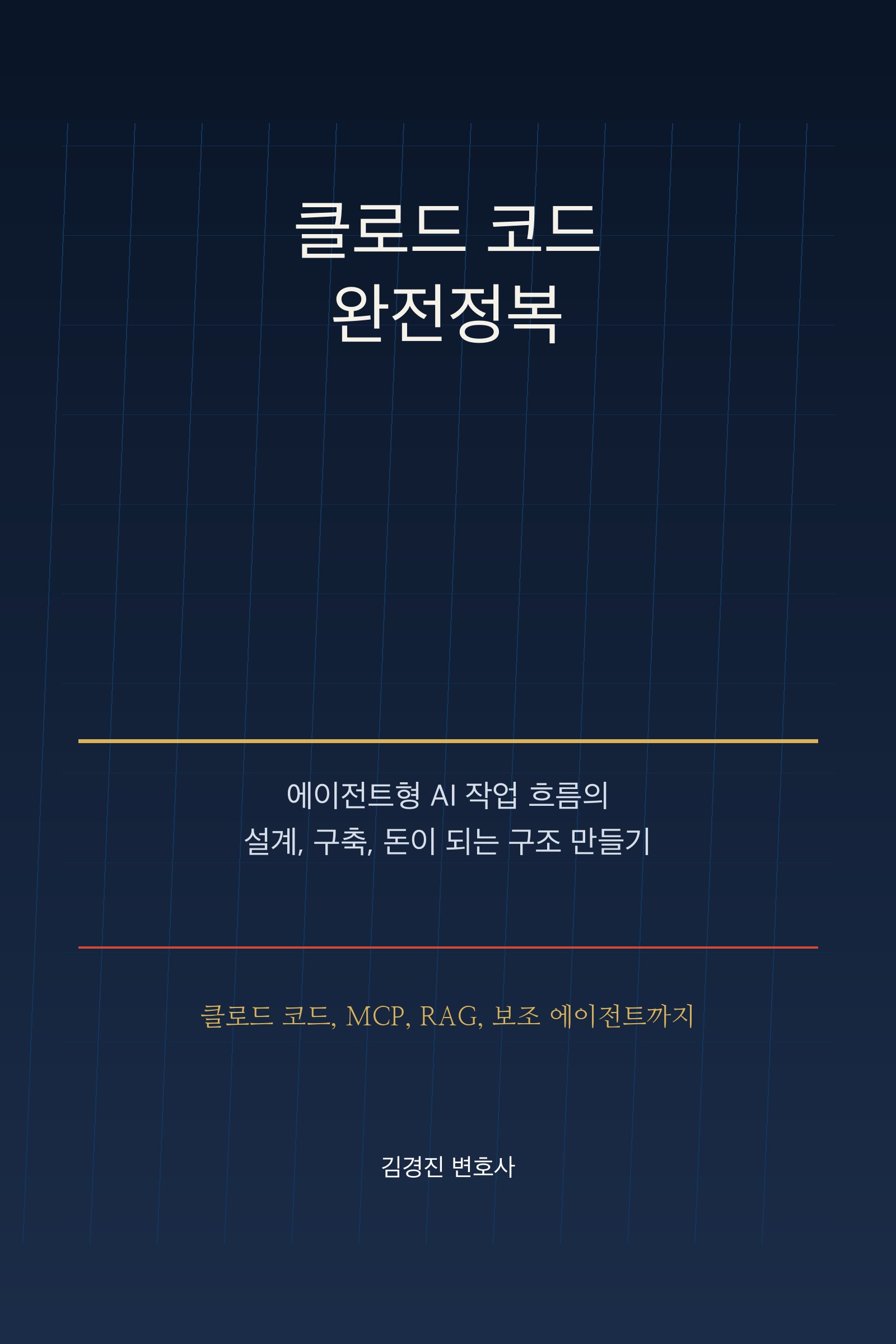
Mastering Claude Code
Chapter 38: Integrating Everything into One System
Kim Kyung-jin
Mastering Claude Code
Scattered Puzzle Pieces into One Picture
Imagine dozens of notes scattered across your desk. One sheet has the WAT Framework written on it. Another has a strategy for managing read length in one sitting. Yet another holds the 7-Day Framework, value-based pricing, and the steps for configuring MCP connection servers. Each piece matters on its own, but scattered separately, they are just a pile of notes.
The purpose of this chapter is to place those notes onto a single map. To make them function not as isolated techniques but as an integrated system. It is the work of connecting the entire flow,how agentic AI practitioners conceive of projects, build them, deliver them, and scale them,into one continuous path.
Reviewing the WAT Framework: The Starting Point of Every Project
Let us revisit the WAT Framework that appeared in the early chapters,Workflow, Agent, and Tool. These three elements are not separate concepts but lenses repeatedly applied when designing projects.
When taking on a new project, there are three questions to ask.
Workflow: What does the overall flow look like to solve this problem? Where does it begin and where does it end? What stages does it move through?
Agent: Where within this flow must the AI make decisions? At which stages should the agent intervene, and which stages are better handled by rule-based logic?
Tool: What tools must the agent access to do its work? Which external services need to be connected via MCP connection servers? Which do you need,file systems, APIs, databases?
Through these three lenses, you can decompose any project. Whether it is cloning a website, automating customer support, or scraping recruitment data, the structure is the same. You sketch the workflow, define the agent's role, and connect the tools.
[Figure 38-1] WAT Framework and Project Design Flow Diagram]
The power of this framework lies in its repeatability. Once you learn it, you can apply it even as industries shift, problems change, and tools evolve. Technology evolves, but the framework remains stable.
Checking the EA Roadmap: Locating Your Current Position
Let us visualize the path covered in this book as a single roadmap. It traces the growth stages of an agentic AI practitioner, or EA.
Stage 1: Setting Up Your Environment and Understanding the Basics
Configuring the terminal, installing Claude Code, learning basic commands. Grasping the concept of read length in one sitting and the strategy for managing how a model counts text fragments. Writing a CLAUDE.md file. This stage is about getting the tools into your hands.
Stage 2: Producing Your First Results
Cloning a website, building a simple web scraping workflow, automating documents. Gaining the experience of directing Claude Code and receiving results. Practicing how to break complex tasks into stages in planning mode. At this stage, the feeling that "the agent is actually doing work" takes shape.
Stage 3: Building Complex Workflows
Connecting MCP connection servers, building search synthesis systems, using helper agents, designing multi-step pipelines. This is the stage where you create structures with multiple agents collaborating, not just one. Error handling, logging, and context management become critical.
Stage 4: Real-World Delivery and Building a Business
Landing clients, setting prices, running QA, and handing off projects. The stage where you build business skills on top of technical capability. The path from free pilots to paid projects, from one-off engagements to retainers, and from warm introductions to cold outreach.
[Figure 38-2] The Four Stages of EA Growth,A Roadmap Diagram]
Wherever you are now, it is important to locate yourself on this roadmap. If you are in Stage 1, there is no need to worry about Stage 4 concerns prematurely. If you are in Stage 3, moving forward into Stage 4 may be more effective than further building technical skills.
You cannot skip any stage. But you can shorten the time spent in each one. The frameworks, checklists, and case studies presented in this book are tools for that acceleration.
Organizing Your Workflow Portfolio
The most direct way to prove your value as a practitioner is through a portfolio. But an AI automation practitioner's portfolio differs from a designer's portfolio. The core is not visual output but a record of problems solved.
An effective portfolio entry has four components.
Problem Definition: What business problem existed? Who was suffering, and in what way?
Approach: How did you design the workflow from the WAT Framework perspective? Which tools and agent structures did you use?
Results: What were the quantifiable outcomes? Numbers,time saved, costs cut, errors reduced.
Lessons Learned: What did you improve in this project, and what will you do differently next time?
One case study with all four components is a hundred times stronger than saying, "I do AI automation."
A practical way to organize your portfolio is a clean Notion page or Google Docs document. It does not need to be flashy. It just needs to be clear. Structure each project using the four elements above, and if possible, attach a short video demo.
Free pilots belong in your portfolio too. Being free is a pricing matter, not a performance matter. If you saved a client five hours per week in a free pilot, that is a valid outcome.
[Figure 38-3] Example of a Workflow Portfolio Entry Structure]
Continuous Learning Resources and Practical Systems
The world of AI shifts rapidly. New models launch, tools update, and the boundaries of possibility expand. Keeping pace is impossible. Trying to know everything means you understand nothing deeply.
Instead, building an effective learning system is what matters.
Core Technology Updates: Track updates to the tools you use daily,Claude Code, major MCP connection servers, and deployment platforms. You need not follow every AI news story, but you cannot miss changes that directly affect your work.
Community Engagement: Connecting with other practitioners in your field solves both information gathering and motivation at once. The forms vary,online communities, in-person meetups, quarterly events. What matters is not working alone in isolation.
Securing experiment time: Beyond client work, I intentionally set aside time for personal projects. Validating new models, trying new workflow patterns, or applying my skills to problems in completely different industries. This experiment time broadens my capabilities and becomes the source from which I can propose new possibilities to clients.
Documentation habit: For each project, I record what I learned, what attempts failed, and what patterns succeeded. These records become material for my portfolio later, serve as reference material when I encounter similar projects, and provide evidence of my growth trajectory.
[Figure 38-4] Diagram of four elements in a continuous learning system]
All of this, the WAT framework, the EA roadmap, the portfolio, and the learning system, connects as one integrated whole. The framework structures projects, the roadmap provides direction for growth, the portfolio accumulates results, and the learning system ensures evolution.
This system is yours. What this book has provided is an initial blueprint, not a finished building. You must revise it as you encounter real-world challenges, adapt it to your own context, and refine it with greater precision as your experience accumulates.
The work of weaving individual techniques and frameworks into one system is complete. But there remains a wider landscape that a person with such a system must look upon. In this era when agent-based AI is evolving rapidly, the question becomes: where should the reader stand?
Kim Gyeong-jin, lawyer and artificial intelligence expert
Specialist in AI legal policy, former member of the National Assembly, author of multiple works
If this book has remained with you even briefly, please support me so that the next story can reach the world.
(Voluntary support account: NH Bank 302-1096-0948-81 Account holder: Kim Gyeong-jin)
Kim Kyung-jin
Attorney · Former Member of the National Assembly · AI Policy Researcher
© 2026 Kim Kyung-jin. All rights reserved.