AI BOARD
AI Board
AI tools, policy moves, and public decisions are tracked in plain language.
(Apple) New Laptops and AI Processing Power
The release of the MacBook M5 Pro/Max and the reality of local LLMs: the truth beyond the marketing numbers
The MacBook M5 Pro/Max was officially released yesterday. On the day preorders began ahead of the March 11 sales launch, Apple put the phrase "up to 6.9 times faster LLM prompt processing than M1" front and center. For anyone interested in local LLMs, where AI runs directly on your own computer without the internet, that is a number that catches the ear.
But wait. Before we unpack the numbers, we need to be clear about something.
The structural difference between cloud AI and local LLMs
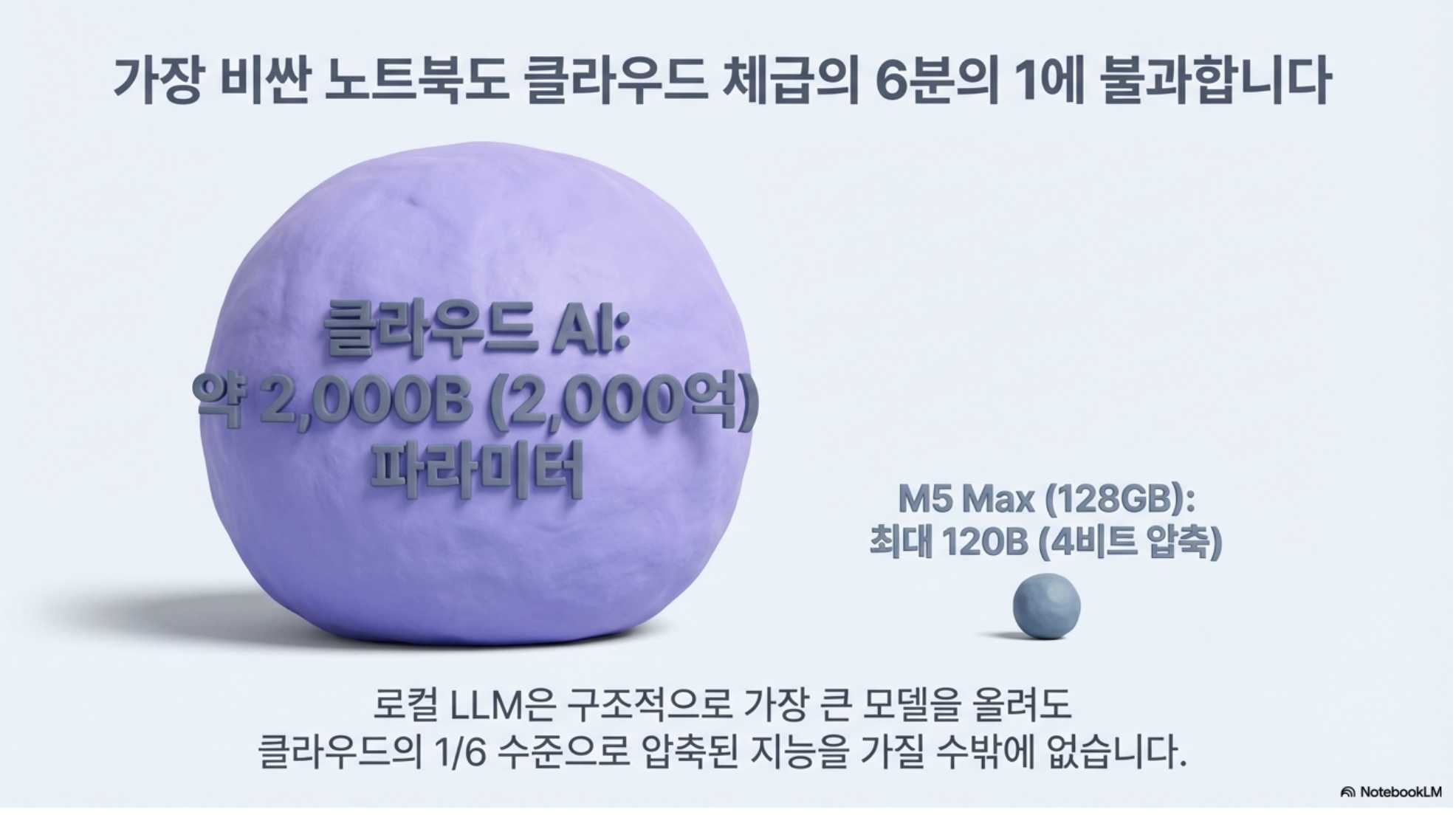
Where do ChatGPT, Gemini, and Claude that we use every day actually run? Not inside my laptop. They run on cloud servers, giant data centers packed with thousands of NVIDIA H100 GPUs. The models those servers handle are around 200 billion parameters, and they pour out answers at close to 200 tokens per second. The experience of letters appearing as if flowing across the screen, that is cloud AI.
The real performance and limits of M5 Max
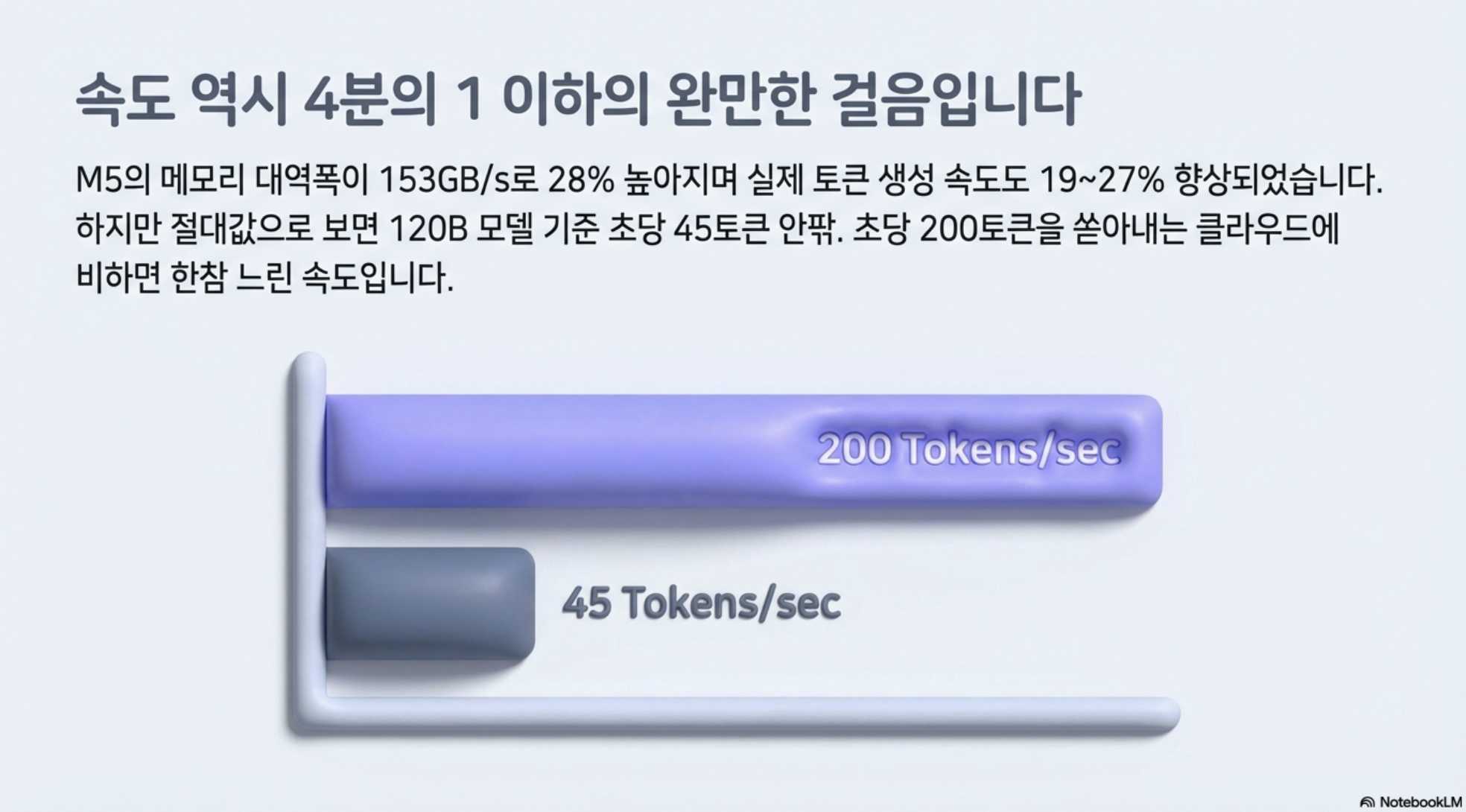
Local LLMs are different. The largest model you can run on an M5 Max with 128GB is 120B, or 120 billion parameters. Even that is a 4-bit compressed version. Compared with the size of cloud AI models, it is about one-sixth. And speed? The M5's memory bandwidth is 153GB/s, 28% higher than M4, and as a result actual token generation speed improved by 19-27%. The numbers alone look impressive. Convert them into absolute values, though, and the story changes. With a 120B model, you get around 45 tokens per second. Compared with cloud AI's 200 tokens per second, that is less than a quarter of the speed.
One-sixth the model, one-quarter the speed. That is the reality of local LLMs that the M5 Max has reached today. This is where the phrase "no matter how fast" starts to matter for the M5. When Apple advertises "6.9 times faster than M1," its comparison target is its own older product from several years ago. It is not a figure compared with cloud AI. Even if the M5 is 6.9 times faster than the M1, it is an improvement from a starting point that was overwhelmingly behind cloud AI. The gap is not being closed. It is still standing in front of a wall that is hard to climb over.
The gap between marketing numbers and felt performance
The '4 times faster LLM processing' Apple emphasizes is not actual token generation speed but prefill, the time it takes to first take in a prompt. The speed at which the answer flows out is tied to memory bandwidth, so even across generations it improves only gradually. This is why marketing numbers and felt speed differ.
The phrase "improved AI features" that laptop makers have been racing to promote over the past few years sits in the same context. Whether Intel, AMD, Apple, or Qualcomm, an improvement in laptop chip AI performance in practice means better local LLM processing. Dedicated circuits called NPUs and neural engines are exactly that. But no matter how much performance rises, the structural limit does not change. There are physical ceilings on the memory one laptop can hold, the power it can consume, and the heat it can cool. Catching up with hundreds of server racks in a data center with a single laptop is fundamentally impossible, even if the M50 comes out, not just the M5.
The real value of local LLMs
Then are local LLMs useless? No. They matter in environments with no internet connection, or when handling sensitive data that is hard to send to external servers, such as medical records or legal documents. Developers can use them to experiment with or customize models directly. As a taste of the technology, they are enough.
But if you plan to use AI for ordinary work and daily life, the calculation is plain. Claude, ChatGPT, and Gemini subscriptions cost around 20,000 to 30,000 won per month. An M5 Max MacBook Pro costs several million won. If you upgrade to an expensive machine only to run a local LLM, you are spending a large sum to use a much smaller, slower, less capable model.
A question of strategy, not hardware
If you need to replace your MacBook because it is slow, replace it. If the reason is video editing, coding, or 3D work, you can feel the performance gains of the M5. But if the reason is "to use AI better," you are far better off spending that money on several years of cloud AI subscriptions.
Changing devices does not improve your AI ability. Problems are solved by strategy, not hardware. Experience, judgment, and data are the real competitive edge.