AI Library
Books for Reading AI
Choose a book, then read it in order from the table of contents.






















[AI Library] 26 The Limits of LLMs and the Roadmap Beyond Them
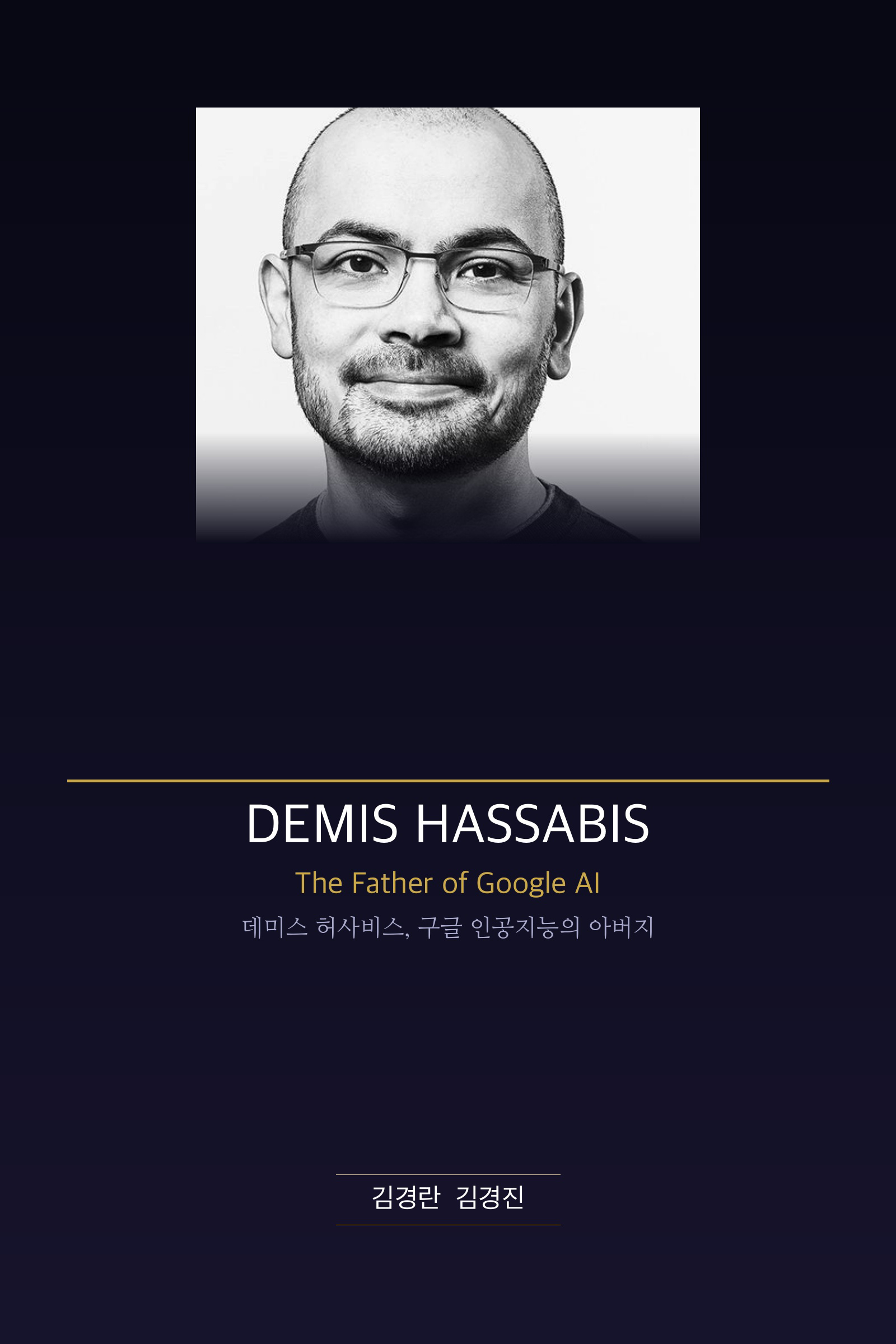
Demis Hassabis, Father of Google's Artificial Intelligence
Part 9. The Final Gate Toward AGI
26 The Limits of LLMs and the Roadmap Beyond Them
Kim Kyung-ran, Kim Kyung-jin
At Google DeepMind's headquarters in King's Cross, London, Demis Hassabis stood gazing out the window at the bustling pedestrians, vehicles, and tree branches swaying in the wind, lost in thought. On the monitor behind him, an elegant poem and complex coding output generated by Gemini glowed on screen, yet an unquenched thirst lingered in his mind. He felt as though he was confronting the same fundamental limitation he had encountered in the early 1990s while developing the game Theme Park.
"Today's AI is like a parrot that speaks remarkably well. It produces the statistically most plausible next word, but it has no idea what that word actually refers to or how this world physically operates." The most critical limitation of large language models that Hassabis identified was the absence of physical grounding and planning.
Models like ChatGPT and Gemini learn from text data across the internet and replicate linguistic patterns to near perfection. But to them, an 'apple' is merely textual information about a red, round fruit. It is disconnected from the physical experience of gripping one in your hand, the gravitational acceleration when it drops, or the crunch when you bite into it. The Shift from "Passive Systems" to "Agent Systems." This limitation does not stay in the realm of philosophy.
When AI tries to control robots in the real world or design experiments to discover new materials, this 'lack of experience' becomes an insurmountable wall. Hassabis defined this as the limitation of a "Passive System." Current LLMs only respond when a user poses a question.
They are severely deficient in the ability to set goals on their own, formulate long-term plans to achieve those goals, and revise strategies when they fail along the way. In January 2025, the World Economic Forum annual meeting in Davos, Switzerland, became the stage for debate over this problem. Hassabis took the stage alongside Dario Amodei of Anthropic and declared that current AI systems are "nowhere near" human-level intelligence.
His words were direct. "You cannot reach human-level intelligence by training on text alone.
You need the real world." At the same event, Yann LeCun, who had left Meta to establish AMI Labs, offered an even sharper critique. "It passes the bar exam and writes code, but it can't handle the real world at all.
That's why we still don't have household robots or fully autonomous cars." His phrase describing the AI industry as "completely LLM-pilled" was a single expression that compressed the structural limitations of the text-centric approach. Consider the request "Plan my vacation for next week." An LLM can list a plausible itinerary, but it becomes helpless at the 'execution' stage: actually booking flights, calling hotels to check availability, and adjusting plans based on weather changes. The model does not understand the causal relationships behind the words it produces; it generates answers based solely on statistical associations within text.
The phenomenon known as 'hallucination' arises from the same root cause. Without any internal mechanism to verify facts, the model strings together high-probability words and produces 'plausible lies.' Hassabis pinpointed this contradiction sharply in his 2025 Davos speech.
Gemini can solve problems at the International Mathematical Olympiad level, yet makes mistakes on elementary school geometry. It generates stunning images but does not understand why a cup should not float in midair. This gap was proof that language models do not truly 'understand' the physical rules governing the world.
The Depletion of High-Quality Data and the Possible Slowdown of AI Progress. An even more serious problem was the exhaustion of data. Hassabis knew better than anyone that "the text data on the internet has been almost entirely consumed." The text data humanity has produced is finite, and skepticism was spreading across the industry that pouring it into ever-larger models through 'Scaling Laws' alone could never reach AGI.
Hassabis himself acknowledged that "evidence of diminishing returns" was appearing across the industry. He added that this did not mean the rate of progress had dropped to near zero, but his judgment was clear: simply making LLMs bigger had its limits. Text alone cannot capture all the knowledge in the world.
The subtle hand movements of a master potter shaping ceramics, the intuitive judgment of a surgeon, the variables in complex physics experiments are all in the domain of
tacit knowledge that has never been recorded in text. Hassabis pointed out that the spatial dynamics, spatial awareness, and physical context of how the world mechanically operates are "hard to describe in words." Language contains far more information about the world than humans had expected, but that information had limitations that even linguists had not anticipated.
For Hassabis, this problem was not a technical obstacle but a fundamental flaw at the heart of 'intelligence,' the subject to which he had devoted his life. He often told DeepMind's engineers: "We are not trying to build an AI that memorizes encyclopedias. We want an intelligence that, when dropped into an unfamiliar environment, can assess the situation on its own and find solutions."
That was the 'living intelligence' he had tried to create at age 12 in front of a chessboard and at 17 as a game developer. An AI that goes beyond the one-dimensional data of text to understand a three-dimensional world governed by time, space, and causality. This was the core challenge of the post-LLM era as Hassabis saw it. The Innovation of World Models and Simulation. "What is intelligence? It is an engine that simulates the future."
The conclusion Hassabis reached while studying the hippocampus and imagination at University College London was transplanted directly into DeepMind's technology roadmap. He was captivated by the fact that the human brain recombines past memories to simulate future scenarios in the mind and then selects the optimal course of action. He was convinced that for AI to possess true intelligence, it should not merely search vast databases but must have a 'World Model' that internalizes how the world works, just as the brain does.
Extending Gemini into a World Model: AI That Simulates and Plans the World. On December 16, 2025, in the season finale of the Google DeepMind podcast, Hassabis had a conversation lasting over 50 minutes with mathematician and science communicator Hannah Fry. It was neither a product launch event nor a review but a conversation looking ten years ahead. Hassabis presented two things that must be achieved to reach AGI.
One was a world model that would enable AI to truly understand physics and space. The other was automated experimentation that would let AI solve fundamental problems like materials science or nuclear fusion through direct experimentation. What mattered more was that these two had to connect and form a single closed loop. A cyclical system of scientific research in which AI poses its own questions, verifies them, and iterates.
For Hassabis, AGI was not the final destination of generative models but the starting point of a scientific research closed loop. What is a world model? By Hassabis's definition, it is the ability of AI to have an intuitive understanding of physical reality. Grasping what can spill, what can move, how objects change, how space is structured, and how time flows. Hassabis stated that world models had always been his central concern.
This was not a new idea. But by 2025, it had become a task that absolutely had to be accomplished. Genie and SIMA: The Foundation of Infinite Training Loops and Physical AI. The most powerful evidence of this vision came from the Genie and SIMA projects. First revealed in 2024, Genie was a model that learned from 2D platformer game videos on the internet and generated playable virtual worlds from a single still image or a simple sketch.
Then in August 2025, Genie 3 arrived and changed the scale entirely. Genie 3 generates realistic 3D environments that can be explored in real time from just a text description or a single image. It lets you experience natural worlds from deserts to oceans, witness extreme weather phenomena up close, and create imaginary worlds and fantastical scenarios. Smooth video at 720p resolution, 20 to 24 frames per second. On the surface it looks like a game generator, but its essence lies in 'learning physics.'
Genie 3 figured out on its own, simply by observing pixel changes, that a character who jumps must fall back to the ground and that a wall blocks further movement. According to Google DeepMind's official description, "World models simulate physical environments by drawing on a deep understanding of them. Genie 3 is a key stepping stone toward AGI, enabling agents to predict how the world evolves and how their actions affect it."
On top of this, SIMA 2 (Scalable Instructable Multiworld Agent) was an agent that acted with purpose inside these virtual worlds. While SIMA 1 in 2024 was limited to following roughly 600 simple commands like "turn left" and "climb the ladder," SIMA 2, unveiled in December 2025, was an entirely different entity. With the Gemini foundation model as its core reasoning engine, SIMA 2 evolved from a passive follower waiting for step-by-step instructions
into an active collaborator that reasons about high-level goals and discusses strategy with users. Where SIMA 1's success rate on complex tasks was only about 31 percent, SIMA 2 significantly narrowed the gap with human player performance. What Hassabis saw in the combination of these two projects was the possibility of an 'Infinite Training Loop.'
Genie creates worlds, and SIMA experiences them. In Hassabis's own words, "Whatever the SIMA agent wants to learn, Genie can create it on the spot." The intriguing part is that these two AIs do not know each other's identity.
Genie does not know that SIMA is another AI. It simply treats SIMA as a player. SIMA, for its part, does not know that the world it experiences was generated by AI. It focuses solely on completing tasks. This cooperation born of mutual ignorance creates a training cycle that is potentially infinitely scalable. SIMA 2's self-improvement mechanism is the core of this loop.
First, Gemini proposes tasks and reward criteria. SIMA 2 goes through trial and error in the environment. Successes and failures are recorded. That experience becomes the training data for the next generation of SIMA 2.
Without any human demonstration, SIMA 2 was able to develop skills through self-directed play in new games, and this self-improvement even worked in entirely new environments generated by Genie 3. This was an extension of the principle by which AlphaGo reached superhuman Go ability through self-play, except the stage had been expanded from the closed space of a Go board to infinitely diverse 3D worlds. The Veo Video Model and Physics Benchmarks: From "Hallucination" to "Grounded Physics." The video generation model Veo, unveiled in 2024, was also part of this picture.
Hassabis used how well the videos generated by Veo followed the laws of physics as a yardstick for AGI. Where previous video models produced 'hallucinations' such as cups floating in midair or a person's hand sprouting six fingers, Veo made an effort to understand and reflect light and shadow, gravity and inertia. But Hassabis was candid.
He acknowledged that current video models "look realistic to the naked eye but have not yet reached 'physics-grade' accuracy." To close this gap, DeepMind was building physics benchmarks. The system reproduces high school-level physics experiments like pendulum motion and rolling balls inside simulations, then verifies whether the AI-generated results follow Newton's laws of motion with 100 percent accuracy.
In a chatbot, hallucination is merely a bug. In physical AI, hallucination can be catastrophic. If a robot misjudges the weight of a cup, the cup shatters. If a self-driving car miscalculates the curvature of a road, an accident follows. "Physically grounded imagination" was precisely the technical goal Hassabis was pursuing. The Technical Realization of the "Simulation Engine of the Mind," Rooted in Neuroscience. All of it traces back to Hassabis's neuroscience background, a grand experiment to build a "Simulation Engine of the Mind" inside a computer.
The discovery he made while studying hippocampal-lesion patients at UCL, that people who lose their memory also lose the ability to imagine the future, taught Hassabis the essence of intelligence. Memory is not a warehouse for storing the past; it is the raw material for simulating the future. The brain rearranges fragments of the past to lay out scenarios that have not yet occurred, and picks the best course of action from among them. The combination of Genie 3 and SIMA 2, Veo's physics benchmarks, and Gemini's multimodal expansion are all engineering translations of this neuroscientific insight.
Hassabis believes that through this world model, AI will be able to simulate complex real-world problems in advance, dramatically reducing the cost of trial and error in reality. Climate change prediction, molecular binding of drug candidates, control of fusion reactions. The idea is for AI to attempt each of these tens of millions of times in a virtual world first, then apply only the verified results to reality. In December 2025, DeepMind announced plans, in partnership with the British government, to open the first fully automated scientific research laboratory in the UK in 2026.
In this laboratory, fully integrated with Gemini, hundreds of materials would be synthesized and tested daily, with AI and robots leading the experiments, data analysis, and course corrections. The virtual closed loop that Genie and SIMA form in the digital world, and the experimental closed loop that this automated lab performs in the physical world. These two parallel autonomous research systems form the skeleton of the AGI that Hassabis envisions. The boy who was once a game developer became a scientist, and now he is teaching AI 'how to simulate the world' to solve problems on a planetary scale.
In Hassabis's words, "In the past we trained AI to produce answers, but now we must train AI to conduct research." This is the path to AGI as he sees it. Not bigger models or greater computing power, but a path grounded in AI's ability to truly 'understand' the world and to 'change' it.
The Future of Agents Equipped with Reasoning and Memory. On December 11, 2024, shortly after returning from the Nobel Prize in Chemistry ceremony in Sweden, Hassabis compressed his core agenda for the next twelve months into a single phrase in an interview with Axios. "World models. That is the next front." But world models alone were not enough.
Even if AI could simulate the world, it would still be only half an intelligence if it could not reason logically from those simulation results and remember past experiences to inform present decisions. Predicting "Truly Impressive and Reliable" Agent Systems Within 2-3 Years. Hassabis defined 2025 and 2026 as "the inflection point where AI evolves from a passive tool into an active collaborator." Through multiple interviews and internal meetings, he forecast that "truly impressive and reliable agent systems" would emerge within two to three years. The agents he described go beyond answering user questions. They are entities capable of carrying out compound instructions like "Considering next year's budget, plan this vacation, book flights and accommodations, and save a restaurant list to my Google Maps."
Google DeepMind was already taking steps in this direction. Project Mariner, unveiled alongside the launch of Gemini 2.0 in December 2024, was a research prototype of an agent that navigates across websites within the Chrome browser and performs tasks on behalf of users. It recognizes and reasons about web elements such as on-screen text, code, images, and forms, then takes action. It achieved a top score of 83.5 percent on the WebVoyager benchmark.
It was still slow and imperfect, of course, but as Hassabis put it, "It is now starting to become technically possible." Project Astra demonstrated the vision of a general-purpose AI assistant with video understanding, screen sharing, and memory capabilities, while the coding agent Jules assisted developers with their code work. Hassabis summed up the philosophy underlying all of it in a single sentence.
"From the beginning, we were working toward agent-based systems. From the start, they could make plans, take actions, and achieve goals." To make this work, two core capabilities were essential: reasoning and memory.
First, the problem of 'memory.' Hassabis made solving the 'short-term amnesia' of current LLMs his top priority. The tendency to forget earlier parts of a conversation or lose context as it grows longer is fatal to using AI as a long-term partner. DeepMind introduced a massive context window of over one million tokens starting with Gemini
1.5 Pro. This is roughly equivalent to holding the entire Harry Potter series in mind at once. By Gemini 2.5 Pro, the system could process three hours of video content.
But Hassabis is working to go beyond merely accepting large inputs. He aims to build an 'Episodic Memory' system in AI, like the human hippocampus, that selects important information, stores it in long-term memory, and retrieves it appropriately when needed. His list of research tasks on the road to AGI, presented at Davos in 2025, explicitly included "better long-term memory" and "the ability to learn continuously." Next comes 'reasoning.'
As behavioral economist Daniel Kahneman classified it, 'System 1' is intuitive and fast thinking, while 'System 2' is the process of logical, slow deliberation. Current chatbots are closer to System 1, firing off answers the instant they receive a question. Hassabis aimed to integrate DeepMind's reinforcement learning expertise so that AI would have internal 'thinking time' before producing an answer.
This idea became reality. Gemini 2.5 Pro, launched in March 2025, carried the official designation of a 'Thinking Model.' It was designed to go through an internal deliberation process, simulating multiple logical paths, verifying its own errors, and producing the optimal answer before generating a response.
Just as AlphaGo explored vast possibilities before placing its next stone, this model unfolds an internal Tree of Thoughts before answering. As Hassabis explained in a podcast interview, "Making large models into increasingly accurate world predictors, into increasingly reliable world models, is a necessary but probably insufficient element. You need to place a planning mechanism like AlphaZero on top of that." Gemini 2.5 Pro reached the top of the LMArena leaderboard and held the number-one position for over six months, recording top performance on International Mathematical Olympiad-level math problems, competitive programming, and doctoral-level scientific reasoning.
Then in November 2025, Gemini 3 Pro arrived. According to Google DeepMind's official announcement, Gemini 3 is "a model that is state-of-the-art in reasoning, designed to grasp depth and
nuance." Gemini 3's Deep Think mode pushed reasoning performance up another level. In Hassabis's words, the goal of Gemini 3 was to create "the most capable all-around model," and the focus was on addressing the weaknesses in coding, reasoning, and math that previous versions had shown.
A Phased Roadmap from Proto-AGI to Full AGI. Hassabis called the state in which reasoning, memory, and world models are integrated 'Proto-AGI.' It is the final gate on the way to full AGI. The phased roadmap he lays out is clear. Stage 1 is the current 'chatbot' form. Stage 2 is a 'Reasoner' that uses tools within a limited scope. Stage 3 is an 'Agent' that holds long-term goals and acts autonomously in the physical and digital worlds. And finally, Stage 4 is an 'Expert/Scientist' that formulates and tests scientific hypotheses on its own, without human intervention, to generate new knowledge. At a joint presentation with Amodei at Davos in 2025, Hassabis estimated a 50 percent probability that AGI would be achieved within ten years.
He made it clear, however, that it would be impossible with AI systems in their current form. "Probably one or two more breakthroughs are needed." The key gaps he identified were the ability to learn from a small number of examples, the ability to learn continuously, better long-term memory, and improved reasoning and planning capabilities.
This list was strikingly specific, and at the same time it revealed that Hassabis was designing every project at DeepMind precisely to fill these gaps. Hassabis summarized the ultimate destination of this journey in a single line. "We are moving from an era of touching smartphones to an era of telling AI our intentions."
In his vision, the agents of the future are both a perfect 'Universal Assistant' that understands each individual's life and a research partner that tackles humanity's toughest problems. At the same time, he warns about the risks these powerful agents could bring: the problems of misaligned goal-setting and misuse of authority.
Google established the principle, while developing Project Mariner, of "conducting proactive research into new types of risks and mitigations, keeping humans in the loop." Research on 'alignment' and 'controllability' must proceed in tandem with technical progress. As SIMA 2 gained the ability to self-improve, this issue grew sharper, and DeepMind's Responsible Development and Innovation Team was involved at every stage of development.
Hassabis's path to AGI does not depend on bigger models or more computing power. It is grounded in AI's ability to truly 'understand' the world and to 'change' it. The world model is the foundation, reasoning and memory are the pillars, and auto-
mated experimentation is the roof. The architect of this structure learned chess at four, made games at 17, and studied the brain in his thirties, a person shaped by diverse intellectual experiences. To him, AGI is not a clever machine. It must become a 'wise tool' that extends and protects human intellect. Within his conviction that AGI will be the most transformative moment in human history lies a scientist's sense of responsibility: that this transformation must head in the right direction. How Transformer Models Work
Kim Kyung-jin
Attorney · Former Member of the National Assembly · AI Policy Researcher
© 2026 Kim Kyung-jin. All rights reserved.