AI Library
Books for Reading AI
Choose a book, then read it in order from the table of contents.










[AI Library] 30 Family and Personal Life
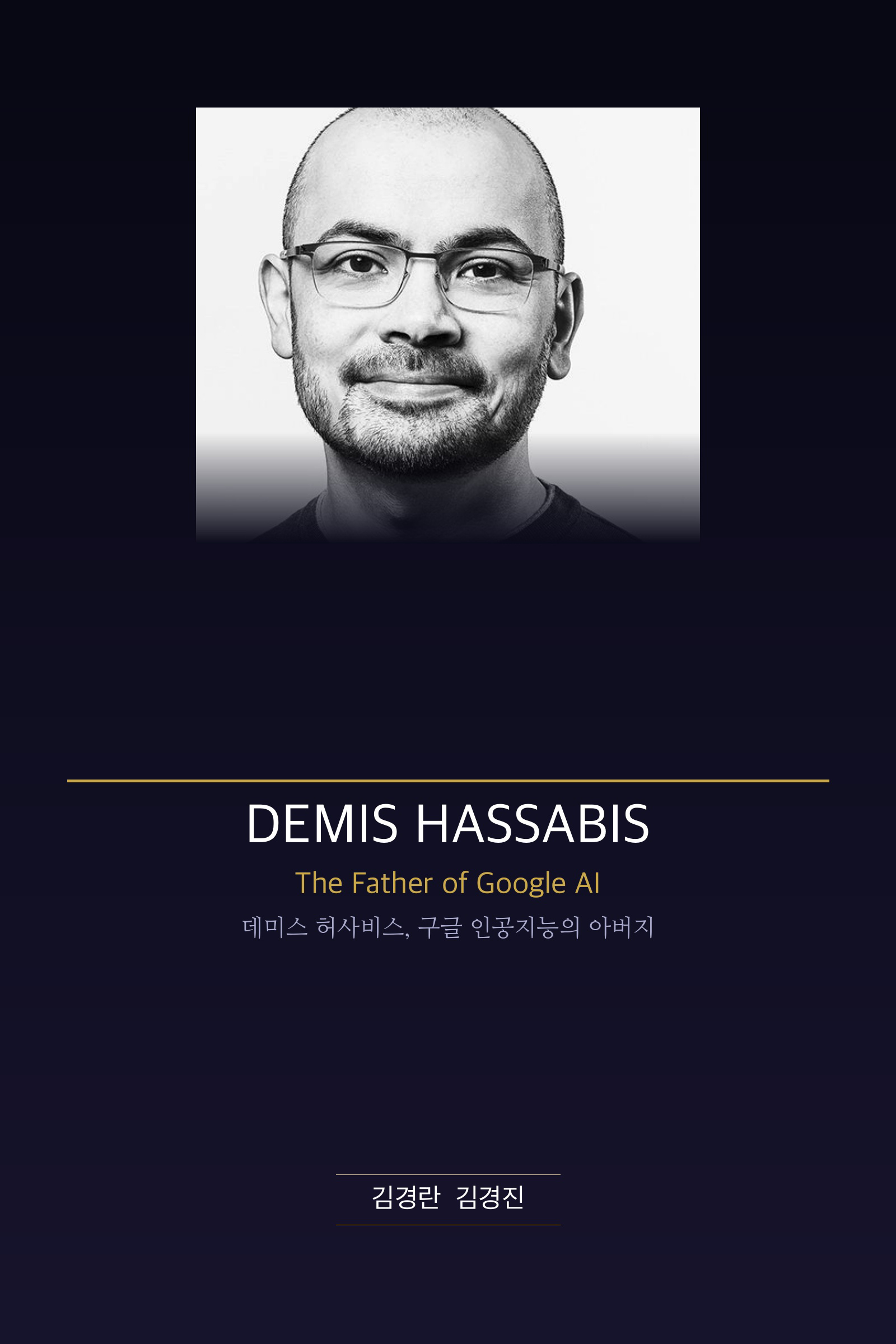
Demis Hassabis, Father of Google's Artificial Intelligence
Part 11. The Human Side of Hassabis
30 Family and Personal Life
Kim Kyung-ran, Kim Kyung-jin
In the fall of 1994, eighteen-year-old Demis Hassabis walked through the old stone walls of Queens' College, Cambridge University. He was the boy who had made Theme Park at Bullfrog Productions, sold millions of copies, and used the income to pay his own university tuition. Around the same time, a young woman from Italy was immersing herself in the world of biology at the same university.
Teresa Niccoli. She would later become a cell biology PhD and a leading dementia researcher at UCL. Hassabis has almost never spoken publicly about the exact moment the two first met at Queens' College. That is his nature.
He is shy and fiercely protective of his private life. What is known is this: the two became a couple in their second year, and they mark the day they first got together as their anniversary rather than their actual wedding date. This single small fact says a great deal about their relationship. An attitude that values beginnings over formalities, a sensibility that treasures the origin point of a bond. While Hassabis studied computer science, Teresa walked the path of biological sciences.
Their fields were different, but they shared common ground. A curiosity about complex systems, a desire to understand invisible structures. While Hassabis was captivated by the possibilities of neural networks and machine learning, Teresa was absorbed in cell polarity and microtubule dynamics. One explored the architecture of artificial intelligence; the other explored the architecture of life.
Their directions differed, but the depth of their questions was the same. The two married around 2005. Their first son was born in 2007, and their second in 2009.
As it happens, 2009 was also the year Hassabis received his PhD in cognitive neuroscience from UCL. While his wife was pregnant with and giving birth to their second child, the husband was astonishing the academic world with a paper on imagination deficits in patients with hippocampus damage. Both stood before the vast mystery of the brain and life, but they also had to stand before another reality called family.
Teresa made a bold decision when their first child was born. She chose to leave academia and become a full-time mother for five years. She reflects on it this way.
"Children grow up so fast. I wanted to spend that time with them, and honestly, I'm not very good at multitasking." A promising scientist who had been doing postdoctoral research under Professor Daniel St Johnston at Cambridge's Gurdon Institute entered the world of diapers and baby food. During those five years, Teresa built friendships with other mothers and quenched her intellectual thirst by taking a part-time master's course in medical ethics and law at King's College London.
The time she spent considering the ethical and legal implications of science would later add humanistic depth to her dementia research. What do the two sons mean to Hassabis? In a rare public interview, he described the children this way: "Each is exceptional in their own way. One leans toward science, the other toward the creative side."
Though the children grow up in a household where both parents are scientists, Hassabis is known not to push them toward any particular path, much as his own father Kostas never did. Kostas Hassabis was a man who ran a toy shop, then wrote songs, then became a teacher. That legacy of diversity passed to Demis, and is now being passed to the next generation.
The two sons are now teenagers. According to an essay Teresa contributed to the Mothers in Science project, "Living with teenagers is another challenge, but both can get themselves to and from school, so the daily logistics have become much easier." In the meantime, Teresa received a Senior Fellowship from Alzheimer's Research UK in 2019 and opened her own lab at UCL.
It is a laboratory that uses Drosophila melanogaster as a model organism to study the molecular mechanisms of Frontotemporal Dementia and Alzheimer's disease. Operating under the name Niccoli Lab, this research group leads several PhD students and postdoctoral researchers and has published papers in the journal Science as of 2025. While the husband was receiving the Nobel Prize in Chemistry for predicting protein structures with AI, the wife was tracking the secrets of dementia in fruit fly brain cells.
Two scientists in one family, each fighting human disease in their own way. This symmetry may be the most striking aspect of the Hassabis family story.
Even after the Google acquisition, Hassabis did not leave London. Highgate, in north London. Famous for Highgate Cemetery where Karl Marx is buried, and close to the green spaces of Hampstead Heath, this is where the Hassabis family lives quietly. In an interview with the Evening Standard, Hassabis made clear he had no plans to leave London.
"We punch above our weight. The world's best universities are producing incredibly smart people, and because there aren't as many opportunities as San Francisco, the top talent is actually looking for more interesting things to do." Even after the Google acquisition, Hassabis reportedly commuted by train until 2016. Apart from slightly more expensive glasses and jackets, he refused the Silicon Valley-style transformation.
As one profile article put it, he remained "the north London prodigy who looked equally at ease over a chessboard or exploring the limits of a ZX Spectrum." This modesty may be intentional. Though Hassabis has never spoken about it publicly, his family's modest financial circumstances during childhood may have led to his indifference toward luxury.
His father Kostas ran a toy shop, then wrote songs, then became a teacher. A home that was not wealthy but rich in intellectual stimulation. That memory appears to have shaped the adult Hassabis's values, prioritizing intellectual pursuit over material display. Let us look more closely at the Liverpool FC connection mentioned earlier.
Supporting Liverpool rather than Arsenal or Tottenham while living in north London is a choice that requires some explanation within English football culture. In the 1970s and 80s, Liverpool dominated European football and built a nationwide fanbase. It is likely that young Demis, born in London, was captivated by Liverpool's dominance during that era.
For a boy who aspired to reach the top of world chess, a team that stood atop Europe would have been a natural object of allegiance. This fandom never changed in adulthood. On the night of May 7, 2019, when Liverpool beat Barcelona 4-0 at Anfield to reach the UEFA Champions League final in historic fashion, Hassabis was in that stadium.
A miraculous comeback after losing 0-3 in the first leg. Divock Origi's quick corner kick trick play. The man designing the future of AI stood amid the chorus of "You'll Never Walk Alone" echoing through Anfield that night.
Hassabis's love of Liverpool extends beyond personal hobby into professional territory. DeepMind is known to have collaborated with Liverpool FC on tracking data analysis. Technology that uses AI to predict the movements of players and the ball, and to simulate the outcomes of various scenarios. This technology was publicly applied to corner kick strategy.
AI simulates thousands, tens of thousands of corner kicks to find optimal starting positions and movement paths. A Nobel laureate providing AI for the tactical development of the football team he supports. This episode reveals a distinctive facet of Hassabis as a person. Grand scientific ambition and boyish football fandom coexisting within one individual.
In 2025, Hassabis posted on X linking Liverpool and Theme Park, showing off his fandom. "Two things I love coming together: Liverpool and Theme Park." He shared a Liverpool-themed isometric graphic generated with the Nano-Banana AI tool, adding, "I need to make a new isometric game, I can't resist."
A Nobel laureate and CEO of Google DeepMind openly displaying nostalgia for the games he made as a teenager and affection for his football team on social media. This is Hassabis's everyday life. Protection of private life and work-life balance (or imbalance). People who know Demis Hassabis use similar words to describe him. Shy. Determined. Low profile. Among the giants of the AI field, Hassabis occupies a unique position. He is far removed from Elon Musk's Twitter storms, Sam Altman's political maneuvering, or Mark Zuckerberg's personal branding.
He prefers to speak through research results and papers, and rarely talks about his family. This protection of his private life appears to be a conscious choice. As DeepMind was acquired by Google, as AlphaGo defeated Lee Sedol, as AlphaFold swept protein structure prediction competitions, media interest in Hassabis grew exponentially.
After winning the 2024 Nobel Prize in Chemistry, it intensified even further. Yet Hassabis does not release family photos, and rarely mentions his wife's and children's names in interviews. All that is known about the children is the brief remark that they are "each exceptional in their own way." There must be a reason for this restraint.
In an era when AI sits at the center of social and political controversy, having the family of the DeepMind CEO attract unnecessary attention is a security concern,
and also a parental instinct to protect the children's environment as they grow. Teresa Niccoli likewise maintains her academic identity independently. Nowhere on the Niccoli Lab website or UCL research profiles does her husband's name appear.
She publishes papers, wins research grants, and supervises students under the name Teresa Niccoli. Her citation count on Google Scholar exceeds 4,700. This is a standing as an independent scientist, not a shadow of her husband.
Yet in terms of work-life balance, Hassabis's life is closer to "imbalance" than "balance." His work routine is well known. During the day, he handles management and meetings as CEO. At night, he immerses himself in research and deep thinking during what he calls his "second shift."
He reads papers, organizes ideas, and reviews code until 3 a.m. This pattern has persisted since before DeepMind's founding, and it forms the background to his academic output: over 2,000 research papers, an h-index of 83, and more than 150,000 citations. Hassabis has never spoken candidly about how this lifestyle affects his family.
However, Teresa's career trajectory provides an indirect clue. Her choice to take a five-year career break likely reflected a practical recognition that both of them could not be immersed full-time in research simultaneously. Teresa wrote: "When the children were young it was harder, but family help was significant, and we had an au pair living with us." Having an au pair, a live-in foreign helper, means the two scientist-parents built an active support system to juggle childcare and research.
Hassabis is known to place family first, but what that "first" actually looks like in practice is hard to know from the outside. He is simultaneously CEO of Google DeepMind, CEO of Isomorphic Labs, an AI advisor to the British government, and a frequent keynote speaker at international conferences. In 2024, after the Nobel Prize, there was a stream of events: the Stockholm ceremony, the Tribeca Film Festival documentary premiere, an appearance on the Lex Fridman podcast.
How much time within this schedule he gets to come home to Highgate and have dinner with his teenage sons, only Hassabis knows. One thing is certain: the very fact that Hassabis does not leave London is itself an expression of commitment to his family. Keeping DeepMind's headquarters in London, making London residency a condition of the Google acquisition, refusing Silicon Valley's pull. Behind all these decisions lies
an unspoken declaration: "This is where my family's home is." The school the children attend, Teresa's UCL lab, Hampstead Heath where they walk on weekends. Maintaining this radius of daily life may be the Hassabis way of balancing the ambition to change the world. Perhaps this is not balance at all, but the conscious management of imbalance. Acknowledging that perfect balance is impossible, but deciding what will never be given up. For Hassabis, that "never" is research and, simultaneously, his London home.
If staying awake until 3 a.m. is what it takes to hold on to both, then that is his solution. It is hard to call it beautiful, but it can be called honest. Books Hassabis loves and sources of inspiration. David Deutsch's The Fabric of Reality: physics and the growth of knowledge. If you ask Hassabis to name the one book he most wants people to read, he has given the same answer on multiple occasions.
David Deutsch's The Fabric of Reality. When he appeared on Ezra Klein's New York Times podcast, Hassabis named this book as his first recommendation, saying: "I think it's a book that raises all of the big questions of physics. I'd love to one day take on those questions with our AI tools."
His entire intellectual ambition is compressed into that single statement. Deutsch is a physicist at Oxford University and a theoretical pioneer of quantum computing. The Fabric of Reality was published in 1997 and attempts to unify four theories.
Quantum mechanics, epistemology (Karl Popper's philosophy of science), evolution (Richard Dawkins), and the theory of computation (Alan Turing). Deutsch's core argument is this: these four strands are actually illuminating a single reality from different angles, and only an integrated understanding can approach the true nature of the universe. The reason Hassabis is drawn to this book is obvious. What Hassabis has done throughout his life is exactly that.
Chess and game design, neuroscience and machine learning, reinforcement learning and protein structure prediction. An attempt to unify seemingly unrelated fields within a single framework. What Deutsch did at the level of physics, Hassabis is doing at the level of intelligence. The influence Deutsch's book had on Hassabis can be traced concretely. Deutsch emphasizes the power of "explanation."
Predicting the world is not enough; one must understand why. This perspective aligns with the core principle Hassabis adopted when
designing DeepMind. AlphaGo was not a program built merely to win at Go. It was an experiment to validate general-purpose learning algorithms through Go.
Victory was the byproduct; understanding was the goal. Deutsch is also a proponent of the many-worlds interpretation. According to this interpretation of quantum mechanics, every possible event actually occurs, but in different universes. Whether Hassabis endorses this interpretation is unknown, but his interest in the concept of "simulation of reality" is clear.
The "simulation engine of the mind" theory he developed during his neuroscience PhD, and the world models DeepMind is developing, both share the common thread of being "systems that replicate and predict reality." Steven Weinberg's Dreams of a Final Theory, which Hassabis read in high school, belongs in the same context. The dream of weaving the fundamental laws of physics into a single unified theory. Hassabis is translating that dream into the language of AI.
In his second podcast conversation with Lex Fridman in 2025, he offered this inference: "All patterns that can be generated or discovered in nature can be efficiently discovered and modeled by classical learning algorithms." Because nature is not random but the product of selection processes, those patterns are learnable. This can be seen as an AI version of the Church-Turing-Deutsch principle that "all physical processes are computationally simulable." The Fabric of Reality is more than a book for Hassabis.
It is a map of the problem he has spent his life trying to solve. What is intelligence, what is reality, how does knowledge grow. A guide showing how these three questions converge into one. When Hassabis said "I'd love to one day take on those questions with our AI tools," it may not be a distant dream. Just as AlphaFold solved the fifty-year-old protein folding problem, the day may come when AI sheds new light on the fundamental laws of physics.
And when that day arrives, the most worn book on Hassabis's shelf will probably be The Fabric of Reality. Greg Egan's Permutation City: consciousness and simulation. If David Deutsch is the source of scientific inspiration in Hassabis's recommended reading, Greg Egan is the source of
imagination. Permutation City, published in 1994 by the Australian science fiction writer Egan, is a novel Hassabis has mentioned repeatedly in interviews. On the Ezra Klein Show, Hassabis introduced the book this way: "It's an amazing story about how interesting and weird the world could get in the context of AI and hyper-realistic simulations."
On X, Hassabis replied to a follower recommending Egan's other novel Diaspora: "Agreed. Diaspora is great, but I think you should read Permutation City first."
The world Permutation City depicts is this: in the near future, technology exists to copy human consciousness into computers. The copied consciousness entities, called "Copies," live in virtual environments. The novel's protagonist, Paul Durham, conducts radical experiments on the nature of consciousness.
He explores whether simulated consciousness is "real" consciousness, and whether consciousness can persist even if the physical hardware underlying the simulation disappears. This novel resonates with Hassabis on multiple levels. First, the problem of consciousness. In his 2022 conversation with Lex Fridman, Hassabis said that "consciousness and intelligence are double dissociable, you can have one without the other."
Intelligent systems without consciousness, conscious beings with limited intelligence. Permutation City explores this space of possibility in novelistic form. Second, the problem of simulation. The "simulation engine of the mind," the central concept in Hassabis's neuroscience research, is the idea that the human brain is an internal model that replicates reality to predict the future. Permutation City pushes this idea to its extreme. If a simulation is sufficiently detailed, can the beings within the simulation know they are inside a simulation? If they can, what does that mean? Third, the relationship between the fundamental laws of physics and computation. Egan is a hard science fiction writer who precisely reflects real physics and mathematics in his novels.
The "dust theory" that appears in Permutation City is fictional, but it raises deep philosophical questions about the boundary between computation and reality. The scientific inspiration Hassabis received from Deutsch's The Fabric of Reality, he encounters again in narrative form in Egan's novel. A pattern emerges from Hassabis's reading tastes.
He reads science fiction for ideas. He is drawn to concepts rather than prose style or character development. He said something similar about Asimov's Foundation series:
"Like most sci-fi, I mainly read it for the ideas. I read Foundation when I was about twelve, so I'm not sure I could properly evaluate the quality of the prose at that point."
Egan's writing is also known for conceptual density rather than emotional depth. The two are alike in this regard. A disposition to reach for truth before beauty. Egan's other work, Diaspora, also influenced Hassabis's worldview.
This novel depicts a future in which humanity has evolved into various posthuman forms including robots, digital beings, and software societies. It can be seen as the literary prototype for the vision of "expanding intelligence" that Hassabis frequently discusses. A future where AI does not replace human intelligence, but where the forms of intelligence themselves diversify. Permutation City and Diaspora lay out a map of those possibilities. Many scientists read science fiction.
But scientists who actually try to implement the ideas they read in science fiction are rare. Hassabis belongs to the latter category. The simulation of consciousness that Permutation City imagined remains a distant prospect, but the prediction of protein structures that AlphaFold imagined is already reality. Some of the dreams the teenage Hassabis dreamed while reading Egan's novels have already been realized, and the rest are moving toward realization.
Douglas Hofstadter's Godel, Escher, Bach; Yuval Harari's Sapiens; Asimov's Foundation. In 1994, seventeen-year-old Demis Hassabis programmed Theme Park's AI during the day at Bullfrog Productions' office, and debated the limits of artificial intelligence with colleagues at night. There was a book that sparked those debates. Douglas Hofstadter's Godel, Escher, Bach: An Eternal Golden Braid, abbreviated GEB. Hassabis said this about the book:
"It was a really important science book for me. I was making Theme Park and developing AI, and I was also reading books like GEB. It's an incredible piece of work.
It weaves Godel's incompleteness theorems with mathematics, Escher's art, and Bach's fugues, showing how these are all connected in some way. Cycles of repeating patterns, infinite patterns. And it linked those to consciousness and intelligence. I was really inspired and started thinking about these deep questions." GEB was published in 1979 and won the Pulitzer Prize. It discovers common structures in the work of three masters: mathematician Kurt Godel, artist M.C. Escher, and composer Johann
Sebastian Bach. Self-reference, recursion, and the emergence of meaning within formal systems. Hofstadter's ultimate question is this: how do non-material phenomena (consciousness, the self) emerge from a material substrate (the brain's neurons)? This question runs through Hassabis's entire career.
Starting with chess AI, designing learning behaviors for NPCs in games, studying the neural mechanisms of the hippocampus, and founding DeepMind to pursue artificial general intelligence. At every stage, Hassabis has stood before the question "what is intelligence," and GEB was its first milestone. The conversation he had with colleagues as a teenager, asking "instead of just using AI in games, couldn't we elevate it to human level," grew from the seed GEB planted. Meanwhile, there is a book from even earlier in his life.
Isaac Asimov's Foundation series. Hassabis recalls: "What was really formative was Asimov's Foundation series. Interestingly, it was Foundation, not the Robot series.
I barely read the Robot books." Foundation is the story of mathematician Hari Seldon using a mathematical tool called "psychohistory" to predict the fall of the Galactic Empire and devise a secret plan to shorten the ensuing dark age. For Hassabis, who read this series around age twelve, the idea of designing civilization's future through mathematics and science must have left a powerful impression.
DeepMind's mission statement, "Solve intelligence, then use it to solve everything else," echoes Seldon's ambition. The difference is that Seldon relied on statistical prediction of human behavior, while Hassabis relies on machines that learn. What these book choices reveal is telling. Hassabis also loves Iain M. Banks's Culture series. He has named Consider Phlebas as one of his favorite books, and even set the cheat code for his Theme Park game as "Horza," the protagonist's name from that novel.
Banks's Culture series depicts a utopian civilization in which highly advanced AIs (called Minds) coexist with humans and alien species. Just as Elon Musk named his SpaceX drone ships after spacecraft from the Culture series, Hassabis likely read in this series a blueprint for a future where AI and humanity co-evolve.
Hassabis's relationship with Yuval Noah Harari's Sapiens is interesting in a different context. Harari is an intellectual who frequently warns about the dangers of AI, and Hassabis is a practitioner trying to realize AI's potential. Records of the two conversing directly are rare, but the fact that Hassabis has read Sapiens suggests he does not remain solely within technological optimism.
Sapiens traces how Homo sapiens came to dominate the Earth through the Cognitive Revolution, the Agricultural Revolution, and the Scientific Revolution, while also confronting the violence and exploitation on the other side of that process. Hassabis's seriousness about AI safety and alignment may stem from such humanistic reading serving as a counterweight to technological optimism. A single thread runs through Hassabis's bookshelf.
Books that break down the boundaries between individual fields and try to paint the big picture. Just as GEB weaves mathematics, art, and music; The Fabric of Reality weaves physics, epistemology, evolution, and computation theory; and Foundation weaves mathematics and the fate of civilization; Hassabis himself weaves neuroscience, computer science, and game design as he moves toward a unified theory of intelligence. The books he reads are miniature versions of the world he dreams of. Music and hobbies. Drum and bass, ambient electronic, classical: a broad range of musical taste. DeepMind's London headquarters has a music room. A music room in an AI research lab might seem odd. But for Hassabis, music is not a luxury; it is a tool.
In an in-depth interview with the American Academy of Achievement, Hassabis explained: "I use music a lot. I listen to music when I'm focusing, and I listen to different music depending on what kind of mood I'm trying to create.
From classical to drum and bass, it depends on what I'm trying to do." This answer compresses Hassabis's way of thinking. Even music is used in a goal-oriented manner. When programming, he chooses music with beats and energy; when thinking or reading, he picks classical like Vivaldi or Mozart.
"Getting you in the right mood" is what matters, he says. The specific genre Hassabis favors is liquid drum and bass. A subgenre of drum and bass, it has fast beats with melodies flowing over them, but no vocals. Hassabis's description is precise: "It needs to have a beat but also melody, and it needs to be interesting. But it can't have lyrics.
If it has lyrics, your brain starts following the words. It has to be purely instrumental, no lyrics." And he interprets this in neuroscientific terms: "I think it probably puts you into an alpha state. This kind of modern music
is repetitive. After a few listens it fades into the background and puts your brain into a kind of rhythmic state, which helps with focus." What is notable here is that even when explaining his music preferences, Hassabis uses the language of neuroscience.
"Alpha state" refers to a type of brainwave associated with relaxed concentration. It is a brainwave linked to meditation and creative thinking. A cognitive neuroscience PhD observing his own brain as if it were an experimental subject, engineering the optimal working environment. It should be called a music strategy, not a music taste.
Hassabis recommends this approach to young people: "One of the most important things is to learn how you yourself work best. Figure out what puts you into a particular creative state and maximize it."
This advice contains the integrated self-understanding of someone who has been a game designer, neuroscientist, and AI researcher. Hassabis's interest in classical music connects back to GEB. The self-referential structures Hofstadter found in Bach's fugues, the patterns of repetition and variation in canons, resemble the structure of learning that Hassabis pursues in AI.
Discovering patterns through repetition, creating something new through variation. Just as Bach's music is built on mathematical structure, DeepMind's AI is built on mathematical structure. Film music also holds an important place in Hassabis's world. During his Elixir Studios days, Hassabis collaborated with composer James Hannigan to create interactive music for Republic: The Revolution and Evil Genius, both of which were nominated for the BAFTA Interactive Music category.
Interactive soundtracks that respond to the player's actions and change accordingly were themselves an intersection of AI and music. There is another thing Hassabis said in the Academy of Achievement interview: "I use movies a lot too."
Music and film, games and science. For Hassabis, all of these are entry points into the "creative state." For some people, music is background noise; for others, it is an object of appreciation. For Hassabis, music is a switch that toggles his brain's operating mode. Put on liquid drum and bass and he enters programming mode; put on Vivaldi and he enters contemplation mode. His brain is an instrument tuned by music, and the sounds that come from that instrument are AlphaGo and AlphaFold.
A deep interest in physics and reading habits. Hassabis's X profile carries a short bio: "Co-Founder & CEO of Google DeepMind. Working towards AGI. Trying to understand the fundamental nature of reality." The last sentence is the key.
For an AI researcher to include "trying to understand the fundamental nature of reality" in his profile shows that Hassabis identifies himself not as a technologist but as an explorer. This interest in physics began in high school. Reading Steven Weinberg's Dreams of a Final Theory was the starting point. Weinberg is a 1979 Nobel Prize laureate in physics, and in this book he describes the dream of explaining all the laws of physics through a single unified theory.
For Hassabis, this book provided an answer to "why do science at all." The impulse to push to the limit of what can be known. The adult Hassabis's interest in physics takes more concrete form. In his 2025 podcast with Lex Fridman, he discusses fluid dynamics and the Navier-Stokes equations. He explores the possibility that AI-based approaches can achieve remarkable results on these problems, traditionally considered extremely difficult to solve in classical systems.
Weather prediction (WeatherNext) and nuclear fusion plasma control (the tokamak reactor project) that DeepMind has already achieved are concrete examples of applying AI to hard problems in physics. There is evidence that Hassabis's interest in physics goes beyond a hobby. The inference he presented in his Nobel Prize lecture:
"All patterns that can be generated or discovered in nature can be efficiently discovered and modeled by classical learning algorithms." He calls this "survival of the stablest." Evolution acts on life, weathering on geological time, and orbital mechanics on cosmic time, all producing patterns. Because these patterns are not random, learning algorithms can in turn efficiently rediscover them. This is a theory of AI expressed in the language of physics, and a theory of physics expressed in the language of AI. Hassabis is a translator between two worlds. And this translation ability comes from his reading habits.
Several characteristics emerge from Hassabis's reading patterns. First, he reads for ideas. He enjoys discovering new concepts more than literary beauty or narrative tension. His remark about Asimov's Foundation, that "like most sci-fi, I mainly read it for the ideas," proves this.
Second, he reads across fields without discrimination. Quantum physics (Deutsch), science fiction (Egan, Banks, Asimov), philosophy (Hofstadter), history (Harari), management (Ed Catmull's Creativity, Inc.). Third, he connects what he reads. He connects the self-referential structures from GEB to AI architecture, the psychohistory from Foundation to general-purpose learning algorithms, and the computability from Deutsch to DeepMind's research direction. What makes this reading habit possible is his "night shift."
During the day, he spends time on meetings and management as CEO. At night, he reads papers and books and thinks deeply. It is during these hours extending to 3 a.m. that Hassabis is most creative. Liquid drum and bass plays in the background, the latest physics papers are open on screen, and notebooks fill with sketches of new connections. For Hassabis, reading is input, research is output, and what links them is connection. About Ed Catmull's Creativity, Inc., he said:
"There haven't been many times when I finish reading something and come up with twenty new ideas I hadn't thought of before. This book did that for me." A person who extracts twenty new ideas from a single book. This is how Hassabis reads.
Books are not finished knowledge but ignition points for new questions. The fundamental laws of physics, the nature of consciousness, the structure of intelligence. These three questions converge into a single question on Hassabis's bookshelf: what is reality? The last line on his X profile is therefore not mere rhetoric. "Trying to understand the fundamental nature of reality."
This is not a job description but an existential declaration. And in the footnotes of that declaration are the names of Weinberg, Hofstadter, and Asimov, read as a teenager; of Deutsch and Egan, read in his twenties; and the blank spaces of countless books yet to be read.
A street lined with London townhouses.
Kim Kyung-jin
Attorney · Former Member of the National Assembly · AI Policy Researcher
© 2026 Kim Kyung-jin. All rights reserved.