AI Library
Books for Reading AI
Choose a book, then read it in order from the table of contents.


















[AI Library] Chapter 9. The Age of AI Factories
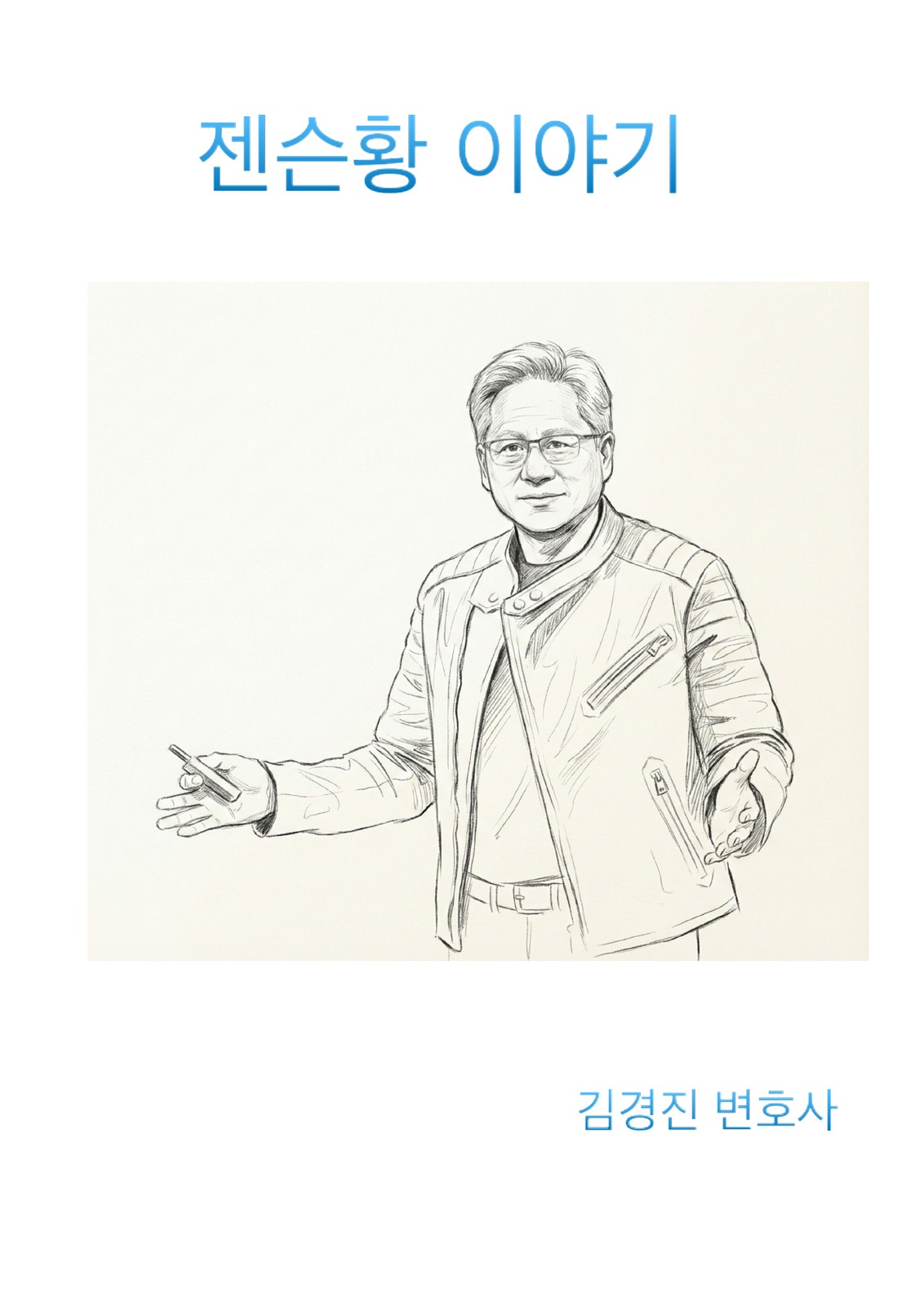
The Jensen Huang Story
Part 2. Architect of a New Age
Chapter 9. The Age of AI Factories
Kim Kyung-jin
Turning points in history always arrive quietly.
It was true when the steam engine remade the world, and again when electricity banished the night. People never grasp, at first, how large the change really is. They see a clever invention, nothing more. Then one day they glance over their shoulders and find that the world has already become something else entirely.
What Jensen Huang is doing right now is exactly that kind of change.
He is redefining what the word "computer" means, from the ground up. The computer we knew was a box sitting on a desk. You tapped the keyboard and letters appeared on the screen; you moved the mouse and an arrow followed it around. That kind of machine.
But that is not what a computer is to Jensen Huang. To him, a computer is a building the size of a city block. It is a factory that runs without stopping, venting heat instead of smoke from its stacks.
The Data Center Is No Longer a Warehouse
Have you heard of a place called a data center? Chances are you have never visited one. They tend to sit where ordinary people never look.
On a sprawling lot at the edge of a city, or in the middle of a desert, a massive building stands with no sign on its wall. There are almost no windows. Inside, thousands, tens of thousands of computers line up in rows, humming.
For the past thirty years, data centers did one thing. They stored information.
Photos you took on your smartphone, messages you sent to friends, videos you watched online: all of it piled up neatly somewhere inside a data center. Think of it as an enormous library. When someone asked for a piece of information, the center pulled it out and showed it; when new information arrived, it slotted into an empty space. That was the entire job of a data center.
Jensen Huang calls this retrieval-based computing. It means a system that finds information someone already created. It works like borrowing a book from a library. The book was written by somebody else long ago, and all you do is locate it on the shelf and carry it home.
Then, in May 2025, at an event in Taiwan called Computex, Jensen Huang made a declaration to the world.
"The data center is no longer a warehouse. It is a factory."
To understand what that single sentence means, you have to think about the difference between a warehouse and a factory.
A warehouse is a place that holds goods. Items come in, get sorted and stacked, and wait until someone needs them. Nothing new is created inside a warehouse. What goes in comes back out unchanged.
A factory is different. Raw materials go into a factory. Iron ore goes in. Plastic pellets go in. All sorts of components go in. Then something happens inside. Machines spin, sparks fly, workers move. And out the other end comes something completely different. Cars come out. Refrigerators come out. Smartphones come out. What enters and what exits bear no resemblance to each other. A factory is a place that makes things.
This is why Jensen Huang called the data center a factory. Data centers no longer pull stored information off a shelf and hand it over. They produce new information.
When you ask ChatGPT a question, the answer was not written down somewhere in advance. It is generated fresh at that very moment. It is like a chef who takes your order and cooks the dish right there on the spot.
Let me use an analogy to show how enormous this shift is.
Imagine walking into a library and asking the librarian, "Tell me about King Sejong of the Joseon Dynasty." The librarian would walk between the shelves, find the right books, and bring them to you. Those books would contain stories about King Sejong that someone had already compiled. The librarian hands them over. That is what data centers used to do.
Now it works differently.
When you ask an AI the same question, the AI does not go looking for a book. Instead, it writes a new account of King Sejong right there on the spot. The account draws on knowledge the AI absorbed during training. But every sentence is being composed for the first time in that instant, shaped to fit your question, arranged in a way you can follow easily.
Jensen Huang calls this generative computing. Instead of retrieving what already exists, the system creates something new.
This shift has changed even the physical appearance of data centers. The old data center was a quiet place. Cool air drifted through the aisles. Blinking lights were the only signs of activity. Storing information does not take much force.
An AI factory is nothing like that.
Tens of thousands of GPUs run without rest. They throw off tremendous heat. Air alone cannot cool them, so chilled liquid flows through pipes to draw the heat away from the chips, much the way blood circulates through a human body to carry heat where it needs to go. If the old data center was a hushed library, the AI factory is a blast furnace burning white-hot.
The chip Jensen Huang developed called Blackwell, and the one coming after it called Rubin, are the engines that power this factory. These chips do not work alone. Thousands, tens of thousands of them link together and operate as if they were a single enormous brain. Jensen Huang puts it this way:
"The entire data center is now one computer factory."
Put Electricity In, Get Intelligence Out
You've probably heard the term "industrial revolution." It was a massive transformation that began in England roughly two hundred and fifty years ago. Before that, humans relied on their own strength or the strength of animals to get work done. Oxen pulled plows through fields. Horses hauled carts loaded with goods. What a person's arms and legs could accomplish had clear limits.
Then came the steam engine. Burn coal, boil water, and steam comes out. That steam pushes a piston, and the piston drives a machine. A force far stronger than human muscle appeared, one that never tired. Spinning machines began turning in factories. Steamships crossed oceans without waiting for wind. The world changed.
After that came electricity. A machine called a generator converted the power of water or coal into electrical current. Electricity is invisible. You can't touch it. But it travels along wires to anywhere you need it. Factories, homes, every corner of every city. Night no longer meant darkness, and machines ran with new precision.
Jensen Huang calls what is happening right now a new industrial revolution. He explains its core like this.
"In the past, we boiled water to make steam, and used a machine called a dynamo to make electricity. It was invisible, but enormously valuable. Now we have a new dynamo. You put electricity in, and intelligence comes out." This isn't a metaphor. It is what is actually happening.
Electricity flows into an AI factory. That electricity powers tens of thousands of GPUs. Inside those GPUs, trillions of calculations take place. And on the other side of the factory, something called tokens come out.
What is a token? Think of it as the smallest piece of information that an AI produces. When writing text, a single word is a token.
When generating an image, a single pixel is a token. Gather enough tokens and they become sentences, then paragraphs, then entire books. Or they become images, videos, the movements of a robot.
This is what an AI factory looks like through Jensen Huang's eyes. Electricity goes in one side; intelligence comes out the other. Just as the steam engine turned coal into mechanical power, just as a power plant turned the force of water into electricity, an AI factory turns electricity into intelligence.
Consider why this matters.
Until now, intelligence came from only one place: the human mind.
A skilled doctor diagnosed illness. A talented lawyer solved legal problems. A creative artist produced works of art.
That kind of intelligence required years of study and experience. It was scarce. It was expensive. Not everyone could have it.
But what if intelligence could be manufactured in a factory?
Imagine it rolling off the line the way cars roll out of an automobile plant. If that happened, the price of intelligence would drop. Anyone could afford to use it.
Much like electricity itself. When it first appeared, it was rare and costly. Today you just plug something into a wall outlet and it's there for everyone.
That is the world Jensen Huang dreams of.
A world where intelligence is as common and as ordinary as water from a faucet or light from a switch.
Running these factories, of course, takes an enormous amount of electricity.
AI factories are hungry for power. A single facility can consume as much electricity as a small city. Jensen Huang knows this. That is why he is partnering with energy companies. Nuclear plants, solar farms, wind farms. He is working with every source of clean energy he can find.
In December 2025, Jensen Huang issued a warning at a research institute in Washington, D.C.
While the United States takes three years to build a data center, he said, China can put up a hospital in a single week. Winning the AI race takes more than good chips. You need factories to run those chips, and you need to build them fast. You also need power plants to supply those factories with electricity.
The world as he sees it looks like a five-layer cake. At the bottom sits energy. Above that, chips. Above that, data centers. Above that, AI models. And at the very top, applications. All five layers must be in place for an AI factory to run properly. Jensen Huang is drawing the blueprint that ties every layer together.
The Engineer Driving a $100 Trillion Industrial Revolution
Every time Jensen Huang steps onto a stage, he throws out staggering numbers.
"This is a $100 trillion opportunity."
One hundred trillion dollars. It's hard to picture how large that is. Add up everything every country on Earth earns in a single year and you get roughly $100 trillion. That's the size of the entire global economy. What Jensen Huang is saying is that AI will reshape all of it.
The IT industry, up to this point, occupied only a fraction of the global economy. It was a market worth roughly three trillion dollars. Building computers, selling software, providing internet services. That was what the IT industry did. A large industry, sure, but compared to manufacturing, agriculture, healthcare, and finance, it was just one piece of the picture.
Jensen Huang sees AI breaking past the boundaries of IT. Because AI is not a tool. AI is the work itself.
Let me explain what that means.
There is a program called Excel. It calculates numbers and creates tables. It is a tool. A person opens Excel, types in numbers, enters formulas, and gets results. The person does the work; Excel helps.
AI is different.
Tell an AI, "Analyze this data and write me a report," and the AI writes the report itself. No one needs to stand over it giving step-by-step instructions. The AI reads the data on its own, finds the meaning, and produces sentences. The AI is doing the work. The person just reviews the output.
Jensen Huang calls this a digital workforce.
A non-human intelligence performing labor. This digital workforce can be deployed in manufacturing, in healthcare, in finance, in transportation, in every industry. That is why the market for AI is not the three trillion dollars of IT but the one hundred trillion dollars of the entire world economy.
Jensen Huang's gaze reaches beyond the computer screen. What he sees is the physical world. Robots turning on factory floors, cars running on roads, machines hauling goods through warehouses. All of these can become the body of AI.
Until now, AI stayed inside the screen.
Writing text, drawing images, carrying on conversations. All of that happened within the digital world. But what Jensen Huang is preparing for is AI stepping out of the screen and into the real world. He calls this physical AI.
To prepare for physical AI, Jensen Huang built something called Omniverse. Omniverse is a virtual replica of the real world. You can build a factory virtually. You can move a robot virtually. You can drive a car on a virtual road.
Why is this necessary? A robot learning to walk has to fall down countless times. A car learning to drive itself has to log hundreds of millions of kilometers. Practicing that much in the real world takes too long and is too dangerous.
So Jensen Huang built a virtual world. Inside Omniverse, a robot falls millions of times and learns to walk. A car drives billions of kilometers on virtual roads and learns to steer. Only after enough training does it come out into the real world.
Throughout 2025, Jensen Huang traveled the globe. Taiwan, Japan, South Korea, India, France, Saudi Arabia, the United States. Everywhere he went, he delivered the same message: every country needs its own AI factory. He calls this sovereign AI.
Each country has its own language. Its own culture. Its own history. An AI that understands these things must be trained on that country's data and built in that country's factories. Depending on AI made by a foreign company could become as risky as depending on another country for your food supply.
Jensen Huang came to South Korea, too. In November 2025, at the APEC summit held in Gyeongju, he announced a plan with the Korean government and its major corporations to install more than 260,000 GPUs in the country. Samsung, SK, Hyundai, Naver. Korea's biggest
companies are all on board. The goal is to build AI that understands the Korean language and Korean culture, right on Korean soil.
Jensen Huang has a clear reason for doing all of this. He controls the infrastructure that powers the global economy. Think of the Romans laying roads across their empire. Roman roads were the corridors through which armies marched, merchants traveled, and information flowed. By controlling the roads, Rome could rule the Mediterranean world.
Jensen Huang is laying the roads of the twenty-first century. Those roads are chips made of GPUs, buildings called data centers, and software called CUDA. On these roads, the wagons of artificial intelligence roll forward. AI for healthcare, AI for finance, AI for manufacturing. Every AI runs on the roads Jensen Huang has paved.
He is not just someone who makes and sells chips. He is an architect drafting the blueprint for a new era. If there is a massive train carrying the hundred-trillion-dollar world economy into transformation, Jensen Huang is sitting in the engineer's seat.
Yet he does not let himself grow complacent. There is a phrase he repeats like a reflex.
"We are always thirty days from going out of business."
The world of technology changes at a terrifying pace. Yesterday's winner can become tomorrow's loser. Jensen Huang knows this better than anyone. So he never stops. Past sixty, he still puts on the black leather jacket and bounds across the stage. He talks about the future with more intensity than people half his age.
No one knows exactly where the intelligence produced in AI factories will take humanity. When the steam engine first appeared, people had no idea how it would reshape the world. The same was true when electricity arrived. New technology always transforms the world in directions no one predicted.
One thing, though, is certain. Jensen Huang stands in the front row of that change. The AI factories he designed are humming at this very moment. New AI factories are going up in every corner of the globe. Electricity goes in; intelligence comes out.
Jensen Huang asks us a question.
"Are you ready for this new age of intelligence?"
His question carries weight. We stand now before a massive door he has opened. The door is already open. Beyond it lies a world none of us have experienced before. History has always favored those who move forward. It is unforgiving to those who hesitate behind. Jensen Huang has already crossed that threshold and is running far ahead.
Kim Kyung-jin
Attorney · Former Member of the National Assembly · AI Policy Researcher
© 2026 Kim Kyung-jin. All rights reserved.