AI Library
Books for Reading AI
Choose a book, then read it in order from the table of contents.


















[AI Library] Chapter 13. Coexistence of Humans and Machines
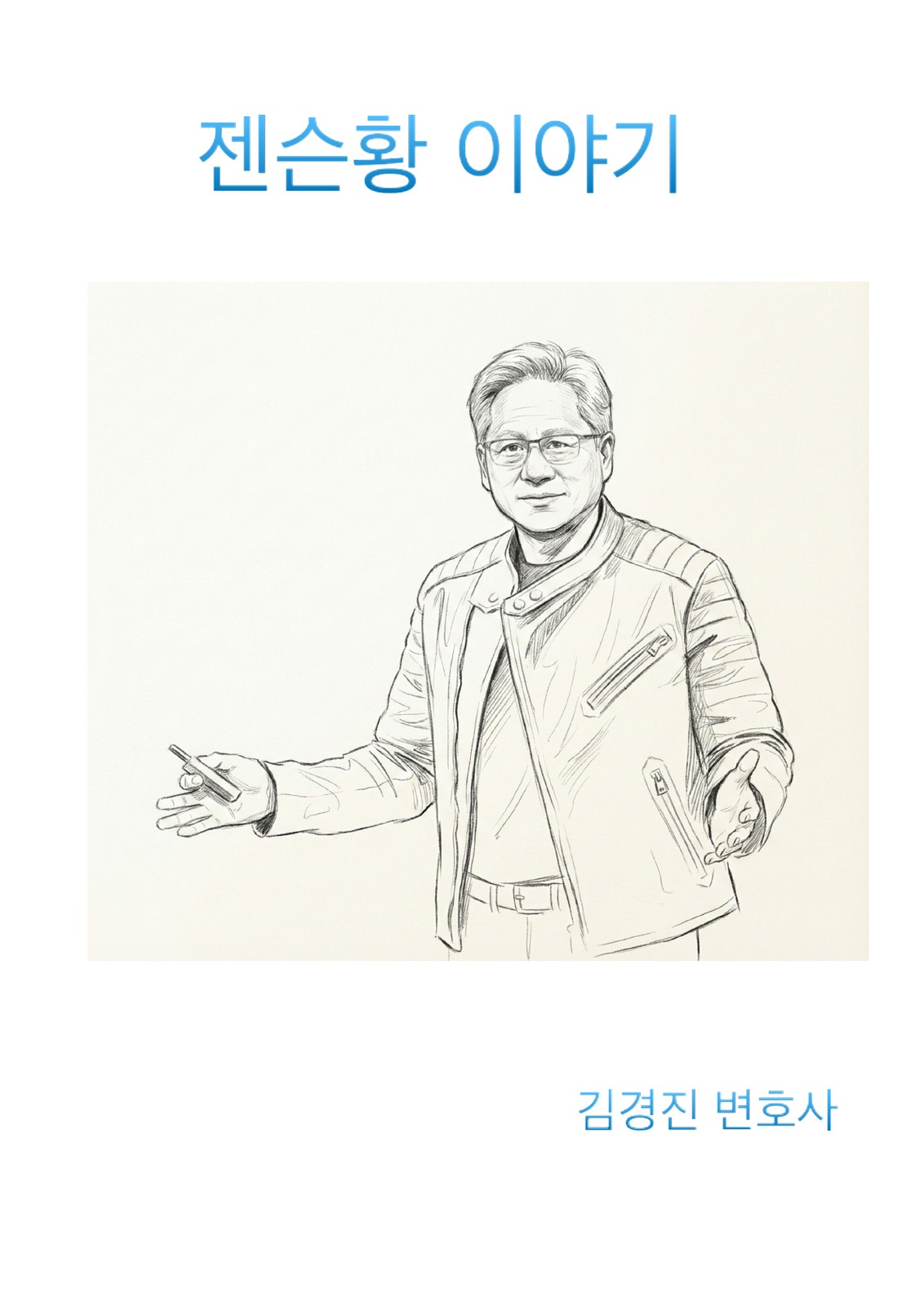
The Jensen Huang Story
Part 2. Architect of a New Age
Chapter 13. Coexistence of Humans and Machines
Kim Kyung-jin
When the Roman Empire was at its height, all roads led to Rome. A network of roads stretching tens of thousands of kilometers connected every province into a single whole. Soldiers marched along these roads, merchants hauled their goods, and scholars spread knowledge. As physical distances shrank, civilization grew at an explosive pace.
What Jensen Huang is building is also a kind of road. A neural network made of silicon and code, an invisible highway where data flows. A new traveler called artificial intelligence walks along this road. And this traveler wants to become our colleague.
In the period crossing from 2024 into 2026, a single question echoed around the world. Will artificial intelligence really take our jobs? Painters wondered whether they should put down their brushes. Writers agonized over whether to break their pens. Even programmers trembled at the fear of being replaced by the very machines they had built.
Jensen Huang saw it differently.
AI Won't Take Your Job
Jensen Huang repeated the same message across speeches and interviews. "AI isn't going to take your job. Another person who knows how to use AI well is going to take your job."
The first time you hear this, it can sound cruel. But think about it for a moment and you realize it echoes a universal truth of history. The one holding the tool has always had the advantage over the one with bare hands. A hunter with a stone axe caught more prey than a hunter without one. A farmer pulling an iron plow harvested more grain than a farmer pulling a wooden plow.
Jensen Huang draws a clear line between a person's "job" and their "tasks." A job is a collection of roles a person performs. Tasks are the individual pieces of work required to carry out that job. What AI takes over is not the entire job but the tedious, repetitive tasks buried inside it.
He offered an interesting example. About ten years ago, Geoffrey Hinton, a leading authority in artificial intelligence, made a prediction: "Within five years, AI will read medical images better than radiologists. There will be no need to train radiologists anymore."
On a technical level, Hinton was right. Today, AI reads X-rays and MRIs faster and more accurately than humans. But something strange happened. Radiologists didn't disappear. Their numbers actually grew.
Why?
One of a radiologist's "tasks" was reading images. But the reason the "job" existed, its purpose, was to diagnose disease and treat patients. Once AI took over the grueling, repetitive work of image reading, doctors could analyze more patient data in greater depth. Diagnostic accuracy went up. Hospitals could care for more patients. The quality of medical services improved. The result was that more doctors were needed.
Jensen Huang compares this to the spreadsheet. When Excel came along, did accountants vanish? They did not. The hours spent punching calculators and reconciling numbers simply shrank. With that freed-up time, accountants could craft financial strategies and advise executives, work of far greater value.
Jensen Huang points to NVIDIA's own example. Every software engineer and chip designer at NVIDIA works with the help of AI tools. Inside the company there is an AI coding assistant called Cursor. It suggests code, finds bugs, and summarizes documents.
So did NVIDIA lay people off? No. It hired even more. As productivity rose, new projects that had been impossible for lack of time suddenly became feasible. Human ideas are limitless. When tools get better, more of those ideas can become real.
Jensen Huang puts it this way: "If a tool can shrink a week's worth of work to an instant, will you end up doing less work, or more?" His answer is clear. "You're going to be busier."
This can sound like a paradox. If the tools get better, shouldn't life get easier? Why would you get busier? The reason is that humans have endless desires and curiosity. Once one problem is solved, they tackle the next. Once they cross one mountain, they go looking for a taller one.
Jensen Huang raises another critical point. The world is facing a severe labor shortage. In manufacturing, transportation, logistics, healthcare, and nearly every other field, there aren't enough people to do the work. The cause is aging populations and falling birth rates. Some projections say the global workforce will be short by roughly 50 million workers by 2030.
AI and robots fill that gap. They take on jobs that humans avoid or that are physically impossible for them. Dangerous factories, deep mines, sprawling warehouses. When machines work in places like these, humans can focus on safer, more creative work.
In January 2026, at CES, the technology trade show, Jensen Huang used a striking phrase. He called robots "AI immigrants." Just as immigrants come to a new land and help its economy grow, robots and AI would join our economy and grow alongside us.
He said: "When robots arrive, jobs arrive with them. Population decline is keeping us from achieving the economic growth we want. AI immigrants need to help us on the production floor. When the economy grows, you naturally end up hiring more people."
In the end, artificial intelligence is not humanity's enemy. It is a lever that amplifies human ability. Just as the tractor didn't replace the farmer but multiplied the farmer's strength, AI multiplies the strength of knowledge workers.
A Future of Working Alongside Digital Colleagues
The office of the future Jensen Huang envisions looks quite different from today's. In it, "biological employees" and "digital employees" work side by side. The biological employees are humans. The digital employees are AI.
The digital employees he describes go well beyond answering questions. They reason on their own, make plans, and use tools to solve problems. Jensen Huang calls this "agentic AI."
The word "agent" originally means a representative, someone who handles affairs on your behalf. Insurance companies have agents. Real estate firms have agents. AI agents are no different. They handle complex work in our place.
Imagine a situation like this. You say, "Plan a trip to Paris for next week." A basic chatbot would stop at listing tourist spots. An agentic AI is different. It searches the internet on its own
and compares flights. It checks hotel prices. It puts together an itinerary and adds it to your calendar. It even makes reservations. It handles a variety of tools with the same ease as a human.
Jensen Huang predicts that future companies will have billions of digital employees. In a marketing department, one AI agent handles market research. Another helps with copywriting. Another analyzes customer data. Human employees collaborate with these agents, distributing tasks and gathering results like a team leader.
He offered an amusing analogy while explaining this shift. "The IT department of the future will become the HR team for digital employees."
Think about what an HR team does. They hire new employees. They teach those employees the company's culture and philosophy. They evaluate job performance. They manage and train people when problems arise. According to Jensen Huang, the IT department of the future does exactly the same thing. It decides which AI models to adopt. That is hiring. It trains the AI on the company's knowledge and data. That is onboarding. It monitors and evaluates whether the AI is functioning correctly. That is performance management.
He says he told NVIDIA's CIO: "You will become the HR director for digital employees in the future. Digital employees will work alongside our biological employees. That is the future of our company."
This shift will fundamentally reshape corporate organizational structures. In the past, software was used as a 'tool.' You opened Excel, opened Word, opened Photoshop. Humans used tools to do work. But agentic AI is not a tool. It is a workforce that performs tasks on its own. AI becomes the entity that uses tools.
Jensen Huang points to NVIDIA's chip design process as an example. NVIDIA's latest chips contain billions of transistors. A transistor is a tiny switch that either allows or blocks electrical current. Billions of these switches come together to form a complex city. Designing and verifying this enormous maze by human effort alone is nearly impossible.
NVIDIA designs chips through AI. AI assists with the design, and those chips in turn create more powerful AI. This is a cyclical structure. Jensen Huang calls it the 'AI factory.' If factories of the past produced goods, factories of the future produce intelligence.
Humans are not marginalized in this process. They focus on higher-order problem-solving instead. How do we stop climate change? How do we develop new treatments? How do we explore space? Human intelligence alone is insufficient to solve these challenges. Digital colleagues called AI work around the clock, analyzing data and running simulations. Humans make decisions based on those results.
In the world Jensen Huang envisions, the human role is that of a 'conductor.' Just as an orchestra conductor gives direction to each musician, humans set the direction for AI agents. Defining what to do and why it matters remains a human responsibility. AI provides the answer to how.
Humans also become 'curators.' A curator selects artworks and plans exhibitions at a museum. Among the countless outputs AI generates, judging what holds real value, what is ethically sound, and what can touch human emotion requires human discernment.
Jensen Huang describes this discernment as 'taste.' AI can write excellent poetry. But feeling why that poem is beautiful is human. AI can present a flawless treatment plan. But holding a patient's hand and offering comfort is the doctor's role.
As technology advances, the value of what is distinctly human rises paradoxically. Empathy, creativity, ethical judgment. These are things machines cannot easily replicate. We are not competing with machines. We must learn to dance with machines and lead more human lives.
Jensen Huang says: "The era of programming languages is passing. Now the programming language is human language." In the past, you had to learn complex machine languages like C++ or Python to give commands to a computer. Only a handful of specialists enjoyed the benefits of technology. But now anyone can give commands by speaking. In English, in Korean, in Japanese. "Analyze this data for me," "Write code that implements this feature," "Draw me a picture like this." If you don't even know how to use AI, you can just ask it."
"How do I use you?"
This means an era has opened where everyone can be a programmer. A farmer can analyze agricultural data. A biologist can study gene sequences. An artist can use new creative tools. Countless people who couldn't realize their ideas because of technical barriers will now unleash their creativity with the help of digital colleagues.
Jensen Huang calls this the 'democratization of technology.' Democratization means power spreading from the few to the many. The democratization of technology means the power of technology spreading from a small number of specialists to everyone.
"Run, Don't Walk"
May 2023, the commencement ceremony at National Taiwan University. Thousands of graduates have gathered on the athletic field. A man in a black leather jacket stands at the podium. It is Jensen Huang. He has just received an honorary degree from the university and is delivering the commencement address.
His words resonated in the hearts of young people around the world.
"Run, don't walk. Either you are running for food, or you are running from being food. Sometimes it's hard to tell which. Either way, run."
Run, don't walk. Either you are running for food, or you are running from being food. This sentence is Jensen Huang's life philosophy. It is also the question he poses to all of us living in a rapidly changing age of AI.
In the natural world, walking means danger. You get caught by a predator, or you miss your prey and starve. The world of technology is the same. In an era where the speed of change is exponential, 'walking' is not maintaining the status quo. It is falling behind.
Jensen Huang has weathered countless crises in the more than 30 years since founding NVIDIA. The company came to the brink of bankruptcy more than once. When his first chip failed, he went to Sega and honestly admitted his mistake. When he had to withdraw from the mobile market, he boldly pivoted toward AI, a field no one was paying attention to.
Each time, he chose to run instead of walk. He felt in his bones that the moment he stood still, he would be left behind.
The pace of technological progress shoots upward along an exponential curve. Yesterday's innovation becomes today's common sense and tomorrow's obsolescence. According to Jensen Huang, AI computing performance has improved 100,000 times over the past decade. Moore's Law said performance doubles every two years, but AI has far exceeded that.
The 'running' Jensen Huang speaks of does not mean a blind sprint for speed alone. It means the agility to sense change, refuse to fear failure, and pivot boldly toward new opportunities. NVIDIA was able to transform from a graphics card company into an AI computing company because he refused to rest on his success in the PC market and sprinted full speed into a field nobody was watching.
He advises the younger generation: do not avoid pain and hardship. Just as muscles grow stronger after the pain of tearing, intellect grows through failure and trials. When people ask Jensen Huang the secret to his success, he answers plainly. "I have endured tremendous pain and humiliation. That is what made me."
The current AI revolution is approaching faster and on a larger scale than either the Industrial Revolution or the arrival of the internet. Hesitating or stepping backward in front of this enormous wave is dangerous. You must ride it. You must not hesitate to learn new technology and turn it into your own weapon.
Jensen Huang says he uses artificial intelligence every day. He uses ChatGPT. He uses Perplexity.
He uses Gemini. He treats them like personal tutors. When he encounters an unfamiliar subject, he asks the AI: "Explain it to me as if I were a twelve-year-old." The CEO of the world's leading AI company is still learning every day. Can the rest of us afford to stand still?
He says, "Start using artificial intelligence right now." It doesn't matter whether you're a student, a working professional, or retired. There is no need to wait for the future. The future is already here. In 2016, when Jensen Huang personally delivered the first supercomputer to OpenAI, they were dreaming of what was to come. Now that dream is reality. A walker can admire the scenery. But only the runner gets to see the new horizon first.
Even as Jensen Huang receives praise as the world's greatest CEO, he still greets every morning with the mindset that "we are thirty days from going bankrupt." This is not anxiety. It is a healthy sense of urgency. He guards against becoming intoxicated by success. The Roman Empire did not decline because of enemies outside its borders. It fell because of complacency and arrogance within. Jensen Huang relentlessly pushes the organization so that NVIDIA, despite becoming a corporate giant, never loses the hunger of a startup.
The world he envisions is not a dystopia where machines rule over humans. It is an era of creation, one where diseases are conquered, the climate crisis is addressed, and anyone can turn an idea into reality. To bring that about, he steps onto the stage today wearing his leather
jacket. And he tells us: technology is only a tool; it is human will that decides where to run with that tool in hand.
The future is not something to predict. It is something to build. And to build it, we must keep running, never stopping, even at this very moment.
Just as Jensen Huang has done, it is time for each of us to run on our own track until we are gasping for breath. Because that is the path to coexisting with machines while preserving human dignity.
Kim Kyung-jin
Attorney · Former Member of the National Assembly · AI Policy Researcher
© 2026 Kim Kyung-jin. All rights reserved.