Table of Contents
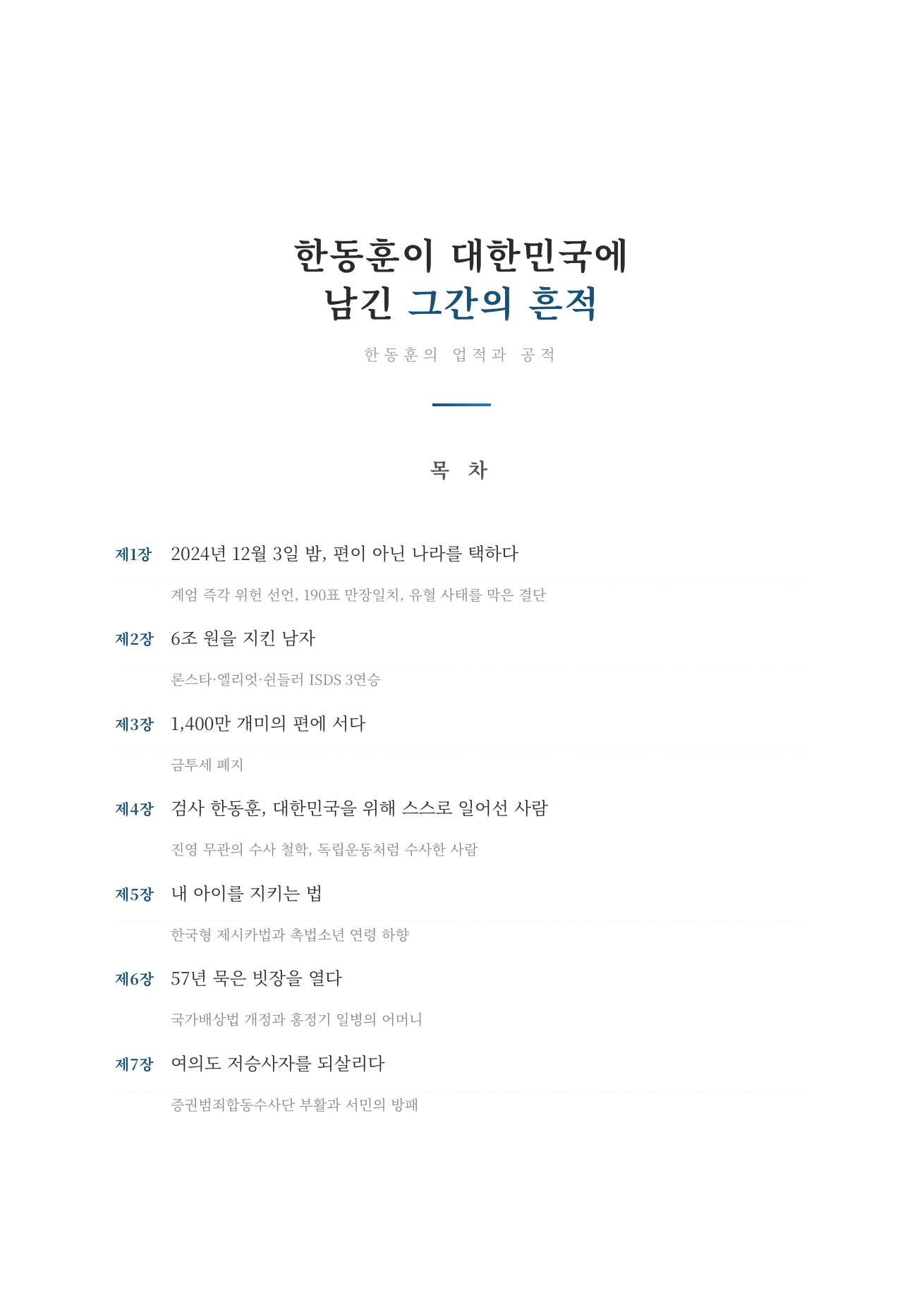
Han Dong-hoon, Busan Buk-gu Gap: A Record of the 100 Days Before and After the Election (Mar. 26-Jul. 3, 2026)
Kim Kyung-jin
Table of Contents and 13 sections
From March 26 to July 3, 2026, this record follows the spring after expulsion, the Busan Buk-gu Gap by-election, victory as an independent, and the first bill submitted in the National Assembly.
Table of Contents
Artificial Intelligence and Medicine
Kim Kyung-jin, Attorney at Law
AI in clinical care, hospitals, education, and research
AI in medical imaging, risk prediction, treatment planning, hospital operations, education, and research, with patient safety, privacy, and accountability.





















[AI Library] Chapter 10: Iran's Checkpoints
The 2026 U.S.-Iran War and the Global Energy Crisis
Chapter 10: Iran's Checkpoints
Kim Kyung-jin
The 2026 U.S.-Iran War and the Global Energy Crisis
Chapter 10: Iran's Checkpoints
10.1 The New Route North of Larak Island
On March 16, 2026, the maritime traffic analysis team of Lloyd's List Intelligence, headquartered in the City of London, detected a peculiar pattern. AIS (Automatic Identification System) signals from vessels transiting the Strait of Hormuz began appearing again, one by one, but their trajectories differed entirely from the established routes. The bidirectional shipping lanes established by the International Maritime Organization (IMO) as Traffic Separation Schemes (TSS), which tankers and LNG carriers had followed for decades, sat empty. Instead, vessels were hugging the Iranian mainland coast, navigating through the narrow waterway between Qeshm Island and Larak Island.
This was the new game being played by Iran's Islamic Revolutionary Guard Corps (IRGC).
To understand that rule, we must look again at the geography of the Strait of Hormuz. The narrowest point of the strait is 34 kilometers. The internationally recognized shipping lane was positioned in the middle of these 34 kilometers, in a broad, deep channel tilted toward the Omani waters. Each bidirectional lane was 3.2 kilometers wide, with a 3.2-kilometer buffer zone between them. Under the United Nations Convention on the Law of the Sea (UNCLOS), all vessels of any nation are guaranteed the right of transit passage through such international straits, allowing them to pass unobstructed and expeditiously. The coastal states on either side of the strait, Iran and Oman, cannot impede or halt this passage. Article 44 of the Convention made this clear.
The IRGC turned this route into a sea of death. Beginning immediately after war broke out on February 28, they laid mines, activated anti-ship missile batteries, and unleashed suicide drones and armed speedboats. On March 1, the tanker Skylight was struck north of Khasab, Oman, killing two Indian crew members and injuring three. That same day, the MKD VYOM was attacked by a drone boat (unmanned suicide vessel), igniting fires in the engine room and triggering explosions; one Indian sailor died. On March 6, the tugboat Mussafah 2 was struck near the strait, claiming the lives of four crew members. This was the deadliest single attack by casualty count. On March 11, the Thai-flagged container ship Mayuree Naree was struck by an unidentified projectile north of Oman at 13 nautical miles, causing fires; the Omani Navy rescued 20 crew members. By mid-March, the International Maritime Organization (IMO) counted at least 18 merchant vessels struck. At least seven people had died.
Once insurers withdrew their war-risk coverage, the route became a vacuum that no one would enter. The International Group of 12 Protection and Indemnity (P&I) clubs, which provide marine liability insurance for 90 percent of global maritime tonnage, completely withdrew insurance coverage for vessels transiting the Strait of Hormuz on March 5. Navigation without insurance meant exposing assets worth hundreds of millions of dollars with no protection, a gamble no rational operator could accept.
And Iran offered an alternative: abandon the existing route and go around the north of Larak Island instead.
According to USNI News, Iran changed the system under which vessels had used the southern route near Omani waters, establishing a new route that went around Larak Island. Lloyd's List Intelligence called this route the "IRGC-controlled corridor" between Qeshm Island and Larak Island. The Associated Press described it this way: "In normal times, vessels use the bidirectional lanes in the middle of the strait. But an increasing number of ships are taking a different path around the north of Larak Island, which positions them within Iranian territorial waters, closer to the Iranian coast."
The fatal characteristic of this new passage lay in the geography itself. The waters north of Larak Island formed a narrow corridor squeezed between the Iranian mainland and the islands Iran had fortified. Unlike the existing TSS route, which adjoined Omani territorial waters and left room for U.S. Navy or coalition maritime forces to monitor and intervene, this route lay within waters over which Iran could clearly assert sovereignty. As Jatin Dua, an anthropology professor at the University of Michigan, explained to USNI News, this route cut through Iranian territorial waters. The moment a vessel entered those waters, the right of transit passage guaranteed in international straits vanished. In Iranian territorial waters, Iran was the law.
Maritime risk analyst Timer Raanan assessed it this way in a Lloyd's List webinar: "This is unprecedented. It is not how traffic moved before the war, and it represents a very unsettling development in Iran's assertion of control over strait traffic."
On the port side, the Iranian coast stretched like a screen, lined with Shahed suicide drones and Khalij Fars anti-ship ballistic missiles. On the starboard side, Qeshm Island and Larak Island were studded with IRGC Navy speedboat bases honeycombed into the rock. Both sides of the vessel lay within Iran's firing range. The passage rarely exceeded 2 kilometers at its widest, and it was not waters designed for 300,000-ton Very Large Crude Carriers (VLCCs) with a draft of 20 meters. The seabed was irregular, currents were strong, and reefs lurked in many places. It was shallow water. For a VLCC to pass through this narrow channel, it had to reduce engine power to minimum and crawl with tugboat assistance. A helmsman's mistake or mechanical failure that took the vessel even dozens of meters off course risked running aground or drifting into Iranian minefields.
CBS News described Larak Island as Iran's "toll booth," noting that "this island, just miles off the Iranian coast, had become the concrete chokepoint of Iran's total control of the strait." Lloyd's List reported tracking 33 transits via Larak Island in late March, but recorded not a single passage through the normal southern route.
The geographic shift created consequences that were both military and legal. The U.S. Navy Fifth Fleet had positioned carrier strike groups in the waters, but entering Iranian territorial waters was an entirely different matter. If a U.S. Navy destroyer entered the waters north of Larak Island claiming to protect American merchant vessels, it would constitute an illegal incursion into Iranian territorial waters. From Iran's perspective, this would provide justification for exercising the right of self-defense; from America's, it would be a gamble requiring acceptance of escalation. Operation Epic Escort, the Pentagon's emergency plan for forcing passage through Hormuz, was theoretically possible but carried the risk of direct engagement with IRGC attack craft and coastal anti-ship missiles deployed on Qeshm and Abu Musa Islands.
Foreign Policy's analysis pinpointed the paradox precisely. U.S. war planners had spent decades preparing for an Iranian closure of the strait, yet the strait was effectively closed. The total number of vessels transiting in March fell short of the pre-war daily average. According to Lloyd's List Intelligence, some 110 vessels passed through daily before the war; after the war, that fell to fewer than 10 per day. From March 1 to 25, the recorded total was 142 transits, compared to 2,652 for the same period in 2025. A 94.6 percent decline. The strait's historical average is about 138 vessels in 24 hours. The 25-day total for March 2026 barely matched a single pre-war day.
Of those 142 vessels, 67 percent had direct trade or ownership ties to Iran; as March progressed, this figure rose to 90 percent. The remainder were mostly Greek-owned or Greek-linked vessels (15 percent) and Chinese vessels (10 percent). Iranian crude oil shipments maintained more than 1.5 million barrels per day, and Vortexa, an energy analytics firm, estimated that about 1 million barrels had transited the strait since March 1. At least eight very large gas carriers (VLGCs) carrying Iranian liquefied petroleum gas (LPG) also passed through after March.
Iran did not completely close the strait. Instead, it transformed the strait into its private property. It established a system in which Iran decided who could pass, when, and under what conditions. The free sea became Iran's private tollbooth. As Eurasia Group chief Ian Bremmer wrote on social media, the strait was not "completely closed." Iranian tankers continued to pass through, carrying oil to China and generating revenue for Iran.
The free sea had become a sea of permission. And that permission came with procedures.
10.2 The Transit Procedure
Shipowners and operators seeking to transit the Strait of Hormuz had to make a phone call first. On the other end was an intermediary connected to the IRGC.
According to information Lloyd's List Intelligence obtained from three separate sources, the procedure worked as follows. Between 72 and 96 hours before a vessel approached the strait entrance from the Gulf of Oman, the operator would contact "IRGC-approved intermediaries." These intermediaries were Iran-connected individuals operating outside Iran. Once contact was made, the operator had to submit extensive documentation.
The documentation list resembled that of a border checkpoint. The vessel's IMO number (the unique identifier assigned by the International Maritime Organization), ownership structure (the equity chain down to the actual owner), the type and quantity of cargo loaded, the final destination of that cargo, and a complete roster of all crew members including their names and nationalities. All this data was transmitted through the intermediary to the IRGC Navy's Hormozgan Provincial Command.
The IRGC then began vetting the data. Lloyd's List called this process "geopolitical vetting." It involved checking against sanctions lists, reviewing cargo suitability (oil received priority over all other cargo), and most critically, verifying whether the vessel had any connection to the United States, Israel, or their Western allies. If the ship's owner, the company that purchased the cargo, the insurance provider, or the nationality of the crew had any connection to a country Iran designated as hostile, transit was denied.
Iran's Foreign Ministry letter to UN Secretary-General António Guterres wrapped this principle in diplomatic language. The strait, it stated, was open to "non-hostile vessels," but only on condition that they "act in coordination with Iran's competent authorities."
Denials began to accumulate. IRGC Navy Commander Alireza Tangsiri posted directly to the social media platform X (formerly Twitter) on March 25, stating that he had turned back the container ship Selen because it had attempted to transit the strait "without following legal procedures and without permission." "All vessels transiting these waters must go through full coordination with Iran's maritime authorities," he declared. Two days later, on March 27, Israel killed Tangsiri in an airstrike on Bandar Abbas. Yet the system he had built continued to function after his death.
An even more dramatic scene unfolded on March 27. Two COSCO container ships, the CSCL Indian Ocean and the CSCL Arctic Ocean, attempted to pass around Larak Island but suddenly reversed course and returned into the Persian Gulf. The MarineTraffic website's satellite data captured this maneuver in real time. The Hong Kong-flagged Lotus Rising had also been turned back the day before at the same island. Despite being Chinese-flagged, they had failed IRGC vetting. The IRGC released a statement immediately after. "After America's corrupt president falsely claimed that the Strait of Hormuz is open, three multinational container ships this morning moved into the designated corridor for authorized vessel traffic, but were turned back after warnings from the IRGC Navy." A follow-up statement followed: "The passage of all vessels to and from ports of Zionist-American enemy allies and supporters is prohibited, regardless of destination or route."
Vessels that passed vetting were issued a unique clearance code and routing instructions by the IRGC. This code functioned as a kind of digital pass, linked to the ship's AIS transponder. When a vessel with the code reached the waters near Larak Island, VHF radio communication began. Al Jazeera's reporting captured this scene vividly: "When a ship enters the strait, IRGC commanders demand its clearance code over VHF radio, shouting for it. The ship responds, and if approved, a boat arrives from the Iranian side to escort the vessel throughout its passage through Iranian territorial waters around Larak Island." Vessels without matching codes, or codes altogether, were not permitted to transit.
The number of vessels passing through this procedure was extremely limited. According to Lloyd's List, from March 13 to 27, only 26 vessels transited the strait using the pre-approved route under the IRGC "toll booth" system. At least nine of these were confirmed to have taken the detour around Larak Island, and 21 more could not be confirmed either way due to absent AIS data. During the same period, not a single vessel transited the normal route with AIS active. After March 15, AIS records for the normal route stood at zero.
Separately, Lloyd's List tracked 46 "dark transits" in March, vessels that passed through the strait with AIS disabled. Both sanctioned and non-sanctioned vessels turned off AIS to evade tracking. Windward identified eight large "dark vessels" exceeding 290 meters (950 feet) operating in the strait with AIS off, including U.S.-sanctioned vessels.
A sea where 110 vessels moved freely each day had become a controlled zone where only a handful of vessels carefully passed under armed IRGC escort. Once a free sea, the Strait of Hormuz had become the most difficult checkpoint to transit in the world.
Security consulting firm Control Risks warned in a client briefing that the United States was unlikely to long tolerate this system, if it represented an attempt to enforce Iran's complete control of the strait rather than individual diplomatic exceptions. "Western-linked shipowners and operators will not voluntarily send vessels into Iranian waters, but others are more likely to accept the risk," it said. Analysts offered a further warning: Iranian approval did not automatically guarantee safe passage.
What captains and crew had to endure went beyond document checks and code verification. For the hours while gray IRGC speedboats heavily armed with machine guns flanked the tanker, forcing it along its course, tension gripped the bridge. Iran's maritime control was not merely an administrative procedure but a display of power combining physical coercion and psychological pressure. An NBC News analyst summarized it this way: "The Islamic Revolutionary Guard Corps confirms the vessel's information and essentially operates like a toll booth."
Procedures that did not exist before the war, submission that would have been unthinkable before the war. After the toll booth route opened around March 13, the frequency of Iranian attacks on merchant vessels dropped noticeably. The last attack came on March 19 when the maritime tug Halul 50 was struck off Ras Laffan, Qatar. The reason for the decline was obvious. Iran had acquired a more effective and sustainable tool than indiscriminate attacks: systematic control.
And at the end of all these procedures, an invoice was waiting.
10.3 Two Million Dollars Per Transit, Payment in Yuan
Iranian legislator Alaeddin Boroujerdi appeared on Iran International, a Persian-language satellite broadcaster based in Britain, and said: "Wars cost money. Of course we should do this, and we should collect transit fees from ships passing through the Strait of Hormuz."
Legislator Mohammadreza Rezaei Kouchi told the IRGC-affiliated news agencies Fars and Tasnim: "Since we are providing security for the strait, it is only right that ships and tankers pay such fees."
The size of those transit fees reached a maximum of 2 million dollars (roughly 2.8 billion won) per vessel transit.
Bloomberg first reported on March 24, 2026, that Iran had begun collecting transit fees from some merchant vessels passing through the Strait of Hormuz, with fees up to 2 million dollars being requested on an ad hoc basis. According to sources who requested anonymity, some vessels had actually paid this amount. On March 26, Bloomberg reported in a follow-up that the Iranian parliament was drafting legislation to codify these transit fees. The semi-official Fars news agency, quoting an anonymous legislator, reported that the bill was set to be finalized the following week and would legally recognize Iran's "oversight" of Hormuz.
CNN, NBC, Al Jazeera, CNBC, and Foreign Policy followed with reports. Lloyd's List confirmed: "Not all vessels paid the transit fee directly, but at least two did, and payment was made in yuan." Jasem Mohamed al-Budaiwi, Secretary-General of the Gulf Cooperation Council (GCC), became the first senior official to publicly condemn Iran for levying fees in exchange for transiting the strait. Foreign Policy identified this fee-collection system as the first instance in modern maritime history of a nation unilaterally imposing tolls on passage through an international strait.
The arithmetic those figures create is worth following.
According to CNN's calculations, approximately 20 million barrels of crude oil pass through the Strait of Hormuz daily during peacetime, equivalent to about ten VLCCs (very large crude carriers). Receiving $2 million per tanker would yield $20 million per day. Over a month, that comes to roughly $600 million (850 billion won). Including LNG carriers, monthly revenue could exceed $800 million. CNN calculated this figure represents 15-20 percent of Iran's monthly oil export revenue in 2024. According to another source, transit fees around $0.50 to $1.20 per barrel were negotiated based on cargo volume.
When this figure is placed alongside others, its significance becomes clear. Egypt's revenue from transit fees through the Suez Canal falls between $700 million and $800 million monthly in normal years. The Suez Canal has been an internationally recognized artificial waterway since its opening in 1869, operated by the Egyptian government exercising legitimate sovereignty. The amount Iran seeks to extract from the Strait of Hormuz is comparable to Suez Canal revenue. The difference lies in this: Suez is an artificial waterway while Hormuz is a natural strait; Suez's toll collection is internationally recognized under law while Hormuz's is not.
Iran's semi-official news agency Tasnim went further. Based on the premise that approximately 120 vessels pass through the strait daily in peacetime, it estimated that collecting $2 million per ship in special security service fees could generate annual revenue exceeding $100 billion (roughly 150 trillion won). While this figure would be difficult to reach under wartime conditions of severely restricted passage, it revealed Iran's ambition to maintain this checkpoint even after the war's conclusion.
Iran's Majlis (parliament) civil committee was drafting legislation on Strait of Hormuz transit fees, with a parliamentary vote expected in late March or early April. The bill legally recognized Iran's sovereignty, dominance and supervision over the strait. If passed, it would mark the first permanent sovereignty-based toll on an international strait in modern maritime history. According to Foreign Policy's analysis, Iran had even raised in preliminary negotiations with the United States the idea of converting the Strait of Hormuz into a permanent cash-generating mechanism like the Suez Canal. Recognition of Iranian sovereignty over the Strait of Hormuz was one of five conditions Iran set for ceasefire.
James Kraska, a professor of international maritime law at the U.S. Naval War College, told CNN: "Imposing transit fees violates the rules of transit passage. Under international law, coastal states have no legal basis to collect tolls from international straits like Hormuz." Articles 26 and 44 of the UN Convention on the Law of the Sea are explicit. All vessels have the right of transit passage through straits used for international navigation, and charging fees for passage itself is prohibited even within territorial waters. States may charge foreign vessels only for services actually provided.
However, there was one complicating fact. Iran signed the 1982 UN Convention on the Law of the Sea but did not ratify it. The United States likewise failed to ratify it. Israel is not a signatory. Iran placed this non-ratification status at the core of its legal argument,claiming it was not bound by a treaty it had not ratified. According to Lawfare's March 2026 analysis of U.S. legal experts, this distinction sat at the center of Tehran's legal claim.
U.S. Secretary of State Marco Rubio warned reporters after the G7 Foreign Ministers meeting in Paris on March 28: "This is illegal, unacceptable, and dangerous to the world. It is crucial that the world has a plan to confront this." G7 foreign ministers jointly stressed the absolute necessity of restoring safe and toll-free freedom of navigation. Yet all commitments came with the caveat that they could only be implemented after hostilities ended. As long as the war continued, Iran's toll booth operated unchallenged. Saudi Foreign Minister Prince Faisal bin Farhan pressed for implementation of wartime countermeasures through five bilateral meetings with European and Indian counterparts at the G7 summit, but achieved no results.
But what shook the global financial order more than the $2 million amount was the currency in which this toll was to be paid.
Chinese yuan (RMB). Not the dollar.
Lloyd's List reported: "Not all vessels paid transit fees directly, but at least two did, and those payments were made in yuan." Settlement was processed through Chinese intermediaries. The payment bypassed the Western-controlled SWIFT system entirely, instead flowing through China's Cross-Border Interbank Payment System (CIPS) under the People's Bank of China. The English edition of Seoul Economic Daily confirmed this: "Iran is allowing only ships from friendly nations like China and India to pass through the strait, and reportedly collected approximately $2 million in transit fees from some vessels in Chinese yuan."
Some reports indicate settlement was processed through Kunlun Bank, a Chinese bank that has historically mediated Iran-China transactions outside the SWIFT system. Other reports mentioned a secret payment network called Chuxin that China had established for Iran. This network was a bypass channel capable of processing yuan payments while completely circumventing U.S. sanctions monitoring. The $400 billion, 25-year cooperation agreement signed by Iran and China in 2021 became the foundation for this payment infrastructure. China received discounted-price Iranian crude in exchange for becoming Iran's largest economic partner, with all transactions conducted outside the dollar system.
To understand what this payment structure means, we must go back to 1974. That was when the petrodollar system was established through an agreement between Saudi Arabia's King Faisal and U.S. President Richard Nixon. Saudi Arabia agreed to receive payment for all oil exports exclusively in dollars, and the United States guaranteed Saudi Arabia's security. For the 52 years following this agreement, nearly all oil on earth was traded in dollars. Buying oil required dollars, and global demand for dollars became the structural foundation supporting American financial hegemony.
Iran's insistence on receiving Strait of Hormuz tolls only in yuan was an act aimed at the heart of this 52-year-old structure.
The scale of CIPS reveals the substance of this trend. During 2025 alone, yuan transactions processed through CIPS totaled $245 trillion, a 43 percent increase from the previous year. The infrastructure was already in place before the war. China had established yuan swap lines with over 40 central banks, and some Middle Eastern central banks were examining the digital yuan (e-CNY) platform mBridge.
From February 28 when the war began through March 15, between 11.7 million and 16.5 million barrels of Iranian crude moved from Iranian ports to Chinese refineries. Not through normal international shipping systems, Western insurance, or dollar settlement. Instead through shadow fleets,vessels operating to avoid sanctions,and all payments occurred outside U.S. dollars. During March, shadow fleet vessels accounted for over 80 percent of ships transiting the Strait of Hormuz. In February, that figure had been about 15 percent.
Within this structure, Western shipping companies faced an impossible dilemma. Converting $2 million in yuan and remitting it to Iranian accounts directly violated U.S. sanctions against Iran. If detected by the U.S. Treasury Department's Office of Foreign Assets Control (OFAC), they faced frozen assets in the United States and expulsion from the dollar financial system. Yet without paying the toll, ships could neither enter nor exit the Persian Gulf.
Asia Times' analysis illuminated the situation broadly. The dollar does not lose its throne overnight, nor is the yuan ready to bear all the burdens of a global reserve currency. China still maintains capital controls, and the openness and credibility of its financial markets lag behind the United States. Even countries dissatisfied with the U.S. dollar show little enthusiasm for replacing one currency dependency with another. Yet trends matter. Russia already sells energy to China in yuan, and in March 2026 alone, India settled 60 million barrels of Russian crude in yuan and dirhams. BRICS nations are discussing non-dollar settlement mechanisms. Iran's yuan-based Hormuz policy did not create a new direction in global finance so much as accelerate a flow that already existed.
European Business Magazine captured the essence of this situation most sharply. A bifurcated oil market had been born: tankers settling in yuan pass through Hormuz, while those settling in dollars are blocked by insurance gaps, minefields, and IRGC targeting. One commodity with two prices, one waterway with two currencies, one barrel of oil with two systems. The very division the dollar had sought to prevent was being accelerated by the war fought to preserve it.
And then Iran's new supreme leader spoke.
10.4 Selective Opening
On March 12, a newscaster on Iran's state television Press TV read a statement with a photograph displayed behind him. The statement's subject was Mojtaba Khamenei, who had been elected as the new supreme leader on March 9 by the Assembly of Experts,an 88-member body of clerics,following his father Ali Khamenei's death in the U.S. and Israeli airstrike on February 28. He was 56 years old. He did not appear personally before cameras. In that same strike, he lost his wife Zahra, a sister, a nephew, and a brother-in-law, and his teenage son Mohammad Bagher was reported killed. He himself was reported injured. Israeli security assessments concluded he had sustained a leg injury, though the severity remained unclear. Iranian-American dissident Amir Salarian told The Guardian, "He does not appear to be in a condition to deliver speeches." Two weeks into the war, no video or audio recording of the new leader had been released.
Though delivered by proxy, one sentence in the statement struck global energy markets.
"The lever of the Strait of Hormuz blockade must continue to be used."
This single sentence confirmed that Iran's control of the strait was not a wartime byproduct but a core element of state strategy. The Soufan Center's analysis concluded that Mojtaba Khamenei views Hormuz not merely as an artery of the global economy but as an extension of Iran's national security and a strategic lever in confrontation with the United States and Israel. His first official statement signaled escalation and regional pressure. Rob Geist Pinfold, a lecturer in international security at King's College London, told Al Jazeera: "We have not actually heard any of what the Trump administration may have hoped for,a change in rhetoric from the new supreme leader, for instance. What we are hearing is a repetition of established positions."
The statement contained other content as well. It said Iran would not abandon avenging the blood of martyrs, and that research had been conducted on opening other fronts where the enemy was inexperienced and extremely vulnerable, which would be activated if the war continued and served Iran's interests. It recommended to neighboring countries the immediate closure of U.S. military bases in the Middle East, warning that those bases would be attacked. Armed groups in Yemen would carry out such operations, it added, and armed groups in Iraq wanted to help.
Oil prices rose immediately after this statement. According to CNBC, the upward momentum in oil prices accelerated following Mojtaba Khamenei's remarks.
Two weeks later, on March 26, Iranian Foreign Minister Abbas Araghchi released a specific list.
China, Russia, India, Pakistan, and Iraq.
Official permission for transit through the Strait of Hormuz was granted exclusively to vessels of these five nations. Iran's Foreign Ministry confirmed this position in a letter to the United Nations' International Maritime Organization (IMO). "Vessels of non-hostile nations may pass after coordination with Iranian authorities." Vessels of the United States, Israel, and their Western allies were barred from passage regardless of what they paid.
Examining each of these five nations reveals Iran's calculation.
China is Iran's largest crude importer and a permanent Security Council member capable of vetoing Western resolutions against Iran. It is also the nation providing yuan settlement infrastructure through CIPS. Before the war, the vast majority of Iranian crude went to China, and even after the war began, Iran's oil exports maintained over 1.5 million barrels daily, continuing to flow to China. Tankers of China's state-owned shipping companies COSCO and China Merchants Energy Shipping transited the strait with minimal friction and the most favorable rates. China imports 45 percent of its crude through the Hormuz region. It maintained strategic reserves of 90 to 130 days and operated Chinese regional refineries (so-called teapot refineries) processing Iranian crude at prices discounted $9-$12 per barrel relative to Brent oil.
Russia is a military ally that, after the Ukraine war, faced Western sanctions alongside Iran and formed an anti-Western coalition with it. Weapons deals, intelligence sharing, and coordination at the United Nations were occurring. Most China-bound transactions of Iranian and Russian crude were being settled through CIPS via yuan or barter.
India maintains friendly relations with the United States while following a traditional non-aligned course. As one of Asia's largest energy consumers, it occupied a position requiring it to monitor both Iran and the United States. Iran offered India an incentive. On March 13, Indian-flagged LNG carriers Shivalik (IMO: 9356892) and Nanda Devi (IMO: 9232503) exited the Strait of Hormuz. Though AIS data was sporadic, Shivalik appeared to have taken an unusual route around Larak Island. Between March 14 and 24, five Indian-flagged LPG carriers transited the strait in three separate passages, and under Operation Sankalp they returned safely with escort from Indian Navy frigates in the Gulf of Oman. Diplomatic negotiation with Iran enabled these transits. Iran's ambassador in Tehran reportedly provided India direct assurance of safe passage.
This arrangement also served as a strategy to prevent India from joining the U.S.-led anti-Iran maritime coalition. So long as India remained on Iran's approved passage list, India's incentive to participate with the U.S. Navy in forced-opening operations on the Strait of Hormuz diminished. Indian refineries were already settling Russian crude in yuan and UAE dirhams, and Iran's incentive pushed India further from the dollar-centered energy system.
Pakistan is Iran's border neighbor and a gas pipeline importer. The government-owned Aframax tanker Karachi (IMO: 9903413) passed through the strait on March 16 with Iranian permission. According to TankerTrackers.com, this vessel confirmed to have used the toll booth route. Iraq shares a border with Iran and is a major importer of Iranian gas and electricity.
Beyond the official five-nation list, individual negotiations were permitting passage. Malaysia announced on March 26 that it had received permission from Iran for vessel transits. Turkey's Transport Minister Abdulkadir Uraloğlu also stated on March 13 that Iran had approved passage of Turkish vessels. A Saudi tanker carrying one million barrels of crude bound for India was permitted to pass. India, Pakistan, Iraq, Malaysia, and China were all negotiating vessel transit arrangements directly with Tehran.
Meanwhile, the situation differed drastically for nations excluded from this list.
South Korea, Japan, and Taiwan,nations with over 70 percent dependence on Middle Eastern crude,faced the equivalent of a severed energy artery. Empty tankers sat anchored off Fujairah and Khasab. IMO Secretary-General Arsenio Dominguez told Al Jazeera that approximately 2,000 vessels were waiting on both sides of the strait. Maritime information analysis firm Windward reported that many operators chose to maintain position outside Hormuz rather than undertake long-distance alternative routes. Large vessels including the tanker Callisto lay anchored in Muscat's Sultan Qaboos Port, with local residents coming out to photograph this unprecedented scene.
Major European shipping companies also abandoned entry. Western-flagged vessels like Maersk, those insured through Western policies, and tankers carrying crude destined for U.S., European, or Japanese ports were blocked from passage by any route. Six cruise ships became trapped in the Persian Gulf, stranding at least 15,000 passengers. Saudi cruise line Aroya, Celestyal Cruises' Discovery and Journey, MSC Cruises' Euribia, and TUI Cruises' Mein Schiff 4 and 5 could not exit the strait.
Iran's selective opening dealt a fatal blow to Saudi Arabia. The world's largest oil exporter depended on the Strait of Hormuz for approximately 60 percent of its pre-war export capacity, and once Iran closed the strait, that route was effectively paralyzed. Saudi Arabia urgently increased the utilization rate of its East-West Crude Oil Pipeline, which bypasses Hormuz and connects to the Red Sea port of Yanbu. Though the pipeline had the capacity to transport five million barrels daily, actual throughput was far less.
Sultan Ahmed Al Jaber, chairman of the Abu Dhabi National Oil Company (ADNOC), told U.S. Vice President JD Vance during a Washington meeting: "If Iran takes Hormuz hostage, every nation pays the ransom,at the gas pump, in grocery stores, at pharmacies, in every household." He characterized Iran's actions as economic terrorism. According to the Financial Times, the UAE had proposed the formation of a Hormuz Security Force to dozens of countries.
Yet the deepest significance of the five-nation approval list lay in this: Iran was fracturing America's alliance network without firing a single shot. The waters open to China remained closed to Japan; those open to India remained closed to South Korea. A structure had been created in which access to energy supply was determined by whether a nation was a U.S. ally or not.
On March 26th, Israel killed Alireza Tangsiri, commander of the IRGC Navy, in an airstrike on Bandar Abbas around 3 a.m. local time. IRGC Navy leadership, including Intelligence Director Behnam Rezaei, was eliminated together. Israeli Defense Minister Israel Katz defined Tangsiri as 'directly responsible for terrorist operations of mine-laying and blockade in the Strait of Hormuz.' A U.S. Navy admiral warned IRGC Navy soldiers to 'abandon your posts or die.' Tangsiri had served as commander of the IRGC Navy since August 2018 and was the person who directly commanded mine-laying and blockade operations in the Strait of Hormuz.
The Maritime Executive, a maritime industry publication, assessed that without Rezaei's intelligence network, 'the IRGC Navy would be mostly neutralized.' However, the same analysis added this: because the toll booth system itself had already become bureaucratized, it could continue to function even after its creator disappeared.
On the same day, President Trump extended by 10 days his moratorium on airstrikes against Iran's energy infrastructure, moving the deadline to April 6th. British Prime Minister Keir Starmer directly acknowledged the nature of this situation: reopening the Strait of Hormuz would require negotiation with Iran, even if the war stopped.
Karen Young, senior researcher at Columbia University's Center for Global Energy Policy, told CNBC: that Iran cannot operate toll booths in the Strait of Hormuz is 'very clear.' 'It will not be accepted or tolerated by the Gulf Cooperation Council states, UAE, Saudi Arabia, and Oman.' But before that 'clarity' became reality, in late March 2026 the Strait of Hormuz's reality consisted of this: 2,000 ships waiting their turn at the entrance to the Persian Gulf, tankers crawling through narrow waters north of Larak Island under IRGC speedboat escort, two million dollars in tolls settled in yuan, and a sea open only to China and India, closed to South Korea and Japan.
Freedom of Navigation: since the end of World War II in 1945, the U.S. Navy had guaranteed this right across global waters. U.S. Energy Secretary Chris Wright acknowledged that America was not yet 'prepared' to escort tankers in the Strait of Hormuz. In the 2002 Millennium Challenge wargame, an enemy force modeled on Iran defeated the materially superior U.S. military. That outcome was becoming reality 24 years later.
The paradox: a war started by the United States was dismantling the maritime order the United States had maintained. Iran's checkpoint stood at the heart of that paradox. The yuan flowed quietly yet steadily into the space the dollar had left behind.
AI expert and attorney Kyungjin Kim
Specialist in AI law and policy, former National Assemblyman, author of numerous works
If this book stayed with you, even for a while, please support the next story to reach the world.
(Voluntary support requested. Account: Nonghyup 302-1096-0948-81 Name: Kyungjin Kim)
Kim Kyung-jin
Attorney · Former Member of the National Assembly · AI Policy Researcher
© 2026 Kim Kyung-jin. All rights reserved.