Table of Contents
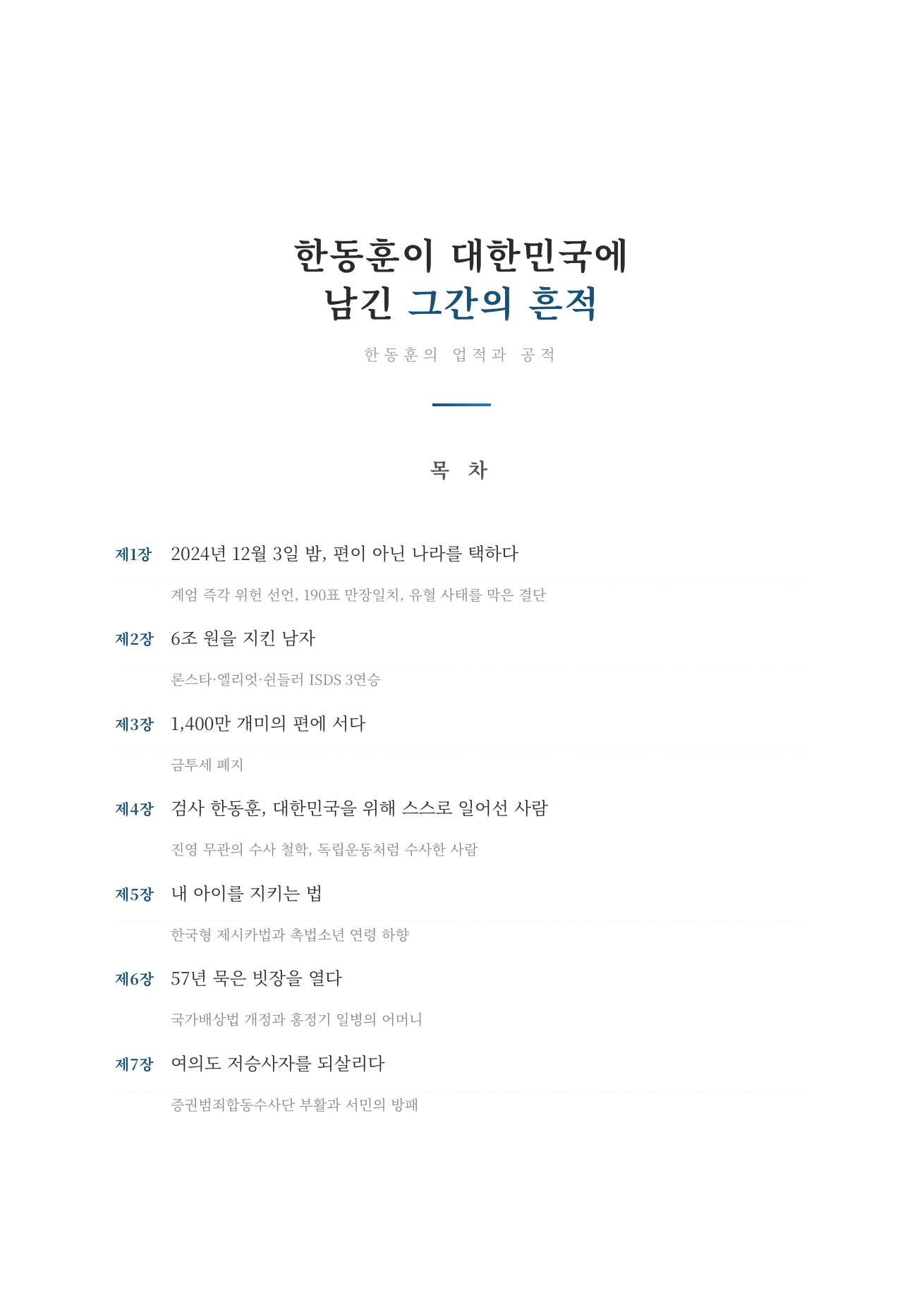
Han Dong-hoon, Busan Buk-gu Gap: A Record of the 100 Days Before and After the Election (Mar. 26-Jul. 3, 2026)
Kim Kyung-jin
Table of Contents and 13 sections
From March 26 to July 3, 2026, this record follows the spring after expulsion, the Busan Buk-gu Gap by-election, victory as an independent, and the first bill submitted in the National Assembly.

Table of Contents
Artificial Intelligence and Medicine
Kim Kyung-jin, Attorney at Law
AI in clinical care, hospitals, education, and research
AI in medical imaging, risk prediction, treatment planning, hospital operations, education, and research, with patient safety, privacy, and accountability.



























[AI Library] Chapter 12: Reimagining the Nation's Structure
The Traces Han Dong-hoon Left on South Korea
Chapter 12: Reimagining the Nation's Structure
Kim Kyung-jin
The Traces Han Dong-hoon Left on South Korea
The Immigration Service Establishment, Creation of the International Legal Affairs Division, and Espionage Law Revision
Han Dong-hoon Considers the Immigration Service Establishment and South Korea's National Structure
In May 2022, upon taking office as Minister of Justice, Han Dong-hoon made an unexpected remark in his inaugural address. "I will put in place a system to advance immigration policy at a high level, including consideration of establishing an Immigration Service."
It was the first time a Minister of Justice had raised the subject of immigration in an inaugural address. Typically, a newly appointed Minister of Justice speaks first of prosecutorial reform or establishing legal order. But Han Dong-hoon posed a more fundamental question: whether South Korea as a nation could continue to exist in the future.
The numbers he observed were stark. South Korea's total fertility rate was 0.7 children. It was the lowest figure in the world. According to a report by the Korea Institute for Future Population Research, the working-age population would shrink by 10 million people compared to now within twenty years. The disappearance of 10 million workers would mean factories shutting down, hospitals closing, military strength diminishing, and pension funds running dry. Han Dong-hoon declared unequivocally, "Multifaceted and structural population decline cannot be addressed by policies aimed at recovery of fertility rates alone. The moment for action has already passed."
This did not mean abandoning policies to encourage childbirth. The idea was to continue fertility incentives while filling the gaps that these measures alone could not address through immigration. "There is no advanced nation without an immigration policy. If we miss this window of opportunity, ten years from now we will face blame and regret for failing to act then."
Han Dong-hoon's survey of the world made one thing clear. Australia was accepting immigrants under the banner "Without population growth, we perish." Canada announced a plan to accept over 1.5 million immigrants and adopted an online immigration application system that expedited the issuance of permanent residence permits. Even the United States, through the Brookings Institution, released a report stating that "the development of rational immigration policy is a means of restoring a nation to health." The world's advanced nations were already treating immigration as a matter of national survival. South Korea alone remained idle.
The problem was that immigration-related functions in South Korea were scattered across multiple ministries. Entry and exit was handled by the Ministry of Justice, foreign workers by the Ministry of Employment and Labor, multicultural family support by the Ministry of Gender Equality and Family, and social integration by the Ministry of the Interior and Safety. It was like five doctors treating a single patient without consulting one another. While a Foreign Policy Committee headed by the Prime Minister was supposed to coordinate these matters, it had no budget allocation authority and lacked real power to carry out its role effectively.
Han Dong-hoon set out to change this structure.
The core strategy was to establish an Immigration Service under the Minister of Justice and consolidate immigration affairs scattered across forty-two laws under a single director of immigration. This structure would enable the Immigration Service to assume all immigration-related functions, including entry and exit control and residence management, nationality, refugees, and foreign resident social integration.
Han Dong-hoon particularly emphasized the principle that "flexible immigration requires strict residence management." The point was to open doors, but not to everyone. He said, "Korea is a semiconductor and IT powerhouse, but superior IT talent doesn't come here because of a lack of predictability. We will treat capable and vetted individuals with exceptional consideration." The idea was to open doors quickly for high-skilled workers while maintaining strict order against illegal residence. He also promised a system to exceptionally facilitate residence qualification conversions for skilled foreign workers recommended by companies.
When meeting with the governor of Jeollanam Province, Han Dong-hoon directly raised the crisis of regional depopulation, noting, "Jeollanam Province maintained a population of over two million until 2004, but it has declined to 1.81 million as of last year." They also discussed region-tailored policies including visa-waiver provisions at Muan Airport, securing foreign workers for shipbuilding, and expanding the seasonal foreign worker program. The governor responded, "An Immigration Service is absolutely necessary to implement systematic foreign worker policy."
Han Dong-hoon saw immigration policy as a matter of national importance comparable to land reform. Just as land reform in the 1950s laid the economic foundation for South Korea, his vision was that immigration reform would serve as a pillar supporting the nation's future in an age of demographic cliffs.
Yet this policy did not proceed smoothly.
Immigration Service establishment was actually a policy that the Democratic Party had pledged four years earlier in its general election platform. Yet when Minister of Justice Han Dong-hoon advanced it, the Democratic Party reversed course. It was a typical scene from Yeouido, where the same policy becomes good or bad depending on who advocates it.
In February 2024, an amendment to the Government Organization Act containing the Immigration Service establishment was submitted to the National Assembly. It was a bill that had been coordinated among relevant ministries, centered on the Ministry of Justice, including the Ministry of the Interior and Safety, the Ministry of Employment and Labor, and the Ministry of Gender Equality and Family. Yet the ruling party, the People Power Party, was passive, and the major opposition Democratic Party was indifferent. After Han Dong-hoon left the Ministry of Justice and entered politics, and following the ruling party's decisive defeat in the general election, the Immigration Service bill drifted without even passing a standing committee of the National Assembly.
An editorial assessment stated: "Immigration reform that relied solely on the individual capacity of Han Dong-hoon amid ministerial silos and political indifference was a predictable limitation. No one takes responsibility, and there is no ministry to follow up. If things end this way, we lose another five years, and that burden will simply transfer to future generations."
Han Dong-hoon's push for the Immigration Service was not simply about admitting more foreigners. It was about reconsidering the structure of South Korea itself. In a nation where children are not being born, where workers are disappearing, where regions are emptying out,how can this nation continue to the next generation? The question posed by this former prosecutor turned Minister of Justice transcended the scope of legal administration and touched upon national design.
The Immigration Service has not yet been established. Yet the fact that local governments such as Gyeonggi Province, Gyeongbuk Province, and North and South Chungcheong Province are competing to attract its location shows that the question Han Dong-hoon raised remains alive. Facing the time bomb of demographic decline, someone must inevitably raise this issue again. Han Dong-hoon was the first to do so.
The Espionage Law Han Dong-hoon Changed: A Revision After 73 Years and Its Full Account
1 The Gap in an Outdated Law
Article 98 of South Korea's Criminal Code was created in 1953, shortly after the Korean War. The essence of the statute reads as follows.
"A person who commits espionage for an enemy nation or aids such espionage shall be punished by death, life imprisonment, or imprisonment of seven years or more."
Here, "enemy nation" refers, according to Supreme Court precedent, only to North Korea. It is a law written for a time seventy years ago when North Korea alone was the threat.
The problem is that the world has changed. There are people passing semiconductor design blueprints to Chinese companies. There are people collecting military intelligence for Russia. There are people secretly photographing American aircraft carriers and posting them on foreign social media. Yet these people cannot be charged with espionage. This is because the "enemy nation" specified in law refers only to North Korea.
Of course, it was not entirely impossible to pursue punishment under other laws. One could invoke the Military Secrets Protection Act, the Industrial Technology Protection Act, the Civil Service Act, and others. But the statutory penalty under the Industrial Technology Protection Act was imprisonment of fifteen years or less, far lighter than espionage, which could carry the death penalty. The situation required treating a person who sold the nation's most confidential secrets to a foreign power not as a "spy" but merely as someone guilty of unauthorized disclosure.
2 A Spy Yet No Espionage Charge: The National Intelligence Service Secrets Leak Case
There is an incident that exposed this legal gap most starkly.
In July 2024, it was revealed that a military civilian employee, Mr. A, from the Defense Intelligence Command had handed over classified military secrets,including the real names and personal details of "black operatives" conducting covert operations overseas and information about front companies,to Chinese intelligence officers. Mr. A was recruited by individuals presumed to be Chinese intelligence operatives at Yanji Airport in China in 2017. Over the following seven years, he systematically leaked classified information and received approximately 160 million won into shell accounts in return.
By any measure, this was espionage. Yet the military prosecutor applied not espionage charges but a general offense of betraying the state against Mr. A. The reasoning was that the leaked classified information went to Chinese intelligence,not to North Korea, the "enemy nation."
That same year, an incident occurred in which a Chinese exchange student photographed an American aircraft carrier docked at Busan Naval Base and the Suwon Air Force Base without authorization, then posted them on Chinese social media. This too could not be prosecuted as espionage.
In short, the situation was this: pass military secrets to North Korea and you are a spy; pass them to China and you are not. It was a structure utterly incomprehensible by any reasonable standard.
3 Han Dong-hoon Speaks Up First
Among high-profile politicians, Han Dong-hoon was the first to actively raise and publicize the issue of expanding espionage law.
Han Dong-hoon raised this issue beginning when he was Minister of Justice. Even during his tenure as Minister and later as interim chair of the People Power Party, he demonstrated strong commitment to revising the law, and he emphasized that it should be prioritized for passage if the People Power Party won the general election.
After being elected party leader in July 2024, he elevated espionage law revision to official party position. When the Defense Intelligence Command secrets leak case broke, Han Dong-hoon posted on social media: "Chinese nationals and others leaked classified files of Republic of Korea intelligence operatives. Absurdly, our country cannot prosecute them for espionage. Our espionage law targets only North Korea, which we designate as an enemy nation."
In August, speaking at a legislative forum held in the National Assembly, he said: "No country in the world limits espionage prosecution to a single enemy nation. We must change 'enemy nation' to 'foreign country' in the espionage statute."
Han Dong-hoon's argument can be summarized in three points.
First, espionage is not solely a North Korean problem. If spies from any country,China, Russia, or elsewhere,target our state secrets, they must be treated as spies. Second, other nations already do this. The United States has expanded application of the Foreign Agents Registration Act (FARA); Britain adopted a National Security Act in 2023; and China revised its espionage law in 2023 to broaden the scope of penalties. Third, this is not simply about intensifying punishment but about protecting national interests and the safety of the people. Han Dong-hoon defined this as "not a matter of expanding penal statutes but a question of national interests and the people, and a philosophical matter concerning how we understand our position within the global order."
4 Opposition and Ruling Party Debate and the Long Legislative Process
How did the opposition respond to Han Dong-hoon's argument?
There was broad consensus between the ruling and opposition parties on the direction of broadening the scope of espionage charges. The Democratic Party also put forward amendments through lawmakers including Jang Gyeong-tae, Kang Yu-jeong, Park Sun-won, and Wi Seong-rak. However, disagreement emerged over specific details.
The opposition's concerns were primarily twofold. First, there was worry that the scope of "state secrets" as defined in law was excessively broad. The Supreme Court precedent held that "even minor matters, if disclosed, could be deemed state secrets if there is manifest risk of benefiting a foreign nation and harming the Republic of Korea," raising concern that ordinary citizens engaged in exchanges with foreigners could become subjects of espionage investigations. Second, there was concern that the scope of domestic surveillance by the National Intelligence Service could expand again.
The legislative process was fraught with obstacles. While it passed the subcommittee of the National Assembly's Judiciary Committee on November 13, 2024, the Democratic Party subsequently did not attend the full committee meeting, citing the need for public hearings, which delayed proceedings. Then, with the emergency martial law incident breaking out on December 3, all legislative discussions came to a standstill.
In November 2025, Justice Minister Jeong Seong-ho reaffirmed the intention to amend the law, reopening discussions. On December 3, 2025, the amendments to the espionage statute passed in the full Judiciary Committee meeting. The fact that the amendments were even brought to the full committee as an agenda item was unprecedented in constitutional history.
5 First Revision in 73 Years, February 26, 2026
On February 26, 2026, amendments to the Criminal Code expanding the scope of espionage charges passed the National Assembly plenary session. It was the first revision since the Criminal Code was enacted in 1953, a gap of 73 years.
In the plenary vote, of the 170 members present, 163 voted in favor, 3 opposed, and 4 abstained. The People Power Party did not participate in the vote itself, citing opposition to the crime of legal distortion, which was bundled with the same bill.
The core of the amendments is as follows. The existing provision punishing those who engaged in espionage on behalf of an enemy state was made more specific and its scope of application expanded. The new provision states that anyone who detects, collects, discloses, transfers, or intermediates state secrets on behalf of a foreign country or equivalent entity under orders, instigation, or other direction from such foreign entity, or who abets such acts, shall be punished by imprisonment of not less than three years.
Espionage on behalf of an enemy state remains punishable by death, life imprisonment, or imprisonment of seven years or longer, as before. Espionage on behalf of a foreign country is punishable by imprisonment of not less than three years. The difference in sentencing distinguishes between "enemy state" and "foreign country," enabling the disclosure of secrets on behalf of a foreign country to be punished under the serious designation of espionage.
With this, espionage charges can now be applied not only to disclosures made on behalf of North Korea but also to those made on behalf of any foreign nation involving state secrets or advanced technology. Industrial espionage linked to foreign corporations or overseas research organizations has also been included as a subject of punishment.
6 The Significance Han Dong-hoon Held in This Matter
The revision to the espionage statute was not accomplished through Han Dong-hoon's efforts alone. Lawmakers from both ruling and opposition parties submitted dozens of amendment proposals, the Ministry of Justice and National Intelligence Service engaged in repeated discussions, and more than 50,000 people signed a national petition.
Yet it was Han Dong-hoon who brought this matter to the center of public discourse. He first championed the revision during his tenure as Justice Minister, emphasized it again while serving as chair of the emergency response committee, and pushed it as party policy upon becoming party leader. He was also the one who most quickly identified the true nature of the shocking incident of military information service secret disclosure.
From Justice Minister to party leader, he never once set aside this issue with each change in position. This is an example of a politician with a prosecution background identifying a gap in the law and investing political resources to fill that gap.
The revised law will go through promulgation procedures and be implemented six months later. A fence that had stood for 73 years was finally being rebuilt.
Han Dong-hoon and the Establishment of the International Legal Affairs Bureau: Creating an Organization to Guard the Nation's Treasury
1 Why This Organization Was Needed
There are cases where foreign investors sue the Republic of Korea government seeking damages in large amounts. This is called ISDS (Investor-State Dispute Settlement). Put simply, it is when a foreign company sues before an international arbitration body, claiming it suffered losses in its investment due to the Korean government.
As of July 2023, a total of 10 ISDS cases had been filed against the Republic of Korea government. Among them, the largest cases were Lone Star (approximately 6 trillion won) and Elliott (approximately 770 billion won).
The problem was that there was no dedicated organization within the Ministry of Justice to handle such international disputes. Each time a lawsuit was filed, cases were entrusted to foreign law firms, with enormous fees paid, repeating this costly structure. Han Dong-hoon pinpointed the problem in this system precisely. "The issue of high costs in ISDS cases stems from insufficient domestic capacity to respond, which is why we inevitably end up relying mainly on foreign law firms."
He has also expressed this problem in a more direct metaphor. "As arbitration-related law firms and business have grown enormous, problem-raising has become widespread globally. Essentially, it is like how if you play pool long enough, only the pool hall owner makes money."
Whether winning or losing the lawsuits, hundreds of billions of won in attorney fees flow to foreign law firms. Han Dong-hoon resolved to change this structure fundamentally.
2 What Does the International Legal Affairs Bureau Do?
On July 26, 2023, the Ministry of Justice (headed by Justice Minister Han Dong-hoon) formally announced plans to establish the International Legal Affairs Bureau while publicizing the legislative notice for the partial amendments to the enforcement rules for the organizational structure of the Ministry of Justice and its affiliated agencies.
Under the International Legal Affairs Bureau, three divisions were established.
First is the International Legal Policy Division. It handles the opening of the legal services market, participation in negotiations for concluding treaties and other international agreements, and provision of related legal advice. When entering into new investment agreements with foreign countries, it is responsible for reviewing in advance whether there are provisions that could later become a source of dispute.
Second is the International Legal Support Division. It handles review work in civil and commercial matters for central administrative agencies including the President and Prime Minister, and addresses matters related to ISDS prevention. It plays the role of preemptively reviewing government policies from a legal standpoint to ensure they do not become grounds for foreign investors to file ISDS claims.
Third is the International Investment Disputes Division. It oversees ISDS response and operational matters. It is the frontline unit that directly responds to lawsuits already filed.
The director of the International Legal Affairs Bureau is held by a prosecutor or senior civil servant, with a total of 8 personnel deployed. By numbers alone, it is a small organization. However, these 8 people serve as the command center overseeing international lawsuits valued in the trillions of won.
Han Dong-hoon explained the significance of this organization as follows: "As we accumulate ISDS experience, we will be able to respond adequately while advancing national interest and reducing costs." It was a declaration to move away from dependence on foreign law firms and build the Republic of Korea's own capacity to handle international disputes.
3 Background to the Establishment: Lone Star and Elliott
It is important to note the timing of the establishment of the International Legal Affairs Bureau. It was July 2023.
Just ten days earlier, on July 18, 2023, Han Dong-hoon had announced follow-up measures regarding the Elliott ISDS ruling. It was a lawsuit Elliott had filed claiming it suffered damages due to undue intervention by the Korean government in the Samsung C&T-Samsung Life Insurance merger process. The Lone Star ISDS case had already resulted in an arbitral tribunal's award of approximately 300 billion won in damages in August 2022, and Han Dong-hoon had just filed a case to annul this ruling.
In establishing the International Legal Affairs Bureau, the Ministry of Justice stated that "major cases such as the Lone Star and Elliott ISDS rulings were successively highlighted as issues," and announced it would "substantially strengthen the response system."
Combined, the amounts from the two ISDS cases totaled close to 7 trillion won. This money came from taxpayer funds. While directly overseeing these lawsuits, Han Dong-hoon reached the conclusion that merely responding to each lawsuit was insufficient. Rather than hastily hiring foreign law firms after disputes erupted, a permanent organization was needed that could prevent disputes in peacetime and respond immediately when they arose.
4 The International Legal Affairs Bureau's First Achievement: Victory in the Lone Star Case
The first director to take office after the International Legal Affairs Bureau was established was Director Jung Hong-sik. He was an expert in international law and international arbitration.
In December 2023, Han Dong-hoon resigned as Justice Minister upon accepting the position of chair of the emergency response committee. Even after he left, the International Legal Affairs Bureau continued to operate. Through the final hearing in the Lone Star ISDS annulment case, the International Legal Affairs Bureau under Director Jung Hong-sik oversaw the proceedings.
On November 18, 2025, the Annulment Committee of the International Centre for Settlement of Investment Disputes (ICSID) issued an order annulling the entire approximately 300 billion won damages award against Lone Star. In reporting the victory, Justice Minister Jeong Seong-ho acknowledged "the tremendous effort of Director Jung Hong-sik," describing him as a "highly capable expert in international law and international arbitration."
In the organization Han Dong-hoon created, the expert Han Dong-hoon had selected concluded the lawsuit Han Dong-hoon had filed. Though the minister changed and the administration changed, the organization continued to operate. It was the moment when Han Dong-hoon's vision of safeguarding national interest through systems rather than relying on individual capacity was proven in reality.
5 A System Created by One Person's Decision
The establishment of the International Legal Affairs Bureau was not a dramatic event. It was merely an administrative decision to create an 8-person organization. It was not something that made headlines in the news.
Yet the funds this small organization preserved reached trillions of won. In the Lone Star ISDS case alone, an award of approximately 400 billion won including interest was completely overturned, and in the earlier Elliott ISDS case, the government's defense arguments were substantially accepted. Adding the Schindler ISDS complete victory confirmed in March 2026 (dismissing claims of approximately 320 billion won), the total amount of cases involving the International Legal Affairs Bureau is difficult to estimate.
Han Dong-hoon, as a prosecutor, directly investigated Lone Star's stock price manipulation and brought a guilty verdict. As Minister of Justice, he used that criminal conviction as a central weapon in ISDS defense strategy. And taking it a step further, he created an organization to ensure this fight could continue even after his departure.
To investigate, prosecute, obtain a guilty verdict, convert that judgment into a shield for international litigation, and establish an organization to wield that shield permanently. It is rare for a single case to form a single narrative over twenty years. That was precisely Han Dong-hoon's role in the Lone Star case.
Kim Kyung-jin
Attorney · Former Member of the National Assembly · AI Policy Researcher
© 2026 Kim Kyung-jin. All rights reserved.