
Table of Contents
Artificial Intelligence and Medicine
Kim Kyung-jin, Attorney at Law
AI in clinical care, hospitals, education, and research
AI in medical imaging, risk prediction, treatment planning, hospital operations, education, and research, with patient safety, privacy, and accountability.



































[AI Library] Chapter 17: The Second Challenge for the Presidency — The Choice of Party Members, The Rejection of La...
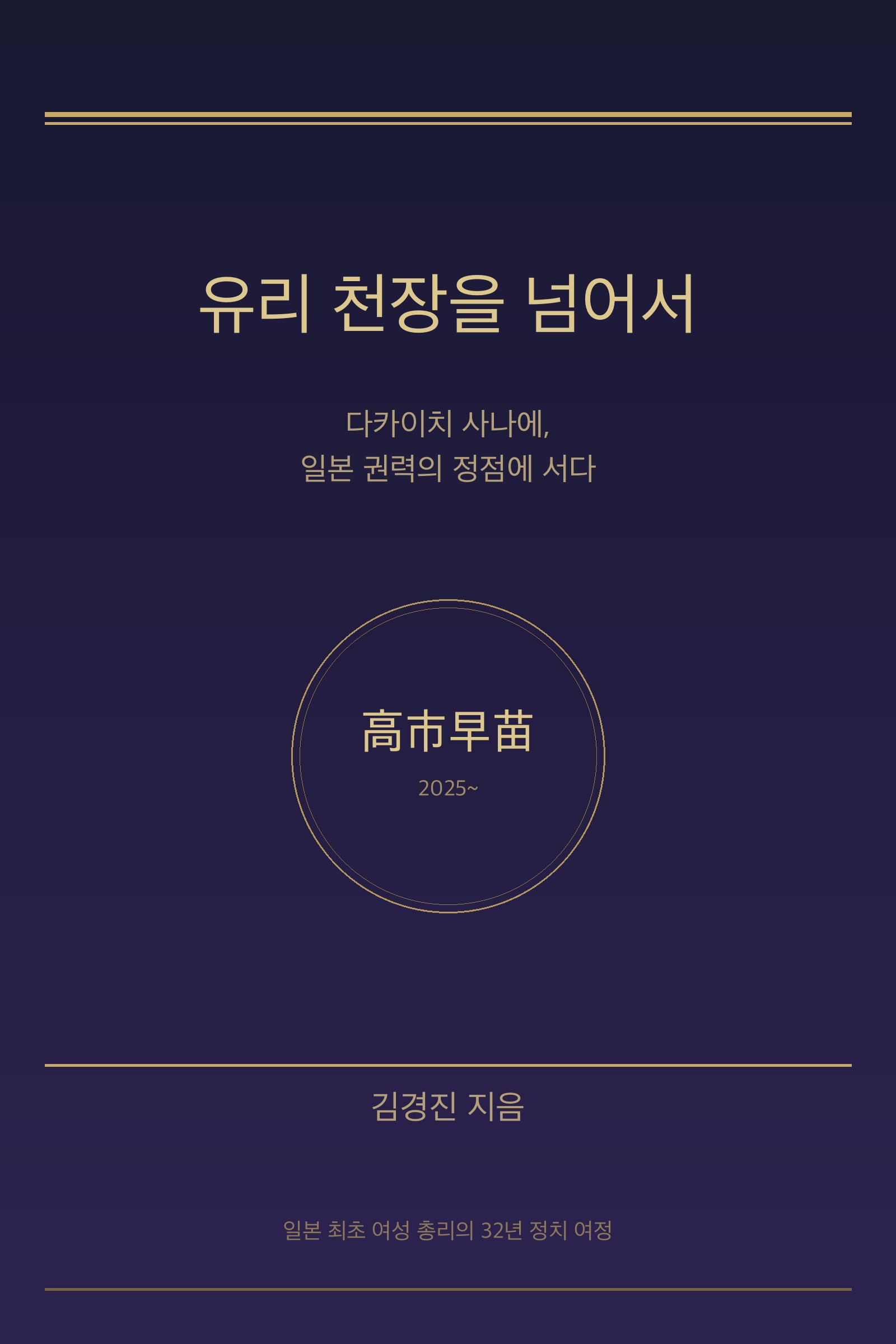
Beyond the Glass Ceiling
Part 4: The Challenge — Three Presidential Elections
Chapter 17: The Second Challenge for the Presidency — The Choice of Party Members, The Rejection of Lawmakers
Kim Kyung-jin
The afternoon of September 27, 2024. The auditorium of the LDP headquarters in Tokyo.
The air was thick with bated breath. A heavy silence filled the auditorium, packed with hundreds of lawmakers and party officials. On the large screen, numbers appeared one by one.
Runoff results: Shigeru Ishiba, 215 votes. Sanae Takaichi, 194 votes.
It was a difference of 21 votes.
Standing on the podium, Takaichi was smiling. She turned toward Ishiba, clapping her hands. Only those close to her could see what that smile was hiding. Reporters on the scene noted that her eyes were red. Yet, she did not waver.
In the first round of voting, she was in first place. In an election with a record-high nine candidates, Takaichi reached the runoff for the first time. And then, she lost in the runoff.
That is the story of the 2024 LDP presidential election.
It all began on August 14.
It was the day Prime Minister Fumio Kishida announced he would not run for reelection as party president. The reason was clear. The scandal involving kickbacks from factional fundraising parties, which had erupted at the end of 2023, had devastated the LDP. Several faction members were disciplined for violating political fund laws. The Kishida cabinet's approval ratings were hovering at record lows. Kishida chose to withdraw, and that announcement ignited a new fire of competition within the LDP.
The seat of the LDP presidency was vacant once again.
Sanae Takaichi announced her candidacy on September 9. Her slogan was "Japan Once Again, to the Top of the World (日本をもう一度、世界のてっぺんに)." It was her second challenge, exactly three years after her defeat in the 2021 presidential election.
But this time, the conditions were completely different.
Shinzo Abe was gone.
Shinzo Abe, who had been the core of Takaichi's camp in the 2021 election, had fallen to a bullet during a campaign speech in July 2022. He had passed away. The Abe faction, the Seiwa Policy Research Council—the largest in the LDP—took a direct hit from the factional fundraising scandal and officially dissolved in 2024. The party network that Abe had woven together over decades had scattered.
Takaichi was alone. More accurately, she had to stand on her own strength.
That was the starting point of her 2024 challenge.
A record number. Nine candidates stepped forward.
Sanae Takaichi. Shigeru Ishiba (石破茂). Shinjiro Koizumi (小泉進次郎). Takayuki Kobayashi (小林鷹之). Yoshimasa Hayashi (林芳正). Toshimitsu Motegi (茂木敏充). Yoko Kamikawa (上川陽子). Taro Kono (河野太郎). Katsunobu Kato (加藤勝信).
The fact that nine people ran simultaneously was a signal that the factional order had collapsed. In the past, LDP presidential elections were often effectively decided through collusion between factions. 2024 was different. Factions had officially dissolved, and individual lawmakers began to move based on their own judgment. The result was the number nine.
Early attention was focused on three individuals.
Shinjiro Koizumi. Son of former Prime Minister Junichiro Koizumi. At 43, he boasted overwhelming popularity among the general public and rank-and-file party members. He was young, had a good image, and spoke of reform. In some polls, he recorded support close to a majority. However, question marks remained regarding his policy depth and experience.
Shigeru Ishiba. He had held major cabinet posts such as Director-General of the Defense Agency and Minister of Agriculture, Forestry, and Fisheries. He was known as a policy expert in defense and security. Although he had consistently received support in party member polls, he had knelt in defeat every time across five presidential bids. He had a strong image as a party outsider.
And Sanae Takaichi. Through her 2021 challenge, she had already become a symbol of the party's conservative wing, and she entered with a track record of two years as Minister in Charge of Economic Security. She had concrete achievements in legislative work regarding semiconductors, artificial intelligence, energy, and defense.
Takaichi's platform consisted of three pillars: an economic vision called "Sanaenomics (サナエノミクス)," crisis management investment focused on increasing defense spending and economic security, and constitutional revision. These three were an inheritance of the Abe administration's legacy, redefined in her own words.
She made it clear that the Bank of Japan should be cautious about rapid interest rate hikes. Opposing the fiscal austerity led by the Ministry of Finance, she advocated for proactive fiscal spending. She publicly declared that she would continue visiting the Yasukuni Shrine even after becoming Prime Minister.
On September 27, the first-round voting results were announced.
Takaichi 181, Ishiba 154, Koizumi 136, Hayashi 65, Kobayashi 60, Motegi 47, Kamikawa 40, Kono 30, Kato 22.
1st Place. Sanae Takaichi.
A strange tension flowed through the auditorium. Analyzing the numbers revealed the story.
Among party members, Takaichi received 109 votes and Ishiba 108. She led by a single vote. Among lawmakers, Takaichi received 72 votes and Ishiba 46. Ishiba's lawmaker votes were fewer than expected.
In the 2021 election, Takaichi's weakness was support from rank-and-file party members. Back then, she fought only with lawmaker votes, while party members chose Shinjiro Koizumi and Shigeru Ishiba. Three years later, that weakness had been addressed. For the first time, party members were also choosing Takaichi.
No candidate won a majority. The election proceeded to a runoff between first-place Takaichi and second-place Ishiba.
She had reached the runoff for the first time.
The runoff voting structure is completely different.
In the first round, the votes of approximately 1.1 million party members nationwide and the votes of Diet members are combined. However, the runoff is contested with only the 368 votes of Diet members and 47 votes from representatives of each prefecture (都道府県), totaling 415 votes. The voices of the nationwide party members disappear.
And just before the runoff, a decisive movement occurred behind the scenes.
The forces of former Prime Ministers Fumio Kishida and Yoshihide Suga coalesced in support of Ishiba. Kishida-aligned lawmakers, Suga-aligned lawmakers, and a portion of Vice President Taro Aso (麻生太郎)'s forces joined. A consensus that "Takaichi must be stopped" formed in an instant.
Why did they seek to stop Takaichi?
The reasons existed on multiple levels.
First was the diplomatic risk. Her declaration that she would continue visiting the Yasukuni Shrine even after becoming Prime Minister would freeze relations with China and South Korea once again. For moderate conservative lawmakers who prioritize managing the US-Japan alliance, this was a concern that could not be ignored.
Second was anxiety over economic policy. Takaichi's stance on putting the brakes on the Bank of Japan's interest rate hikes raised alarms about threatening the independence of monetary policy. Her advocacy for proactive fiscal expansion would clash head-on with fiscal hawks, including those at the Ministry of Finance.
Third, there was a more fundamental reason. There was a concern that Takaichi's hardline conservative path would pull the entire LDP to the right. In particular, a realistic sense of crisis spread among moderate conservative lawmakers that floating voters and unaffiliated urban voters would turn their backs on the LDP.
A so-called "Anti-Takaichi Alliance" was formed. This formation took place within the few hours just before the runoff.
Just before the runoff, Takaichi gave a speech. Amid the fervor of her supporters, her speech exceeded the allotted time. Analyses emerged that the atmosphere, which made victory seem imminent, caused her to lose restraint in her speech. It was said that at that moment, the minds of some wavering lawmakers hardened.
The results were in.
Ishiba 215 votes. Takaichi 194 votes.
Looking at Diet member votes alone, it was 189 for Ishiba versus 173 for Takaichi. Ishiba also led in the prefectural representative votes, 26 to 21.
Ishiba, who had only 46 Diet member votes in the first round, surged to 189 in the runoff. 143 votes that had gone to other candidates in the first round flocked to Ishiba in the runoff. Takaichi's votes grew from 72 in the first round to 173. An increase of 101 votes. However, far more flocked to Ishiba's side.
The numbers say it all.
The party members wanted Takaichi. The lawmakers chose Ishiba. That split was the difference of 21 votes.
This is the structure of the LDP presidential election in Japan. No matter how strong the sentiment of party members nationwide may be, lawmakers can overturn it in the runoff. That a candidate who took first place by reflecting the will of party members in the first round loses in the runoff is a paradox of LDP democracy.
Shigeru Ishiba became the 28th President of the LDP. It was a position won after five attempts.
For Takaichi, it was two challenges and two defeats.
Immediately after the presidential election, Ishiba offered Takaichi the position of Chairperson of the LDP General Council. It was a top-level party leadership post. However, Takaichi refused. She also expressed her intention not to accept any cabinet posts. She chose a path of not participating in the Ishiba cabinet.
This choice can be interpreted from various angles.
It could have been pride, an inability to accept entering the cabinet in a way that made her Ishiba's subordinate after losing the election. Or it could have been a cold-headed assessment of reality, believing that the Ishiba cabinet would not last long. It might also have been a strategic calculation that she could only draw a line against the Ishiba cabinet's limitations when the next opportunity arrived by maintaining an independent position outside the cabinet.
Ultimately, that judgment proved correct.
The Ishiba cabinet held a general election just one month after its launch. In the October 2024 general election, the LDP lost a significant number of seats. It was a shocking result where the ruling coalition with Komeito lost its majority. Prime Minister Ishiba's approval ratings were low from the start. The LDP's centripetal force wavered following the dissolution of the factions.
Takaichi watched from outside the cabinet, maintaining her own path.
What did Takaichi gain and lose in the 2024 presidential election?
Gains: Reaching the runoff for the first time. First place in party member votes. First place in the overall first round. It was proven that she could gather this many votes through her own strength even without Abe or the support of factions. Her specialized field of economic security led to persuasive support. Party members chose Takaichi for the first time.
Losses: Defeat in the runoff. Lawmakers blocked Takaichi.
Structural tasks were clearly revealed. The gap between party members and lawmakers. The reasons why lawmakers do not support Takaichi. Whether it is a matter of ideology, the remnants of factional politics, or a realistic judgment regarding diplomatic risk. It was likely all three.
The 2024 election clearly showed that as long as that gap remains unbridged, the presidency will not come.
However, history reveals its meaning only when read from the end.
Without the 2021 defeat, there would have been no post as Minister of Economic Security in 2022. Without that post, there would have been no first-place finish in the 2024 party member vote. Each defeat became a stepping stone.
In a broader context, the 2024 presidential election was not merely a contest to choose a president. It was a moment where the internal dynamics of the LDP, changed after the fundraising scandal, were first expressed in the form of a presidential election. Although factions were officially dissolved, their personal relationships and inertia do not vanish overnight. Within that inertia, Takaichi had to build a new alliance through her own strength.
Reaching the runoff in first place among nine candidates was the achievement of that work.
The Ishiba cabinet was launched. However, voices discussing "post-Ishiba" began to emerge from within the party at an early stage. In the center of that discussion, a name appeared once again: Sanae Takaichi.
Two challenges, two defeats. There were things that those two times had built up. The support of party members, expertise in economic security, and the clarity of maintaining an independent path regardless of factions. These things did not disappear.
The Ishiba cabinet's approval ratings showed little sign of rising. The state of a minority ruling coalition continued. Impatience grew within the LDP. And then came 2025.
A third opportunity was approaching faster than expected.
References - 2024 Japan LDP Presidential Election Wikipedia: https://ja.wikipedia.org/wiki/2024%E5%B9%B4%E8%87%AA%E7%94%B1%E6%B0%91%E4%B8%BB%E5%85%9A%E7%B7%8F%E8%A3%81%E9%81%B8%E6%8C%99 - Nikkei — Details of 1st round and runoff results for Shigeru Ishiba as new LDP President: https://www.nikkei.com/article/DGXZQOUA14BMT0U4A810C2000000/ - Tokyo Shimbun — Shigeru Ishiba becomes new LDP President, defeating Sanae Takaichi in runoff: https://www.tokyo-np.co.jp/article/356859 - Nikkei — LDP Presidential Election, Sanae Takaichi takes 1st place in party member votes: https://www.nikkei.com/article/DGXZQOUA274600X20C24A9000000/ - Daily Shincho — The decisive reason Takaichi fell from the presidency: https://www.dailyshincho.jp/article/2024/10010550/