
Table of Contents
Han Dong-hoon, Busan Buk-gu Gap: A Record of the 100 Days Before and After the Election (Mar. 26-Jul. 3, 2026)
Kim Kyung-jin
Table of Contents and 13 sections
From March 26 to July 3, 2026, this record follows the spring after expulsion, the Busan Buk-gu Gap by-election, victory as an independent, and the first bill submitted in the National Assembly.
Table of Contents
Artificial Intelligence and Medicine
Kim Kyung-jin, Attorney at Law
AI in clinical care, hospitals, education, and research
AI in medical imaging, risk prediction, treatment planning, hospital operations, education, and research, with patient safety, privacy, and accountability.





































[AI Library] 2 The Prodigy at the Chessboard
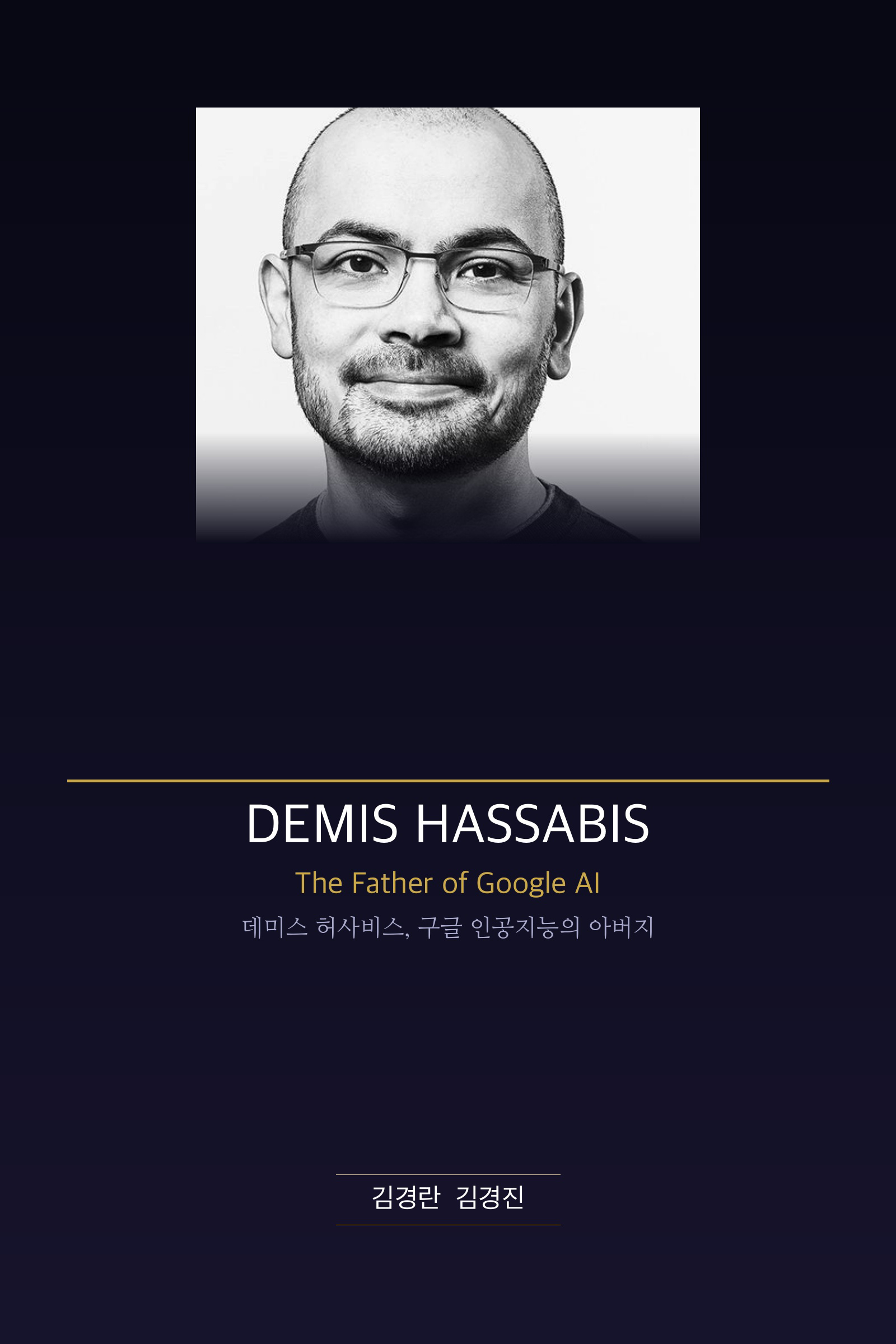
Demis Hassabis, Father of Google's Artificial Intelligence
Part 1. Thinking About Thinking as a Child
2 The Prodigy at the Chessboard
Kim Kyung-ran, Kim Kyung-jin
He started chess at age four and reached Master rating (Elo 2300) by thirteen. He learned by watching his father and uncle play. In 1980, an ordinary evening was unfolding in the Hassabis household in North London. His father, Costas, and his uncle had set up a chessboard on the living room table and were moving pieces. Neither was a professional player; they were amateurs enjoying a leisure pastime.
Four-year-old Demis was watching. The child's eyes took in the quiet battle playing out on the sixty-four squares of the black-and-white grid. Demis said he wanted to play too.
His father and uncle found the little boy's curiosity endearing, nothing more. They figured that once they showed him the names of the pieces and how they moved, he would lose interest quickly. They were wrong.
Just two weeks after learning the rules, the four-year-old began beating his father. His uncle fell next. Hassabis later recalled:
'Chess felt like something I already knew how to do. I learned at four, and I don't even remember learning it.' Costas sensed that something extraordinary lived inside his son.
This Greek Cypriot father, who had run a toy shop, written songs, and drifted between teaching jobs, always chasing the next challenge, took his son straight to the local chess club. 'That's where it all started,' Hassabis says matter-of-factly. The chess career that began there unfolded at startling speed.
At five he appeared on the national stage. At six he lifted the trophy at the London Under-8 championship. The adults at the chess club were astonished by the way the small boy read a position. He was not merely calculating the next move.
He sensed the flow of the entire board, read his opponent's intentions, and visualized situations several moves ahead in a way no other child his age could. He always played against older opponents, and he grew rapidly inside that challenge. His concentration at the chessboard reshaped his daily life.
After-school hours, weekends, and holidays were all consumed by chess. He frequently missed school to compete in overseas tournaments. His parents were sensitive about his results. They celebrated his wins and took his mistakes or losses
hard. For young Hassabis, chess was pure play and, at the same time, a heavy undertaking freighted with family expectations. What had started by chance at his father's and uncle's chessboard had already become the axis around which the boy's entire life turned.
Without that living-room chessboard, there would have been no DeepMind. No AlphaGo, no AlphaFold. The moment a four-year-old said to his father, 'I want to play too,' was the first move in a long journey that would lead, forty years later, to a Nobel Prize in Chemistry.
Captain of the England Junior Team. At nine he became captain of the England Under-11 team. At an age when most children are still absorbing basic opening theory, Hassabis held a position representing his country. He continued to captain the England junior squad after that.
In his own words, 'I was always captain of the national team for my age group, and I mostly played against much older players.' The junior team captaincy is not awarded on chess skill alone. It includes leading the team at tournament venues, discussing strategic lineup decisions, and helping stabilize teammates psychologically. That a child barely into his teens performed this role tells us that, beyond his calculating power over the board, Hassabis was already developing the ability to read people and manage situations.
The leadership he would later exercise at DeepMind, directing more than two thousand researchers, had its first rehearsal in the junior chess team captain's chair. At thirteen, Hassabis reached an Elo rating of 2300. The Elo rating is the international standard system for quantifying a chess player's strength.
A typical amateur club player sits between 1200 and 1400. At 1800 you are recognized as a formidable player. Cross 2000 and you earn the title 'Candidate Master'; above 2200 you officially hold 'Master' status. For a thirteen-year-old to reach 2300 meant he had risen to a level that overwhelmed most adult club players.
At that point, Hassabis ranked second in the world among players under fourteen. First place belonged to Hungary's Judit Polgar. Polgar's rating was 2335, thirty-five points above his.
Judit Polgar went on to become the greatest female chess player in history, setting the record as the youngest-ever Grandmaster at fifteen and defeating Garry Kasparov. The fact that the person just above Hassabis when he stood second in the world was a genius of that caliber
paradoxically reveals how extraordinary Hassabis's own talent was. During this period his daily life was completely occupied by chess. Even during school terms he regularly missed classes to compete in international tournaments across Europe. Summer and Christmas holidays were filled entirely with tournament schedules.
The rest of his time went to studying opening theory, analyzing game records, and memorizing endgame patterns. His plan at the time was to become world champion. He also understood that achieving that goal would require devoting his entire life to chess alone.
Yet precisely in this period, an interesting paradox began to grow. The deeper he sank into chess, the more Hassabis sensed that the range of what chess could teach him was narrowing. In its early stages, chess had given him general-purpose thinking skills.
The ability to decompose problems, recognize patterns, and see several moves ahead. But as he entered master-level play, what he needed increasingly became specialized knowledge useful only for chess. The twentieth-move variation of a specific opening, the win-loss theory of a particular endgame position. This knowledge had no application whatsoever in any other field. The number 'world number two' was glorious, but it was also a signpost at a fork in the road.
One path meant staking his life on chess and racing toward world number one. The other meant carrying the thinking skills chess had given him out into the wider world. The thirteen-year-old did not make the choice, but the question was already germinating inside him. The meta-skills chess taught: strategic thinking and pattern recognition. Cultivating the ability to understand complex systems and see moves ahead. Hassabis called chess a 'mental gym.'
A person lifting weights in a gym is not doing it for the weights themselves. The purpose is to build strength, and that strength transfers to every other activity in daily life. Chess played exactly that role for Hassabis. The thinking skills he trained on those sixty-four squares became a tool that cut through his entire life long after he left the board.
The first meta-skill chess taught was the ability to grasp a complex system as a whole. In its starting position, a chessboard holds thirty-two pieces, and the number of possible games is roughly ten to the power of 120. That figure dwarfs the number of atoms in the observable universe (approximately ten to the power of 80). To find the best move inside this vast space of possibilities,
calculating every variation one by one is impossible. Instead, you must read the structure of the entire board. You must sense where force is concentrated, where weaknesses lie, and what your opponent's strategic intent is.
Seeing the forest, not just individual trees. Hassabis trained this ability repeatedly from early childhood. The habit of gauging how a single move would affect the balance of the whole board before making it, the habit of reading the dynamics of an entire system rather than isolated events, became a way of thinking ingrained in his body.
This ability operated in exactly the same way years later when he designed reinforcement-learning algorithms at DeepMind, when he managed an organization of thousands of researchers, and when he took on the biological grand challenge of protein folding. The second meta-skill is pattern recognition. A master-level chess player recognizes specific patterns the instant he sees the arrangement of pieces on the board.
According to the research of cognitive psychologist Adriaan de Groot, a chess master stores between fifty thousand and one hundred thousand patterns in memory. When these patterns activate instantly, the master grasps in seconds what a novice would need ten minutes to analyze. What Hassabis did every day for nine years, from age four to thirteen, was precisely the construction of this pattern library.
Pattern recognition becomes a powerful weapon outside the chessboard as well. Detecting regularities in scientific data, reading market currents in business, classifying player behavior types in game design: all are fundamentally pattern-recognition tasks. Hassabis himself understood this clearly.
'When you play chess at a high level, what you're really honing are meta-skills. Problem solving, imagination, creative thinking, strategic thinking. You can transfer those to other areas like science or business.' The third meta-skill is the ability to plan by looking several moves ahead.
In chess, before making a move you calculate at least three to five moves forward. Masters look ten or more moves ahead. What this requires is not simple arithmetic but conditional reasoning: 'If I play this, my opponent will respond like that, which gives me these options, and among them, which leads to the most advantageous position five moves later?'
This is essentially the task of building and searching a decision tree inside one's head, and it is also the human version of the Monte Carlo Tree Search that DeepMind would later apply in AlphaGo.
Hassabis spent nine years rigorously forging these three meta-skills on the chessboard: systems thinking, pattern recognition, and forward-looking planning. The three correspond precisely to the core components of the artificial intelligence systems he later designed. Deep learning handles pattern recognition; reinforcement learning handles the search for optimal actions within a system; tree-search algorithms handle planning by looking ahead through future possibilities.
The training that a four-year-old boy began at his father's chessboard bore fruit thirty years later as the design principles of the most powerful artificial intelligence in human history. The chessboard was more than a game to Hassabis. It was the first laboratory for understanding intelligence itself.
Age twelve, the Liechtenstein tournament. In the spring of 1989, an international chess open was held in Liechtenstein, a tiny country surrounded by the Alps. Twelve-year-old Demis Hassabis was competing. The tournament hall was packed with hundreds of players.
Chess masters from various countries moved pieces amid tension. Hassabis's opponent was German FIDE Master Carsten Pieper-Emden. The game was long and grueling.
For more than ten hours the two could not leave the board. As the middlegame gave way to the endgame, pieces dwindled, and the game drifted into a complex ending of king and queen versus king, rook, bishop, and knight. Past sixty moves, past seventy, all the way to move seventy-seven. The twelve-year-old's concentration and stamina were reaching their limit.
The decisive moment arrived. Hassabis resigned. Then his opponent stood up and demonstrated something dramatic.
Had Hassabis sacrificed his queen, a stalemate sequence, a draw, was still available to him. His opponent had attempted a cheap trick at the last moment, and the exhausted twelve-year-old had missed it. 'I felt my stomach twist,' Hassabis recalls.
Hassabis left the tournament hall and walked through the fields of Liechtenstein. The Alpine mountains encircled him; beautiful scenery stretched in every direction. During the walk, a thought arose in the twelve-year-old's mind.
In his mind's eye he looked down at the tournament hall, and what he saw was hundreds of brilliant minds moving pieces in order to beat each other. 'That room is filled with astonishingly talented people. And they are using their brains to compete against and defeat one another.
'What if all those brains could be connected into a single system? Could we cure diseases? If that time and energy could be directed somewhere better, couldn't we do more good for the world?' It was a twelve-year-old's intuition. Closer to a conviction than a logical deduction.
It was a fundamental question that burst out in a state of emotional rock-bottom, right after losing an agonizing ten-hour game to a careless blunder. He loved chess, but should it consume his entire life? Was it really the best use for these brilliant minds to spend themselves only on defeating each other? What if this intellectual capacity could be pooled and directed at humanity's real problems? From this moment, Hassabis's change of direction began. He did not quit chess immediately, of course. He continued competing for years afterward, and at Cambridge he played three consecutive years in the Oxbridge match.
But the goal of becoming world champion was quietly set down during that walk in Liechtenstein. A new question took its place: Could the thinking power trained through chess be applied to bigger problems? The mission Hassabis later announced when founding DeepMind, 'Solve intelligence, and then use that to solve everything else,' is precisely that twelve-year-old's intuition translated into adult language.
The regret he felt seeing hundreds of brains locked onto chessboards in that Liechtenstein tournament hall; the wish that their intellectual power could be turned toward challenges like curing cancer or addressing climate change. Twenty years later, this crystallized into the concept of artificial general intelligence (AGI). Instead of hundreds of chess masters, tens of thousands of computers operating under a single learning algorithm to predict protein structures, search for drug candidates, and analyze weather patterns. That was exactly what Hassabis dreamed of. The Liechtenstein walk is the origin point of this biography.
Had the ten-hour defeat not given him that realization, Hassabis might have lived out his days as a brilliant chess Grandmaster. But the twelve-year-old saw beyond the board, and that gaze ultimately reached far enough to change the history of science.
His first computer (the ZX Spectrum 48K) and programming. Developing an Othello AI on the Commodore Amiga. One afternoon in 1984, at a London chess tournament, eight-year-old Demis Hassabis clutched a winner's trophy. In his hands was prize money of two hundred pounds. Any other child his age would have dashed to a toy shop.
But Demis headed for an electronics store. The item he chose there was a small machine with a black body and rainbow stripes: the Sinclair ZX Spectrum 48K. It was an 8-bit home computer released in 1982 by Sir Clive Sinclair.
It had a flat rubber keyboard, a crude design that required connection to the living-room television for a display, and a slow method of loading programs from cassette tapes. On specifications alone it was modest, but the machine's real power lay in its price. A tag of 125 to 175 pounds sparked a revolution, placing computers in ordinary homes across Britain. More than five million units sold, this small box became the seed of the British IT industry and the catalyst that transformed thousands of teenagers into so-called 'Bedroom Coders.'
In the Hassabis household, not a single adult knew anything about computers. Father Costas and mother Angela called themselves 'technophobes,' people thoroughly distant from machines. Having no teacher at home turned out to be a blessing rather than a handicap for the boy.
He had to forge his own path. The boy took his father's hand and headed to Foyles, the large bookshop on Charing Cross Road in London. He sat down in front of the computer-programming shelves and opened a book.
Hassabis later recalled the period: 'I used to go to Foyles with my dad and sit in the programming section learning how to get infinite lives in games. The amazing thing about computers in those days was that the moment you turned them on, you could start programming right away.
I understood instinctively that this machine was a magical tool where I could unleash my creativity.' The ZX Spectrum had a built-in BASIC interpreter, so you could begin coding the instant it powered on. Each key on the keyboard was assigned up to six functions; pressing the 'J' key alone automatically entered the command 'LOAD.'
The boy typed out code printed in magazines, sometimes dozens of lines, sometimes hundreds, character by character, absorbing the grammar of programming through his fingertips.
In Britain at the time, computer magazines like 'Your Sinclair,' 'Crash,' and 'Sinclair User' published source code for games and utilities in every monthly issue. Readers typed the code in and ran it themselves. A single typo would halt the program, and the process of hunting down and fixing errors naturally taught children the fundamentals of logical thinking and debugging.
For Demis this process was not suffering; it was a game. Reading an opponent's moves on the chessboard and tracking a bug through code demanded essentially the same faculty: recognizing patterns and tracing logical pathways. As he grew, his tools evolved with him.
The ZX Spectrum's 48 kilobytes of memory and near-monochrome graphics soon could not contain the boy's ambition. Demis switched to the far more powerful Commodore Amiga. The Amiga was a 16-bit computer with, for its time, spectacular color graphics and stereo sound.
In front of this new machine, Demis posed to himself for the first time the fundamental question that would run through his entire life: 'Can I make a computer think the way I do?' His first experimental subject for finding the answer was the board game Othello.
Hassabis dissected the decision-making process that occurred inside his own head when he played Othello. How did he evaluate which side held the advantage? How did he predict where the opponent would place a stone next? When looking several moves ahead, which branches did he explore first, and which did he prune? He translated this thought process into an algorithm. It was around this time that he taught himself the basics of search techniques such as alpha-beta pruning, which efficiently cuts branches from a game tree.
The finished program played well enough to beat his younger brother. Hassabis later recalled this experience in an Academy of Achievement interview: 'One of the first programs I remember writing was a program that played Reversi, which in Britain we call Othello.
It played pretty well. It could beat my little brother.' Inside that small success lay a vast archetype.
Observing a human thought process, translating it into an algorithm, and making a machine arrive at optimal decisions on its own: this three-step flow shares precisely the same skeleton as the process by which, twenty years later, DeepMind conquered Atari games, surpassed the god of Go, and predicted the structures of proteins. The black box an eight-year-old chess boy bought with two hundred pounds in prize money became the starting line of a forty-year journey that would change the future of humanity. In that era, play and research were one. In the childhood of Demis Hassabis, no boundary existed between play and research.
For most children, games were an escape from school and homework. For Demis, a game was a system to be precisely disassembled and reassembled. When he got hold of a new game, he first enjoyed it, then tore it apart. Why did the on-screen character move that way? What logic governed the scoring system? Why did the difficulty curve bend at that particular point? The computer sitting in the boy's room was not an entertainment device; it was the most sophisticated laboratory in the world.
Britain in the 1980s provided good soil for such a boy to grow. In classrooms and homes supplied with ZX Spectrums and BBC Micros, thousands of teenagers were learning to code. Matthew Smith created 'Manic Miner' at seventeen. David Braben and Ian Bell completed the space exploration game 'Elite' in their university dormitory.
The Oliver Twins gave birth to the 'Dizzy' series from their bedroom. It was the golden age of bedroom programmers. An era in which untrained teenagers wrote code in their bedrooms and sold the results to publishers for pocket money. Demis stood in the middle of that cultural wave.
Yet the boy was gazing at a subtly different place from the other prodigies of his generation. Where most young programmers poured their passion into flashier graphics, faster speeds, and more stimulating gameplay, Demis's interest lay in the behavior of the entities inside games. Why did enemy characters always move in the same pattern? What if a character could observe the player's actions, learn from them, and use a different strategy next time? 'How do you give intelligence to beings in a virtual world?'
The question was excessively large for a boy of roughly ten, but for a child who had explored the depths of human intellect through chess matches, it was a natural next step. When Demis came home, he went straight to the computer.
The hours spent converting experiences accumulated over tens of thousands of chess moves into code. The chess habit of looking three or five moves ahead before making one became the instinct for designing conditional branches and recursive functions in programming. The intuition for calculating the relative value of pieces in an instant became the foundation for building evaluation functions in game AI.
The memory of experiencing the reward of victory and the cost of defeat thousands of times became the decisive groundwork for later understanding the reward systems of reinforcement learning. None of these connections were consciously engineered. The boy wrote code because it was fun, and he analyzed games because it was fun.
A distinctive habit formed in Hassabis during this period: integrative thinking, looking at a single problem from multiple angles simultaneously. While developing games, he observed human psychology.
Why do some games hold a person captive for hours while others bore them within five minutes? While designing artificial intelligence, he grew curious about how his own brain worked. In the moment when a good chess move comes to mind intuitively, which part of the brain activates? A machine tirelessly searches every possible variation, while a human ignores most branches and leaps straight to the crux. Could the strengths of these two worlds be combined? The boy defined himself as 'a child who thinks about thinking.'
He did not yet know the academic term metacognition, but he was already practicing it. His room was buried under programming books and floppy disks, chess game collections and gaming magazines. He spent more time watching data on a screen respond exactly as he intended than playing outdoors.
What might have looked like isolation to some was, for the boy, the happiest state of immersion, fitting puzzle pieces together one by one. The method of exploring the nature of intelligence inside the safe, controlled environment of games became the core philosophy of DeepMind. In 2013, DeepMind's experiment in which an agent was shown only screen pixels of the Atari game 'Breakout' with no rules explained and left to learn on its own; in 2016, AlphaGo Zero becoming the god of Go through self-play alone without human game records; in 2020, AlphaFold solving the fifty-year grand challenge of protein folding.
The archetype of all of these originated in the simple question a boy asked himself while building an Othello AI in a room in North London: 'Can a computer think the way I do?' The room where an eight-year-old chess boy sat before a black box bought with two hundred pounds in prize money was not merely a childhood space. It was the first stage of a forty-year quest to solve intelligence and use it to tackle humanity's hardest problems. The boy who competed in chess tournaments
Kim Kyung-jin
Attorney · Former Member of the National Assembly · AI Policy Researcher
© 2026 Kim Kyung-jin. All rights reserved.