Table of Contents
Artificial Intelligence and Medicine
Kim Kyung-jin, Attorney at Law
AI in clinical care, hospitals, education, and research
AI in medical imaging, risk prediction, treatment planning, hospital operations, education, and research, with patient safety, privacy, and accountability.



























[AI Library] 10 Silicon Valley Courtship and Google
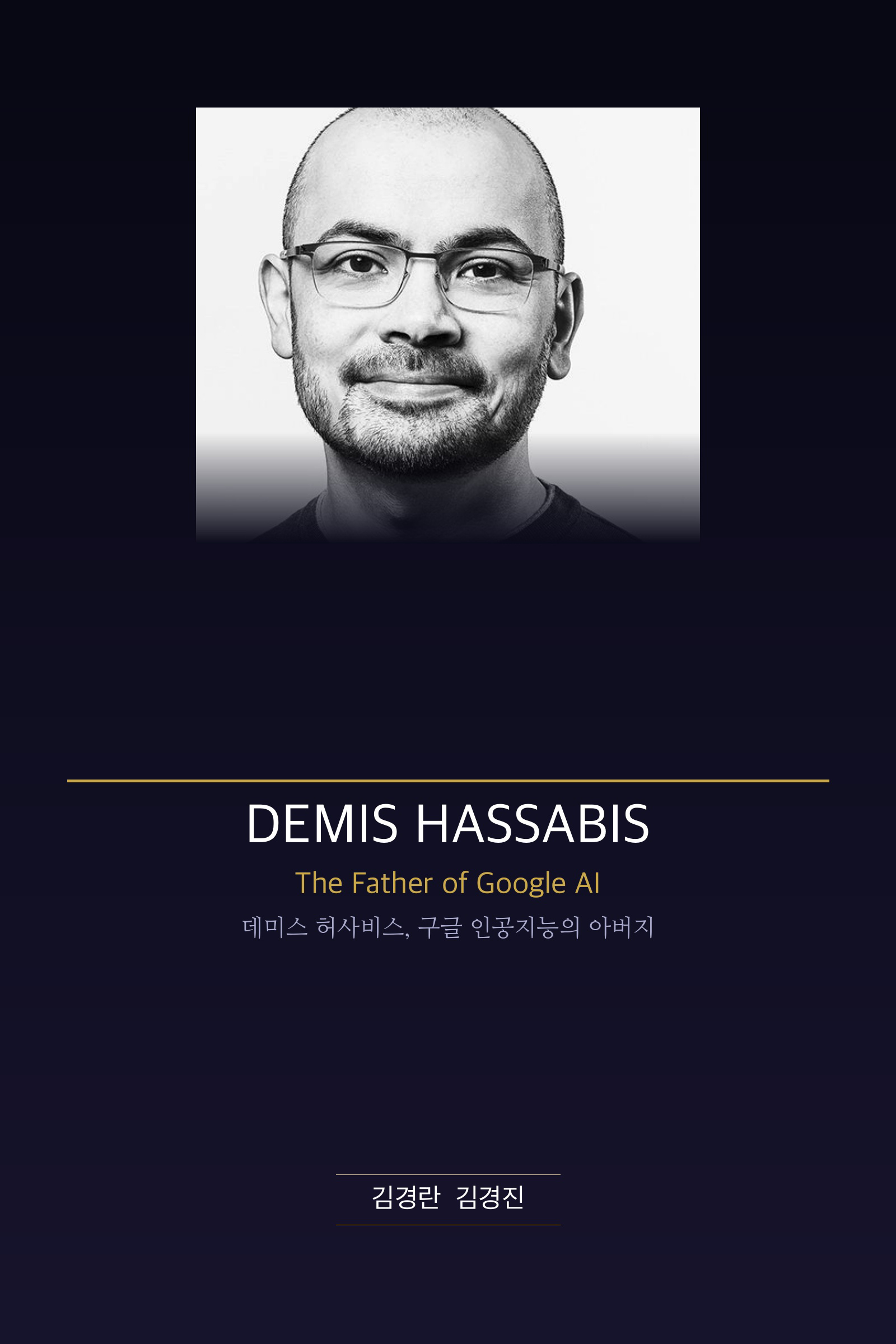
Demis Hassabis, Father of Google's Artificial Intelligence
Part 4. DeepMind
10 Silicon Valley Courtship and Google
Kim Kyung-ran, Kim Kyung-jin
warned that it would 'follow you there.' In 2010, DeepMind began in a rundown office near Russell Square in London. From the very start, it hit a practical wall: funding. At the time, DeepMind had absolutely no product or service to sell. All they had was the abstract, enormous vision inside Demis Hassabis's head: 'to solve intelligence.'
The UK's venture capital scene was not as mature then as it is now, and investors willing to fund a science lab with no revenue model were rare. Hassabis concluded that the only place that could understand his vision was Silicon Valley. He boarded a flight to San Francisco, where he met Peter Thiel, co-founder of PayPal and a radical technology investor. Hassabis, a chess master, and Thiel, a chess enthusiast, formed a bond over a shared philosophy: playing moves that transcend the limits of human intelligence.
Thiel's investment was a lifeline for DeepMind, but an even more dramatic encounter awaited. Through Thiel's introduction, Hassabis met Elon Musk in the cafeteria at SpaceX headquarters. Musk was consumed by a grand plan to make humanity a multi-planetary species and prevent the extinction of civilization.
Their conversation turned into a deep discussion about the future of technology and the fate of humanity. Musk passionately explained his Mars colonization plan to Hassabis. The idea was that a colony on Mars had to be built to preserve human civilization in the event of a climate catastrophe or asteroid impact on Earth.
Hassabis paused, looked Musk in the eye, and delivered a calm but chilling warning: 'Elon, your plan is brilliant, but you're overlooking one thing. If we develop AGI, artificial general intelligence, without securing its safety, that AI will follow you all the way to Mars.'
That single remark shook Musk. He had factored in physical disasters and resource depletion, but had not deeply considered that an entity called superintelligence
could threaten humanity beyond any physical distance. Hassabis argued that artificial intelligence is not merely a tool made of code; it could be the birth of a new species capable of escaping human control. He stressed that aligning that intelligence with the right values is just as important as creating the intelligence itself.
This conversation upended Musk's worldview. He decided to invest in DeepMind on the spot. But it was not an investment made in expectation of financial returns.
As Musk later confessed, he invested 'to prevent the emergence of a Terminator, or at least to keep an eye on what they were doing.' For Hassabis, the investment meant more than securing funds. It stamped into the minds of Silicon Valley's most powerful figures that AGI was not a science fiction plot, but a scientific challenge achievable within their lifetimes and the greatest existential threat facing humanity.
With that, DeepMind surged from a small London startup to the recognized epicenter of AI, watched closely by technology leaders worldwide. The AGI vision that captured early investors: What captivated DeepMind's early investors was not flashy demo videos or user metrics. In the early 2010s, most AI companies focused on narrow artificial intelligence in limited domains like 'big data analytics' or 'image recognition.'
They sold better recommendation algorithms or more accurate ad-targeting technology. Hassabis was different. Standing before investors, he declared: 'We don't build products.
We build intelligence itself.' The AGI vision Hassabis presented was a mega-scale scientific project comparable to the Apollo program or the Manhattan Project. He laid out a blueprint: fuse neuroscience and machine learning to create a general-purpose algorithm that could learn on its own, plan, and solve problems in unfamiliar environments, just as humans do.
It sounded almost like alchemy given the technology of the time. But Hassabis had a powerful narrative to persuade investors. He wove together his childhood experience as a chess champion, his years creating virtual worlds as a game developer, and the neuroscientific insights he gained studying memory and imagination at University College London.
He argued: 'If the human brain is a machine that processes information according to physical laws, we can reproduce those principles on a silicon chip.' He also defined games as the perfect testbed for measuring and training AI intelligence. The strategy of training AI in game environments with clear rules and objectives before tackling real-world complexity struck investors as a logical, stepwise approach.
Major investors like Peter Thiel's Founders Fund and Li Ka-shing of Hong Kong were drawn to the potential for exponential growth that Hassabis described. Hassabis made the case he had believed since DeepMind's founding: that AI would solve humanity's grand challenges, from disease to energy to climate change. This was not a proposal for mere technology development. It was a proposal to upgrade the operating system of human civilization.
Investors sensed intuitively that if DeepMind succeeded, the value it would generate would be on an entirely different scale from existing internet or software companies. Beyond technical vision, Hassabis also presented a distinctive organizational model. He said he would build a 'hybrid organization' combining academic research freedom with startup execution speed.
His plan to gather the world's top scientists in one place and let them focus on long-term challenges free from publication pressures became a magnet for genius-level researchers who were disillusioned with the university system. Investors saw in Hassabis the coexistence of Steve Jobs's reality distortion field and Albert Einstein's scientific intuition. Without a single product, DeepMind attracted funding from Silicon Valley's elite investors and laid the decisive foundation for Google's eventual acquisition.
Hassabis had not just raised money; he had assembled believers who would join his quest. Rejecting Facebook and joining Google: acquired by Google in 2014. By late 2013, as DeepMind's technical achievements became visible, Silicon Valley's tech giants began to move. The first to extend an offer was Mark Zuckerberg of Facebook (now Meta). Zuckerberg dispatched his private jet to invite Hassabis and DeepMind's co-founders to California.
But negotiations fell apart. The surface reason may have been a disagreement over price, but the fundamental reason was a clash of philosophy.
Hassabis worried that Facebook would use DeepMind's technology merely to optimize its news feed or improve facial recognition. He did not want DeepMind to become a cog inside a giant corporation. It was Google's Larry Page who moved into that gap.
In January 2014, Google announced the acquisition of DeepMind for approximately 500 million dollars (roughly 400 million pounds at the time). It was the largest acquisition Google had ever made in Europe. At the time, DeepMind had only about 50 employees, and its revenue was zero.
Many observers in Silicon Valley said Google had lost its mind. Pouring over 500 billion won into a small British research lab with no revenue model looked like an irrational gamble. But Larry Page, like Hassabis, was a person who dreamed of moonshots.
Page saw that DeepMind would go beyond improving Google's search engine; it would become the engine that transformed Google into a true AI company. For Hassabis, the acquisition was not a simple exit. It was the process of securing the enormous resources, the fuel, needed to realize AGI, his 40-year quest.
The deal was conducted in secret, yet with lightning speed. Hassabis later recalled the moment: 'We had the blueprint to build a rocket, but we didn't have the fuel to launch it into space. Google provided that fuel.'
Acquisition conditions: establishment of an ethics board, London headquarters retained, research autonomy guaranteed. Hassabis was remarkably exacting and firm at the negotiating table. He was wary of DeepMind being absorbed into Google and disappearing. He wanted to remain 'DeepMind within Google,' not 'Google's DeepMind.'
To that end, he put forward three unprecedented conditions, and Larry Page accepted them. The first condition was the establishment of an ethics board to oversee the ethical use of DeepMind's technology. Hassabis knew better than anyone that as AI technology grows more powerful, the risk of misuse grows with it.
He wanted to categorically block DeepMind's technology from being used for military purposes or espionage. This was a condition virtually without precedent in the history of tech acquisitions. An acquired company was demanding of its acquirer: 'I will set up oversight to make sure you don't misuse my technology.' It showed that Hassabis viewed AI not as a mere commodity but as an enormous force that would affect all of humanity. The second condition was keeping the headquarters in London.
Normally, companies acquired by Google are absorbed into the Mountain View campus, the Googleplex. But Hassabis refused to let DeepMind be steeped in Silicon Valley's commercial culture. He believed London's academic traditions, Europe's diverse talent pool, and a calm research environment distanced from Silicon Valley's 'move fast and break things' ethos were essential for developing AGI.
He wanted to make DeepMind not a 'commercial company' but 'a 21st-century Bell Labs.' Google made the unusual concession of allowing DeepMind to build its own independent kingdom at King's Cross in London. The third condition was securing research autonomy.
DeepMind was guaranteed the authority to focus on long-term AGI research without being subordinated to Google's short-term product development cycles. In other words, it could continue basic scientific research like Go-playing AI or protein structure prediction that would not generate immediate revenue. This negotiation proved that Hassabis was not just a developer but a strategist who could stand toe to toe with massive capital to protect his mission. 'Embracing Goliath': accelerating research through computing power and resources. The merger with Google gave DeepMind the power of a giant.
AI research, particularly deep learning and reinforcement learning, demands enormous computing power. Running millions of simulations and training massive neural networks requires thousands or tens of thousands of GPUs and data centers. The cost was beyond what a startup could bear.
With Google's acquisition, DeepMind gained the right to use the most powerful computing infrastructure on the planet, as freely as it wished. It was like an army fighting with rifles suddenly receiving a nuclear-powered aircraft carrier. Access to early versions of Google's custom AI chip, the TPU (Tensor Processing Unit), catapulted DeepMind's research speed.
AlphaGo, which would later astonish the world, could not have been trained or played its matches without Google's cloud infrastructure. In its match against Lee Sedol (9-dan), AlphaGo used 1,920 CPUs and 280 GPUs. Only a handful of companies on Earth, Google among them, could mobilize resources that flexibly. The Google brand became a black hole pulling in talent from around the world.
With Google's financial backing, DeepMind recruited the finest minds from academia and could offer PhD-level researchers salaries on par with the finance industry. Hassabis had climbed onto the shoulders of a giant and could now reach toward the star he had dreamed of: AGI. Yet the merger also carried the seeds of tension.
'Don't be evil,' Google's motto, and 'Solve intelligence,' DeepMind's mission, seemed harmonious on the surface. But the profit-seeking instinct of a massive public company and the idealism of a pure research lab were destined to collide. Hassabis had to walk a constant tightrope, drawing on Google's resources while trying to escape its control. This tension would become starkly visible later as DeepMind merged with Google Brain and faced commercialization pressure amid competition with OpenAI. The 2014 agreement was the starting point that made DeepMind a legend, but it was also the beginning of shackles that would force Hassabis to agonize endlessly between two identities: entrepreneur and scientist.
When Google acquired DeepMind, Hassabis found himself possessing enormous wealth overnight. By Silicon Valley convention, he might have moved to a Palo Alto mansion and driven a Tesla. He did not.
He stayed in Highgate, north London, and commuted by train until 2016. A lifelong Liverpool FC fan, he was at Anfield in 2019 to witness the 4-0 comeback against Barcelona in person. It was a night when a future Nobel Prize laureate sang along to 'You'll Never Walk Alone' and cheered with the crowd.
Demis Hassabis in the DeepMind era.
Kim Kyung-jin
Attorney · Former Member of the National Assembly · AI Policy Researcher
© 2026 Kim Kyung-jin. All rights reserved.