










[AI Library] 17 The AI That Won a Nobel Prize
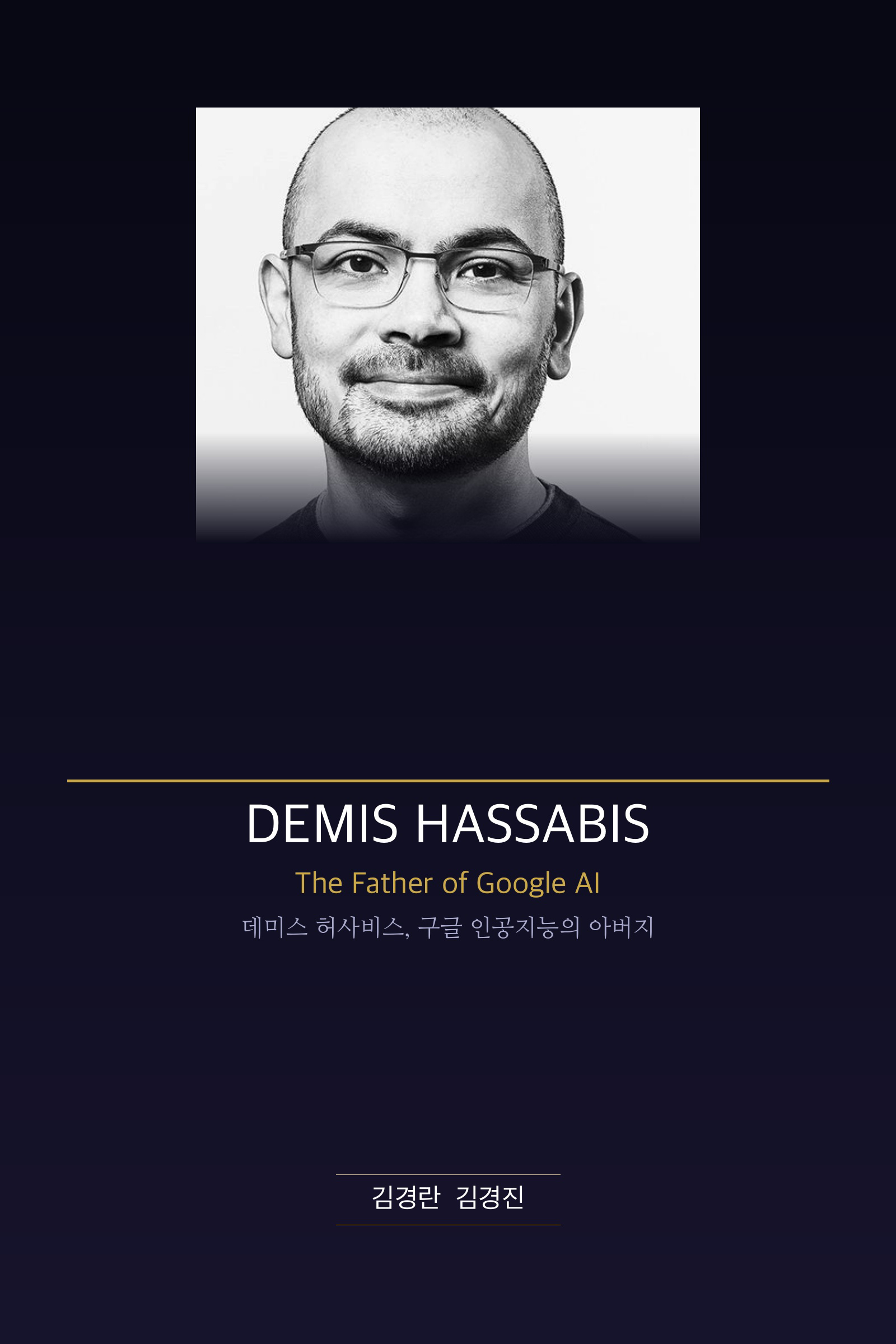
Demis Hassabis, Father of Google's Artificial Intelligence
Part 6. Digital Biology
17 The AI That Won a Nobel Prize
Kim Kyung-ran, Kim Kyung-jin
On October 9, 2024, morning in London began under the same gray sky the city always wears. At Google DeepMind's King's Cross headquarters, a strange tension hung in the air. A single phone call from the Royal Swedish Academy of Sciences had changed everything.
When the phone rang, Demis Hassabis was having an ordinary morning with his wife. The news from the other end of the line was a signal that the mission he had relentlessly pursued -- over chess boards since age four, in front of computer screens since age twelve, and through the organization called DeepMind for the past fifteen years -- the mission of 'solving intelligence' had finally received recognition from the highest authority in science. That year's Nobel Prize in Chemistry was awarded to three people.
David Baker, a professor at the University of Washington and a pioneer in protein design, received half the prize. Demis Hassabis and DeepMind's senior researcher John Jumper shared the other half. This was not an ordinary award ceremony. It was a declaration that artificial intelligence was no longer the exclusive domain of computer science or a revenue-generating tool for Silicon Valley, but had been accepted as a 'scientific tool' for decoding nature's deepest secrets.
Hassabis's prize was AI's answer to a fifty-year-old challenge posed by Christian Anfinsen, the 1972 Nobel Chemistry laureate: 'Can the three-dimensional structure of a protein be predicted from its amino acid sequence alone?' For half a century, countless biologists had wrestled with X-ray crystallography in laboratories, spending years -- sometimes entire doctoral programs -- to determine a single protein structure. But AlphaFold2, developed by the team led by Hassabis and Jumper, compressed that process to minutes, even seconds.
It was a moment comparable to Galileo turning his telescope skyward and discovering Jupiter's moons. Just as the telescope expanded the horizons of astronomy, AI fundamentally expanded the horizons of biology. When the Nobel Committee called it 'one of the discoveries that confer the greatest benefit to humankind,' they were not praising the technology's performance alone.
They were acknowledging that AI could complement and extend the limits of human intelligence, accelerating scientific discovery at speeds and scales previously impossible. It was the moment when DeepMind's mission -- 'understand intelligence, then use it to solve everything else,' a vision Hassabis had championed since the company's earliest days -- began to become reality. AlphaFold had predicted and publicly released the structures of more than 200 million proteins, virtually every known protein on Earth, and over two million researchers across 190 countries were using it to push the frontiers of science, from malaria vaccines to plastic-degrading enzyme research.
'A surreal experience': Hassabis's reaction and the response from the scientific and AI communities. At the press conference and interviews held immediately after receiving the news, Hassabis appeared visibly moved, a departure from his usual cool, analytical demeanor. He described the moment as a 'surreal experience.' 'My mind went blank. It is an unbelievable honor.'
In that brief confession lay the overwhelming emotion of an outsider's path -- from game developer to neuroscientist to entrepreneur -- converging at the summit of mainstream science. He credited his colleague John Jumper and the entire DeepMind team. 'This was a massive team effort.
What we built is not just an algorithm. It is a crystallization of knowledge, assembled by hundreds of engineers and scientists working through the night.' His attitude showed that the traditional myth of the 'lone genius scientist' was being replaced in the AI era by collaboration between collective human intelligence and machine intelligence. The scientific community's reaction was intense.
A brief debate flickered among some conservative chemists: 'Is this pure chemistry or computer science?' But the majority acknowledged that the award reflected an inevitable shift. Biologists praised AlphaFold as 'the Google Maps of our field.' AI researchers, seeing deep learning reach beyond the Turing Award to the Nobel Prize, cheered that 'the AI winter
is over for good.' Combined with Geoffrey Hinton receiving the Nobel Prize in Physics just one day earlier, 2024 was recorded as 'the year of AI Nobel Prizes.' The Nobel Prize opened a new door: expanding influence over policymakers and the public. The Nobel Prize meant more than prestige for Hassabis.
It was like being handed an enormous megaphone. When he had previously spoken about AI risks and regulation as the CEO of a Big Tech company, people tended to interpret his words as strategy or marketing designed to protect corporate interests. But the title of 'Nobel laureate' lent his statements the authority of pure science.
After the award, Hassabis began exerting stronger influence in meetings with government policymakers around the world. He evangelized the possibility of 'radical abundance' that AI could bring, while also warning with scientific rigor about the dangers of uncontrollable superintelligence. To the public, he was no longer a cold tech executive but a 'sage' working to conquer disease and solve humanity's hardest problems.
The Nobel Prize became the most powerful weapon backing his argument that the AGI he envisioned should not be a commercial product alone but a public asset for all of humanity. From CBE (2017) to knighthood: an icon of British science. In March 2024, before the excitement of the Nobel Prize had even faded, another honor arrived. The British Crown announced it would confer a Knight Bachelor on Demis Hassabis. It was a promotion, seven years after he received the CBE in 2017 for his contributions to science and technology.
The ceremony at Buckingham Palace -- kneeling before King Charles III and receiving the touch of a sword on his shoulder -- was a symbolic scene: a boy born to an immigrant family in north London, educated at state schools, who had carved his own path through chess and coding, was now recognized as one of Britain's foremost intellects. Hassabis's knighthood carried special meaning for Britain as well. It showed that the great British scientific lineage running from Isaac Newton to Charles Darwin to Alan Turing had extended into a new domain -- AI -- in the twenty-first century.
The British government and scientific establishment held Hassabis up as a 'modern-day Turing,' showcasing to the world that Britain was both the birthplace of AI technology and a nation with ethical leadership in the field. For Hassabis, the title 'Sir' went beyond personal glory. It was a medal proving that while DeepMind belonged to Silicon Valley's capital, its roots and philosophy remained deeply embedded in the British traditions of the humanities and sciences. 'Architects of AI' -- 2025 TIME Person of the Year (joint selection). In April 2025, Hassabis was named to TIME magazine's list of the 100 Most Influential People for the second time, following his first appearance in 2017.
Nobel Chemistry laureate Jennifer Doudna wrote in her tribute: 'He is not just building powerful systems -- he is building understanding,' praising how Hassabis fused biology and computing. In December of the same year, TIME named 'Architects of AI' as its 2025 Person of the Year, jointly selecting Demis Hassabis alongside Sam Altman and Jensen Huang. The magazine cover showed the three gazing in different directions against a backdrop of complex neural networks resembling the human brain.
TIME explained the selection by calling them 'the people who placed the most powerful tool since fire into humanity's hands.' Of Hassabis specifically, the magazine wrote: 'Amid commercial competition, he never lost sight of AI's essential value as a vehicle for scientific discovery, and he contributed to expanding the total sum of human knowledge.' 2025 was the year that large language models like Gemini had fully permeated daily life around the world. It was also the inaugural year in which AI began solving real problems in the physical world: drug development, climate prediction, new materials discovery.
Hassabis's selection as Person of the Year at that juncture symbolized that the AI revolution had moved beyond the novelty of chatting with bots and entered the phase of redesigning the foundations of civilization. In an interview, he said: 'We are only at the starting line. The real transformation will begin when AI leaves the laboratory and starts solving the hardest problems in our lives,' revealing that his gaze was fixed not on present glory but on the future of AGI.
Hassabis's study is lined with some of the most prestigious awards in science, arranged alongside his Nobel medal. 2023 was his 'year of prizes.' He received the Breakthrough Prize in Life Sciences, often called Silicon Valley's Nobel, along with its three-million-dollar purse.
He won the Lasker Award for Basic Medical Research and the Canada Gairdner International Award in rapid succession. These prizes have traditionally been seen as precursors to the Nobel Prize in Physiology or Medicine or Chemistry, and it was unprecedented for a computer scientist rather than a physician to sweep them. It was a powerful signal that the paradigm in biology was shifting from 'observation and experiment' to 'data and prediction.'
He also received the highest honors from the academic institutions he once called home. The University of Cambridge and University College London (UCL), as well as the University of Oxford and Imperial College London, competed to confer honorary doctorates on him. As a young man, he had grown frustrated with the slow pace of academia and leapt into the world of startups. Now he had become the person academia most respected, returning to the lectern.
In his acceptance speeches, he often said: 'I did not leave academia. I took a different path for a while in order to expand it.' Among the many honors Hassabis has received, one of the titles he cherishes most is Fellow of the Royal Society (FRS).
In 2018, at the age of forty-one, he was elected one of the youngest Fellows in the 360-year history of the Royal Society. He had placed his name on the same register as giants like Isaac Newton, Charles Darwin, Albert Einstein, and Stephen Hawking. He was also elected a Fellow of the Royal Academy of Engineering (FREng).
Holding fellowships in both the scientific (FRS) and engineering (FREng) academies is exceedingly rare. It was official recognition of Hassabis's unique identity: a 'convergent intellect' who combined the spirit of scientific inquiry with the problem-solving capacity of engineering. Sitting in the Royal Society's antique meeting rooms discussing the future of AI, he also grappled intensely with how that technology could solve real-world engineering challenges.
For him, these fellowships were not honorary titles. They were a weighty obligation -- a noblesse oblige -- to speak with responsibility about the impact of science and technology on society.
The scene at the announcement of the 2024 Nobel Prize in Chemistry
Kim Kyung-jin
Attorney · Former Member of the National Assembly · AI Policy Researcher
© 2026 Kim Kyung-jin. All rights reserved.