


AI Library
The Age of Autonomous Scientific Discovery
Kim Kyung-jin, Attorney at Law
AI Scientists and Self-Driving Labs
This book follows how AI scientists and self-driving labs are changing the way science generates and verifies claims. It covers literature-based discovery, natural-language protocols translated into robot commands, multi-agent research systems, closed-loop laboratories, materials search, the verification gap, chains of evidence, research harnesses, journal ethics, and legal responsibility.

AI Library
A New Era of Life Sciences Opened by Artificial Intelligence
Structural Proteomics, Genomic Foundation Models, Autonomous Laboratories, and Global Governance
Kim Kyung-jin, Attorney at Law
This book is a research volume compiled with artificial intelligence. A human selected the materials and structured the work, while AI models drafted the sentences and cross-checked the facts.

AI Library
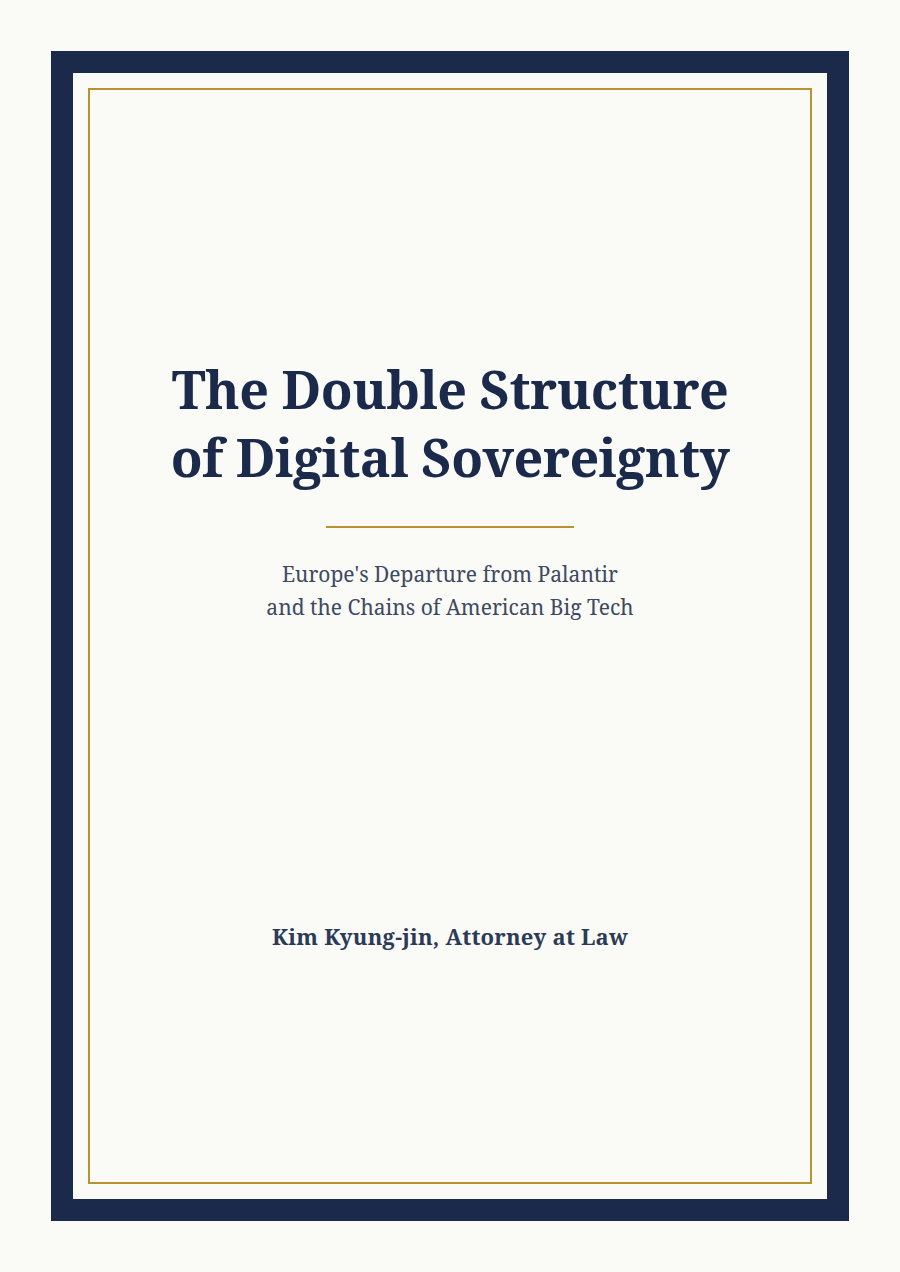
The Double Structure of Digital Sovereignty
Europe’s Departure from Palantir and the Chains of American Big Tech
Kim Kyung-jin, Attorney at Law
This is a record of 2026, when European intelligence agencies and defense ministries began removing analytics tools from America’s Palantir. It covers the replacement decisions made by France’s General Directorate for Internal Security (DGSI), Germany’s Federal Office for the Protection of the Constitution (BfV), and the Netherlands Ministry of Defense; the incident in which US export controls severed an ally’s ac…

New English Edition
Artificial Intelligence in Horticulture
Kim Kyung-jin, Attorney at Law
Across five chapters and ten sections, this book examines computer vision for crop diagnosis, harvesting robots and autonomous field systems, smart greenhouses and digital twins, precision irrigation and supply-chain quality control, high-throughput phenotyping, and predictive breeding.

New English Edition
Artificial Intelligence in Food Crop Agriculture
Kim Kyung-jin, Attorney at Law
Across six chapters and eighteen sections, the book examines digital agricultural infrastructure, remote sensing, crop diagnosis, yield forecasting, precision irrigation, genomics, molecular breeding, agricultural robotics, climate-smart agriculture, and global food security.

New English Edition
The Future of Forestry and Agroforestry
Kim Kyung-jin, Attorney at Law
Driven by Artificial Intelligence and Digital Innovation
Across five chapters and fifteen sections, the book follows satellites, drones, LiDAR, digital twins, forest-specific language models, wildfire and pest forecasting, forestry robotics, agroforestry, timber traceability, and forest carbon markets.

New English Edition
Smart Livestock Farming: AI Enters the Barn
Kim Kyung-jin, Attorney at Law
Sensors listen, cameras watch, and artificial intelligence helps farmers decide.
Across five chapters and fifteen sections, the book follows precision livestock farming from animal health and reproduction to robotic milking, virtual fencing, digital twins, methane reduction, welfare, and data ownership.
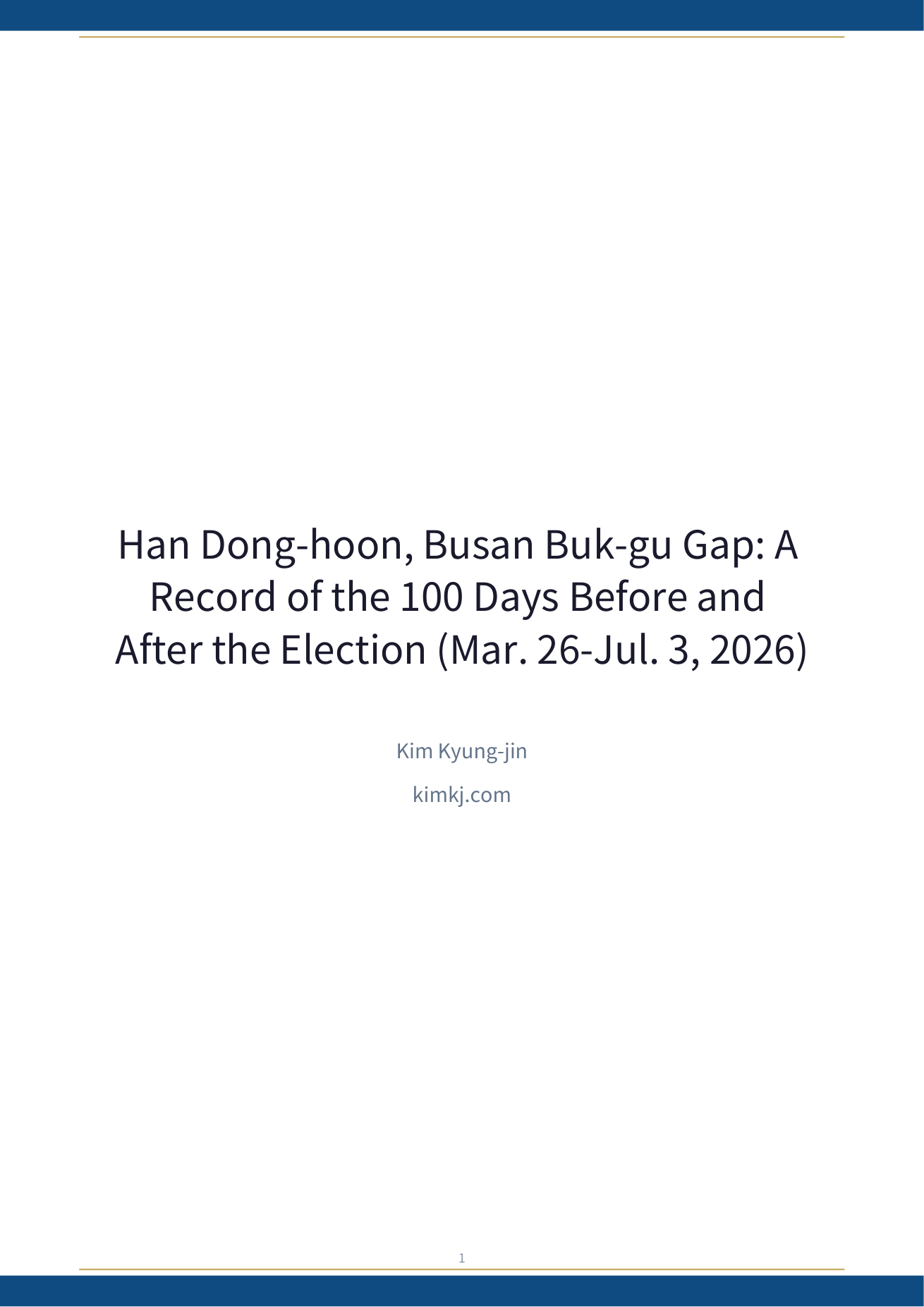
Table of Contents
Han Dong-hoon, Busan Buk-gu Gap: A Record of the 100 Days Before and After the Election (Mar. 26-Jul. 3, 2026)
Kim Kyung-jin
Table of Contents and 13 sections
From March 26 to July 3, 2026, this record follows the spring after expulsion, the Busan Buk-gu Gap by-election, victory as an independent, and the first bill submitted in the National Assembly.

Table of Contents
Artificial Intelligence and Medicine
Kim Kyung-jin, Attorney at Law
AI in clinical care, hospitals, education, and research
AI in medical imaging, risk prediction, treatment planning, hospital operations, education, and research, with patient safety, privacy, and accountability.







































[AI Library] Chapter 28: No Kings
The 2026 U.S.-Iran War and the Global Energy Crisis
Chapter 28: No Kings
Kim Kyung-jin
The 2026 U.S.-Iran War and the Global Energy Crisis
Chapter 28: No Kings
28.1 March 28: 3,300 Protests Across 50 States
Saturday morning, March 28, 2026, at 10 a.m., people stood in lines on the Memorial Bridge in Arlington, Washington D.C. They marched toward the Lincoln Memorial. Picket signs hung from their hands. "Put Down the Crown, Clown." Some rang bells while others beat drums. A giant balloon shaped like Trump in a diaper swayed above the crowd.
At that same moment, 6,000 kilometers away in Saint Paul, Minnesota, people were gathering. In a small square in Clarksville, Georgia. In downtown Dallas, Texas. In the village of Kotzebue, Alaska. Simultaneously, across all 50 American states and at more than 3,300 locations, people took to the streets. According to the organizers Indivisible and MoveOn, between 8 and 9 million people participated. It was the largest single-day protest in American history.
"No Kings." That was the name of the protest. No kings were needed.
This slogan first appeared in June 2025. About 5 million people participated in the first No Kings protest, opposing the Trump administration's authoritarian actions. The second protest in October drew 7 million. The third on March 28 surpassed all previous records. The very fact that each successive protest grew larger showed that anger was not a fleeting emotion but accumulating structurally.
There was a metric that fundamentally set March 28's protest apart from the previous two. Geography. Two-thirds, 66 percent of all protest RSVPs were registered outside major cities. Not traditional progressive cities like New York or Los Angeles, but double-digit protests appeared in Republican strongholds like Idaho, Wyoming, Montana, and Utah. Two thousand people gathered in Lakeland, Florida. Lakeland lay within a county that Trump won by 21 percentage points in the 2024 presidential election. Protests also occurred in South Dakota and Louisiana. Senator John Thune's district and House Speaker Mike Johnson's district. In The Villages, Florida, 6,750 residents of a retirement community turned out, split between two locations. In Palm Beach County, where Trump's Mar-a-Lago residence is situated, this happened just days after Democratic candidate Emily Gregory flipped a Republican seat in a special state legislative election.
From Tucson to Oro Valley in Arizona is about 13 kilometers. People lined up across this distance, forming a human chain. The organizers called it a "Visible corridor of democracy." Registration surged in key swing areas for midterm elections, such as Bucks County in Pennsylvania and East Cobb in Georgia.
Eight million people did not gather around a single issue. Some came to oppose the Iran war. Others were angered by ICE agents killing two American citizens in Minnesota. Many were furious that gasoline prices had jumped from $2.97 a gallon before the war to over $4 in just one month. Billionaire tax cuts, the rollback of transgender rights, the cover-up of the Epstein files. All these grievances mingled on protest signs. "Get ICE out." "Don't bleed for oil." "Protect workers, not billionaires." "Remove ICE from our neighborhood." Different angers united under one slogan. "No kings. No thrones. No crowns."
Solidarity protests took place outside the United States as well. In London, at Place de la Bastille in Paris, in Rome, Berlin, Costa Rica, Australia, and Japan. Protests occurred on every continent except Antarctica. Some were organized by Democrats Abroad, the organization of American expatriates; others saw local citizens join spontaneously.
The White House response was terse. Spokeswoman Abigail Jackson said, "Trump Derangement Therapy Sessions." She added that only paid journalists would pay attention to these protests.
In New York City, more than 350,000 people marched from Central Park West to Times Square. The NYPD announced there was not a single protest-related arrest. In Los Angeles, tens of thousands marched through downtown, and some clashed with police in front of a federal detention facility at night. Tear gas was fired and 9 people were arrested. In Dallas, clashes erupted between No Kings marchers and counter-protesters. Among the counter-protesters were people convicted in the January 6 Capitol riot who had been pardoned.
In Portland, thousands marched to the beat of drums. Police had issued warnings in advance to stay away from ICE facilities. In Baltimore, the march stretched from City Hall to the Federal Building in Fell where an ICE field office operated. In Hagerstown, Maryland, between 2,500 and 3,000 people gathered. A few miles from the city lay a 71,000-square-meter warehouse in Williamsport used as an ICE detention center. Jackie Fairbrother from Germantown said she had originally planned to go to the Washington D.C. protest but changed course after seeing the Hagerstown ICE counter-rally on social media.
In Hawaii, the protest bore a different name. "No Dictators." It was a gesture of respect for the history of the Hawaiian Kingdom. About 10,000 people gathered in front of the Hawaii State Capitol in Honolulu. In Princeton, New Jersey, Governor Miki Sherrill gave a speech beside the Princeton Battle Monument. It was the very spot where George Washington defeated the forces of King George III in 1777.
In Fort Myers, protesters dressed in red cloaks and white bonnets from Margaret Atwood's novel "The Handmaid's Tale" led the march. In Nashville, similarly dressed protesters crossed the John Seigenthaler Pedestrian Bridge and marched to Public Square Park. In Austin, a crown-shaped ice sculpture was placed at the protest site. It was designed to melt throughout the day.
Judy Bursack, 79, in Los Angeles was battling cancer and could not walk without a walker. Unable to join the downtown march, she stood alone at the corner in front of her apartment holding a homemade sign. "I can't go there with everyone else, so I'm doing this alone." The last large-scale protest she had attended was the Women's March in 2017. She called it a "religious experience."
3,300 protest sites. More than the total number of counties in the United States. What this number meant was clear. Anger was not confined to the progressive bubbles of New York and San Francisco. The suburban middle class that had supported or tolerated Trump, elderly residents of retirement communities, truck drivers in rural areas had turned their backs. War, oil prices, and cost of living had demolished the boundaries of ideology.
28.2 Trump's Approval Rating: 36 Percent
What shook the White House more than the sound made by 8 million people on the streets was a number.
By late March 2026, polling results poured in. A UMass Amherst poll conducted from March 20 to 25 among 1,000 respondents showed President Trump's job approval at 33 percent. It was 5 percentage points below July 2025's 38 percent and 11 percentage points below April 2025's 44 percent. It was the lowest since his inauguration. A Quinnipiac University poll from early March showed 37 percent approval and 57 percent disapproval, a net approval of minus 20. A Strength In Numbers/Verasight survey also showed 37 percent approval and 60 percent disapproval. An NBC News poll put it at 44 percent, but even that was 3 percentage points lower than a year earlier. Regardless of which poll you looked at, the direction was the same. Downward.
Tatishe Nteta, director of the UMass poll, explained: "Skyrocketing inflation, stock market crashes, an unpopular war in the Middle East, long airport lines from government shutdowns, and nationwide anti-government protests. It is unsurprising that approval took a hit." What he flagged as a "serious concern for the White House" was different. Among the core groups that had delivered Trump's victory in the 2024 presidential election,men, working-class voters, African Americans, moderates, and independents,support had dropped 13 to 20 percentage points compared to April 2025.
The driver of this decline was the Iran war and oil prices. Nate Silver of FiveThirtyEight wrote in a March 26 analysis that Trump's drop in popularity was "almost certainly" tied to rising gasoline prices. His net approval on economic management was minus 21.3, and his net approval on inflation was minus 32.7. Both were near their lowest points since his second term began. A Yahoo/YouGov survey found 66 percent of respondents opposed Trump's response to gas prices. The outlet reported that "Trump's economic approval has never been this low, including during the first wave of the COVID-19 pandemic."
Support for the war was even worse. According to an AP-NORC poll, 59 percent of Americans said military attacks on Iran were excessive. A Reuters/Ipsos survey found only 29 percent supported the air strikes on Iran. Two-thirds of respondents, including 44 percent of Republicans, expected gas prices to rise further. Support for actual ground troops was 7 percent.
There is a principle in American political history called the "rally-around-the-flag effect." When a president initiates a war, approval ratings spike initially. The classic example is George W. Bush's approval exceeding 90 percent after initiating the Afghanistan war following 9/11 in 2001. In the 2026 Iran war, this phenomenon did not occur. Opposition outpaced support immediately after the war began. According to FiveThirtyEight's Iran war-specific approval tracking launched on March 25, net approval for the war was minus 14.3. It was the lowest level since the war started.
The rally failed for two reasons. One was the absence of justification. In the 2024 presidential election, Trump campaigned as a peace candidate, promising to "end endless wars." When he initiated bombing of Iran without congressional approval, a sense of betrayal erupted within his support base. According to a Strength In Numbers/Verasight survey, 13 percent of Trump's 2024 voters said they regretted their vote. It was twice the regret rate among Harris voters.
The other was the sign at the gas pump. The national average gasoline price, which was $2.97 per gallon before the war, topped $4 on the day of the March 28 protests. It had risen more than a dollar in a month. In some regions like California, it had already exceeded $5. Weekly diesel price increases were $1.12 per gallon in Texas, $1.11 in North Carolina, and $1.08 in Georgia. All three are critical swing states for midterm elections.
In an interview with the New York Post, President Trump said, "I think the polls are good, but I don't care about the polls. I need to do the right thing." At the time he said this, his net approval on price management was minus 39. Even his border security approval, which he had bragged about most throughout his tenure, had turned negative.
Between 33 and 37 percent. The numbers varied by polling organization, but every poll told the same story. The floor supporting Trump was giving way.
28.3 A Minnesota Night
Among the 3,300 protests, organizers designated Saint Paul, Minnesota as the national "flagship event." There was a reason.
In December 2025, the Trump administration launched "Operation Metro Surge," deploying 3,000 federal agents under the Department of Homeland Security to the Minneapolis-Saint Paul region. The stated purpose was illegal immigrant enforcement. Armed federal agents raided residential neighborhoods, arrested parents in front of schools, and dragged away nail salon owners. Citizens took to the streets to monitor the agents' actions.
In January 2026, two American citizens were shot dead by federal agents. Renee Good. A mother of three. Alex Pretti. A VA hospital nurse. They were shot in the back by ICE agents, collapsed on the street, and died with no one investigating. Minnesota residents stood guard in brutal cold, facing rubber bullets and tear gas. Resistance involving tens of thousands of people ultimately forced a scale-back of the operation. By February, Operation Metro Surge had effectively ended.
On March 28, people gathered again in Minnesota. In front of the State Capitol. Organizers expected 100,000. State police reported at least 50,000 confirmed. Organizers estimated 200,000. Regardless of which figure was right, it was the largest political rally in Minnesota history.
Minnesota Governor Tim Walz took the stage in a flannel shirt. Referencing the White House calling protesters "radicals," he said, "You're damn right we've been radicalized." He paused, then continued. "Radicalized by compassion. Radicalized by decency. Radicalized by due process. Radicalized by democracy."
Governor Walz introduced the next speaker. "A man who has given voice to the working class his entire life. Someone who has sung about our hopes and dreams, our fears, everything that makes us human." After a moment, he added, "We don't need kings, but we need a Boss."
Bruce Springsteen took the stage with his guitar.
"This winter, federal troops brought death and fear to the streets of Minneapolis," Springsteen said. "But they picked the wrong city." The crowd roared. "The strength and solidarity of Minneapolis and Minnesota have inspired the nation. Your resilience and commitment have told us something. That this is still America. That this reactionary nightmare and this invasion of American cities will not be tolerated."
And he called out two names. "Renee Good. Mother of three. Brutally murdered. Alex Pretti. VA hospital nurse. Executed by ICE. Shot in the back and died on the street, and our lawless government could not even muster the decency to investigate that death. Their courage, their sacrifice, their names will not be forgotten."
The crowd began chanting "ICE out now." Springsteen picked up his guitar and performed "Streets of Minneapolis." It was a song written one day after the ICE shooting incident in January, recorded two days later, and released. Federal agent boots, rubber bullets and smoke, people falling on snow-covered streets. It was his third live performance of the song.
Springsteen once told the Minnesota Star Tribune about the song: "Sometimes you find yourself in the right place at the right time, and something bigger than the band happens. The time in Minneapolis ranks at the top of all the meaningful performances I have done."
Following Springsteen, Joan Baez took the stage. An icon of the anti-war movement of the 1960s. She performed Bob Dylan's "The Times They Are A-Changin'" with Maggie Rogers. Tom Morello, guitarist for Rage Against the Machine, made a surprise appearance.
Senator Bernie Sanders took the microphone. He began with American history. "In 1789, they spoke loudly and clearly to the world. In this new country, America, we do not want a king." After reading the opening line of the Declaration of Independence, he continued. "Today in 2026, our message is exactly the same. Kings are not needed. We will not allow this country to slide into authoritarianism or oligarchy. In America, the people govern."
Sanders' speech had two axes. One was wealth inequality. "Never in American history have so few possessed so much wealth and power. The top one percent owns more wealth than the bottom ninety-three percent." The other was the Iran war. "Let's be honest. The American people were lied to about the Vietnam War. They were lied to about the Iraq War. And today they are being lied to about the Iran War. This war must end immediately."
He recited numbers. Thirteen American soldiers killed since the war began. Hundreds wounded. Twelve more wounded in just a single day yesterday. After pointing out that Trump started the war without Congressional approval, in violation of international law, he recalled the 2024 presidential election promises. "He ran as a peace candidate. He promised no more endless wars. It was a lie."
Representative Ilhan Omar mentioned Shahjarah Tayebeh Girls' School in Iran that was bombed on the first day of the war. It was an incident where at least 175 people were killed. "Trump's talk of liberating Iranian women means bombing schools and killing children."
Jane Fonda, instead of giving a speech, read a statement from Becca Good, wife of Rene Good. Actor Robert De Niro participated via pre-recorded video. "Because of Trump, I wake up depressed every morning, but today I'm happier because millions of people are protesting here." He also sent congratulations to Minnesotans. For driving ICE out of the city.
A large banner hung on the Capitol steps. "We had whistles, they had guns. The revolution starts in Minneapolis."
The rally ended around 5 p.m. Springsteen was scheduled to start his "Land of Hope and Dreams" tour at the Target Center in Minneapolis three days later. A "No Kings" themed tour. He said he would start in Minneapolis and end in Washington. "This tour will be political and about what is happening in this country right now."
Iraq War veteran Niizod Denasha explained why he came to the Saint Paul rally. "I enlisted twenty years ago. I believed in the Constitution. Right now, rights are being trampled." Bob Mize, a sixty-eight-year-old retired lawyer from Iowa, had tears in his eyes talking about his grandson serving in the Marines. He was worried the grandson could be deployed to Iran. "Having this many people here helps. I wish there was more we could do."
28.4 Midterm Elections and the Energy Crisis
There is an old saying in American politics. "It's the economy, stupid." This phrase was created by James Carville, Bill Clinton's campaign strategist, in 1992. In 2026, that sentence needs only one word changed. Gasoline instead of economy.
"It's the gas prices."
For American voters, gasoline prices are different from any other economic indicator. The price of bread or milk can only be checked by going to the store, but gas prices appear on the service station sign every day on the commute. In a country where the average commute is twenty-seven minutes, in suburban areas where public transportation is virtually nonexistent, in a structure where groceries cannot be bought without a car, a one-dollar change in price per gallon is like watching part of your monthly salary evaporate. Political scientists compare gasoline prices to a regressive tax. It means a tax that is harsher on ordinary people than on the wealthy.
In late February before the war, the national average gasoline price was two dollars and ninety-seven cents per gallon. President Trump boasted about low gas prices in his State of the Union address. Energy Secretary Chris Wright even performed a stunt of pumping gas himself at a service station in Corpus Christi, Texas. It was a message that the administration was keeping fuel costs low for ordinary people.
The Iran War began on February 28. Within a week, the national average rose sixteen cents to three dollars and eleven cents. A week later, three dollars and thirty-eight cents. By late March, it broke through four dollars. Both the American Automobile Association (AAA) and GasBuddy confirmed the same figures. It was the first time prices entered the four-dollar range since Russia's invasion of Ukraine in 2022.
The direct reason for the oil price increase was the Strait of Hormuz. As this waterway, through which one-third of the world's maritime oil transportation passes, faced the risk of closure, Brent crude exceeded ninety dollars per barrel. American crude oil (WTI), which was sixty-seven dollars per barrel the day before the war, jumped into the ninety-dollar range. The U.S. Energy Information Administration (EIA) predicted in its March short-term outlook that Brent crude would remain above ninety-five dollars per barrel for two months.
Patrick De Haan, chief oil analyst at GasBuddy, wrote on March 30: "The situation is extremely volatile and unpredictable." Gregory Brew, chief analyst for Iran and oil at Eurasia Group, offered this forecast early in the war: "Gasoline from three dollars fifty to four dollars per gallon, and five-dollar diesel, will be coming soon." Three weeks later, that forecast became reality.
The reporting that most accurately captured what these numbers meant politically was from Axios. It was an analysis showing that three of the top four states with the largest weekly diesel price increases were key battleground states in the midterm Senate race. Texas, North Carolina, Georgia. In the states Republicans had to win to maintain their Senate majority, the numbers on the service station signs that voters see every day had jumped up more than a dollar.
According to an AP-NORC survey, forty-five percent said they were "extremely" or "very" worried about whether they would be able to afford gasoline over the next few months. In late 2024, right after Trump's reelection, the response to the same question was thirty percent. A fifteen-percentage-point increase. The war had created that difference.
There was a historical pattern. In the 1970s oil shock, Jimmy Carter's reelection was thwarted. In 2008, when oil prices were at one hundred forty dollars, Republicans suffered a crushing defeat. In midterm elections, it is almost a law that the party of the president loses seats. According to Nate Silver's analysis, it is a historical trend that the opposition party gains an average of about five percentage points in the Generic Ballot during the period leading up to the midterm elections. By March, Democrats were already ahead by six percentage points. If this trend continued, in November the Democratic Party would enter a phase where a commanding victory, or a "wave," would be possible.
Anxiety within the Republican Party was becoming visible. Speaking on condition of anonymity, a Republican campaign strategist told CNBC: "If the oil price increase is temporary, that's fine, but if it sustains at all, it's really bad. Grocery prices are high, housing costs are high, and now if gas prices go up on top of that, where does it end?" Republican lawmakers, worried about losing reelection along with the president, began distancing themselves from the White House. They did not publicly criticize Trump, but their silence on war policy grew longer.
The Trump administration deployed multiple measures to control oil prices. Releasing the Strategic Petroleum Reserve (SPR). Considering easing sanctions on Russia and Venezuela. Supporting tanker passage through the Strait of Hormuz with naval escort. Providing tanker insurance through the U.S. International Development Finance Corporation (DFC). CNN reported that White House officials had made solving this problem the top priority before the November midterm elections.
However, the market did not respond strongly to these measures. Ian Bremmer of Eurasia Group analyzed it this way for Al Jazeera. If Trump could secure the Strait of Hormuz and create the perception that he had forced Iran into submission, the short-term pain might not extend to the midterm elections. "On the other hand, if this goes on for eight weeks, three months or more, and gas prices continue rising, Democrats will attack saying, 'Trump said he would avoid endless wars, but look what he has gotten us into.'"
The same week the March 28 protest took place, a small event unfolded in Florida. A special election was held in the state House district that includes Palm Beach, where Trump's Mar-a-Lago estate is located. Democratic candidate Emily Gregory flipped this solid Republican district. Ken Martin, chair of the Democratic National Committee (DNC), said: "If Democrats can win in Trump's backyard, they can win anywhere."
Unless the war ended quickly or gas prices fell quickly, the seven months remaining until November would be a long time for Republicans. Time magazine's reporting summarized the situation: "A chain where war brings economic impact and economic impact affects elections" was already in operation. Grocery prices, transportation costs, and service costs were all rising in tandem with oil prices, and as long-term interest rates increased, they were pushing up mortgage and auto loan costs.
The path of the energy crisis that began at the Strait of Hormuz, passing through gas stations in the American Midwest and reaching the voting booths in November, was already visible. Trump and the Republicans stood in the path of that crisis.
AI expert Attorney Kim Kyung-jin
Specialist in AI legal policy · former National Assembly member · author of numerous works
If this book stayed with you even for a moment, please support it so that the next story can come out into the world.
(Voluntary support requested. Account: Nonghyup 302-1096-0948-81 Account holder: Kim Kyung-jin)
Kim Kyung-jin
Attorney · Former Member of the National Assembly · AI Policy Researcher
© 2026 Kim Kyung-jin. All rights reserved.