AI Library

AI Library

Books for Reading AI

Choose a book, then read it in order from the table of contents.

Uzbekistan Beyond the Blue Domes cover

Table of Contents

Uzbekistan Beyond the Blue Domes

Kim Kyung-jin, Attorney at Law

From Memories of the Silk Road to 2026 Changes and Practical Travel Logistics

An 18-chapter non-fiction book that explains Uzbekistan's history, society, economy, environment, and 2026 travel logistics, linking them to 142 official sources.

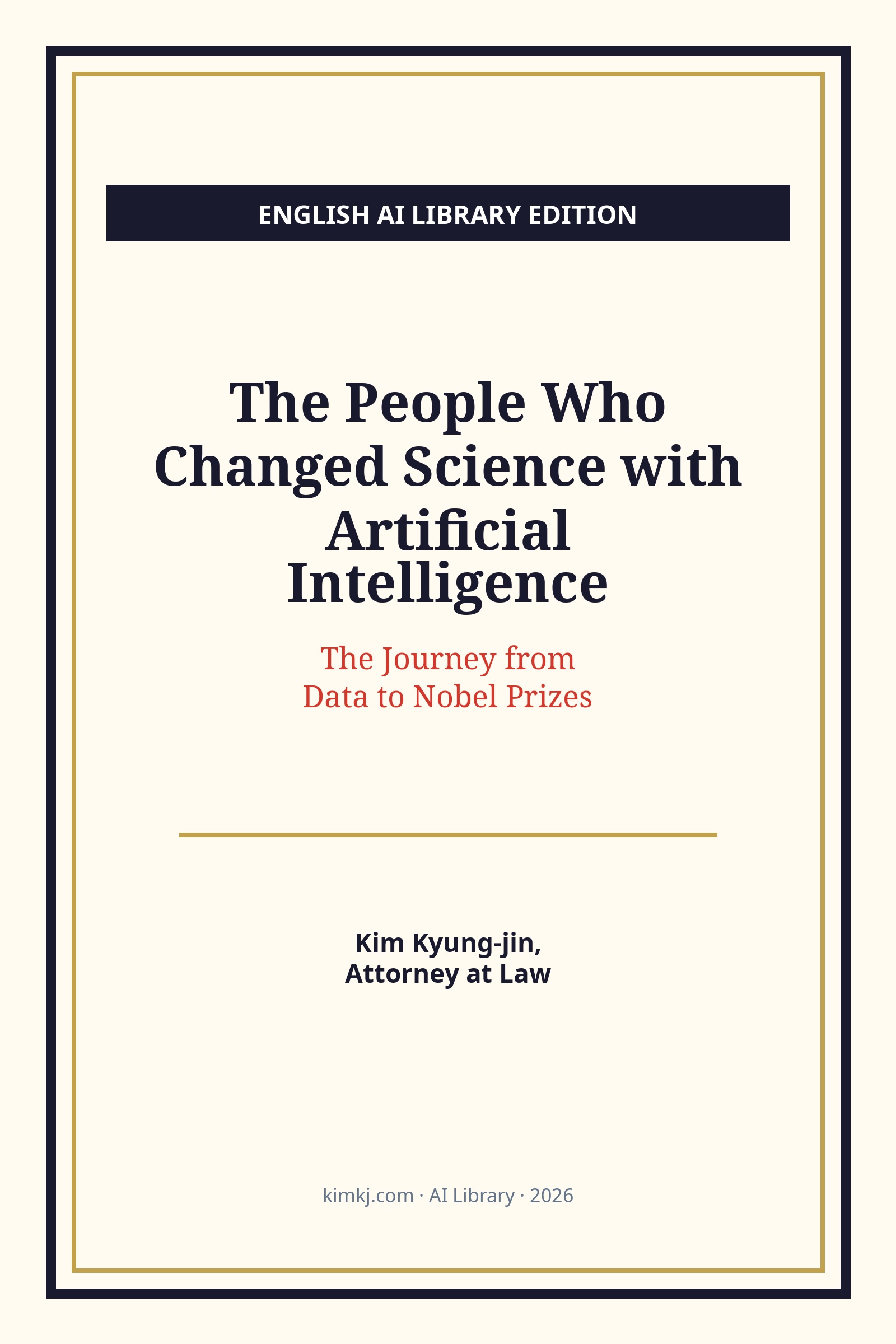
The People Who Changed Science with Artificial Intelligence cover

Table of Contents

The People Who Changed Science with Artificial Intelligence

Kim Kyung-jin, Attorney at Law

The Journey from Data to Nobel Prizes

This book follows eleven scientists who moved artificial intelligence into the heart of scientific discovery, from protein folding and new drug discovery to self-driving laboratories, machine scientists, automated paper reading, and the legal question of who owns a discovery made by a machine.

The Age of Autonomous Scientific Discovery cover

AI Library

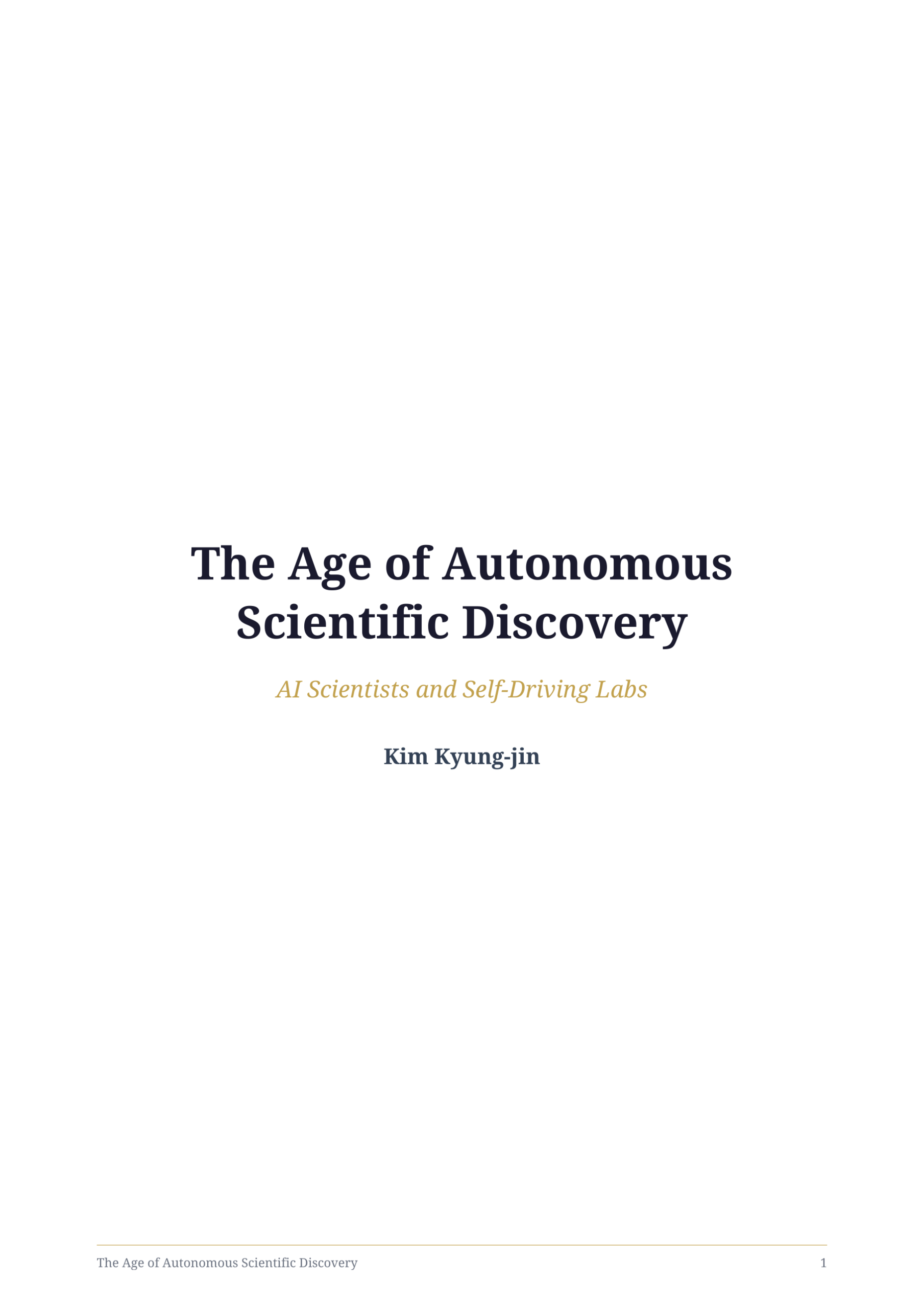
The Age of Autonomous Scientific Discovery

Kim Kyung-jin, Attorney at Law

AI Scientists and Self-Driving Labs

This book follows how AI scientists and self-driving labs are changing the way science generates and verifies claims. It covers literature-based discovery, natural-language protocols translated into robot commands, multi-agent research systems, closed-loop laboratories, materials search, the verification gap, chains of evidence, research harnesses, journal ethics, and legal responsibility.

A New Era of Life Sciences Opened by Artificial Intelligence cover

AI Library

A New Era of Life Sciences Opened by Artificial Intelligence

Structural Proteomics, Genomic Foundation Models, Autonomous Laboratories, and Global Governance

Kim Kyung-jin, Attorney at Law

This book is a research volume compiled with artificial intelligence. A human selected the materials and structured the work, while AI models drafted the sentences and cross-checked the facts.

Get 1,000% More from Your Computer with AI Agents cover

Table of Contents

Get 1,000% More from Your Computer with AI Agents

Kim Kyung-jin

Twenty-four practical ways to change daily life and work with AI agents

This book shows how to get past the moments when a computer becomes difficult by working with an AI agent. It guides readers through installation and a first conversation, safe delegation, file organization and automatic backup, photo, PDF and video work, shortcuts and monitoring tools, diagnosing a slow computer, reviving an older PC, reading error messages, and putting a work environment in order.

The Double Structure of Digital Sovereignty cover

AI Library

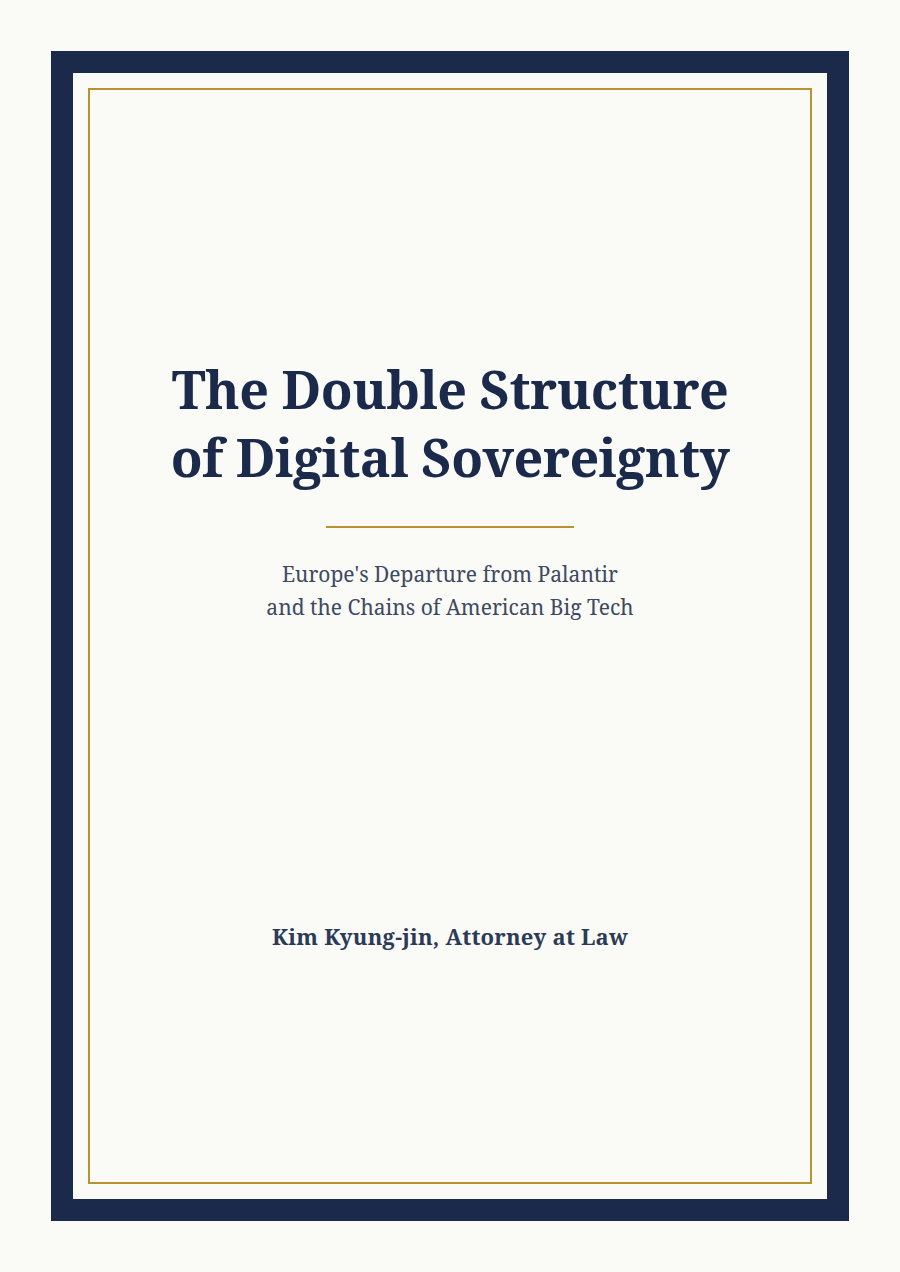
The Double Structure of Digital Sovereignty

Europe’s Departure from Palantir and the Chains of American Big Tech

Kim Kyung-jin, Attorney at Law

This is a record of 2026, when European intelligence agencies and defense ministries began removing analytics tools from America’s Palantir. It covers the replacement decisions made by France’s General Directorate for Internal Security (DGSI), Germany’s Federal Office for the Protection of the Constitution (BfV), and the Netherlands Ministry of Defense; the incident in which US export controls severed an ally’s ac…
Artificial Intelligence in Horticulture cover

New English Edition

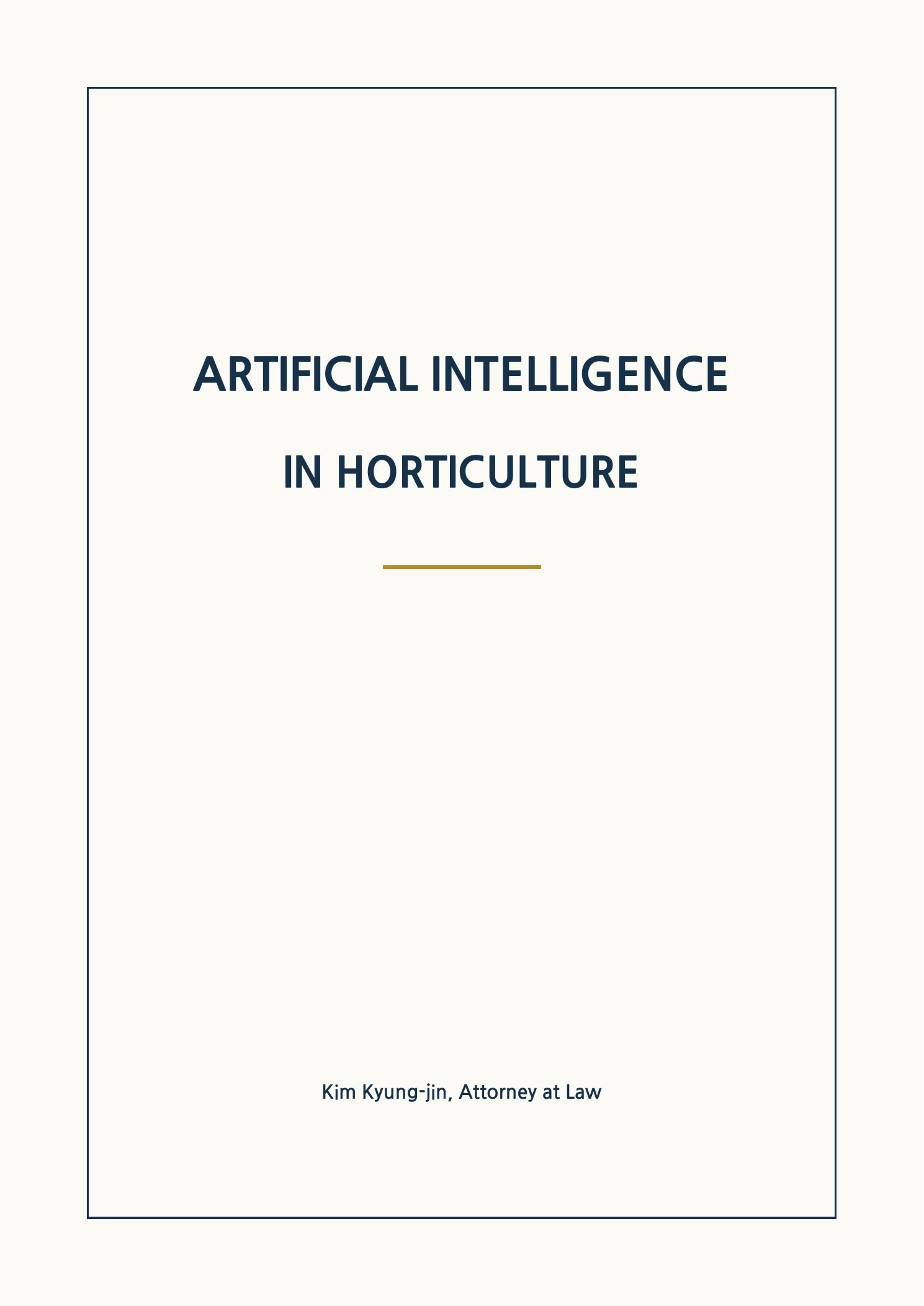
Artificial Intelligence in Horticulture

Kim Kyung-jin, Attorney at Law

Across five chapters and ten sections, this book examines computer vision for crop diagnosis, harvesting robots and autonomous field systems, smart greenhouses and digital twins, precision irrigation and supply-chain quality control, high-throughput phenotyping, and predictive breeding.
Artificial Intelligence in Food Crop Agriculture cover

New English Edition

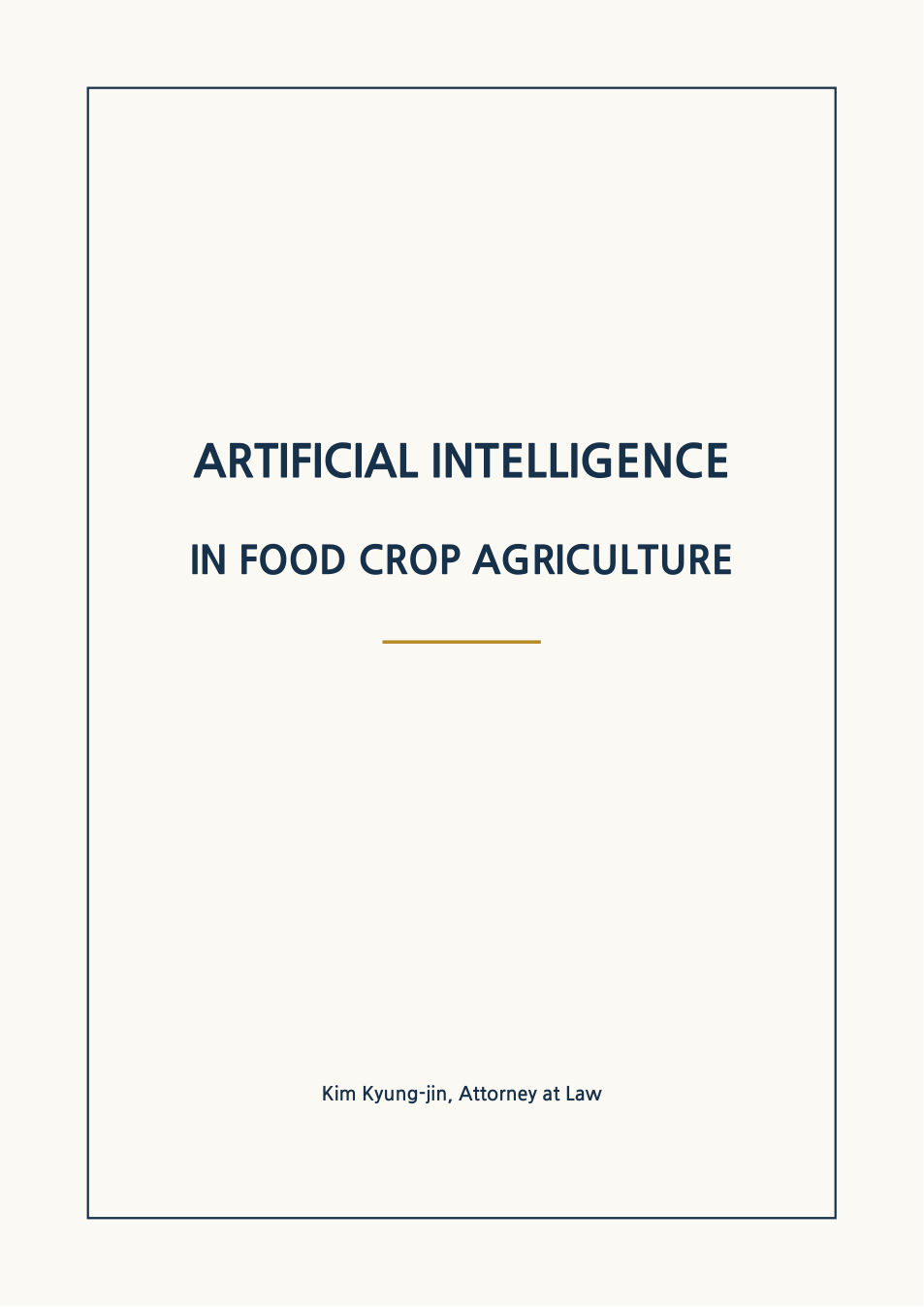
Artificial Intelligence in Food Crop Agriculture

Kim Kyung-jin, Attorney at Law

Across six chapters and eighteen sections, the book examines digital agricultural infrastructure, remote sensing, crop diagnosis, yield forecasting, precision irrigation, genomics, molecular breeding, agricultural robotics, climate-smart agriculture, and global food security.
The Future of Forestry and Agroforestry cover

New English Edition

The Future of Forestry and Agroforestry

Kim Kyung-jin, Attorney at Law

Driven by Artificial Intelligence and Digital Innovation

Across five chapters and fifteen sections, the book follows satellites, drones, LiDAR, digital twins, forest-specific language models, wildfire and pest forecasting, forestry robotics, agroforestry, timber traceability, and forest carbon markets.

Smart Livestock Farming cover

New English Edition

Smart Livestock Farming: AI Enters the Barn

Kim Kyung-jin, Attorney at Law

Sensors listen, cameras watch, and artificial intelligence helps farmers decide.

Across five chapters and fifteen sections, the book follows precision livestock farming from animal health and reproduction to robotic milking, virtual fencing, digital twins, methane reduction, welfare, and data ownership.

The Paradigm Shift in AI Drug Discovery cover

Table of Contents

The Paradigm Shift in AI Drug Discovery and the Future Convergence Ecosystem

Kim Kyung-jin

From data-driven target discovery to self-driving laboratories

From finding the protein behind a disease and drawing the molecule, to screening out toxicity, replacing animal testing with organ chips, running trials on virtual patients, and settling who is liable when an AI-designed drug goes wrong. Fifteen sections across five parts, written so that no background in biology or chemistry is needed.

The Shaking Archipelago, The People Who Remember cover

Table of Contents

The Shaking Archipelago, The People Who Remember

Kim Kyung-jin

Japan's Earthquakes, Tsunamis, and Disaster Preparedness

This book follows the Nankai Trough, the 2011 Tohoku earthquake and tsunami, Mount Fuji's eruption risk, seismic observation networks, historical documents, tsunami deposits, the lesson of Onagawa Nuclear Power Station, and evacuation challenges in an aging society.

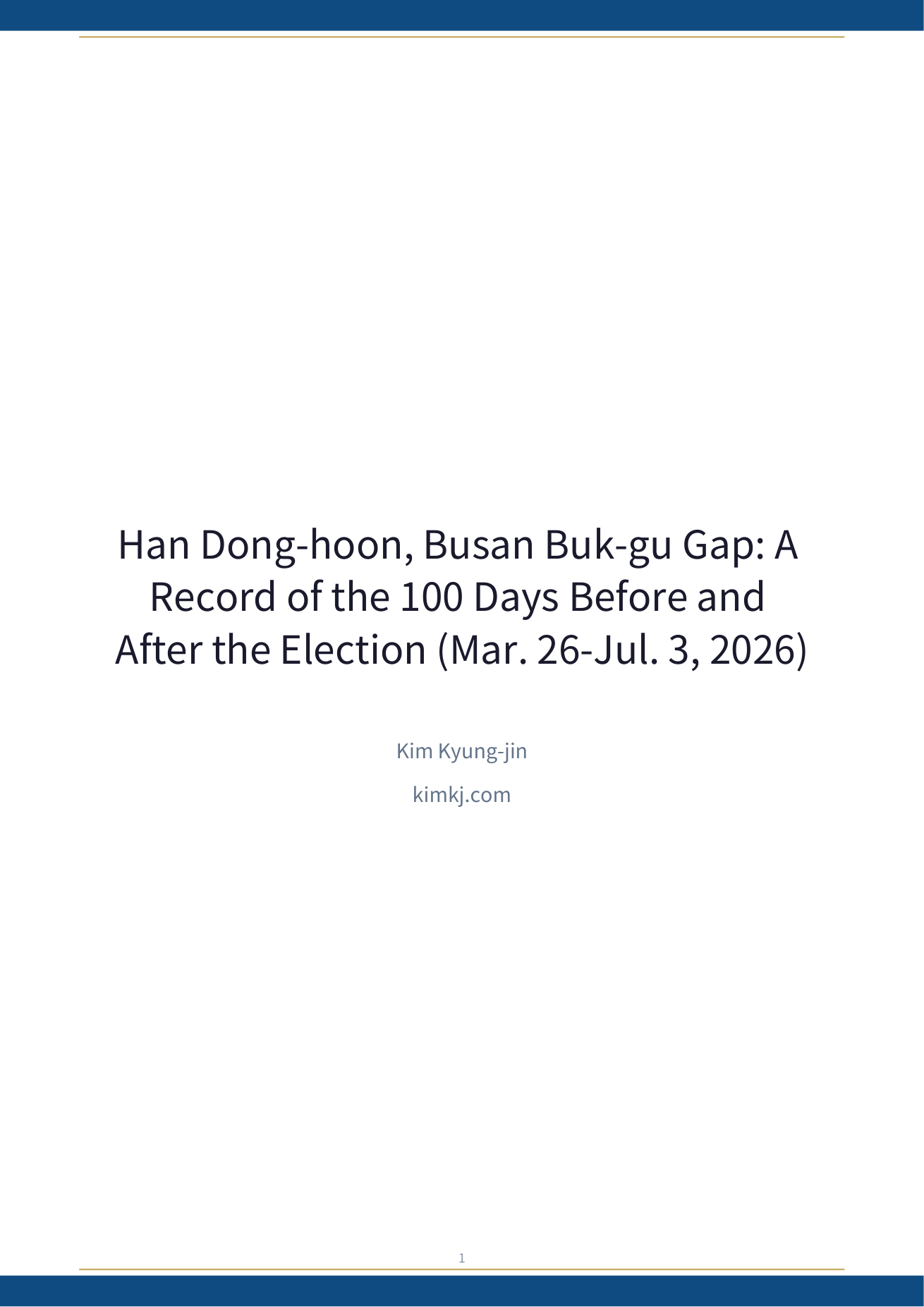
Han Dong-hoon, Busan Buk-gu Gap: A Record of the 100 Days Before and After the Election (Mar. 26-Jul. 3, 2026) cover

Table of Contents

Han Dong-hoon, Busan Buk-gu Gap: A Record of the 100 Days Before and After the Election (Mar. 26-Jul. 3, 2026)

Kim Kyung-jin

Table of Contents and 13 sections

From March 26 to July 3, 2026, this record follows the spring after expulsion, the Busan Buk-gu Gap by-election, victory as an independent, and the first bill submitted in the National Assembly.

Artificial Intelligence and Medicine cover

Table of Contents

Artificial Intelligence and Medicine

Kim Kyung-jin, Attorney at Law

AI in clinical care, hospitals, education, and research

AI in medical imaging, risk prediction, treatment planning, hospital operations, education, and research, with patient safety, privacy, and accountability.


The EU AI Act cover

Table of Contents

The EU AI Act

Kim Kyung-jin, Attorney at Law

A Practitioner’s Guide for Korean Companies

From August 2, 2026, a game company’s chatbot in Pangyo and a medical-device reading software in Busan fall under Article 50 of the EU AI Act, even without a single office in Europe. Rather than summarizing the provisions, this book reads them from the enforcement authority’s point of view: extraterritorial reach, transparency duties, general-purpose AI models, high-risk systems, and the double regulation that overlaps with Korea’s AI Framework Act. It is a field guide to what a Seoul-headquartered company must prepare, when, and how.

South Korea's AI Basic Act: A Practical Guide for Business Operators cover

Contents

South Korea’s AI Basic Act: A Practical Guide for Business Operators

Kim Kyung-jin, Attorney at Law

Compliance, Obligations, and Opportunities under Korea’s AI Regulation

On January 22, 2026, the AI Basic Act came into effect in the Republic of Korea. This book was written by an attorney for business operators. It answers questions such as “Is our service high-impact AI?”, “How should prior notification be conducted?”, and “What preparations are needed when expanding into the EU?”

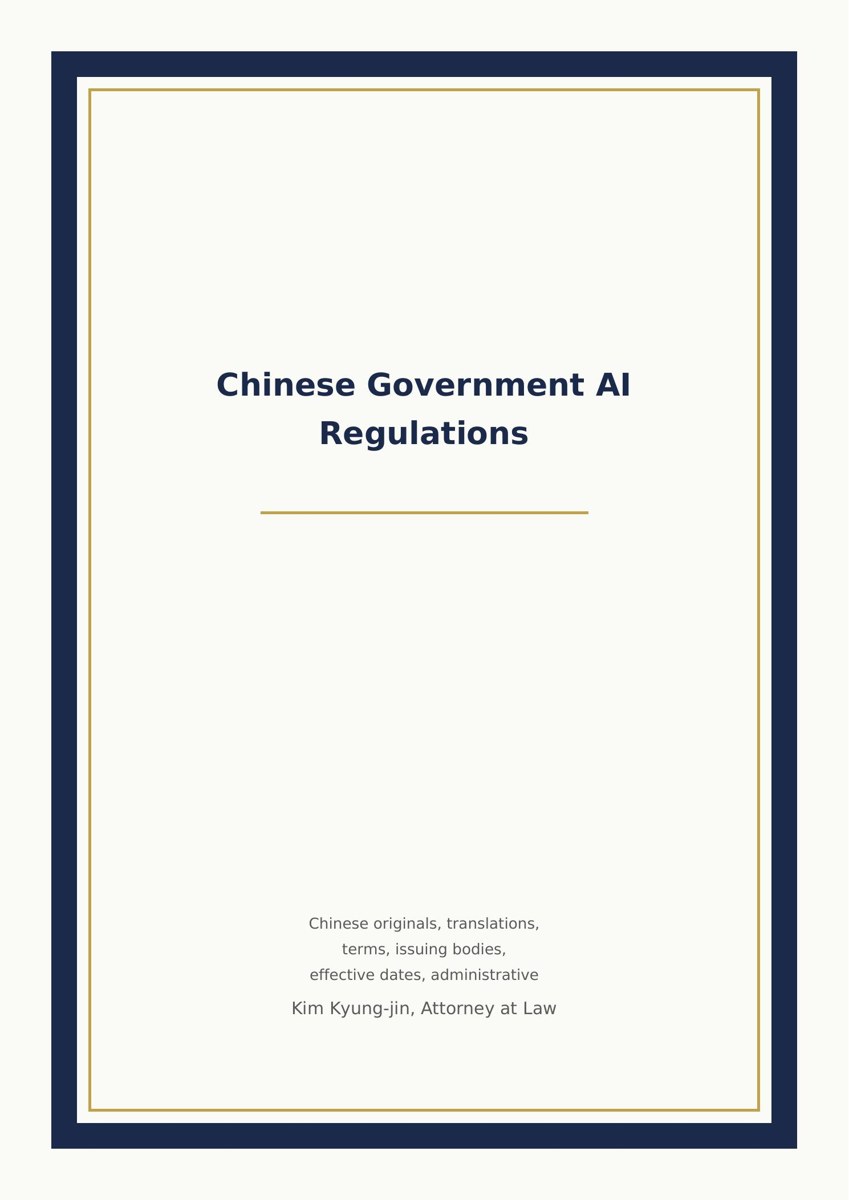
Chinese Government AI Regulations cover

Contents

Chinese Government AI Regulations

Kim Kyung-jin, Attorney at Law

Chinese originals, translations, terms, issuing bodies, effective dates, administrative interpretations, and judicial materials

This edition orders Chinese AI-related laws, administrative regulations, military regulations, departmental rules, policy documents, and national standards by legal force. Each entry keeps the Chinese original text and adds an English translation or explanation, legal terms, issuing body, effective date, administrative interpretations, and judicial materials where available.

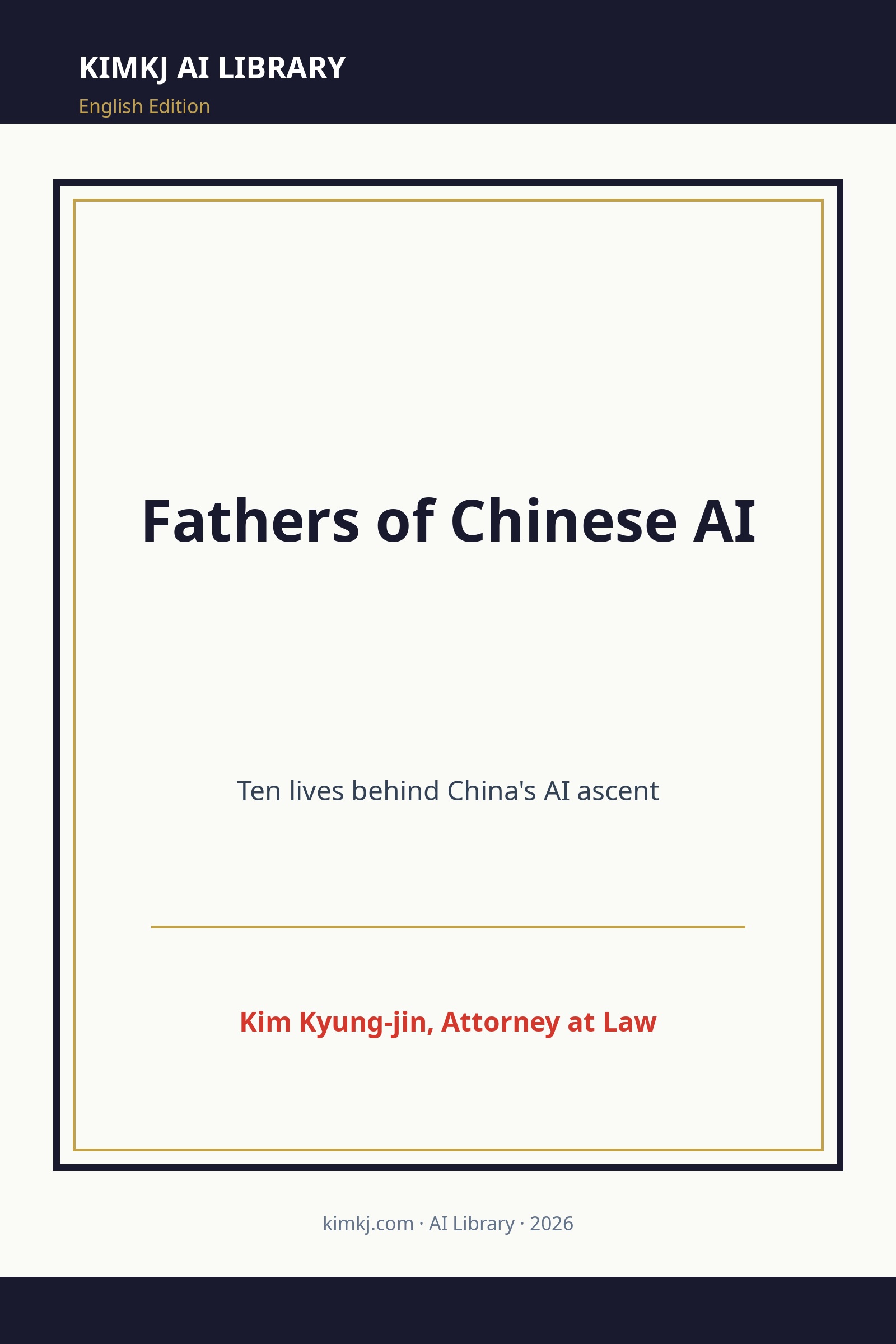
Fathers of Chinese AI cover

Table of Contents

Fathers of Chinese AI

Kim Kyung-jin, Attorney at Law

Ten lives behind China's AI ascent

This book follows Kai-Fu Lee, Robin Li, Jie Tang, Liang Wenfeng, Yang Zhilin, Yan Junjie, Wang Xiaochuan, Jingren Zhou, Shunyu Yao, and Yonghui Wu through the laboratories, companies, models, and policy environment that shaped Chinese AI.

How Far Has AI Entered Chinese Hospitals? cover

Table of Contents

How Far Has AI Entered Chinese Hospitals?

Kim Kyung-jin, Attorney at Law

A quiet shift in clinics, imaging rooms, and hospital administration

This book follows how artificial intelligence has entered Chinese hospitals, using Chinese and English materials together with original Chinese policy texts. It covers national policy, medical foundation models, clinical decision support, image reading, hospital information departments, traditional Chinese medicine, AI-native hospitals, the patient experience, hallucination and responsibility, regulation, and money. The final chapters collect major Chinese guidelines and the 84 health-sector AI application scenarios, with translated text and summaries.

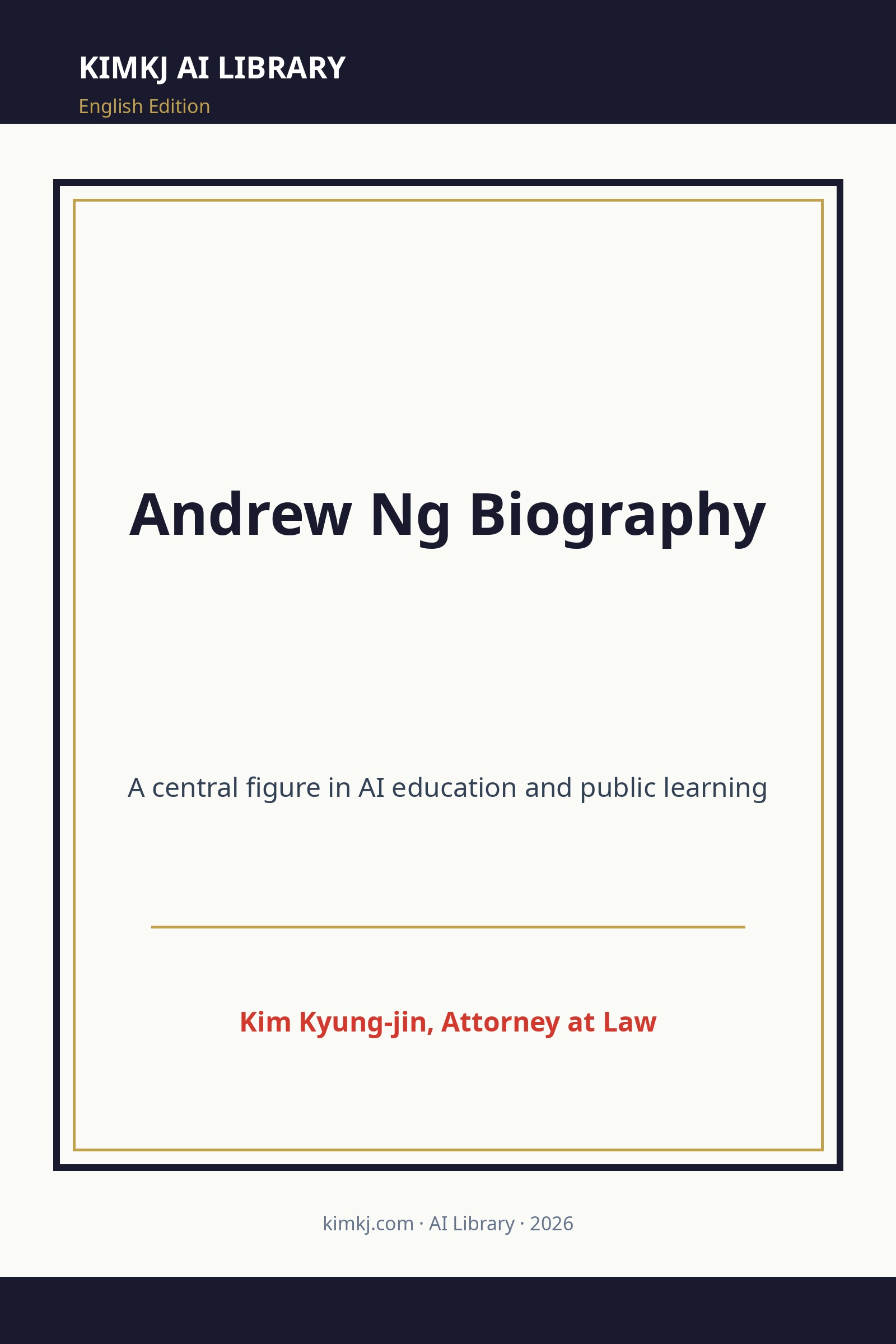
Andrew Ng Biography cover

Table of Contents

Andrew Ng Biography

Kim Kyung-jin, Attorney at Law

A central figure in AI education and public learning

This book follows Andrew Ng from London, Hong Kong, Singapore, Carnegie Mellon, MIT, Berkeley, and Stanford to Google Brain, Coursera, Baidu, DeepLearning.AI, Landing AI, AI Fund, and Amazon. It reads his career through research, teaching, company building, and his practical view of AI.

Mykhailo Fedorov, Leading Figure of Ukraine's Drone War cover

Table of Contents

Mykhailo Fedorov, Leading Figure of Ukraine's Drone War

Kim Kyung-jin

From the State in a Smartphone to the Defense Ministry of the Drone War

This book follows Diia, IT Army, Starlink, UNITED24, Brave1, the Unmanned Systems Forces, drone procurement, and battlefield data to explain how Mykhailo Fedorov tied technology to state power in wartime Ukraine.

China’s Leading AI Firms and Government Agencies cover

Table of Contents

China’s Leading AI Firms and Government Agencies

Kim Kyung-jin

Policy, Companies, Data, and Hardware in China’s Intelligent Economy

This book follows China’s AI policy arc from the 2017 next-generation AI plan to AI+ and the 15th Five-Year Plan. It maps the roles of the State Council, NDRC, CAC, MIIT, and SAC, then reads DeepSeek, the AI Tigers, Alibaba, Tencent, Baidu, ByteDance, iFLYTEK, Huawei Ascend, East Data West Computing, manufacturing, education, consumption, and humanoid robotics as one connected system.

U.S. Department of War CDAO (Chief Digital and AI Officer) cover

Table of Contents

U.S. Department of War CDAO (Chief Digital and AI Officer)

Kim Kyung-jin, Attorney at Law

How the Military’s Brain Is Being Redesigned

From the moment in January 2026 when the U.S. Department of War declared data hoarding a national security threat, this book follows the birth of the CDAO (Chief Digital and Artificial Intelligence Office) and the five organizations it absorbed, Advana and the War Department Data Platform, the Open DAGIR procurement experiment, Project Maven and CJADC2 on the battlefield, and Responsible AI, allies, and critics — the story of how America is redesigning its military’s brain.

Science and Technology Commission of the CMC of the Communist Party of China cover

Table of Contents

Science and Technology Commission of the CMC of the Communist Party of China

Kim Kyung-jin

STC, Military-Civil Fusion, and China’s Military Technology Innovation

This English AI Library edition follows the CMC Science and Technology Commission, the Equipment Development Department, military-civil fusion, intelligentized warfare, emerging technology competition, and the institutional limits of China’s military innovation system.

The Chinese Communist Party School cover

Table of Contents

The Chinese Communist Party School

Kim Kyung-jin

Where Power Is Trained

This book follows the Chinese Communist Party school system from Ruijin and Yan'an to the Central Party School, the National Academy of Governance, provincial and county schools, young-official training classes, Cai Qi's leadership, and the Mwalimu Julius Nyerere Leadership School.

DARPA, America’s Defense Research Lab cover

Table of Contents

DARPA, America’s Defense Research Lab

Kim Kyung-jin

This book follows DARPA through its 2026 office reorganization, budget signals, AIxCC, AI Forge, RACER, LongShot, quantum computing, space robotics, battlefield medicine, and strategic-material programs, using official sources as the main trail.

AI and the Classroom cover

Table of Contents

AI and the Classroom

Kim Kyung-jin

The AI Teacher That Does Not Give Answers

From Estonia's AI Leap and Khanmigo to answer leakage, Korean AI digital textbooks, and teacher-in-the-loop classrooms, this book asks how AI can protect thinking instead of replacing it.

Spiderweb cover

Table of Contents

Spiderweb

Kim Kyung-jin

Ukraine's drone revolution that changed the map of war

A narrative account of Operation Spiderweb on June 1, 2025, and how Ukraine's drones reached deep inside Russia and changed military planning, intelligence work, and security assumptions.

A Map of the 2026 U.S.-China Collision cover

Table of Contents

A Map of the 2026 U.S.-China Collision

Kim Kyung-jin

The year tied in Busan and left unsolved in Beijing

A one-year map of tariffs, chips, rare earths, Taiwan, sea lanes, and Korea's choices between Washington and Beijing.

China's 2026 Power Map cover

Table of Contents

China's 2026 Power Map

Kim Kyung-jin

The completion of one-man rule, and the empty seat that follows

A map of Xi Jinping's power system, the military purge, the blocked succession path, and the economic-security dilemma.

The Architect of Contradictions cover

Table of Contents

The Architect of Contradictions

Kim Kyung-jin

Peter Thiel and the empire built by a man who hated competition

Peter Thiel, from a South African childhood to PayPal, Facebook, Palantir, politics, and the dream of defeating death.

Claude, GPT, Palantir, and the 2026 World War cover

8 readings

Claude, GPT, Palantir, and the 2026 World War

Kim Kyung-jin

How Artificial Intelligence Came to Pull the Trigger of War. Prologue, 3 Parts / 6 Chapters, Epilogue

A single name sits on the screen. An intelligence officer looks at it for twenty seconds, confirms only that it is a man, and moves on. Inside those twenty seconds a person dies, and the responsibility for deciding to kill him disappears. From Lavender over Gaza to Maven in Ukraine, Epic Furies over Iran, and target selection in the skies of Venezuela, this book follows the hand that chooses targets as it passes from human to machine in the wars of 2026.

China's Robotics Industry 2026: The Age of Mass Production and Real-World Deployment cover

25 readings

China's Robotics Industry 2026: The Age of Mass Production and Real-World Deployment

Kim Kyung-jin

From the humanoid mass-production race to U.S.-China hegemony: the state of China's robotics industry in 2026. Table of Contents, Preface, 7 Parts / 23 Chapters, Epilogue

In a factory in Shenzhen, hundreds of humanoid robots repeat the same motion. This book traces the mass-production race between Unitree and UBTECH, the Optimus supply chain, real-world deployment sites, and where Korea stands amid the U.S.-China tech hegemony.

Crossing the Adolescence of Technology Cover

15 Parts in Total

Crossing the Adolescence of Technology

Kim Kyung-jin

Dario Amodei, Anthropic, and the Struggle Toward Controllable Intelligence. Table of Contents, Preface, Prologue, 12 Chapters, Epilogue

The struggle of a physicist who lost his father to create controllable artificial intelligence. The story of Dario Amodei and Anthropic clashing with the Pentagon and the White House, shaking the era with the scaling law and Constitutional AI.

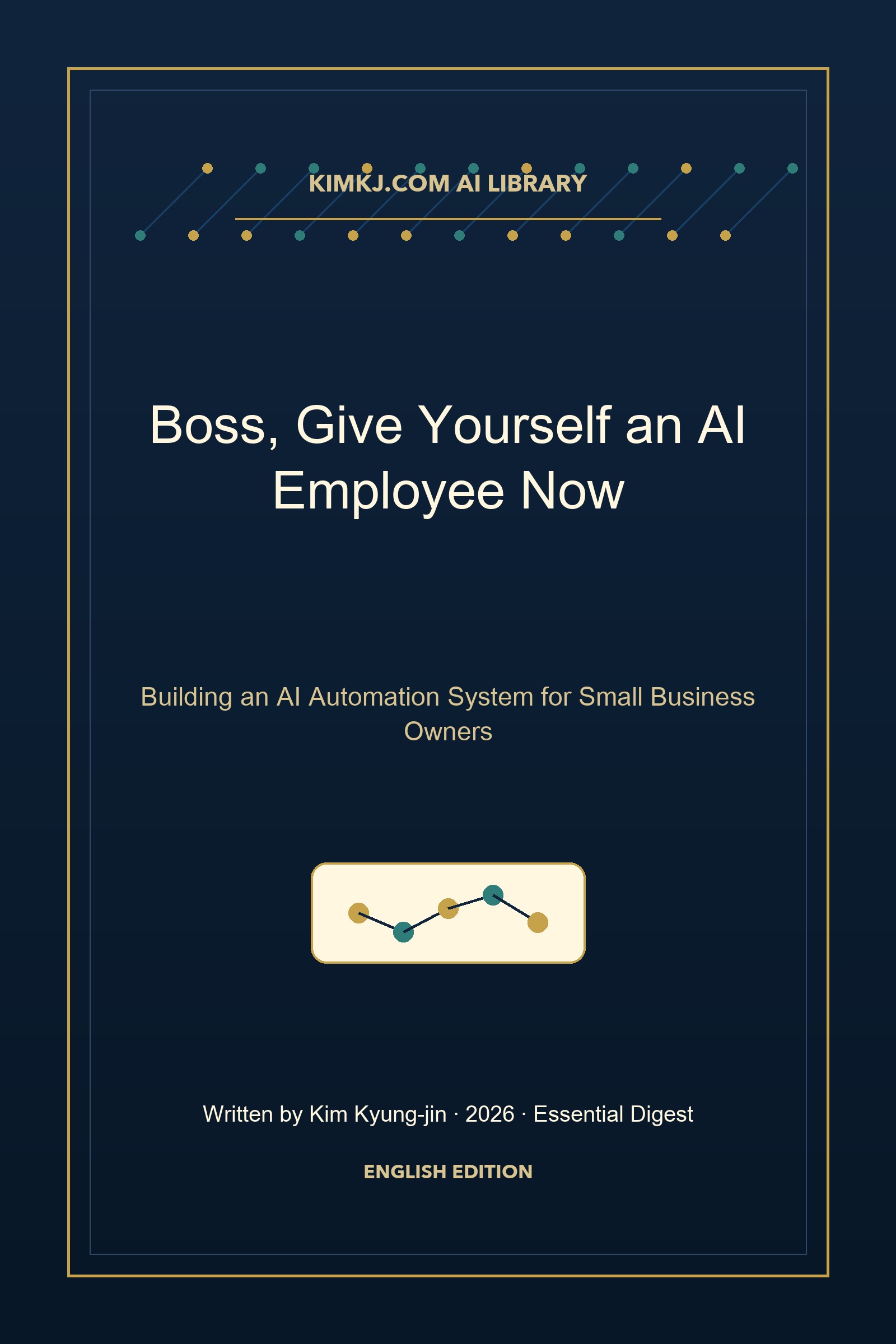
Boss, Give Yourself an AI Employee Now

Table of Contents, 43 Chapters, 11 Appendices, Epilogue

Boss, Give Yourself an AI Employee Now

Written by Kim Kyung-jin

Building an AI Automation System for Small Business Owners

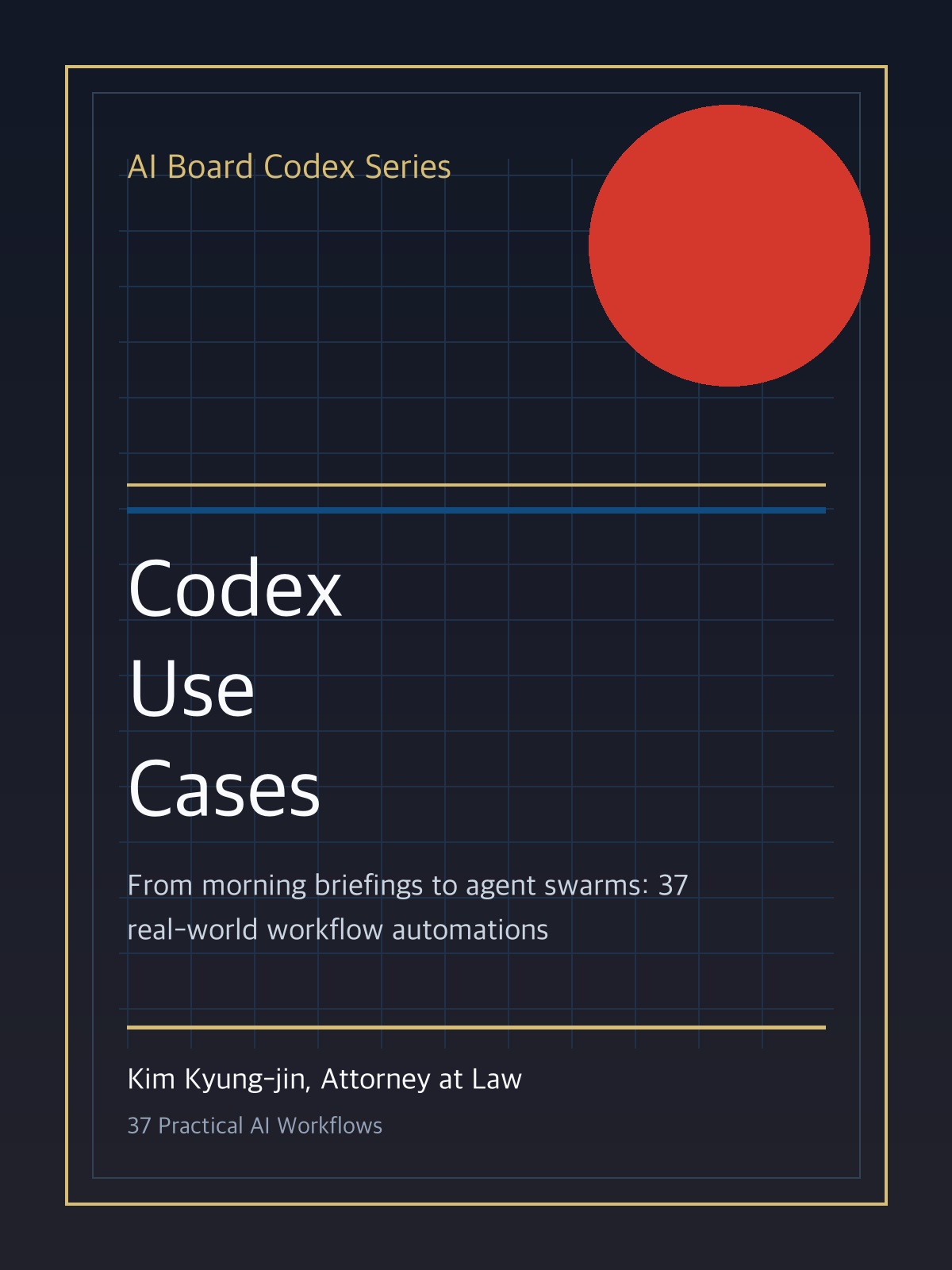
37 Concrete Codex Use Cases cover

Book-style reading

37 Concrete Codex Use Cases

Kim Kyung-jin

From morning briefings to agent swarms: 37 real-world workflow automations

This guide gathers 37 ways to connect Codex and AI agents to real work: personal routines, data processing, marketing, sales, documents, development, and browser control.

2026 Beijing: The Dangerous Dance of Two Giants book cover

16 posts available

2026 Beijing: The Dangerous Dance of Two Giants

Kim Kyung-jin

Table of Contents, Introduction, 13 Chapters, Epilogue

This book reads the Beijing summit through Hormuz, rare earths, Taiwan, Boeing, soybeans, AI chips, and Korea’s exposure to the U.S.-China bargain.

Leaving It to AI and Stepping Away cover

27 posts

Leaving It to AI and Stepping Away

Kim Kyung-jin

A Complete Beginner’s Guide to YOLO Mode. Table of contents and 26 chapters

A beginner-friendly online book on YOLO mode in Claude Code and Codex. It explains how to let AI read files, write code, run commands, and finish work while keeping rollback, Docker sandboxing, and safety checks close at hand.

Artificial Intelligence Fighter, Artificial Intelligence Air Force book cover

43 posts available

Artificial Intelligence Fighter, Artificial Intelligence Air Force

Kim Kyung-jin

Table of Contents, Preface, 40 Chapters, Epilogue

Artificial Intelligence Fighter, Artificial Intelligence Air Force is an online AI Library book by Kim Kyung-jin. It covers AI fighters, autonomous air power, unmanned combat aircraft, CCA, MUM-T, sixth-generation fighters and is organized as Table of Contents, Preface, 40 Chapters, Epilogue.

Artificial Intelligence on Trial book cover

26 posts available

Artificial Intelligence on Trial

Attorney Kyungjin Kim

Table of Contents, Preface, 21 Chapters, 3 Appendices

Artificial Intelligence on Trial is an online AI Library book by Attorney Kyungjin Kim. It covers artificial intelligence and law, AI liability, algorithmic judgment, courts and technology and is organized as Table of Contents, Preface, 21 Chapters, 3 Appendices.

PALANTIR book cover

16 posts available

PALANTIR: War, Surveillance, Artificial Intelligence

Attorney Kyungjin Kim

Table of Contents, Preface, 14 Chapters

PALANTIR: War, Surveillance, Artificial Intelligence is an online AI Library book by Attorney Kyungjin Kim. It covers Palantir, war, surveillance, artificial intelligence, data analytics, national security and is organized as Table of Contents, Preface, 14 Chapters.

Brain Readers: Neuralink and the Final Human Revolution book cover

21 posts available

Brain Readers: Neuralink and the Final Human Revolution

Kim Kyung-jin

Table of Contents, Prologue, 18 Chapters, Epilogue

Brain Readers: Neuralink and the Final Human Revolution is an online AI Library book by Kim Kyung-jin. It follows Neuralink, brain-computer interfaces, brain data, medicine, neurorights, and the future of human enhancement.

Artificial Intelligence and the Reshaping of Society book cover

16 posts available

Artificial Intelligence and the Reshaping of Society

Kim Kyung-jin

Table of Contents, Preface, 13 Chapters, Epilogue

Artificial Intelligence and the Reshaping of Society is an online AI Library book by Kim Kyung-jin. It follows how artificial intelligence changes work, education, inequality, cities, democracy, and human relationships.

The Jensen Huang Story book cover

16 posts available

The Jensen Huang Story

Kim Kyung-jin

Table of Contents, Preface, 13 Chapters, Epilogue

The Jensen Huang Story is an online AI Library book by Kim Kyung-jin. It covers Jensen Huang, NVIDIA, GPUs, AI chips, and the AI industry.

Ten Questions AI Poses to Humanity book cover

12 posts available

Ten Questions AI Poses to Humanity

Kim Kyung-jin

Table of Contents, Preface, 10 Chapters

Ten Questions AI Poses to Humanity is an online AI Library book by Kim Kyung-jin. It asks how artificial intelligence changes truth, weapons, work, data, identity, and human control.

Malaysia and the Malacca Strait book cover

23 posts available

Malaysia and the Malacca Strait: Whoever Controls It Controls the World

Kim Kyung-jin

Table of Contents, Preface, 20 Chapters, Epilogue

Malaysia and the Malacca Strait is an online AI Library book by Kim Kyung-jin. It covers Malaysia, the Malacca Strait, maritime logistics, geopolitics, global trade, and Southeast Asia’s strategic future.

Georgia history and culture travel book cover

24 posts available

A Journey Through Georgia’s History and Culture

Kim Kyung-jin

Table of Contents, Preface, 17 Chapters, 4 Appendices, Epilogue

A Journey Through Georgia’s History and Culture is an online AI Library book by Kim Kyung-jin. It covers Georgia’s history, culture, religion, politics, travel, and the Caucasus crossroads between Europe and Asia.

Reading Armenia book cover

13 posts available

Reading Armenia: A Thousand Prayers, One Mountain

Kim Kyung-jin

Table of Contents, Preface, 10 Chapters, Epilogue

Reading Armenia: A Thousand Prayers, One Mountain is an online AI Library book by Kim Kyung-jin. It covers Armenian history, faith, Mount Ararat, cultural memory, travel, and the endurance of a small nation.

Mastering Claude Code book cover

41 posts available

Mastering Claude Code

Kim Kyung-jin

Table of Contents, Preface, Chapters, Appendices

Mastering Claude Code is an online AI Library book by Kim Kyung-jin. It covers Claude Code setup, commands, workflows, automation, agents, and practical methods for using Claude Code in real work.

Claude Cowork and Agent manual book cover

11 posts available

Claude Cowork and Agent Utilization Manual

Kim Kyung-jin

Table of Contents, Preface, 8 Chapters, Closing Note

Claude Cowork and Agent Utilization Manual is an online AI Library book by Kim Kyung-jin. It covers Claude Code, AI agents, coding automation, work automation, and practical agent-based collaboration.

2026 U.S.-Iran War and the Global Energy Crisis book cover

39 posts available

The 2026 U.S.-Iran War and the Global Energy Crisis

Kim Kyung-jin

Table of Contents, Preface, Chapters and Appendices

The 2026 U.S.-Iran War and the Global Energy Crisis is an online AI Library book by Kim Kyung-jin. It covers war, oil, the Strait of Hormuz, maritime security, energy markets, and the global consequences of conflict.

The Traces Han Dong-hoon Left on South Korea book cover

13 posts available

The Traces Han Dong-hoon Left on South Korea

Kim Kyung-jin

Table of Contents, Prologue, Chapters, Epilogue

The Traces Han Dong-hoon Left on South Korea is an online AI Library book by Kim Kyung-jin. It examines his record in justice policy, immigration reform, public institutions, and the structural questions facing South Korea.

The Han Dong-hoon Story book cover

39 posts available

The Han Dong-hoon Story

Kim Kyung-jin

Table of Contents, Prologue, Chapters, Epilogue

The Han Dong-hoon Story is an online AI Library book by Kim Kyung-jin. It traces Han Dong-hoon’s life, public career, political choices, and the changing landscape of South Korean conservative politics.

Beyond the Glass Ceiling cover

39 entries

Beyond the Glass Ceiling

Kim Kyung-jin

Table of contents, prologue, 31 chapters, epilogue, 5 appendices

A political biography tracing Sanae Takaichi’s rise from Nara to Japan’s premiership, through party struggles, security policy, diplomacy, and the meaning of Japan’s first female prime minister.

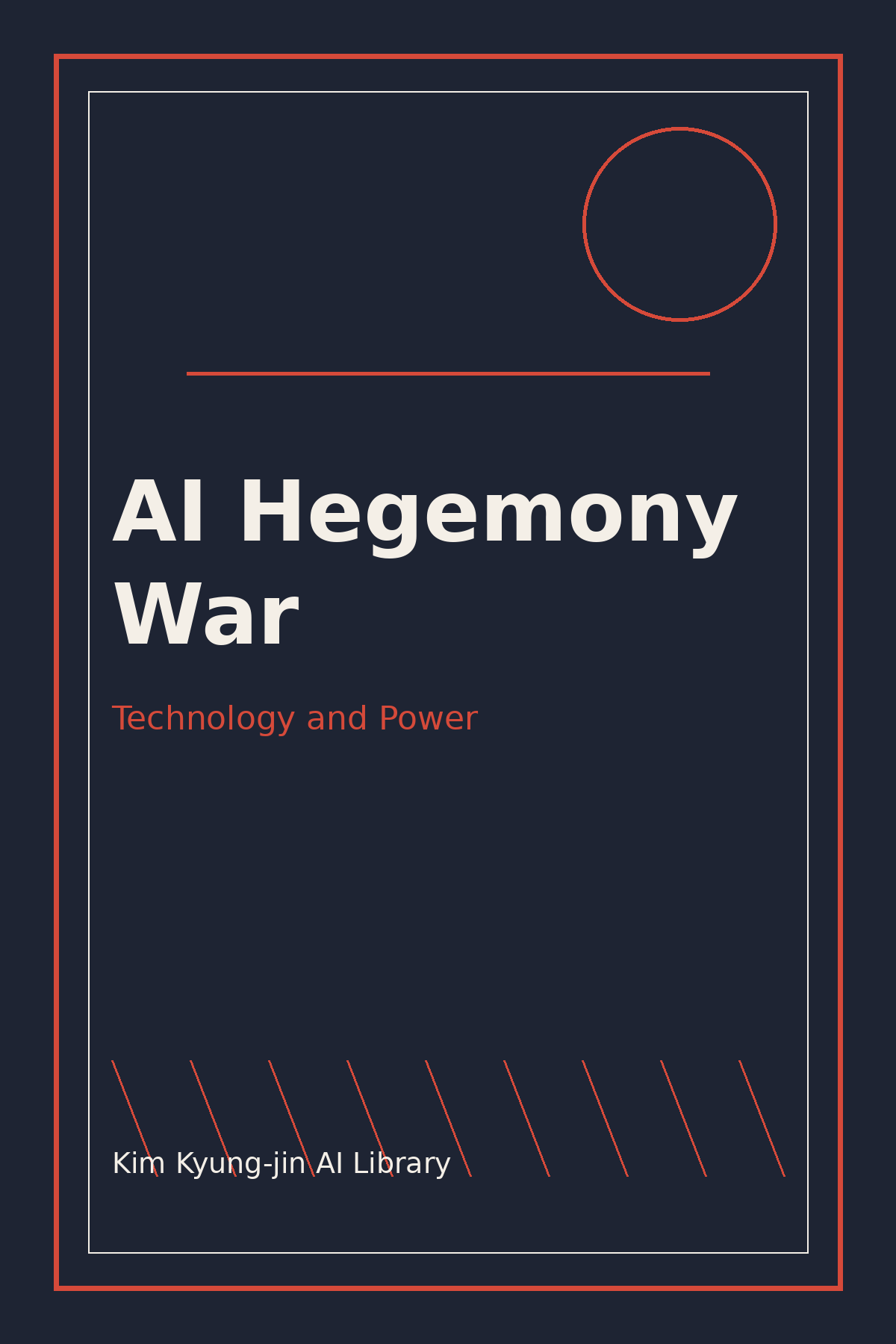
AI Hegemony War book cover

8 posts available

AI Hegemony War

Kim Kyung-jin

Table of Contents, 7 Chapters

An online AI Library book by Kim Kyung-jin on AI superintelligence, the U.S.-China technology race, Europe and Korea’s AI laws, and international AI governance.

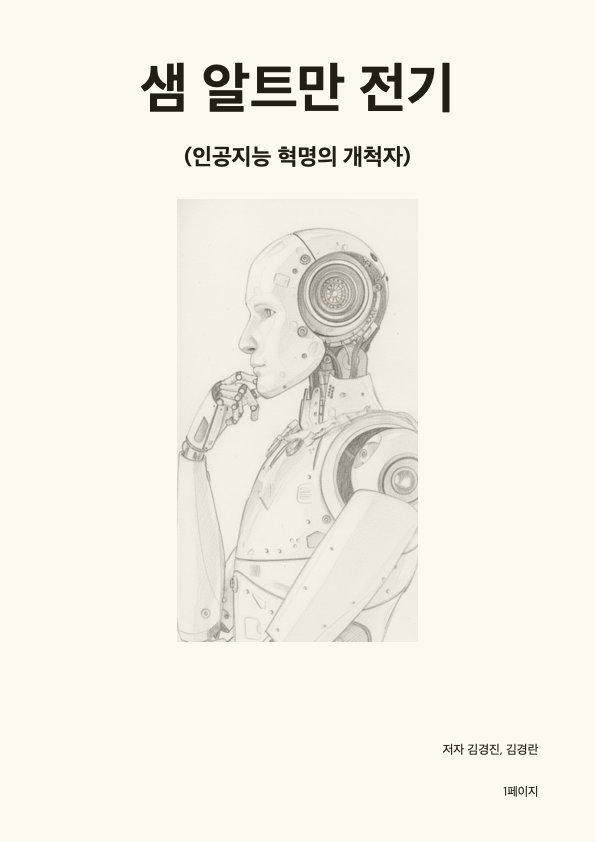
Sam Altman Biography: Pioneer of the AI Revolution cover

22 posts

Sam Altman Biography: Pioneer of the AI Revolution

Kim Kyung-jin, Kim Kyung-ran

Table of contents, preface, 7 parts, 20 chapters

An online biography following Sam Altman’s childhood, startups, Y Combinator, OpenAI, ChatGPT, the 2023 board crisis, and his sense of responsibility in the AI era.

From Chaiwala to Prime Minister cover

13 entries

From Chaiwala to Prime Minister

Kim Kyung-jin

Table of contents, preface, 10 chapters, epilogue

A political biography tracing Narendra Modi from a chai-selling boy in Vadnagar to RSS organizer, Gujarat chief minister, and three-term prime minister, while reading modern India, Korea-India relations, and the risks of a rising power.

AI Classroom: Your Grades Will Change book cover

26 posts available

AI Classroom: Your Grades Will Change

Kim Kyung-jin

Table of Contents, Preface, 24 Sections

An online AI Library book by Kim Kyung-jin on how AI can support elementary, middle, and high school learning, teaching, assessment, and educational equity.

Military Artificial Intelligence cover

17 entries

Military Artificial Intelligence

Kim Kyung-jin and Kim Won-tae

Table of contents, preface, 14 chapters, epilogue

A full-length study of military artificial intelligence, from autonomous weapons, drones, command systems, logistics, and cyber defense to the strategies of the United States, China, Israel, Korea, and global defense AI companies.

Global Case Studies in Introducing AI into Public Administration book cover

25 posts available

Global Case Studies in Introducing AI into Public Administration

Kim Kyung-jin

Table of Contents, 23 Chapters, Epilogue

An online AI Library book by Kim Kyung-jin on public-sector AI adoption, national strategies, administrative services, governance, and future policy tasks.

Seven Misunderstandings About the Arctic Route book cover

10 posts available

Seven Misunderstandings About the Arctic Route

Kim Kyung-jin

Table of Contents, Preface, 7 Chapters, Epilogue

An online AI Library book by Kim Kyung-jin on seven common misunderstandings about the Arctic Route, including speed, liner service, insurance, safety rules, year-round access, carbon impact, and infrastructure.

Artificial Intelligence Election cover

14 posts

Artificial Intelligence Election

Kim Kyung-jin

Table of contents, author preface, 11 chapters, closing essay

An online book on campaign messaging, publicity materials, digital campaigning, data analysis, campaign operations, disinformation defense, legal risk, and ready-to-use prompts.

Demis Hassabis book cover

34 posts available

Demis Hassabis, Father of Google’s Artificial Intelligence

Kim Kyung-ran, Kim Kyung-jin

Table of Contents, Author’s Preface, 31 Chapters, Epilogue

Demis Hassabis, Father of Google’s Artificial Intelligence is an online AI Library book by Kim Kyung-ran, Kim Kyung-jin. It covers Demis Hassabis, Google DeepMind, artificial intelligence, AlphaGo, AI research and is organized as Table of Contents, Author’s Preface, 31 Chapters, Epilogue.

The Dhammapada 423 Verses book cover

28 posts available

The Dhammapada: 423 Verses

Kim Kyung-jin

Table of Contents, Editor’s Note, 26 Chapters, 423 Verses

An online AI Library book by Kim Kyung-jin. This edition arranges all 423 verses of the Dhammapada into 26 chapters for slow, poetic reading.

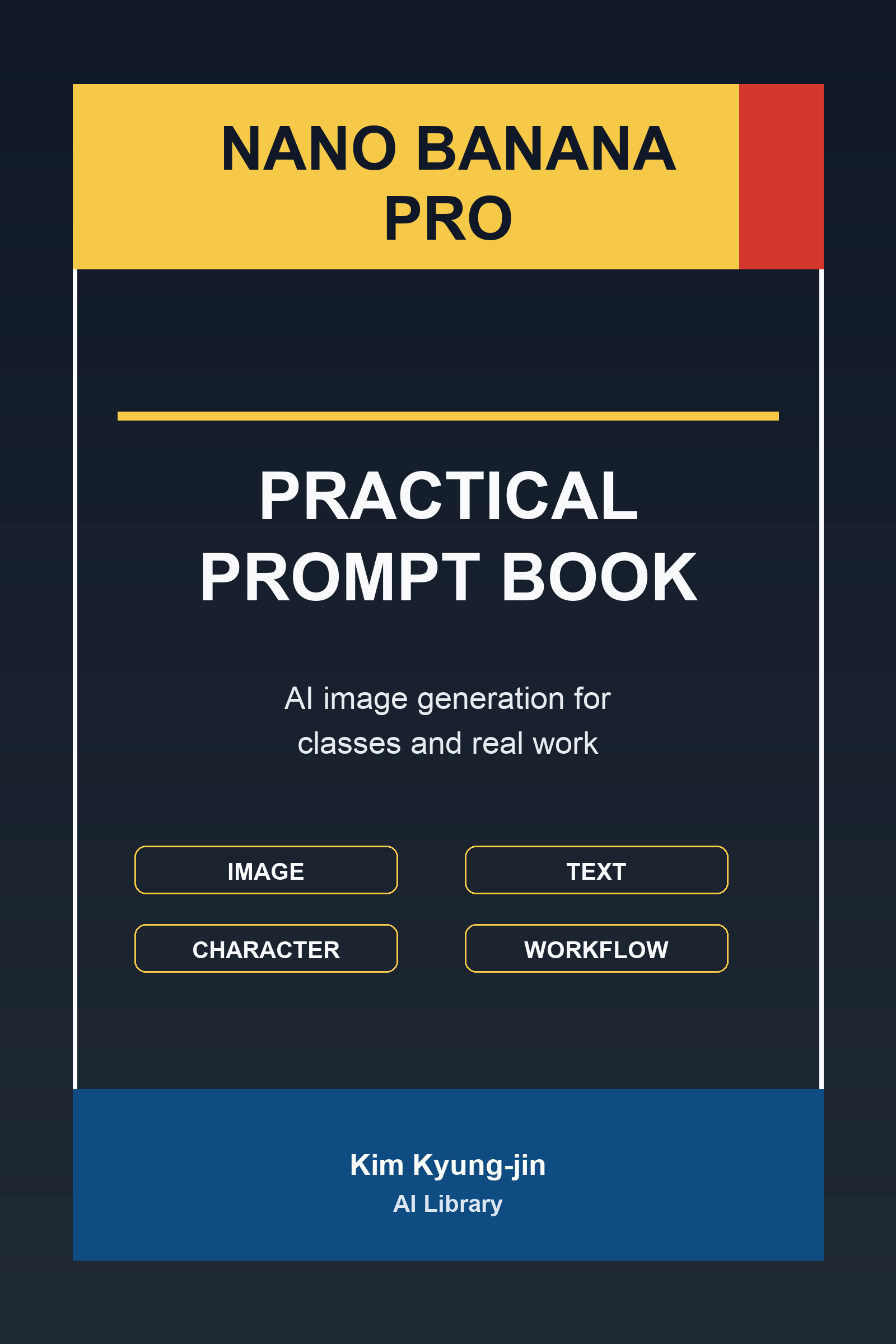
Nano Banana Pro Practical Prompt Book cover

24 posts

Nano Banana Pro Practical Prompt Book

Kim Kyung-jin

6 parts, 22 chapters, classroom prompt appendix

An online book for using Nano Banana Pro in classes and real work, covering image generation, editing, text rendering, character consistency, business use cases, and monetization.

Liberal Arts AI for College Students book cover

16 posts available

Liberal Arts AI for College Students

Kim Kyung-jin

Table of Contents, Preface, 13 Chapters, Closing Essay

An online AI Library textbook for college students. It introduces AI history, daily use, document work, research, images, presentations, video, productivity, learning, careers, copyright, and governance.

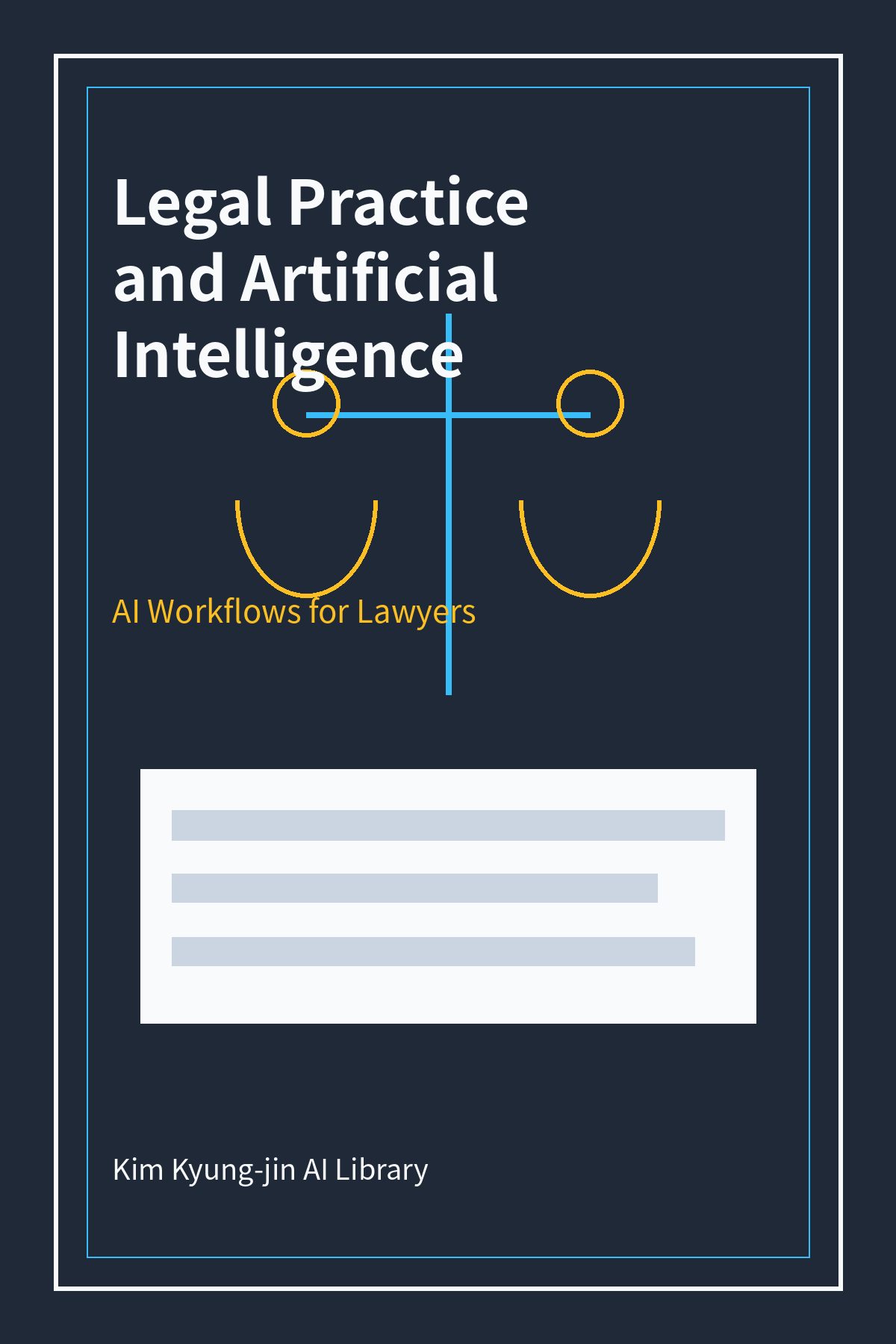
Legal Practice and Artificial Intelligence book cover

16 posts available

Legal Practice and Artificial Intelligence

Kim Kyung-jin

Table of Contents, Preface, 14 Parts

An online AI Library book by Kim Kyung-jin on legal research, drafting, evidence analysis, contract review, NotebookLM, and practical generative AI workflows for legal practice.

Hello, I Am Kim Kyung-jin book cover

10 posts available

Hello, I Am Kim Kyung-jin

Kim Kyung-jin

Table of Contents, Preface, Recommendations, 6 Chapters, Closing

An online AI Library book on Kim Kyung-jin’s life, science and technology policy, parliamentary diplomacy, legislative battles, Dongdaemun vision, and proposals for Korea’s demographic future.

Politics and People book cover

25 posts available

Politics and People

Kim Kyung-jin

Table of Contents, Prologue, 22 Chapters, Epilogue

An online AI Library book by Kim Kyung-jin on how politics begins with reading people, winning trust, keeping relationships, and enduring seasons of crisis.

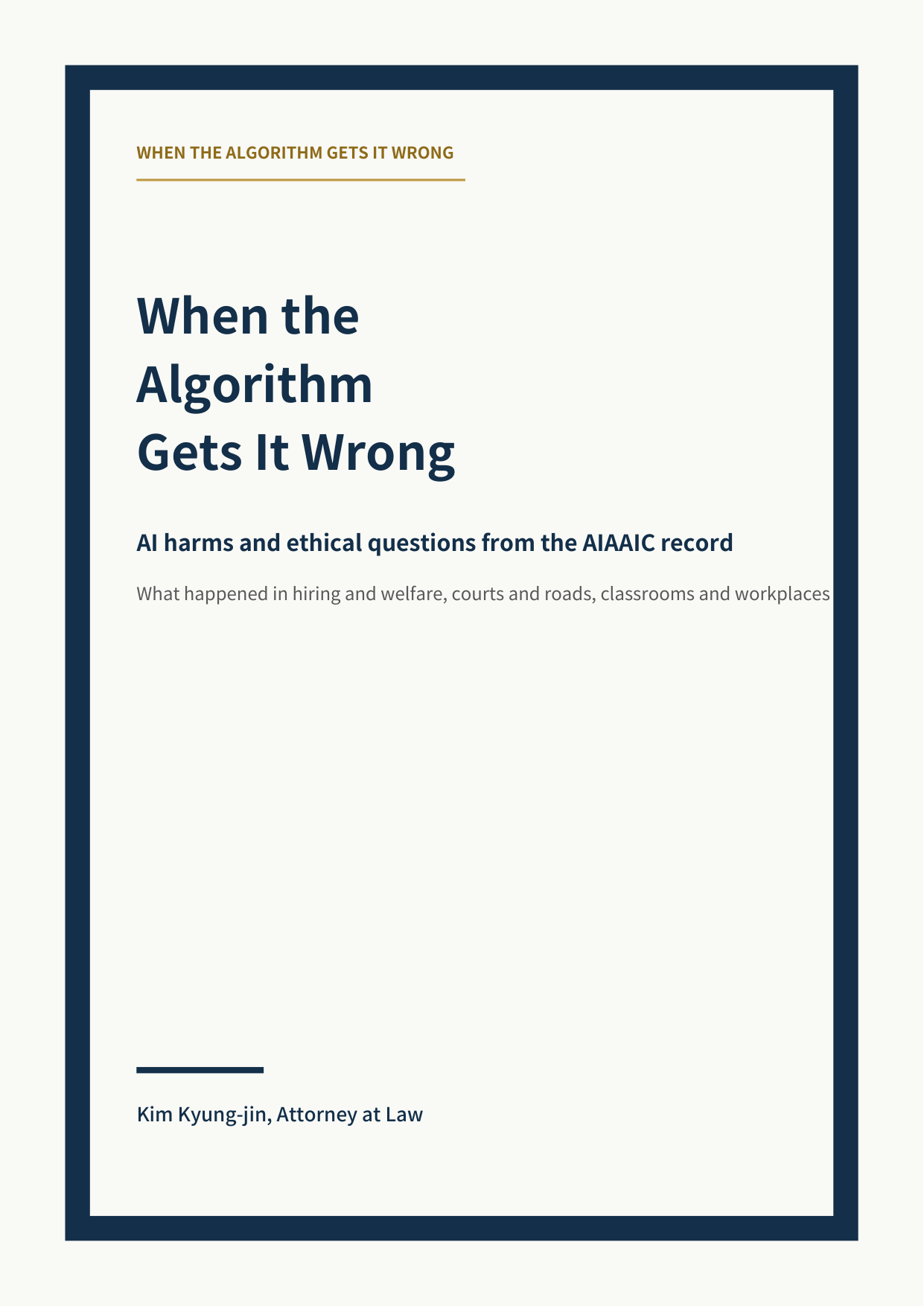
When the Algorithm Gets It Wrong: AI Harms and Ethical Questions from the AIAAIC Record cover

Table of Contents

When the Algorithm Gets It Wrong: AI Harms and Ethical Questions from the AIAAIC Record

Kim Kyung-jin

What happened in hiring and welfare, courts and roads, classrooms and workplaces

AIAAIC is an international database that collects AI and algorithmic incidents from around the world. This book picks eighteen subjects from that record and follows what actually happened and why. Rejection emails that arrive at three in the morning. Debt notices for money never owed. Handcuffs in front of two small daughters. A summer reading list of books that do not exist. A driverless car that hit a child near a school. A robot arm that read a man as a box. Technical terms are explained in plain words the moment they appear, so no computing background is needed. The incidents in this book took place between 2020 and 2025. Artificial intelligence has been moving faster every day, so by today’s standards some of these cases will feel dated and even a little jarring. Nothing here is inaccurate, but please read it with that time gap in mind.

[AI Library] Chapter 32: The Decarbonization Paradox

2026 U.S.-Iran War and Global Energy Crisis
Author
Kim Kyung-jin
Date
2026-05-06 06:11
Views
975

The 2026 U.S.-Iran War and the Global Energy Crisis

Chapter 32: The Decarbonization Paradox

Kim Kyung-jin

The 2026 U.S.-Iran War and the Global Energy Crisis

Before writing Chapter 32, I will search for the latest relevant materials. The research is sufficient. Now I will write Chapter 32.

Chapter 32: The Decarbonization Paradox

32.1 Why a Single Oil Disruption Shakes the Age of Renewable Energy

In March 2026, on a day when Brent crude surpassed $126 a barrel, a strange scene unfolded in Berlin. In front of the German parliament, climate activists held a rally calling for the expansion of renewable energy, while just blocks away at the Ministry of Economy building, a minister held an emergency press conference announcing that the government would review restarting already-closed coal-fired power plants. Two scenes, on the same day, in the same city, close enough that people could have crossed paths, became the most honest self-portrait of Germany's 2026 decarbonization policy.

Over the past twenty years, Germany has conducted the world's boldest decarbonization experiment under the banner of Energiewende. It poured over 570 billion euros into solar and wind power, raising renewable energy's share of total electricity generation to more than half. Politicians declared that a new era of energy independence, liberated from oil and natural gas, had begun. But in spring 2026, with the Strait of Hormuz blocked, the shell of that declaration was stripped away.

The problem stems from a single, deceptively simple number. According to data from the International Energy Agency (IEA), electricity currently accounts for roughly 20 percent of global final energy consumption. The remaining 80 percent is not electricity. Natural gas burned directly in industrial boilers, diesel moving trucks and ships, jet fuel lifting aircraft, methane turning fertilizer plants. No matter how many solar panels are laid out or wind turbines erected, this 80 percent of the world that electricity cannot reach still cannot function for a single day without the physical combustion of fossil fuels. The advance in renewable energy that climate activists hail and cite is, strictly speaking, a transformation occurring within one-fifth of total energy consumption.

To understand why the 20-to-80 ratio does not shift easily, one must consider the physical properties of electricity as an energy form. Electricity is difficult to store. It cannot be placed in tanks and shipped anywhere in the world like liquid fossil fuels. Despite advances in battery technology, the energy density of lithium-ion batteries remains at one-fortieth to one-fiftieth that of gasoline. Against this wall of physics, the electrification of large container ships and large aircraft is not a feasible option at the technology level of 2026. Shipping, which moves 80 percent of global trade, still burns bunker C fuel, and commercial aviation, which sends hundreds of millions of people skyward each day, cannot rise a single step without jet fuel.

A more fundamental vulnerability lies in the structural dependency created by the intermittency of renewable energy. When the wind stops and clouds cover the sky, renewable energy cannot generate power. To fill this gap, modern grids must always maintain backup power that can be switched on and off instantly. Many European countries closed coal plants due to high carbon emissions and ideologically shut down nuclear plants as well, choosing instead to plug the gap with natural gas. As a result, the grid appeared focused on solar and wind and environmentally friendly, but its final safety net was liquefied natural gas (LNG) shipped in from Qatar or the United States.

Qatar is responsible for roughly one-quarter of global LNG exports. The Ras Laffan complex is the world's largest single LNG production facility, and most of its cargo passes through the Strait of Hormuz bound for Europe and Asia. When the 2026 Iran war blocked the strait and the risk to Ras Laffan's operations became real, Europe's spot natural gas prices spiked more than 30 percent within days. This is why factories in Germany and France, which had positioned themselves as leaders of the energy transition, had to consider shutdowns. Even as solar panels and wind turbines covered rooftops and coasts, it was Persian Gulf natural gas that sustained the grid when the wind died at night.

Digging into the roots of this paradox, one encounters the fact that energy policy was designed in the language of politics, not physics. Net-zero by 2050, 45 percent renewable energy by 2030. These figures are both the minimum demands set forth by climate science and simultaneously political numbers born on the stage of election promises and international treaties. No prime minister told their constituents: "The energy transition will take decades, and during that process electricity prices will rise and industrial competitiveness may temporarily decline." Instead, politicians illuminated only the dramatic growth curve of renewable energy while quietly burying the reality that electricity accounts for 20 percent of total energy consumption.

Professor Vaclav Smil has long warned of this reality. Looking at the history of energy transitions, it has always taken fifty to one hundred years for dominant energy sources to be replaced, from wood to coal and from coal to oil. Nor did new energy push out existing energy. Humanity burns far more coal today while using oil than it did at the height of the Industrial Revolution. Energy is not replaced but added. Yet the declaration to reduce fossil fuels to several percentage points of total energy supply by 2050 means overturning the entire energy infrastructure at a speed history has never shown.

According to 2026 IEA analysis, on the current trajectory, fossil fuels' share of global energy supply is projected to fall from 80 percent to 73 percent by 2030. Seven percentage points. A change produced by two decades of effort and tens of trillions of dollars in investment. Within those seven percentage points, when the Strait of Hormuz is blocked, the global economy still suffers severe shock. Even in a world where renewable energy supplies 37 percent of the grid, when a single fossil fuel supply chain falters, the entire remaining system triggers a chain reaction. This is why renewable energy growth does not fundamentally eliminate fossil fuels' vulnerability. Rather, by prematurely suppressing investment in fossil fuel infrastructure, spare capacity within supply chains has shrunk, creating a paradox where even small shocks cause steeper price swings.
In spring 2026, even after Brent crude surpassed $126 a barrel, renewable energy generators worldwide continued running. Wind turbines in the North Sea off Denmark turned in the wind that day, and California's solar farms converted afternoon sunlight into electricity. Yet a chemical factory in Tokyo stopped its lines for lack of naphtha, a hydrocarbon from oil refining and raw material for plastics and synthetic fibers. A fertilizer plant in Bangkok halted shipments as ammonia feedstock ran out. An airline in Mumbai cut routes as jet fuel prices doubled. This is the reality of why the age of renewable energy shakes at one move of oil. Changing the way electricity is produced and overturning the entire material foundation that modern civilization rests upon are completely different orders of task.

32.2 Where Oil Is Still Necessary

On the morning of March 5, 2026, a research team at a securities firm in Yeouido, Seoul distributed an urgent report. Its title was "The Strait of Hormuz Blockade and the Chain Crisis of the Petrochemical Industry." The report's opening sentence read: "Half of the sulfuric acid needed to produce one lithium-ion battery for a modern electric vehicle passes through the Strait of Hormuz." This is why Lotte Chemical and LG Chem's stock prices plummeted in tandem that day.

To understand why this sentence matters, one must follow the material world of manufacturing a single electric vehicle. The key battery materials for electric vehicles, cobalt and nickel, are mined mostly in the Democratic Republic of Congo and Indonesia. Refining these ores into pure metals for batteries requires large quantities of sulfuric acid. Sulfuric acid is made by burning sulfur, more than half of which is produced as a byproduct in the crude oil and gas refining processes of Middle Eastern oil states such as Saudi Arabia and Qatar, then shipped through the Strait of Hormuz to Asia. If the strait is blocked, sulfur supply is cut, sulfur supply cut means sulfuric acid prices rise, sulfuric acid prices rise means battery mineral refining costs increase, and ultimately electric vehicle prices go up. The electric vehicle, a symbol of decarbonization, is inextricably linked to fossil fuel supply chains that are regarded as the opposite of decarbonization.

The four pillars of modern civilization identified by Professor Vaclav Smil, namely ammonia, plastic, steel, and cement, each in its own way prove this paradox.

First, ammonia. More than half the food consumed by eight billion people on Earth is produced thanks to nitrogen fertilizer. Ammonia, the raw material of nitrogen fertilizer, is made by the Haber-Bosch process, which combines nitrogen and hydrogen from air under high temperature and pressure, with nearly all the hydrogen extracted from natural gas. A substantial portion of global ammonia production comes from Qatar, Saudi Arabia, Iran, and Oman. When these countries' natural gas is blocked, fertilizer prices rise, when fertilizer prices rise farmers reduce usage, and when usage drops yields fall. Global fertilizer prices jumped more than 40 percent following the Hormuz blockade in spring 2026 because of this chain.

Plastic is more direct. The foundation of all plastic products we use daily is naphtha and ethylene. These substances come from crude oil refining. Ethylene is the starting point for the entire petrochemical industry and the foundation of virtually all plastic products, from plastic bags to PET bottles, packaging, pharmaceuticals, auto parts, and electronics housings. Ethylene is produced through the "cracking" process, which decomposes naphtha at high temperature, and this process likewise consumes enormous energy, that is, more fossil fuels. In a world without oil, we cannot produce replacement materials for current plastics at the same scale with present technology.

The reality of steel and cement is harsher. To make pure molten iron from iron ore, one must burn coke, a solid carbon mass made from processing coking coal, in a blast furnace. The heat from this process exceeds fifteen hundred degrees Celsius. While it is technically possible to maintain this temperature with electricity, replacing all of the world's annual steel production of 1.9 billion tons with electricity at current technology and cost levels is not a practical option. Cement is the same. Cement kilns that decompose limestone to produce calcium oxide must reach up to fourteen hundred fifty degrees Celsius, and the primary fuels producing this heat are coal and petroleum coke. Because cement production itself releases carbon dioxide during the thermal decomposition of raw materials, replacing the fuel with electricity still makes complete elimination of carbon emissions impossible.

Beyond these four, the number of things that cannot be made without oil is difficult to count.

Wind turbine blades are made from epoxy resin and polyester resin, petrochemical products based on ethylene extracted from naphtha. EVA film, ethylene-vinyl acetate, used as the key encapsulation material in solar panels, is also a product of petrochemical processes. The synthetic rubber in electric vehicle tires comes from oil, and the asphalt that paves the roads those tires travel uses bitumen, the residue from crude oil refining, as its primary raw material. Hospital disposable syringes, IV tubes, and surgical gloves are plastic, and those plastic molecules came from crude oil. Even inside the clean rooms where smartphones and semiconductor chips are made, many cleansers and specialty chemicals are products of petrochemical processes.

In an article for IEEE Spectrum, Professor Smil calculated the materials needed to manufacture a single five-megawatt wind turbine. One hundred fifty tons of steel in the foundation concrete, two hundred fifty tons of steel in the nacelle and hub, five hundred tons of steel in the tower. To make this steel requires a blast furnace burning coke. The composite materials needed to make three blades over sixty meters long contain roughly one hundred seventy gigajoules per ton of energy equivalent in crude oil. To build sufficient wind power capacity worldwide by 2030, the equivalent of ninety million tons of crude oil's energy must go into manufacturing those installations. This is why Smil calls the wind turbine a "pure embodiment of fossil fuels."

In spring 2026, as the Strait of Hormuz blockade extended into its second and third weeks, naphtha shortages became a tangible reality. At Korea's petrochemical complexes, the warning lights came on for ethylene cracker feedstock procurement. As Korean petrochemical companies found it difficult to meet domestic demand, the government had to urgently review releasing stockpiled naphtha. Helium, essential for semiconductor manufacturing, also faced supply disruptions. Helium is a byproduct from natural gas extraction, and Qatar is the world's third-largest helium exporter. Samsung Electronics and SK Hynix attempted to substitute helium supplies with American sources, but U.S. helium volumes were already insufficient to meet global semiconductor factory demand.

All these facts point to a single conclusion. Oil is, before all else, a fuel we burn away, but a material that constitutes modern civilization. Oil as fuel can potentially be replaced by electricity. But oil as the raw material for ammonia, plastic, steel, cement, asphalt, synthetic rubber, and lubricants has no replacement substance at the same scale at current technology levels. No matter how quickly the energy transition toward decarbonization advances, unless we sever this material dependency, disruptions in the oil supply chain will always strike at the arteries of civilization. While it is free to declare an age of renewable energy, until that declaration becomes reality we still rest a substantial part of our lives on one waterway out of twenty-one miles.

32.3 The Speed of Energy Transition and the Gap with Reality

In March 2026, two types of documents circulated simultaneously in the corridors of the European Parliament in Brussels. One was a "Green Deal Implementation Progress Report" prepared by the commissioner in charge of climate policy, and the other was an internal memo from a closed meeting hastily convened by energy ministers. The former reported smooth progress toward the 2030 renewable energy goal. The latter had one sentence marked in bold: "If the current situation persists for more than four weeks, natural gas supplies to parts of industrial regions in Germany and Italy could enter crisis stage before June."

The gap between the speed of energy transition and reality lies in just such a difference of one document. The space between the speed of declaration and the speed of physical reality,this gap appears each time crisis strikes.

The reality of grid infrastructure most clearly shows why this gap exists. According to IEA analysis, to achieve carbon neutrality goals, more than double the current transmission infrastructure must be built by 2030. This is work of laying cables, building substations, and stabilizing the grid. Yet the actual pace of this work lags far behind the pace of solar and wind installation. Analysis suggests that 1,650 gigawatts of renewable energy installations have been completed worldwide but cannot operate due to lack of transmission lines and sit waiting. This exceeds five times Germany's entire installed generation capacity. The generators exist but the lines do not.

In Europe, building a single new high-voltage transmission line takes an average of ten to fifteen years. Environmental impact assessments, community approval, administrative permits, legal challenges, construction, completion. This chain does not accelerate even with sufficient funding. Local residents do not want high-voltage transmission towers passing in front of their homes. This is the NIMBY, Not in My Back Yard, phenomenon, and it appears more strongly the more advanced a democracy is. Even in countries with high public support for renewable energy, local opposition to transmission tower construction is strong. Even the strongest renewable energy advocates oppose high-voltage transmission towers crossing their own backyards.

A more fundamental gap beyond grid expansion lies in energy storage technology. Large-scale energy storage is essential to overcome the intermittency of solar and wind. It is true that battery storage system costs are falling rapidly, but building battery infrastructure on a scale sufficient to store several days' worth of national electricity demand is nearly impossible at 2026 technology and cost levels. This is why Germany, despite raising renewable energy's share of generation above 50 percent, must still operate coal and gas plants when the dark, windless winter condition of "Dunkelflaute" arrives.


Another gap created by energy transition is the replacement of the target of geopolitical dependency. In the fossil fuel era, threats to energy security were Middle Eastern oil producers and Russia. In the renewable energy era, the threat is the supply chain of critical minerals. China currently controls sixty to ninety percent of global supply of lithium, cobalt, and graphite, used in electric vehicle batteries, and rare earth elements, the raw material for permanent magnets essential in wind turbines and electric motors, their mining and processing. Accelerating decarbonization directly leads to deepening dependence on China. The energy transition undertaken to escape Persian Gulf oil creates geopolitical dependency on another single supplier.

The 2026 crisis became a stage that proved the real-world meaning of this gap. Looking at the response of the Global South,developing countries in Africa, South Asia, Southeast Asia, and Latin America,it becomes even clearer. For these countries, the top priority of energy policy is not carbon reduction but escaping energy poverty. Where hundreds of millions still lack sufficient electricity, demands that developing countries apply the carbon neutrality schedule set by advanced countries wholesale ignore reality. For developing countries, the fastest and cheapest means of supplying energy is still coal or natural gas. To build renewable energy infrastructure, capital procurement costs reach double those of advanced countries, and obtaining permits and skilled personnel is far more difficult. Under these conditions, China and India continued building new coal-fired power plants in 2026. Between the language of climate goals and the physics of energy reality, what they chose was electricity arriving.

The oil shock of the 1970s, the Russia-triggered energy crisis of 2022, and the 2026 Hormuz crisis all repeat the same lesson: excessive dependence on a particular energy source makes the entire economy vulnerable in the face of external shocks. Yet the remedy this lesson demands is not completed by simply increasing renewable energy quickly. Decarbonization of industrial processes supporting the modern economy, breakthrough in energy storage technology, massive grid expansion, diversification of critical mineral supply chains, and securing base load power inevitably necessary during the net-zero transition. All these tasks must proceed simultaneously.

Climate science correctly identifies the necessity of energy transition. But the pace of energy transition is determined not by scientists' reports but by actual transformer delivery times, transmission tower construction permitting periods, and the production cost of green hydrogen needed to electrify blast furnaces and fertilizer plants. This gap between the dates politicians declare and the dates when physical infrastructure is built cannot be filled with slogans.

The bitterest lesson left by the 2026 crisis is this: by hastening renewable energy transition while simultaneously hostile to investment in fossil fuel supply chains, the world met crisis from the middle of the most precarious transition period, neither old system nor new. Having removed coal and nuclear power as stable base load, the world placed its economy atop an unstable triangle of solar, wind, and gas, and then blocked that gas's final refuge.

The direction of energy transition is right. The speed and path must be set within the bounds that reality allows. The world of 2026 paid for ignoring that boundary and prioritizing ideals alone. It paid in three forms: $126-a-barrel oil, empty Manila streets, shuttered German factories. The oil age's final warning was not a call to eliminate oil, but to understand the weight of everything we must prepare to eliminate it.

Kim Gyeong-jin, Attorney and AI Specialist

Expert in AI Law and Policy · Former Member of the National Assembly · Author of Multiple Works

If this book has stayed with you, even for a moment, please support the next story to reach the world.

(Voluntary support account: NH Bank 302-1096-0948-81 Account holder: Kim Gyeong-jin)

Kim Kyung-jin

Attorney · Former Member of the National Assembly · AI Policy Researcher

kimkj.com

© 2026 Kim Kyung-jin. All rights reserved.

#KimKyungjin #AILibrary #2026USIranWarandGlobalEnergyCrisis
kimkj.com Home
Scroll to Top
kimkj.com Home kimkj.com Home