AI Library
The Age of Autonomous Scientific Discovery
Kim Kyung-jin, Attorney at Law
AI Scientists and Self-Driving Labs
This book follows how AI scientists and self-driving labs are changing the way science generates and verifies claims. It covers literature-based discovery, natural-language protocols translated into robot commands, multi-agent research systems, closed-loop laboratories, materials search, the verification gap, chains of evidence, research harnesses, journal ethics, and legal responsibility.
AI Library
A New Era of Life Sciences Opened by Artificial Intelligence
Structural Proteomics, Genomic Foundation Models, Autonomous Laboratories, and Global Governance
Kim Kyung-jin, Attorney at Law
This book is a research volume compiled with artificial intelligence. A human selected the materials and structured the work, while AI models drafted the sentences and cross-checked the facts.

AI Library
The Double Structure of Digital Sovereignty
Europe’s Departure from Palantir and the Chains of American Big Tech
Kim Kyung-jin, Attorney at Law
This is a record of 2026, when European intelligence agencies and defense ministries began removing analytics tools from America’s Palantir. It covers the replacement decisions made by France’s General Directorate for Internal Security (DGSI), Germany’s Federal Office for the Protection of the Constitution (BfV), and the Netherlands Ministry of Defense; the incident in which US export controls severed an ally’s ac…
New English Edition
Artificial Intelligence in Horticulture
Kim Kyung-jin, Attorney at Law
Across five chapters and ten sections, this book examines computer vision for crop diagnosis, harvesting robots and autonomous field systems, smart greenhouses and digital twins, precision irrigation and supply-chain quality control, high-throughput phenotyping, and predictive breeding.
New English Edition
Artificial Intelligence in Food Crop Agriculture
Kim Kyung-jin, Attorney at Law
Across six chapters and eighteen sections, the book examines digital agricultural infrastructure, remote sensing, crop diagnosis, yield forecasting, precision irrigation, genomics, molecular breeding, agricultural robotics, climate-smart agriculture, and global food security.
New English Edition
The Future of Forestry and Agroforestry
Kim Kyung-jin, Attorney at Law
Driven by Artificial Intelligence and Digital Innovation
Across five chapters and fifteen sections, the book follows satellites, drones, LiDAR, digital twins, forest-specific language models, wildfire and pest forecasting, forestry robotics, agroforestry, timber traceability, and forest carbon markets.

New English Edition
Smart Livestock Farming: AI Enters the Barn
Kim Kyung-jin, Attorney at Law
Sensors listen, cameras watch, and artificial intelligence helps farmers decide.
Across five chapters and fifteen sections, the book follows precision livestock farming from animal health and reproduction to robotic milking, virtual fencing, digital twins, methane reduction, welfare, and data ownership.

Table of Contents
Han Dong-hoon, Busan Buk-gu Gap: A Record of the 100 Days Before and After the Election (Mar. 26-Jul. 3, 2026)
Kim Kyung-jin
Table of Contents and 13 sections
From March 26 to July 3, 2026, this record follows the spring after expulsion, the Busan Buk-gu Gap by-election, victory as an independent, and the first bill submitted in the National Assembly.
Table of Contents
Artificial Intelligence and Medicine
Kim Kyung-jin, Attorney at Law
AI in clinical care, hospitals, education, and research
AI in medical imaging, risk prediction, treatment planning, hospital operations, education, and research, with patient safety, privacy, and accountability.












[AI Library] Chapter 6: Unlocking the Latch Sealed for 57 Years
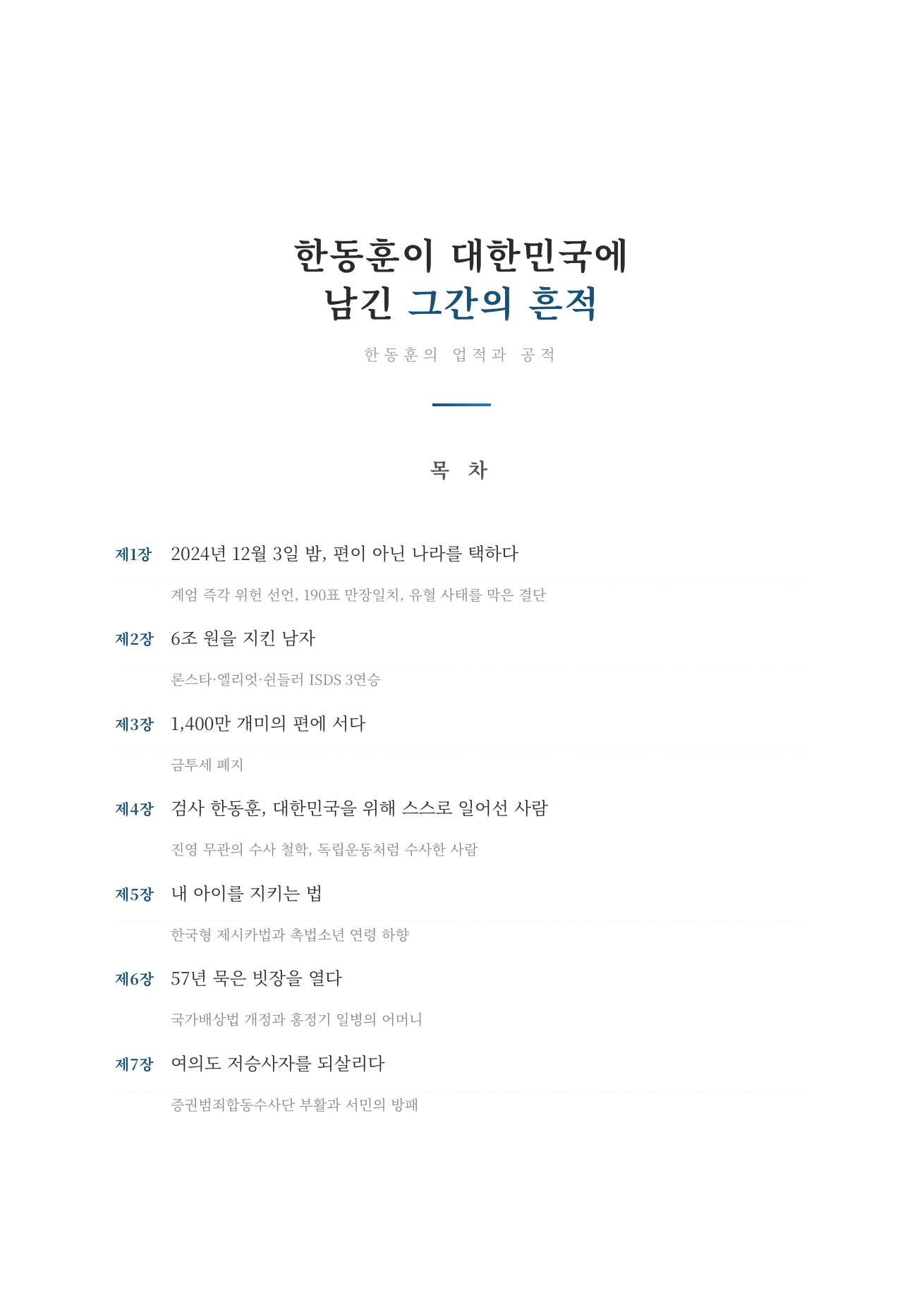
The Traces Han Dong-hoon Left on South Korea
Chapter 6: Unlocking the Latch Sealed for 57 Years
Kim Kyung-jin
The Traces Han Dong-hoon Left on South Korea
The Revision of the State Compensation Act and the Mother of Private Hong Jung-gi
Opening the Latch Sealed for 57 Years: The Revision of the State Compensation Act and Han Dong-hoon's Promise
1 A Mother's Eight Years
In March 2016, seven months after enlisting in the Army, Private Hong Jung-gi's body began showing bruising. Vomiting and headaches followed. The regiment's medical unit confirmed a drop in platelets but returned him saying it was not an emergency. On the same day, a private hospital said there was a high possibility of leukemia and that detailed examination was necessary, but the battalion commander, upon receiving the report, did not send him to a higher-level hospital. When his condition worsened and he was taken to the division hospital's emergency room, the attending military doctor, judging his vital signs normal, did not evacuate him. An attempt to transfer him to the Military Hospital in Chuncheon also fell through due to lack of available beds.
Private Hong Jung-gi developed complications less than a month after falling ill and passed away without ever learning his diagnosis. He was twenty years old.
His mother, Ms. Park Mi-sook, held the military authorities accountable. But the answer was a wall: the prohibition on double compensation. The principle is that even if a soldier dies or is injured in the line of duty and receives compensation under another law, they cannot claim damages from the state. Since she had already received death compensation, she could not pursue a damages lawsuit challenging the state's negligence.
She had raised her son for twenty years and sent him to serve the nation, yet he did not return. The state's negligence was unmistakable. Yet the law itself, and the state, prevented her from seeking accountability.
2 The Latch of 1967
This wall was built in 1967. When soldiers deployed to the Vietnam War began receiving compensation through lawsuits, the Park Chung-hee government, concerned about fiscal burden, revised the State Compensation Act to provide only compensation to fallen and disabled soldiers while blocking damage claims.
In 1971, the Supreme Court ruled this provision unconstitutional. In response, the Park Chung-hee regime, drafting the Yushin Constitution in 1972, embedded the prohibition on double compensation directly into the constitution. Since the Supreme Court had ruled it unconstitutional, the provision could have been overturned at the statutory level. That is why they cemented it into the constitution.
For more than half a century after that, soldiers and police risked their lives in service, yet when they died due to state negligence, their families received only fixed compensation. No solace for grief, no accountability for state fault,these were not permitted. The latch set up to preserve finances when the nation was poor continued to block the path of military families for more than fifty years, even after the nation had grown wealthy.
3 Justice Minister Han Dong-hoon: "Now It Is Time for Change"
In 2023, the lawsuit by Private Hong Jung-gi's family lost in the first trial. Though the court acknowledged the state's negligence, it ruled that compensation was impossible due to the prohibition on double compensation. The court indirectly recommended settlement, asking the state to pay the family 25 million won as consolation and offer an apology.
The Justice Ministry, representing the government in litigation, rejected the settlement recommendation, citing difficulties in accepting it under current law. However, Justice Minister Han Dong-hoon at the time, expressing sympathy for the problems inherent in the prohibition on double compensation, promised to push for a revision of the State Compensation Act and submitted a government legislative proposal.
"I judged that change is needed and that now is the time for it. I will amend the State Compensation Act to open a path for families to seek independent consolation damages."
The Justice Minister is the government's representative in litigation. In cases where the state is a defendant, his duty is to stand on the state's side. Yet Han Dong-hoon had sided with the family, technically his ministry's opponents in court. To uphold the law while changing it if flawed. To hold to principle while seeing the person beyond the principle. That was Han Dong-hoon's way.
On December 15, 2023, Ms. Park Mi-sook, mother of Private Hong Jung-gi, met with Justice Minister Han Dong-hoon at the Government Complex in Gwacheon. The meeting lasted more than an hour.
Han Dong-hoon said, "You have endured so much. It is you who will change this law. It is something that should naturally be done, and I believe there will be no disagreement in the National Assembly." After hearing about other military death cases from families, he asked questions about the case progression and took notes.
"It is you who will change this law." In this statement to the family, the minister conveyed an understanding that the agent of change would be the victim themselves, not the government or the National Assembly. It was a different tone from the typical politician's "I will solve this for you."
On October 24, 2023, a revision to the State Compensation Act allowing families of fallen military and police personnel to seek consolation damages passed the Cabinet meeting. However, with the expiration of the 21st National Assembly's term, the bill was discarded.
4 Party Leader Han Dong-hoon Keeps the Promise
Even after leaving office as Justice Minister, even after becoming party leader, Han Dong-hoon did not let go of this promise.
On November 26, 2024, Han Dong-hoon met with Ms. Park Mi-sook, mother of Private Hong Jung-gi, again at the National Assembly. This time he came as party leader, not as justice minister. His title had changed, but the woman sitting across from him was the same mother.
Han Dong-hoon said, "A nation's dignity is determined not only by who it produces but by whom it remembers." He continued, "When our nation was truly impoverished, we lacked the means to properly honor and compensate, so we even amended the constitution to block paths to compensation for military fallen soldiers, and that constitution remains in place today." He then promised, "Even without amending the constitution, the family's right to seek consolation damages can be recognized through revising the State Compensation Act. The cause is too compelling not to complete this legal revision as quickly as possible."
A nation's dignity depends not on who it produces but on whom it remembers. In this single sentence lies the compressed reason why Han Dong-hoon was so committed to this bill. A nation that tells the families of soldiers who sacrificed their lives for it, "You have already received compensation, so there is no further responsibility." Han Dong-hoon could not accept such a nation's dignity.
5 December 10, 2024: Change After 57 Years
On December 10, 2024, the revision to the State Compensation Act passed the National Assembly plenary with 284 votes in favor and 2 against out of 286 members present. It was virtually unanimous.
The core of the amendment is that families of fallen and deceased soldiers and police officers can now seek consolation damages from the state. The latch that had blocked the path of families for 57 years since 1967 has been opened.
On the same day, a package of bills substantially improving treatment for military personnel passed together. Revisions to the Military Personnel Disaster Compensation Act, Civil Servants Disaster Compensation Act, and Civil Servants Pension Act also passed the plenary, adjusting pension payment criteria for families of fallen military personnel and civil servants based on their posthumous promotion rank. Also passed was a revision to the Basic Law on Military Personnel Status and Service, allowing reduction or exemption of criminal liability when military personnel cause harm to others during lawful duty performance without intent or gross negligence; a revision to the Military Personnel Act specifying a 120-day deadline for families of fallen soldiers to request reconsideration; and a revision to the Basic Law on Military Personnel Welfare allowing properties with obsolete military facilities to be prioritized for sale for military welfare purposes.
It was not just the amendment to the State Compensation Act. The entire system surrounding military life and death was comprehensively reformed all at once.
6 The Minister's Promise, the Party Leader's Fulfillment
Tracing the history of these bills back to their origin, Han Dong-hoon stands at the starting point. In 2023, as Justice Minister, he acknowledged the injustice of the prohibition on double compensation and submitted an amendment. When the 21st National Assembly discarded it, he became party leader and pushed it through again in the 22nd National Assembly. He met with Private Hong Jung-gi's mother twice, once as minister and once as party leader, made the same promise both times, and kept it.
After her son's death, Ms. Park Mi-sook, mother of Private Hong Jung-gi, met with major figures from both parties and advocated for a legal revision. A mother carrying the grief of losing her child, moving through the halls of the National Assembly. A politician who answered her plea and changed the law. Han Dong-hoon told that mother, "It is you who will change this law." And to make the law she sought to change actually change, he walked in the same direction both from the position of justice minister and as party leader.
A nation where families of soldiers who died protecting it must cry out, "Is my child worth less than a dog?" Changing such a nation's law is not a monumental political achievement. He simply did what should naturally be done. Yet the reality of this nation was that this naturally necessary task had been neglected for 57 years. Han Dong-hoon was a person who put that abandoned natural duty into action. That is another manifestation of this principle: rigorous against the strong, merciful to the weak. Not merely being strict about the powerful's wrongdoing, but answering the cry of the vulnerable. For Han Dong-hoon, this balanced approach to justice was both a prosecutorial philosophy and a way of life.
Kim Kyung-jin
Attorney · Former Member of the National Assembly · AI Policy Researcher
© 2026 Kim Kyung-jin. All rights reserved.