AI Library
The Age of Autonomous Scientific Discovery
Kim Kyung-jin, Attorney at Law
AI Scientists and Self-Driving Labs
This book follows how AI scientists and self-driving labs are changing the way science generates and verifies claims. It covers literature-based discovery, natural-language protocols translated into robot commands, multi-agent research systems, closed-loop laboratories, materials search, the verification gap, chains of evidence, research harnesses, journal ethics, and legal responsibility.
AI Library
A New Era of Life Sciences Opened by Artificial Intelligence
Structural Proteomics, Genomic Foundation Models, Autonomous Laboratories, and Global Governance
Kim Kyung-jin, Attorney at Law
This book is a research volume compiled with artificial intelligence. A human selected the materials and structured the work, while AI models drafted the sentences and cross-checked the facts.

AI Library
The Double Structure of Digital Sovereignty
Europe’s Departure from Palantir and the Chains of American Big Tech
Kim Kyung-jin, Attorney at Law
This is a record of 2026, when European intelligence agencies and defense ministries began removing analytics tools from America’s Palantir. It covers the replacement decisions made by France’s General Directorate for Internal Security (DGSI), Germany’s Federal Office for the Protection of the Constitution (BfV), and the Netherlands Ministry of Defense; the incident in which US export controls severed an ally’s ac…
New English Edition
Artificial Intelligence in Horticulture
Kim Kyung-jin, Attorney at Law
Across five chapters and ten sections, this book examines computer vision for crop diagnosis, harvesting robots and autonomous field systems, smart greenhouses and digital twins, precision irrigation and supply-chain quality control, high-throughput phenotyping, and predictive breeding.
New English Edition
Artificial Intelligence in Food Crop Agriculture
Kim Kyung-jin, Attorney at Law
Across six chapters and eighteen sections, the book examines digital agricultural infrastructure, remote sensing, crop diagnosis, yield forecasting, precision irrigation, genomics, molecular breeding, agricultural robotics, climate-smart agriculture, and global food security.
New English Edition
The Future of Forestry and Agroforestry
Kim Kyung-jin, Attorney at Law
Driven by Artificial Intelligence and Digital Innovation
Across five chapters and fifteen sections, the book follows satellites, drones, LiDAR, digital twins, forest-specific language models, wildfire and pest forecasting, forestry robotics, agroforestry, timber traceability, and forest carbon markets.
New English Edition
Smart Livestock Farming: AI Enters the Barn
Kim Kyung-jin, Attorney at Law
Sensors listen, cameras watch, and artificial intelligence helps farmers decide.
Across five chapters and fifteen sections, the book follows precision livestock farming from animal health and reproduction to robotic milking, virtual fencing, digital twins, methane reduction, welfare, and data ownership.

Table of Contents
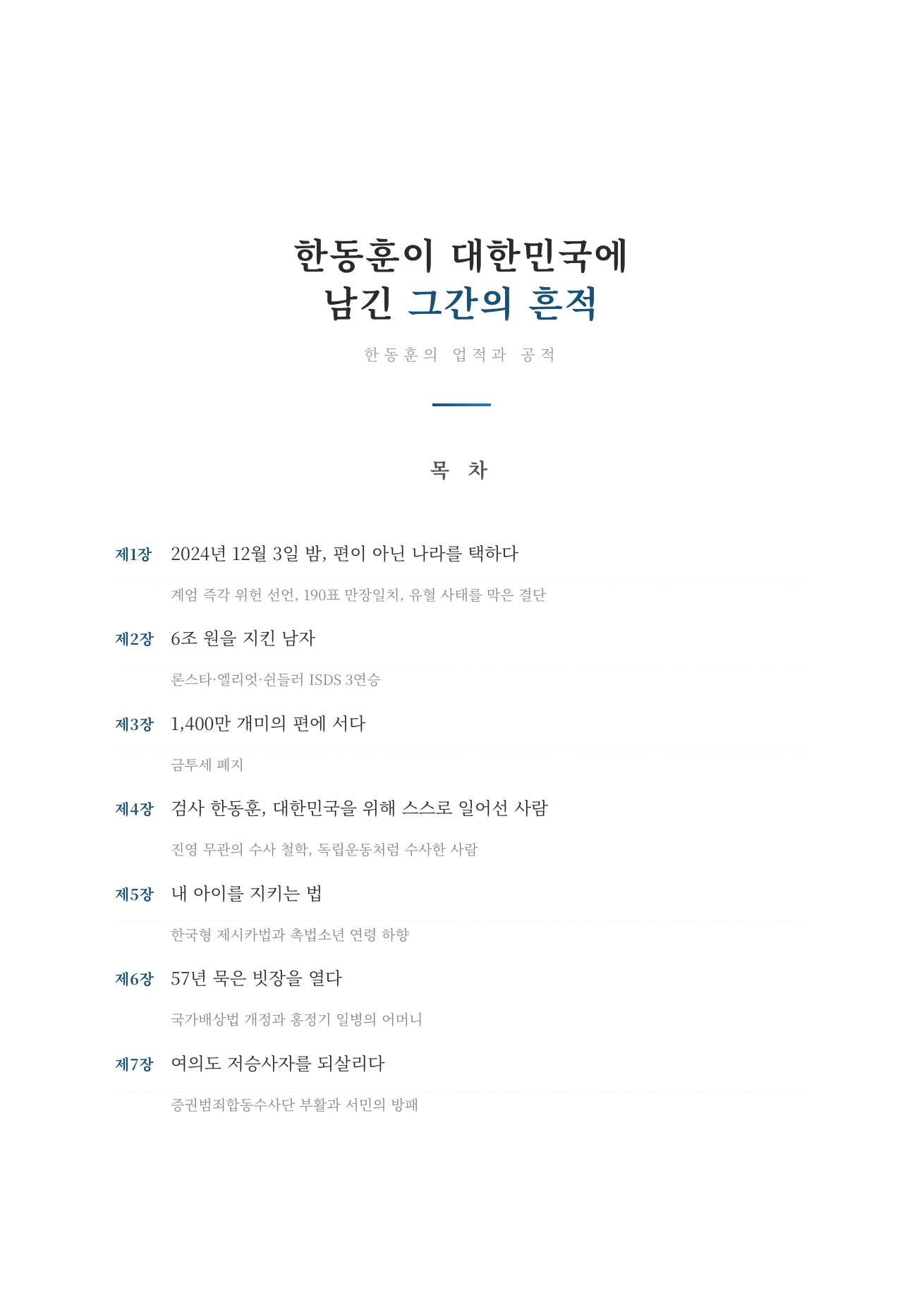
Han Dong-hoon, Busan Buk-gu Gap: A Record of the 100 Days Before and After the Election (Mar. 26-Jul. 3, 2026)
Kim Kyung-jin
Table of Contents and 13 sections
From March 26 to July 3, 2026, this record follows the spring after expulsion, the Busan Buk-gu Gap by-election, victory as an independent, and the first bill submitted in the National Assembly.
Table of Contents
Artificial Intelligence and Medicine
Kim Kyung-jin, Attorney at Law
AI in clinical care, hospitals, education, and research
AI in medical imaging, risk prediction, treatment planning, hospital operations, education, and research, with patient safety, privacy, and accountability.





[AI Library] Chapter 6: The Only Man to Speak Harsh Truths to the Presidential Couple
The Han Dong-hoon Story
Chapter 6: The Only Man to Speak Harsh Truths to the Presidential Couple
Kim Kyung-jin
The Han Dong-hoon Story
PART 02 Strong and Weak (強强弱弱) Han Dong-hoon · Original Text 01
It was a weekend afternoon on January 21, 2024.
In that moment when winter sunlight slanted through the window, Han Dong-hoon's phone rang. The name that appeared was a key figure from the Presidential Office. Before he even answered, he already knew what this call meant.
The conversation was brief. The voice acting on behalf of the President was direct. "Mr. Chairman, I hope you will consider your resignation."
Han Dong-hoon fell silent for a moment. This was not an unexpected call. He knew that just days earlier, the twelve words he had uttered had shaken Yongsan. Regarding the allegations that First Lady Kim Keon-hee had received luxury handbags, he had said:
"Measures that match the public's expectations are necessary."
Only twelve words. But those twelve words had directly touched the line that the Presidential Office at Yongsan had been desperately trying to defend with their life. What the President was willing to stake everything on defending was First Lady Kim Keon-hee.
Han Dong-hoon held the phone to his ear and gazed out the window.
Someone might have lowered their head at that moment. Someone might have offered excuses. Someone might have tried to find a compromise.
But Han Dong-hoon's answer was different.
"I came forward before the people. I will do what needs to be done."
The conversation ended that way.
The next day, January 22, Han Dong-hoon stood before reporters. The rumor of his resignation had already spread through the media. Countless camera flashes exploded.
He spoke calmly, yet firmly.
"My term continues until after the general election."
He made clear his intention not to resign.
Tension hung thick between Yongsan and Yeouido. Political circles began to speak of 'Yoon's heart' and 'Han's heart' as the gap between these two men who once looked in the same direction began to widen, a rift opening up between them.
Two days later, on January 23, a fire broke out in Seocheon, South Chungcheong Province. A traditional market was reduced to ashes. President Yoon Suk-yeol visited the scene, and Han Dong-hoon was also there. The two men faced each other.
Han Dong-hoon bowed deeply before President Yoon.
That bow was captured entirely by the press cameras. Some read it as surrender. Others read it as courtesy. Han Dong-hoon himself said this about that day: "My respect and trust for the President have not changed."
He rode the presidential train with the President. On the surface, it seemed to be resolved. A key figure in pro-Yoon circles, Representative L M, moved to mend relations, saying "there was a misunderstanding in the conversation." This was not the first time Han Dong-hoon had clashed with the Presidential Office.
Since his time as Justice Minister, he had been known as 'the minister who speaks hard truths.' He did not know how to flatter, and he did not know how to read the room.
It was the same when the medical crisis erupted.
On February 6, 2024, the government announced the confirmed expansion of medical school enrollment by 2,000. Resident physicians submitted collective resignation letters. Hospital emergency rooms began to shut down one by one. Patients waiting for surgery trembled with anxiety. The lives of the people were at risk. The Minister of Welfare argued for gradual expansion. It was the voice from the field. But the President wanted a comprehensive expansion. In the end, 2,000 was confirmed.
On April 1, 2024, at a campaign rally in Busan, Han Dong-hoon took the microphone in that heated venue ahead of the general election and said something many did not expect.
"I regret insisting on the 2,000 figure. A more flexible approach is necessary." And he added:
"Today the government also made clear its position to discuss without adhering to the 2,000 figure."
The party chairman publicly expressed disagreement with government policy. And on no less a stage than a nationally broadcast campaign rally.
Yongsan made no effort to hide its displeasure.
Words like "Why is the party doing this?" circulated.
But Han Dong-hoon did not back down.
"Since I took the lead in the People Power Party, have I failed to change any of the points I raised?" His question went unanswered.
On September 6, with Han Dong-hoon's mediation, a consultative body comprising the ruling party, opposition, medical professionals, and the government was proposed. The Presidential Office finally took a step back.
"We will discuss if you bring a reasonable plan without being bound by the 2,000 figure." "The door to dialogue has opened through Chairman Han Dong-hoon's mediation."
Representative Ahn Cheol-soo proposed: "Let us discuss a plan to gradually increase numbers while examining proposals such as 1,004 new positions over ten years."
But a fundamental resolution was not achieved.
Later, on November 27, 2025, the Board of Audit and Inspection released its audit results. The conclusion was harsh. "The basis for the 2,000 expansion is insufficient, and the logical consistency is lacking."
The Board went further in its statement:
"The Ministry of Welfare calculated the necessary number of doctors to align with the directives of former President Yoon Suk-yeol."
It was precisely what Han Dong-hoon had been concerned about from the beginning. He was not wrong. He was simply right too early, ahead of his time.
The night of December 3, 2024.
That night, forever inscribed in Korean constitutional history, an emergency martial law was declared.
Han Dong-hoon did not hesitate.
He rushed to the National Assembly. Though martial law forces attempted to seal it off, he gathered with other lawmakers in the main chamber. And he led the repeal of martial law.
Martial law was lifted.
Democracy was preserved.
But the price was severe.
On December 14, the impeachment motion against President Yoon Suk-yeol passed. Five senior party members resigned en masse. The party leadership collapsed.
On December 16, Han Dong-hoon stepped down as party leader.
"All of this is due to my shortcomings."
Those were his final words.
January 13, 2026, 11:45 p.m.
In the dead of night, the People Power Party's Ethics Committee suddenly convened. The agenda was to vote on his expulsion.
On January 29, the Supreme Council met.
The expulsion was confirmed.
Han Dong-hoon issued a statement.
"I will return without fail."
He reflected. From that day in January 2024, when he received the call from the presidential office demanding his resignation, to this moment. Exactly two years had passed.
He had offered frank criticism to the presidential couple. He had called out their stubbornness in the medical crisis. And he had stopped the emergency martial law.
For that, he was expelled from the party.
But Han Dong-hoon had no regrets.
"There were those who fawned around power. I sought to correct the problems." These were his words in an interview years later. And he continued.
"They boasted endlessly while dining with the president. Yet why did they say nothing then? Why did they not offer candid advice? I believe they must answer for what they were doing at that moment."
Strength against strength, weakness against weakness.
Be firm with the strong, be gentle with the weak.
This was Han Dong-hoon's philosophy. And because of this philosophy, he became the only cabinet member able to offer harsh truths to the strongest person of all, the president, and his wife.
Even if the price was expulsion.
If this book has stayed with you for even a moment, please support bringing the next chapter of this story to the world.
(Voluntary support account: Nonghyup 302-1096-0948-81 Account holder: Kim Kyung-jin)
Kim Kyung-jin
Attorney · Former Member of the National Assembly · AI Policy Researcher
© 2026 Kim Kyung-jin. All rights reserved.