AI Library
The Age of Autonomous Scientific Discovery
Kim Kyung-jin, Attorney at Law
AI Scientists and Self-Driving Labs
This book follows how AI scientists and self-driving labs are changing the way science generates and verifies claims. It covers literature-based discovery, natural-language protocols translated into robot commands, multi-agent research systems, closed-loop laboratories, materials search, the verification gap, chains of evidence, research harnesses, journal ethics, and legal responsibility.
AI Library
A New Era of Life Sciences Opened by Artificial Intelligence
Structural Proteomics, Genomic Foundation Models, Autonomous Laboratories, and Global Governance
Kim Kyung-jin, Attorney at Law
This book is a research volume compiled with artificial intelligence. A human selected the materials and structured the work, while AI models drafted the sentences and cross-checked the facts.

AI Library
The Double Structure of Digital Sovereignty
Europe’s Departure from Palantir and the Chains of American Big Tech
Kim Kyung-jin, Attorney at Law
This is a record of 2026, when European intelligence agencies and defense ministries began removing analytics tools from America’s Palantir. It covers the replacement decisions made by France’s General Directorate for Internal Security (DGSI), Germany’s Federal Office for the Protection of the Constitution (BfV), and the Netherlands Ministry of Defense; the incident in which US export controls severed an ally’s ac…
New English Edition
Artificial Intelligence in Horticulture
Kim Kyung-jin, Attorney at Law
Across five chapters and ten sections, this book examines computer vision for crop diagnosis, harvesting robots and autonomous field systems, smart greenhouses and digital twins, precision irrigation and supply-chain quality control, high-throughput phenotyping, and predictive breeding.
New English Edition
Artificial Intelligence in Food Crop Agriculture
Kim Kyung-jin, Attorney at Law
Across six chapters and eighteen sections, the book examines digital agricultural infrastructure, remote sensing, crop diagnosis, yield forecasting, precision irrigation, genomics, molecular breeding, agricultural robotics, climate-smart agriculture, and global food security.
New English Edition
The Future of Forestry and Agroforestry
Kim Kyung-jin, Attorney at Law
Driven by Artificial Intelligence and Digital Innovation
Across five chapters and fifteen sections, the book follows satellites, drones, LiDAR, digital twins, forest-specific language models, wildfire and pest forecasting, forestry robotics, agroforestry, timber traceability, and forest carbon markets.
New English Edition
Smart Livestock Farming: AI Enters the Barn
Kim Kyung-jin, Attorney at Law
Sensors listen, cameras watch, and artificial intelligence helps farmers decide.
Across five chapters and fifteen sections, the book follows precision livestock farming from animal health and reproduction to robotic milking, virtual fencing, digital twins, methane reduction, welfare, and data ownership.

Table of Contents
Han Dong-hoon, Busan Buk-gu Gap: A Record of the 100 Days Before and After the Election (Mar. 26-Jul. 3, 2026)
Kim Kyung-jin
Table of Contents and 13 sections
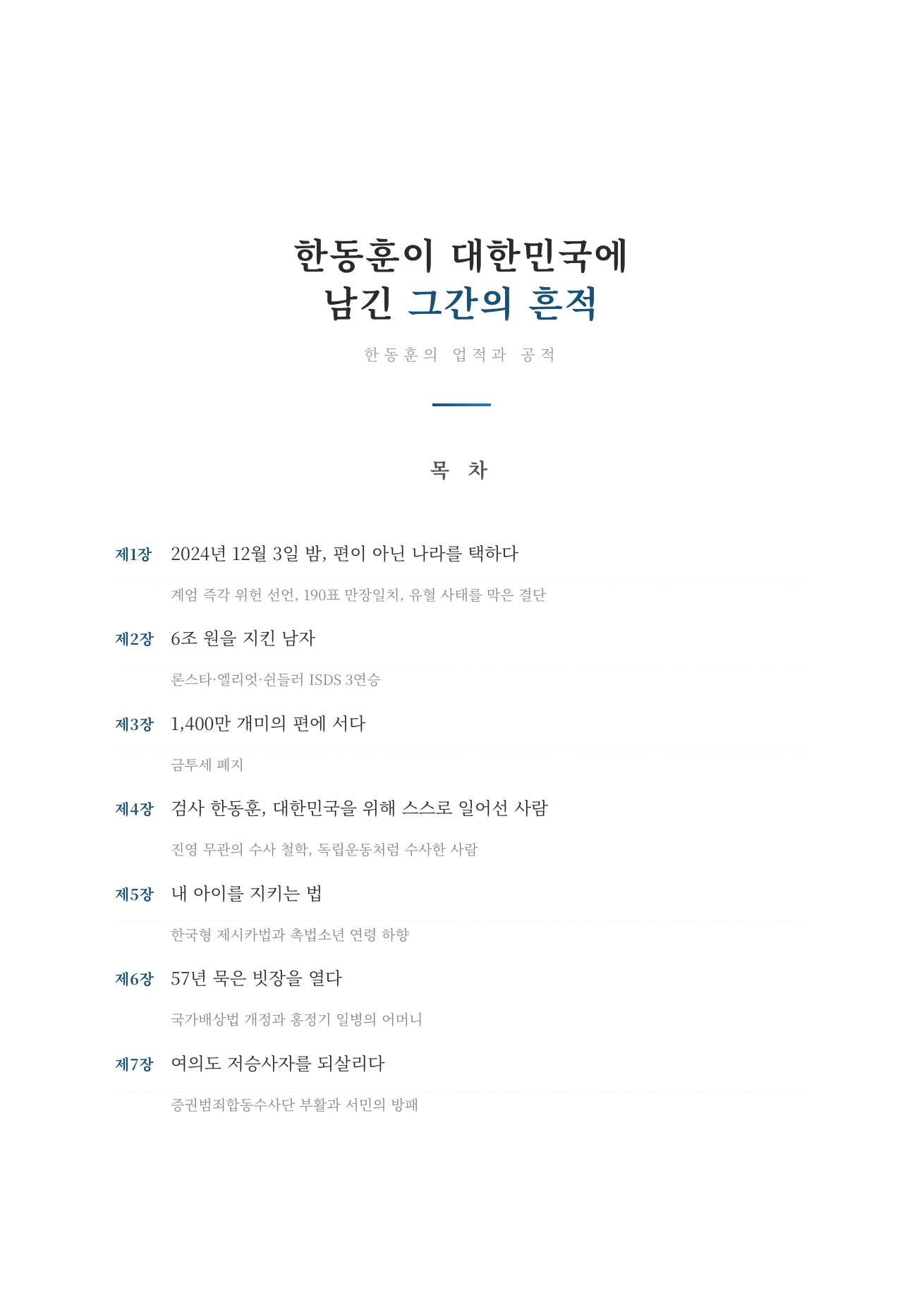
From March 26 to July 3, 2026, this record follows the spring after expulsion, the Busan Buk-gu Gap by-election, victory as an independent, and the first bill submitted in the National Assembly.
Table of Contents
Artificial Intelligence and Medicine
Kim Kyung-jin, Attorney at Law
AI in clinical care, hospitals, education, and research
AI in medical imaging, risk prediction, treatment planning, hospital operations, education, and research, with patient safety, privacy, and accountability.







[AI Library] Chapter 28: Han Dong-hoon, Altar Server at Sudong Cathedral
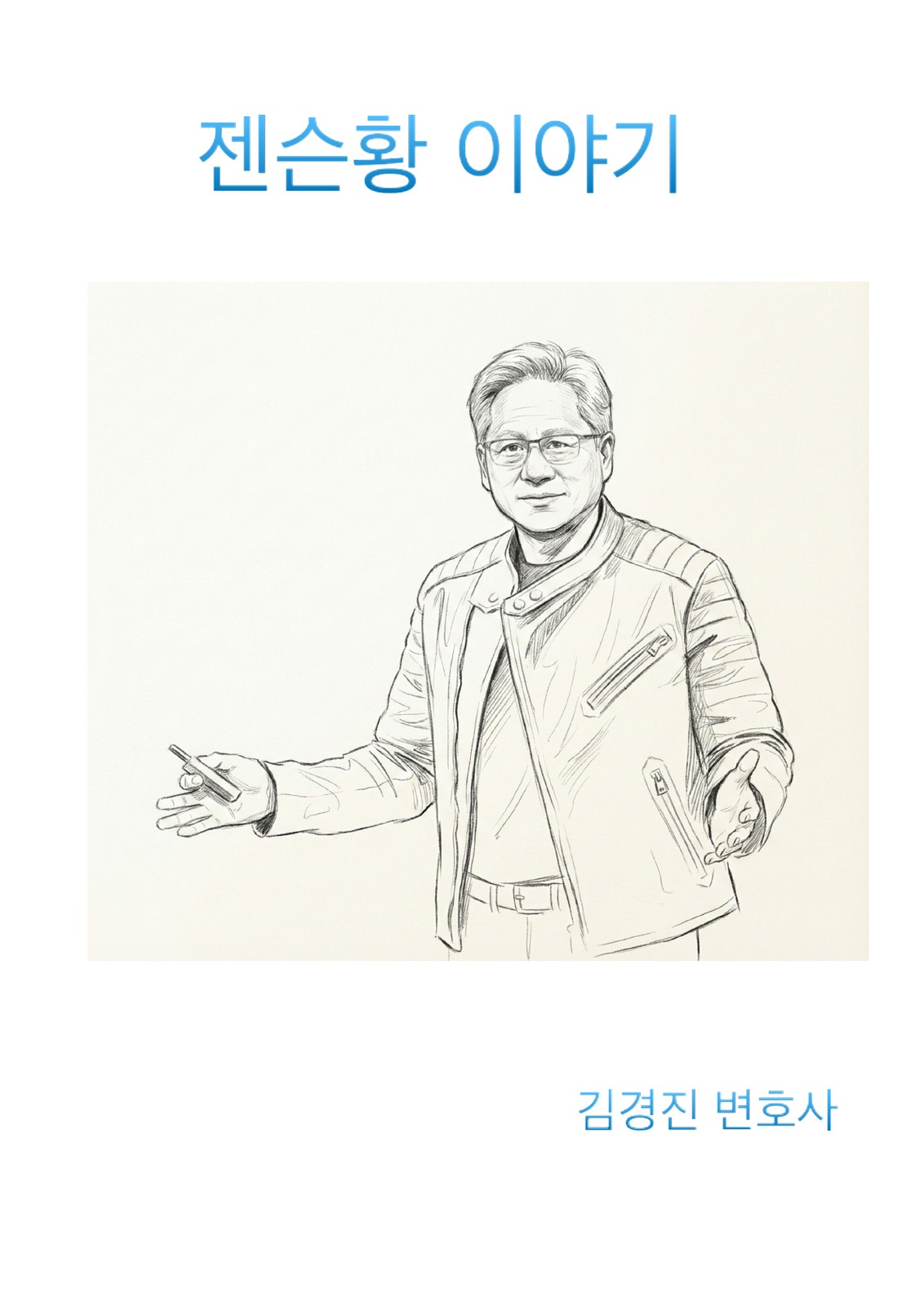
The Han Dong-hoon Story
Chapter 28: Han Dong-hoon, Altar Server at Sudong Cathedral
Kim Kyung-jin
The Han Dong-hoon Story
PART 07 Han Dong-hoon the Man · Original Text 01
One Sunday morning in the early 1980s, the bell of Sudong Cathedral in Cheongju City, North Chungcheong Province, rings out across a quiet village. A boy in a white vestment stands before the altar, helping with mass. This child with close-cropped hair and eyes as clear as an angel's is called a "boksa," a young altar server who assists the priest during mass.
The boy stands with hands clasped together, devout and reverent.
A different kind of seriousness settles in his gaze, distinct from that of other children his age.
This boy is none other than young Han Dong-hoon.
Han Dong-hoon was born in Seoul in 1973. His childhood memories are filled not with the glittering streets of Seoul, but with the humble landscapes of Chungcheong.
The family moved to Cheongju due to his father's work transfer. His father was the head of the Korean division of AMK, then a global manufacturer of magnetic recording heads, and the factory was located in Cheongju.
His life in Cheongju remained an indelible memory throughout his life. Raised in a devout Catholic family, he worked as an altar server at Sudong Cathedral in Cheongju, assisting Father Gerald Hammond.
This blue-eyed priest, known by his Korean name Father Ham Je-do, came to Korea in the 1960s and devoted his life to missionary work in North Korea and tuberculosis eradication programs.
For young Han Dong-hoon, helping with mass beside Father Ham was not merely a religious ritual. It was a process of learning dedication to community and warmth toward others. Later, he would compare this time to Toto, the protagonist of the Italian film "Cinema Paradiso." Just as Toto learned about film beside the projectionist, Han Dong-hoon learned how to live beside Father Ham.
His father too was deeply faithful, having attended seminary to become a priest in his youth. This family environment became the soil in which Han Dong-hoon naturally acquired the value of "public good" from childhood.
The fact that he later sought out Father Ham Je-do, now over ninety years old, to share old memories shows that even amid a brilliant elite life, he treasured his roots and connections.
When he moved to Jampyeong-dong, Seocho-gu, Seoul in the fifth grade of elementary school, he entered the life of Gangnam's prestigious academic district. His trajectory through Shindong Elementary School, Gyeongwon Middle School, and Hyundai High School, culminating in admission to Seoul National University's School of Law, represents the typical course of South Korea's mainstream elite. Throughout his school years, he never dropped from the top ranks of his class and served as class president, a model student.
With his tall stature, fair complexion, and excellent grades, he was popular among his female classmates and commanded deep respect among his male peers.
However, the Han Dong-hoon his classmates remember was not merely a top student who excelled at academics. He was an outsider possessed of a contrarian spirit, one who stood within the mainstream order yet resisted injustice.
An anecdote from his middle school years illustrates this. A teacher instructed students to sign a farewell note only for a top student who was transferring schools. Han Dong-hoon, then class president, raised the issue publicly: "Why must we sign only for that student? It violates fairness."
The word "fairness" from the mouth of a fourteen-year-old boy. It was the seed of a value he would guard with his life.
He mixed freely with so-called "problem students" and those with lower grades. Even rebellious children, it is said, acknowledged and followed him when he was class president. He did not bow to authority or hierarchy but possessed a horizontal sense of fellowship.
He enrolled at Seoul National University's School of Law in 1992. At age 22, while still a fourth-year student, he passed the 37th National Judicial Examination.
During his university years, he served as a founding member of Seoul National University's amateur orchestra club SNUPO, where he also played the flute. As a law student, he did not abandon his artistic sensibility.
During his time at the Judicial Research and Training Institute, he could not drink alcohol, which concerned his classmates. Instead of being swept up in drinking gatherings, he kept his own time and saved money. He had learned from childhood how not to be swept along by the crowd.
The sense of the "marginal person" who belonged to the mainstream while not falling into its logic. This became the driving force that would later allow him to direct his efforts toward living power. He loved his organization, yet he was an "eternal outsider" who did not surrender to its logic.
If this book has remained beside you for even a moment, please support us so that the next story can come into the world.
(Voluntary support account: Nonghyup 302-1096-0948-81 Account holder: Kim Kyung-jin)
Kim Kyung-jin
Attorney · Former Member of the National Assembly · AI Policy Researcher
© 2026 Kim Kyung-jin. All rights reserved.