


AI Library
The Age of Autonomous Scientific Discovery
Kim Kyung-jin, Attorney at Law
AI Scientists and Self-Driving Labs
This book follows how AI scientists and self-driving labs are changing the way science generates and verifies claims. It covers literature-based discovery, natural-language protocols translated into robot commands, multi-agent research systems, closed-loop laboratories, materials search, the verification gap, chains of evidence, research harnesses, journal ethics, and legal responsibility.

AI Library
A New Era of Life Sciences Opened by Artificial Intelligence
Structural Proteomics, Genomic Foundation Models, Autonomous Laboratories, and Global Governance
Kim Kyung-jin, Attorney at Law
This book is a research volume compiled with artificial intelligence. A human selected the materials and structured the work, while AI models drafted the sentences and cross-checked the facts.

AI Library
The Double Structure of Digital Sovereignty
Europe’s Departure from Palantir and the Chains of American Big Tech
Kim Kyung-jin, Attorney at Law
This is a record of 2026, when European intelligence agencies and defense ministries began removing analytics tools from America’s Palantir. It covers the replacement decisions made by France’s General Directorate for Internal Security (DGSI), Germany’s Federal Office for the Protection of the Constitution (BfV), and the Netherlands Ministry of Defense; the incident in which US export controls severed an ally’s ac…

New English Edition
Artificial Intelligence in Horticulture
Kim Kyung-jin, Attorney at Law
Across five chapters and ten sections, this book examines computer vision for crop diagnosis, harvesting robots and autonomous field systems, smart greenhouses and digital twins, precision irrigation and supply-chain quality control, high-throughput phenotyping, and predictive breeding.

New English Edition
Artificial Intelligence in Food Crop Agriculture
Kim Kyung-jin, Attorney at Law
Across six chapters and eighteen sections, the book examines digital agricultural infrastructure, remote sensing, crop diagnosis, yield forecasting, precision irrigation, genomics, molecular breeding, agricultural robotics, climate-smart agriculture, and global food security.

New English Edition
The Future of Forestry and Agroforestry
Kim Kyung-jin, Attorney at Law
Driven by Artificial Intelligence and Digital Innovation
Across five chapters and fifteen sections, the book follows satellites, drones, LiDAR, digital twins, forest-specific language models, wildfire and pest forecasting, forestry robotics, agroforestry, timber traceability, and forest carbon markets.

New English Edition
Smart Livestock Farming: AI Enters the Barn
Kim Kyung-jin, Attorney at Law
Sensors listen, cameras watch, and artificial intelligence helps farmers decide.
Across five chapters and fifteen sections, the book follows precision livestock farming from animal health and reproduction to robotic milking, virtual fencing, digital twins, methane reduction, welfare, and data ownership.


Table of Contents
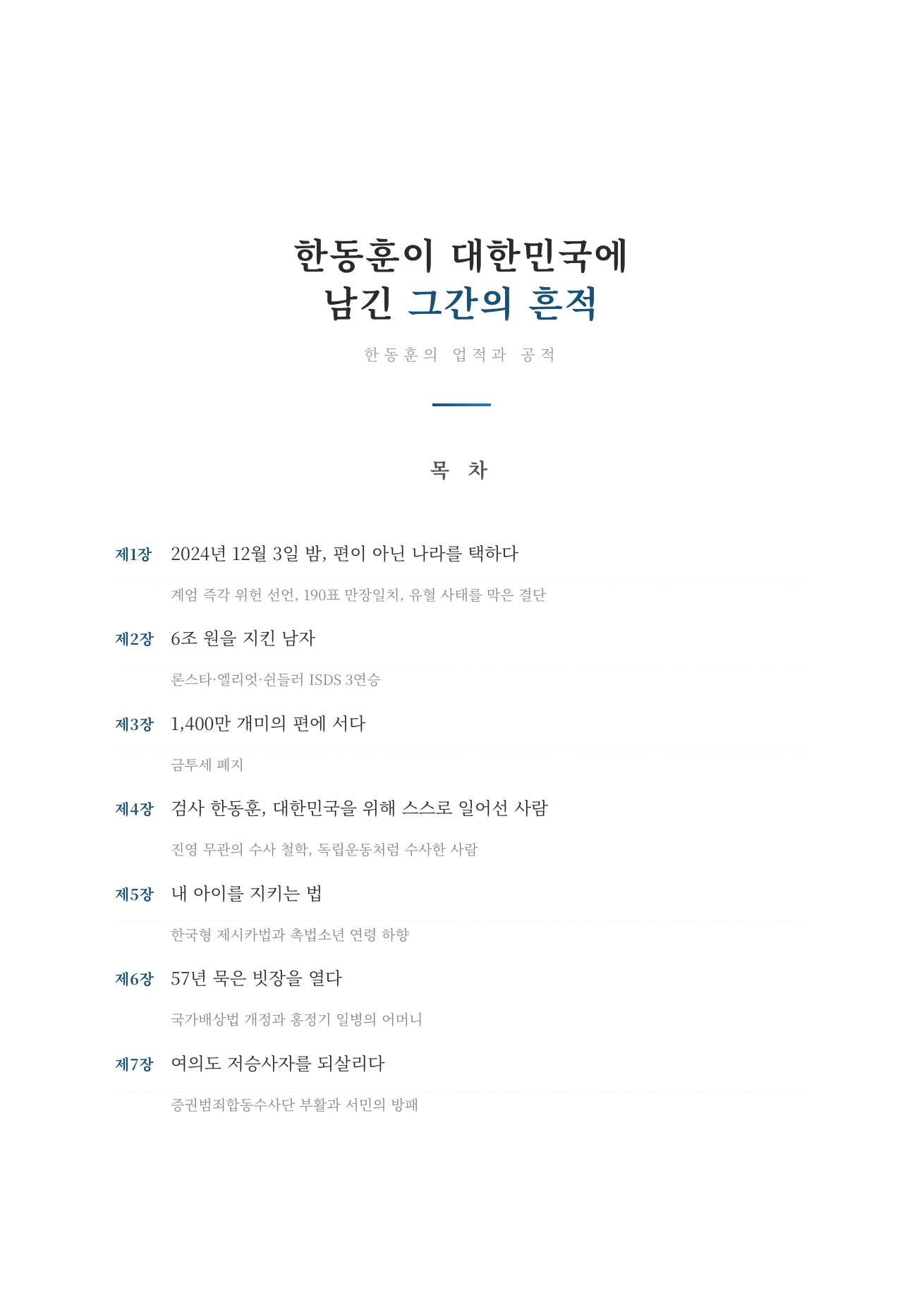
Han Dong-hoon, Busan Buk-gu Gap: A Record of the 100 Days Before and After the Election (Mar. 26-Jul. 3, 2026)
Kim Kyung-jin
Table of Contents and 13 sections
From March 26 to July 3, 2026, this record follows the spring after expulsion, the Busan Buk-gu Gap by-election, victory as an independent, and the first bill submitted in the National Assembly.
Table of Contents
Artificial Intelligence and Medicine
Kim Kyung-jin, Attorney at Law
AI in clinical care, hospitals, education, and research
AI in medical imaging, risk prediction, treatment planning, hospital operations, education, and research, with patient safety, privacy, and accountability.





























[AI Library] Chapter 13: The First Female Policy Research Council Chairperson, the Longest-Serving Minister for Int...
Beyond the Glass Ceiling
Part 3: Growth — From Cabinet Member to the Heart of the Party
Chapter 13: The First Female Policy Research Council Chairperson, the Longest-Serving Minister for Internal Affairs and Communications
Kim Kyung-jin
Part 1. The Regime Returns, and Her Era Begins
December 16, 2012, was a winter evening in the Japanese archipelago where the sun set early. As soon as the various broadcasting stations began their election result specials, the numbers were clear. The Liberal Democratic Party (LDP) won 294 seats. Combined with the Komeito Party, the ruling coalition held 325 seats. This comfortably exceeded two-thirds of the 480 seats in the House of Representatives. It was the moment the LDP reclaimed power after that historic defeat three years and three months earlier, when the Democratic Party of Japan (DPJ) swept 308 seats and pushed the LDP into the opposition.
Political reporters in the studios repeated the word "landslide." Analysis of the reasons for the loss, analysis of the reasons for the win, and the future distribution of seats followed. However, this lawmaker, who represented all of Nara Prefecture as her constituency, stood outside the framework of such analysis. Sanae Takaichi succeeded in her sixth term. She was already a veteran of the electoral game. The question of interest that night was: After Shinzo Abe becomes Prime Minister, where will her position be within the LDP?
The answer arrived without much of a wait.
In the LDP presidential election in September 2012, Takaichi had publicly supported Abe. To support Abe at the time, she had withdrawn from the Seiwa Policy Research Group (清和政策研究会), the Fukuda faction. Factions are the units for personnel appointments in Japanese politics. Leaving a faction means discarding one's protective shield for appointments. Based on that decision, Abe became president, and the LDP won a landslide in the general election. Takaichi watched as the seeds she had sown grew into a massive tree.
President Abe had appointed her as the Chairperson of the LDP Public Relations Headquarters (広報本部長) even before the general election. It was a position in charge of overseeing the party's messaging during the campaign. "Take back Japan (日本を、取り戻す。)." Blue posters featuring this general election slogan were put up in front of stations across Japan. Takaichi, as the Public Relations Chairperson, was responsible for the design and dissemination of that message.
However, the Public Relations Chairperson was just the prelude. The main act arrived immediately after the reclamation of power.
Late December 2012. Chairperson of the LDP Policy Research Council (政務調査会長). Sanae Takaichi’s name was placed in that seat.
Insiders recall that a momentary silence fell within the party. The Chairperson of the Policy Research Council is a position that, along with the Secretary-General (幹事長) and the Chairperson of the General Council (総務会長), constitutes the so-called "Three Key Positions (三役)" of the LDP organization. Since the founding of the LDP, the fact that these three positions are the core of the party's decision-making has never changed. While the Secretary-General oversees the party's organization, funds, and elections, and the General Council Chairperson leads the General Council—the party's highest decision-making body—the Policy Research Council Chairperson leads the Policy Research Council, which deliberates and decides on all party policies.
The Policy Research Council (政務調査会), or Sei-cho-kai (政調会) for short, is the heart of the LDP's policy. Before the Cabinet can submit a bill to the Diet, that bill must pass through the Sei-cho-kai. Dozens of divisions (部会), research commissions, and special committees within the party review policies in each field, and the Policy Research Council Chairperson consolidates those results to form the party's platform. This is the center where the mechanism of "prior screening by the ruling party" operates in Japanese politics. No matter how strongly a Prime Minister wishes to push a policy, it cannot become the party's platform without the consent of the Sei-cho-kai. If the Policy Research Council Chairperson shakes their head, the bill does not go up to the Diet.
It was the first time in the LDP's 57-year history that a woman sat in that position. Since the party's founding in 1955, there was no precedent for a woman holding any of the Three Key Positions.
The reaction within the party was twofold. One was welcome. It was already a proven fact within the party that Takaichi was outstanding in her policy capabilities. During the first Abe Cabinet, there was no field she was not involved in, and even during the years in opposition, she was recognized as a party expert in various fields such as broadcasting and communications, science and technology, and agriculture. There was also a view that it was a fitting reward for someone who had left their faction to help Abe.
The other was cautious concern. The Sei-cho-kai is a place where conflicting interests within the party collide. The divisions in each field are staffed by veteran lawmakers with long-standing ties to various industries. Coordinating with them cannot be done with mere policy knowledge. It requires networking, experience, and a sense of political balance. No one was certain what kind of friction the fact that she was a woman might cause.
Takaichi herself did not waver. Her method was to clarify her position in the meeting room, listen to opposing opinions, and then formulate a conclusion based on that. Legislation related to regulatory reform, specifically the third arrow of Abenomics—the growth strategy—had to pass through the Sei-cho-kai. To what extent should regulations in the medical, agricultural, and energy sectors be relaxed? Each division put forward its own interests. The Policy Research Council Chairperson had to navigate that jungle of interests to create the party's platform.
This period lasted about a year and a half. Takaichi led the LDP's policy production line as the Policy Research Council Chairperson until she joined the Cabinet in September 2014. That experience became the foundation that made her subsequent time as the Minister for Internal Affairs and Communications possible.
Another mark Takaichi left during her time as the Policy Research Council Chairperson was her image as a "politician who transcends factions." Although the LDP had been reorganized under President Abe's leadership at the time, the interests of various factions were still intertwined within it. The Sei-cho-kai is the stage where these factional interests are expressed in the language of policy. The agricultural faction opposes opening the rice market, the construction faction demands public works budgets, and lawmakers related to manufacturing want deregulation. One must create the "LDP's policy" above all these demands.
Takaichi performed this role without the protection of any specific faction. At times, this was a disadvantage. Without the backing of a faction, there is no network to hold one up when disputes arise within the party. However, in other ways, it was a strength. She was able to earn trust as someone who did not represent the interests of a specific faction but instead used policy itself as the standard for judgment.
By the time she finished her tenure as the Policy Research Council Chairperson and moved to the position of Minister for Internal Affairs and Communications, Takaichi's status within the party had risen much higher than before she joined the Abe administration. Not only her record as the first woman but also her experience in actually operating the party's most complex policy coordination body created that status.
Part 2. The Ministry of Internal Affairs and Communications, and the Woman Who Led It
September 3, 2014. Prime Minister Abe carried out the second reshuffle of his Cabinet. The slogan Abe put forward this time was "A Society where Women Shine (女性が輝く社会)." It was a high-profile appointment that brought in five female Cabinet members. One of those five was Sanae Takaichi.
Minister for Internal Affairs and Communications (総務大臣). The 18th. She was the first woman to hold the post.
The Ministry of Internal Affairs and Communications (MIC) is a unique entity within the Japanese central government system. It was created in 2001 through the merger of three organizations: the Ministry of Home Affairs (自治省), the Ministry of Posts and Telecommunications (郵政省), and the Management and Coordination Agency (総務庁). As a result of absorbing the duties of all three agencies, the MIC came to have one of the most extensive scopes of jurisdiction in Japan.
First is local administration. It oversees more than 1,700 prefectures and municipalities nationwide. The local civil service system, local tax system, and the allocation of local allocation tax are all under the jurisdiction of the MIC. Considering the scale of local allocation tax in Japan's budget, this alone gives the MIC enormous administrative power.
Second is broadcasting and communications. The granting and cancellation of broadcasting licenses, allocation of radio waves, operation of the Broadcasting Act, and management of telecommunications carriers are the duties of the MIC's Information and Communications Bureau. This means that the authority to regulate the entire broadcasting ecosystem, including private broadcasters and NHK, lies with the Minister for Internal Affairs and Communications.
Third is elections. The basic framework of election management is under the jurisdiction of the MIC. This includes amendments to the electoral system, standards for managing voter lists, and political fund regulations.
Fourth is statistics. Major national statistics, including the census (population census), are produced by the MIC's Statistics Bureau.
Fifth is firefighting. The Fire and Disaster Management Agency is an external bureau of the MIC. It is an important pillar of the disaster response system.
Adding all of these together, the MIC can be called the "foundation ministry" of Japanese administration. Administration most closely related to the daily lives of citizens, the infrastructure of information and communications, the finances of local regions, and the framework of elections. The areas handled by the Minister for Internal Affairs and Communications are as politically sensitive as they are broad. Any decision will collide with interests somewhere.
Takaichi becoming the Minister for Internal Affairs and Communications meant taking on all of these areas simultaneously.
Abe's "A Society where Women Shine" slogan was sometimes criticized. Critics pointed out that increasing the number of female Cabinet members was different from actually increasing women's participation in society. The employment structure of Japanese society, the burden of childcare, and the ratio of management positions do not change overnight just because the number of Cabinet members changes. That criticism was correct to some extent. However, on the other hand, the sight of Sanae Takaichi actually leading the complex administration of the MIC showed that women can perform that role, at least at the highest level of politics. That symbolism cannot be taken lightly.
One of the most urgent tasks immediately after taking office was the My Number system. The My Number system is a system that assigns a 12-digit personal number to every Japanese citizen to be used for social security, taxes, and disaster response. It is similar to South Korea's resident registration number, but its introduction in Japan was much later and faced significant public resistance. Concerns about privacy infringement, the risk of information leakage, and the fear of personal management by the state had prevented the system's introduction for a long time.
When Takaichi took office as the Minister for Internal Affairs and Communications, legislation for the My Number system had already been completed in 2013, but the actual operation was just beginning. In October 2015, the sending of 'notification cards' to inform every household in the country of their personal number began. Approximately 128 million notification cards were delivered by mail. During the delivery process, misdelivery accidents occurred. By early November, eight cases of misdelivery had been reported. In a press conference, Takaichi stated, "We cannot cause anxiety to the citizens," and strengthened on-site guidance.
However, notification cards were just the beginning. The real goal was the dissemination of the My Number Card, the personal number card. If one obtains the card, various administrative services can be handled online. Without this card, the foundation for digital administration cannot be created. However, the adoption rate did not rise easily. Citizens were not applying for the cards.
This task began during her first term as the Minister for Internal Affairs and Communications and continued into her second term. It was a homework assignment that was not easily solved, yet absolutely had to be.
The Hometown Tax Donation (ふるさと納税) system was also an important task. The Hometown Tax Donation system, implemented in 2008, is a structure where taxpayers can receive deductions from their income tax and resident tax equivalent to the amount they donate to local governments they wish to support. The intent was to correct the structural imbalance where tax revenue is concentrated in cities while local regions suffer from financial difficulties.
However, as the system took root, problems arose. Local governments began to competitively offer expensive return gifts to attract donations. Beef, crab, rice, electronics. The return gifts effectively degenerated into a means of 'shopping.' The original intent of helping local finances became blurred. When the 2015 tax reform doubled the deduction limit and introduced the "One-Stop Special Case (ワンストップ特例)" system, which allows for deductions without filing a final tax return, the amount of Hometown Tax Donations surged nearly fourfold compared to the previous year. It reached 165.2 billion yen.
While supporting the expansion of the system, Takaichi put the brakes on the overheating of return gifts. She applied guidelines to the ratio and content of return gifts. It was an effort to find a balance in the game where local regions were competitively attracting taxpayers.
Regional Revitalization (地方創生) was also a core agenda of the Abe Cabinet. It was a policy aimed at alleviating the unipolar concentration in Tokyo and countering the population decline in local regions. The MIC was responsible for the financial backing of this policy through its authority to allocate local allocation tax. Projects such as the expansion of the "Local Revitalization Cooperation Volunteers (地域おおこし協力隊)," decentralized energy infrastructure projects, and the "Regional 10,000 Project" were pushed through the MIC.
Takaichi later recalled this period: "The position of Minister for Internal Affairs and Communications is not a position for pushing just one policy. You must move in several directions simultaneously while maintaining a balance between local and central, broadcasting and communications, and analog and digital." That balancing act was the reality of her first term as Minister.
Another area Takaichi particularly focused on as Minister for Internal Affairs and Communications was the fiscal consolidation of local governments. Since the late 2000s, Japan's local governments had been trapped in the double hardship of financial difficulties and population decline. Small towns and rural areas, in particular, were under structural pressure as tax revenues decreased while social security expenditures increased due to aging. The local allocation tax distributed by the MIC was a key tool for alleviating this imbalance. Takaichi put effort into improving the calculation method of allocation tax and providing institutional support for administrative efficiency between local governments.
In addition, the local utilization of ICT (Information and Communications Technology) was an important task. Takaichi promoted the integration and standardization of local government systems. Having more than 1,700 municipalities nationwide each operating different formats of administrative systems was the height of inefficiency. Standardizing them would reduce administrative costs and improve services for residents. It was not an easy task. Each local government resisted changing its existing system. It was the role of the MIC to persuade them and promote standardization, and Takaichi made that direction clear.
Part 3. February 8, 2016, That Afternoon in the Budget Committee
It was about 17 months after she became the Minister for Internal Affairs and Communications. February 8, 2016. The House of Representatives Budget Committee of the Japanese Diet. The layout of the meeting room is always the same. Ruling party lawmakers sit facing the Prime Minister and Cabinet members, while opposition lawmakers cast questions from the opposite side. On this day, Soichiro Okuno (奥野総一郎), a lawmaker from the opposition Democratic Party, stood to ask questions.
His questions were about the intersection of the Broadcasting Act and the Radio Act. Specifically, whether a suspension of radio waves could be ordered for a broadcasting station that continuously broadcasts politically biased content, and whether she could promise not to do so. Article 4 of the Broadcasting Act stipulates the duty of political impartiality for broadcasters. Article 76 of the Radio Act stipulates that the Minister for Internal Affairs and Communications can order the suspension of radio waves. What kind of authority is created when these two provisions are linked?
Takaichi's response began.
"Article 4 of the Broadcasting Act is not a mere ethical regulation. Even during the era of the Democratic Party government, the government has interpreted it as having legal normativity."
She continued.
"If a broadcaster continues to use public radio waves while repeating a situation that is not improved at all, if it is not improved at all even after administrative guidance, it is impossible to promise that we will not take any action."
And the decisive sentence.
"I cannot categorically state that such a thing will absolutely never happen in the future (まったく将来にわたってそれがありえないとは断言できません)."
It took only a few hours for this statement to pass through the Budget Committee room to the evening news broadcasts and to the social pages of the next morning's newspapers.
The reaction was broad and immediate.
The Tokyo Bar Association released a statement of protest. The gist of the statement was three points: First, the statement infringes on the freedom of expression guaranteed by Article 21 of the Constitution. Second, Article 4 of the Broadcasting Act is an autonomous ethical regulation for broadcasters and cannot be used by the government as a basis for administrative disposition. Third, this statement creates a powerful chilling effect in broadcasting and threatens democracy. The statement demanded the immediate withdrawal of the remarks.
The statement from the Japan Federation of Commercial Broadcast Workers' Unions (Minpo Roren) was more direct. "This is a threat and intimidation to broadcasting stations. The statement by the Minister for Internal Affairs and Communications is already posing a threat to broadcasting sites." The Japan Lawyers' Association for Freedom, a legal organization, issued a separate statement of protest. The opposition launched a full-scale offensive in the Diet.
Academia also raised its voice. Constitutional scholars pointed out that Takaichi's interpretation of the legal nature of Article 4 of the Broadcasting Act deviated from previous government interpretations. Successive governments had viewed Article 4 of the Broadcasting Act as a provision for internal discipline by broadcasters, and had maintained the position that issuing administrative dispositions based on it would be an infringement on the freedom of expression. Takaichi's statement was seen as crossing the boundary of that interpretation.
Prime Minister Abe stepped in to defend her. "The Minister for Internal Affairs and Communications was answering on the general theory of the Broadcasting Act." He argued that she had merely explained a legal interpretation under an extreme hypothetical. However, the fire of criticism did not go out.
Takaichi herself posted an explanatory column on her official website. "This is a general theory assuming an extremely extreme and limited situation. It is nothing more than explaining how the relationship between the Broadcasting Act and the Radio Act is interpreted legally." However, she did not withdraw her statement.
At the heart of this controversy was an old question of democracy. Is it legitimate to demand political impartiality from broadcasters who use public radio waves? Can that demand be enforced through administrative power? If the government can order a suspension of radio waves for a broadcast it judges as "unfair," what happens to broadcasts critical of the regime?
In any democratic country, this question is not simple. The tension between the fairness of broadcasting and the limits of government regulation exists in all societies. However, there was a reason why this statement was received particularly sensitively in Japan. This was because the timing of the statement was at a point where the Abe administration's relationship with the media was already tense.
In 2015, a statement from a private meeting of then-LDP executives was reported, saying, "There is a need to punish the media." In the Chief Cabinet Secretary's press conferences, friction with specific reporters was repeated. Against this background, the Minister's statement on radio wave suspension was read not just as a question of legal interpretation, but as an expression of the government's will to control the media.
In the 2016 World Press Freedom Index released by Reporters Without Borders, Japan's ranking fell 11 places from 61st to 72nd. The report explicitly stated Takaichi's radio wave suspension statement as one of the major deteriorating factors.
And around this time, prominent anchors on major Japanese broadcasts stepped down one after another. Hiroko Kuniya (国谷裕子) of NHK. Shigetada Kishii (岸井成格) of TBS. Ichiro Furutachi (古舘伊知郎) of TV Asahi. The reasons explained for each departure were different—contract expiration, ratings, generation change. However, the fact that all three of these anchors were known for broadcasts critical of the regime raised questions that their departures might not be a simple coincidence.
The term "Takaichi Phobia (高市恐怖症)" emerged at broadcasting sites. It was not an official term. It was an expression that came out during conversations between political reporters and broadcasting officials. It meant that after the Minister mentioned "radio wave suspension," an atmosphere of internal self-braking was created at broadcasting sites when airing content critical of the regime. Even without direct instructions or pressure, a single statement from the Minister for Internal Affairs and Communications acted as a threat.
Takaichi herself did not accept this framing. "Why is it oppression to hold broadcasters who use public radio waves accountable? Why is it an infringement on press freedom to demand fair broadcasting?" Her claim was not without logic. The principle that those who use radio waves, which are public goods, bear corresponding responsibilities is recognized internationally.
However, who decides the criteria for "fair broadcasting"? If the government has the authority to enforce those criteria, isn't there a risk that broadcasts uncomfortable for the government will be defined as "unfair"? In the face of that question, Takaichi's logic was not completely closed.
This incident did not simply pass by. In 2023, controversy grew again as administrative documents were released that contained the process of the MIC internally changing its interpretation of the Broadcasting Act in 2015. Circumstances were included in the documents that Takaichi was involved in the interpretation of the Broadcasting Act during her tenure as Minister. Takaichi clashed violently with the opposition over the interpretation of the documents. She strongly maintained the position that the documents were incorrectly described.
The documents recorded the process in 2015 where MIC executives internally summarized the interpretation of Article 4 of the Broadcasting Act as an "obligation with legal binding force" rather than "autonomous norms of broadcasters." The opposition's claim was that this change in interpretation became the basis for Takaichi's 2016 statement. Takaichi countered that the descriptions in the documents exaggerated or distorted her instructions. Whichever side the truth lay on, this controversy revealed that the long-standing debate surrounding the Broadcasting Act and the Minister's authority did not stem from Takaichi alone, but from structural ambiguities in the overall Japanese broadcasting regulation system.
Comparatively speaking, government regulation of broadcasting is not completely neutral in any country. The Federal Communications Commission (FCC) in the United States, Ofcom in the United Kingdom, and the Korea Communications Commission in South Korea all manage broadcasting fairness standards to some extent. It is not strange in itself that the Minister for Internal Affairs and Communications in Japan is involved in the operation of the Broadcasting Act. The problem was the structural risk that the direction of that involvement could tilt in favor of the power in office. Takaichi's statement was recorded in history as a case showing that this risk is not a mere theory.
The statement of February 8, 2016, settled as a permanent point of contention in Takaichi's political career. Every time she stands for any position, this statement is summoned. Supporters say it was an answer faithful to the law and principles. Opponents say it was a threat to press freedom. Both sides still believe their interpretation is correct today.
Part 4. The Returning Minister, and the Night of 100,000 Yen
On August 3, 2017, Prime Minister Abe reshuffled the Cabinet. Sanae Takaichi stepped down as Minister for Internal Affairs and Communications. Her tenure during her first term alone reached about 1,066 days, a period equivalent to about two-thirds of the total. With that number alone, she had already approached historical records. However, Takaichi's career at the MIC did not end there.
September 11, 2019. Prime Minister Abe reshuffled the fourth Cabinet again. The Minister for Internal Affairs and Communications post returned to Takaichi. The 23rd Minister. She also concurrently served as Minister of State for Special Missions (in charge of the My Number system).
The most important task during her second term as Minister was the dissemination of My Number Cards. It was a homework assignment that had continued since her first term. Despite the government's recommendation to create the cards, the public's response was lukewarm. As of the end of 2019, the card adoption rate hovered around 15% of the total population. In this state, the digitalization of administration could not move forward. Takaichi pushed for integrating health insurance card functions into the card. Her logic was that the number of situations where the card can be used must be increased for citizens to apply for issuance.
And in early 2020, a situation that no one had expected arrived.
The novel coronavirus. Since the first infected person was confirmed in Japan in January 2020, the infection spread nationwide. By March, economic activity had contracted sharply. Self-employed people, non-regular workers, and small and medium-sized enterprises began to collapse. The government hurriedly created economic support measures.
On April 7, Prime Minister Abe declared a state of emergency. On the same day, the outline of a supplementary budget proposal emerged. At first, a plan to pay 300,000 yen only to low-income households was considered. However, the direction changed due to the strong demand of the Komeito Party. The "Special Fixed-Sum Cash Benefit (特別定額給付金)" system, which pays 100,000 yen per person to all citizens, was born.
On April 20, a press conference was held at the MIC. Minister Sanae Takaichi explained the outline of the system. 100,000 yen per person would be paid to all citizens registered in the Basic Resident Register as of the reference date, April 27. Application methods were mail application and online application. Payments were to be transferred to bank accounts in the name of the applicants themselves. The implementing entities were the respective municipalities. Costs were 100% subsidized by the state.
The MIC oversaw the administrative processing of this system. Approximately 1,700 municipalities nationwide had to receive applications and process payments under their respective conditions. 100,000 yen each to about 125 million people in Japan. The total payment exceeded 12 trillion yen, the largest cash benefit in history.
At first, online applications using My Number Cards were encouraged. However, the system could not withstand the surge of visitors. Because the adoption rate of My Number Cards was low, few people could even use the online application itself. Ultimately, most of the benefits were made through mail applications. Regions where payments were delayed popped up one after another.
Paradoxically, this chaos reaffirmed the necessity of My Number Card dissemination and administrative digitalization. If the card adoption rate had been high, if online applications had been smooth, the payments would have been made much faster. That logic, which Takaichi had emphasized for years, was ironically proven amidst the COVID crisis.
September 11, 2020. Prime Minister Shinzo Abe announced his resignation. A recurrence of ulcerative colitis. It was a carbon copy of his stepping down in 2007 from the first Cabinet for the same reason. It was a cruel repetition of 13 years ago. Takaichi's second term as Minister for Internal Affairs and Communications also ended with it.
Abe's exit had a politically complex meaning for Takaichi. Abe was the most important supporter in Takaichi's political career. She had left her faction to support Abe, and in return, she had served as Policy Research Council Chairperson and Minister for Internal Affairs and Communications. That axis was shaken. Yoshihide Suga became the new Prime Minister. Takaichi was not included in the Suga Cabinet. However, that was not the end. A year later, the Suga Cabinet also came to an end, and Takaichi would run in the presidential election in her own name for the first time.
Her tenure during the second term was about 373 days. Combined with the first term, it totaled 1,066 days. The number was fixed.
Part 5. What 1,066 Days Signify
On June 20, 2017, the Nihon Keizai Shimbun published a short article. "Minister Takaichi's tenure to become the longest ever on the 21st (高市総務相の在任期間、21日歴代1位に)." It was the day Takaichi surpassed the record of Toranosuke Katayama (片山虎之助), who had served as the first Minister for Internal Affairs and Communications since the MIC was launched with the 2001 central government reorganization and had the longest first-term tenure. And the final number combined with the subsequent second term was 1,066 days.
To understand the meaning of this record, one must look again at the characteristics of the position of Minister for Internal Affairs and Communications. Cabinet reshuffles in Japan are frequent. Ministers change whenever the Prime Minister manages approval ratings or readjusts the balance of power within the party. The Minister for Internal Affairs and Communications is no exception. Before Takaichi, the average tenure of successive Ministers for Internal Affairs and Communications since the MIC's launch was around 300 days. It was common for them to be replaced before serving even a full year.
The fact that Takaichi spent 1,066 days in that seat tells two things. One is Abe's trust. Leaving a politically sensitive ministry like the MIC to someone for a long time is a risk for a Prime Minister. Broadcasting policy creates conflict with the media, and local administration collides with local interests. Entrusting Takaichi with that position twice and keeping her for a long time is direct evidence that Abe trusted her ability and direction.
The other is Takaichi's own capability. The work of the MIC is not an area that can be understood in a short period. The calculation method for local allocation tax, the legal procedures for broadcasting licenses, and the technical standards for statistical surveys. Time is needed to deeply understand these and reflect them in policy decisions. The tenure of 1,066 days was also the time Takaichi deeply dug into the interior of the MIC.
How did the MIC change during that time?
The foundation for the My Number system was created. Although it was not complete dissemination, the path from starting with notification cards to advancing to the practical use of My Number Cards was established during this period. The long flow that followed—administrative digitalization, COVID benefit payments, and health insurance card integration—had its starting point here.
The Hometown Tax Donation system took root. The system that started in 2008 took a leap with the 2015 tax reform, and the framework of the system was refined as return gift regulation guidelines were created during Takaichi's time. Today's Hometown Tax Donation market, which exceeds 1 trillion yen annually, stands on the foundation of this period.
A roadmap for the transition to 4K and 8K broadcasting was established. The reason Japan was able to start 4K and 8K broadcasting services in December 2018 is that the policy direction was decided during this period. The MIC created the roadmap to advance to the next stage after the complete nationwide transition of terrestrial digital broadcasting, and Takaichi led it.
Cybersecurity policy was also incorporated into the MIC's domain during this period. The security of communication networks, cyber defense of important infrastructure, and the capacity building of the so-called "Japan CERT" were pushed under the leadership of the MIC.
All of these did not decorate flashy headlines. When the Hometown Tax Donation system grew rapidly, what the broadcasts focused on was the overheating of return gifts, and when the My Number system became known to the public, it was during misdelivery accidents. The work of building the foundation of a system is quiet, slow, and uncelebrated.
However, if the policy direction had wavered every time the Minister changed, none of these would have been able to get on track. That is where the consistency of the 1,066 days contributed.
The record of being the longest-serving has another meaning. It is its meaning as a political asset.
Takaichi challenged the presidential election three times: in 2021, 2024, and 2025. In a presidential election, the most powerful basis for a candidate to explain their capabilities is experience. What have they done in what position? For Takaichi, 1,066 days as Minister for Internal Affairs and Communications was the core of that experience. She led the most extensive ministry in Japanese administration longer than anyone else in history. She knows the fiscal structure of local autonomy, knows the technical details of broadcasting and communications policy, and knows how administrative digitalization works. That experience gave specificity to the claim that she is "a person who can become Prime Minister."
In October 2025, Sanae Takaichi became the 104th Prime Minister of Japan. She was the first female Prime Minister in Japanese constitutional history. On the road to that position, 1,066 days as Minister for Internal Affairs and Communications was not just an item in her career. A person who has handled the foundation of Japanese administration, a person who oversaw the administration of paying benefits to the entire nation in a crisis, a person who designed the future of broadcasting and communications. Those specific achievements were attached in front of her name.
The year and a half she spent overseeing the party's policies as Policy Research Council Chairperson. The 1,066 days she spent laying the foundation of Japanese administration as Minister for Internal Affairs and Communications. These two chapters were times when politician Sanae Takaichi's capabilities were actually tested and verified. The modifier of being the first woman was the result of that time, not the condition that allowed that time to begin. She did not reach that position because she was a woman; she moved on to the next position because she proved herself in that position.
Records are numbers, but behind numbers are decisions. Decisions over 1,066 days. Some were praised, some were harshly criticized, and some are still under evaluation. However, without those decisions, the name Sanae Takaichi would have been much lighter. History will remember them.
The most specific legacy the MIC experience left for Takaichi as Prime Minister is a sense for administrative reality. Some politicians have ideology and vision but do not know the specific way administration operates. They shout grand slogans without knowing what is possible and what is impossible, and how laws, budgets, and personnel interlock. Takaichi was different. She learned on the ground how local governments react when Hometown Tax return gift regulations become guidelines, what incentives are needed to increase My Number Card dissemination, and what the fastest route to executing COVID benefit payments is. She went through thousands of meetings with MIC bureaucrats. That accumulation backed up Prime Minister Takaichi's administrative sense.
The meaning as a female politician also needs to be reconsidered. When Takaichi became the Policy Research Council Chairperson and when she became the Minister for Internal Affairs and Communications, the Japanese media and voters focused on the modifier "first woman." That was a correct reaction. It is important to record the moment an old glass ceiling is broken. However, Takaichi refused to be bound by that modifier. Her attitude was that she would not take on special tasks because she was a female politician, but would take on the most difficult and extensive positions as a politician. The MIC is not a ministry in charge of "women's policy." Broadcasting, communications, local autonomy, elections. She made her own judgments and took responsibility in all these areas.
That is probably the core of what this chapter wants to say. The record of being the first woman is about opening the door. However, what one did inside that door is a separate story. Sanae Takaichi opened the door and endured for 1,066 days inside. When those two things are together, they finally become history.