

AI Library
The Age of Autonomous Scientific Discovery
Kim Kyung-jin, Attorney at Law
AI Scientists and Self-Driving Labs
This book follows how AI scientists and self-driving labs are changing the way science generates and verifies claims. It covers literature-based discovery, natural-language protocols translated into robot commands, multi-agent research systems, closed-loop laboratories, materials search, the verification gap, chains of evidence, research harnesses, journal ethics, and legal responsibility.
AI Library
A New Era of Life Sciences Opened by Artificial Intelligence
Structural Proteomics, Genomic Foundation Models, Autonomous Laboratories, and Global Governance
Kim Kyung-jin, Attorney at Law
This book is a research volume compiled with artificial intelligence. A human selected the materials and structured the work, while AI models drafted the sentences and cross-checked the facts.

AI Library
The Double Structure of Digital Sovereignty
Europe’s Departure from Palantir and the Chains of American Big Tech
Kim Kyung-jin, Attorney at Law
This is a record of 2026, when European intelligence agencies and defense ministries began removing analytics tools from America’s Palantir. It covers the replacement decisions made by France’s General Directorate for Internal Security (DGSI), Germany’s Federal Office for the Protection of the Constitution (BfV), and the Netherlands Ministry of Defense; the incident in which US export controls severed an ally’s ac…
New English Edition
Artificial Intelligence in Horticulture
Kim Kyung-jin, Attorney at Law
Across five chapters and ten sections, this book examines computer vision for crop diagnosis, harvesting robots and autonomous field systems, smart greenhouses and digital twins, precision irrigation and supply-chain quality control, high-throughput phenotyping, and predictive breeding.
New English Edition
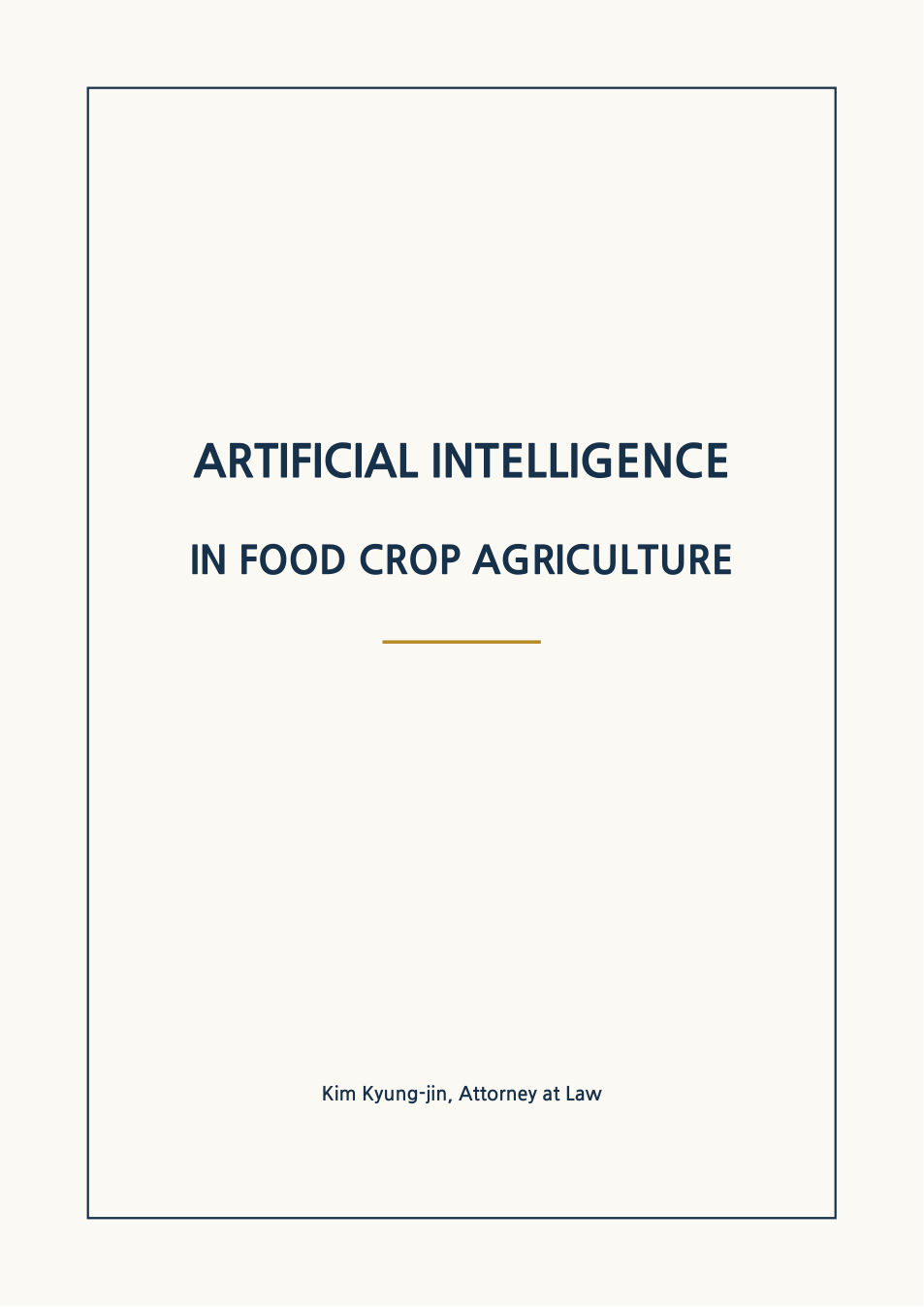
Artificial Intelligence in Food Crop Agriculture
Kim Kyung-jin, Attorney at Law
Across six chapters and eighteen sections, the book examines digital agricultural infrastructure, remote sensing, crop diagnosis, yield forecasting, precision irrigation, genomics, molecular breeding, agricultural robotics, climate-smart agriculture, and global food security.
New English Edition
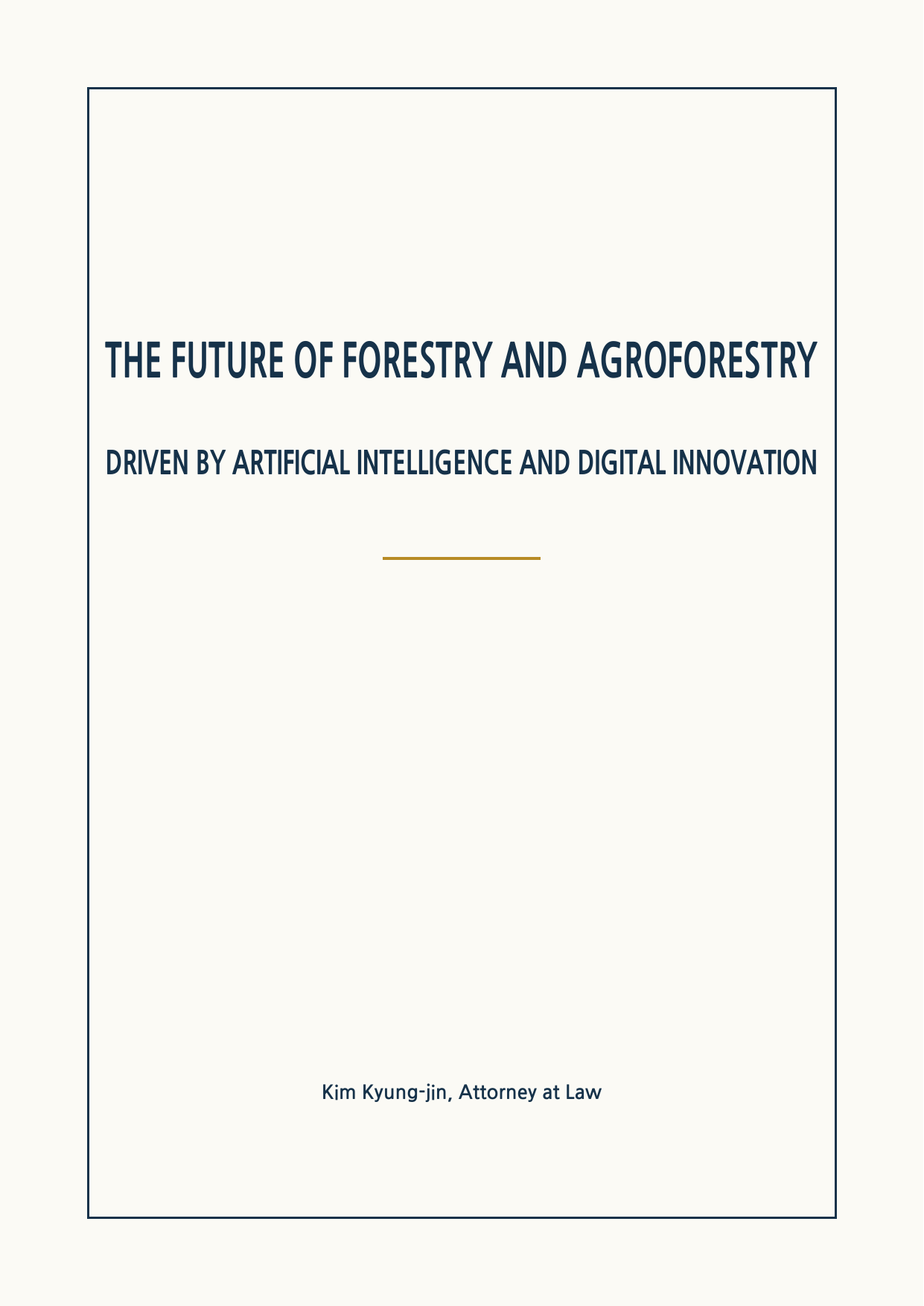
The Future of Forestry and Agroforestry
Kim Kyung-jin, Attorney at Law
Driven by Artificial Intelligence and Digital Innovation
Across five chapters and fifteen sections, the book follows satellites, drones, LiDAR, digital twins, forest-specific language models, wildfire and pest forecasting, forestry robotics, agroforestry, timber traceability, and forest carbon markets.

New English Edition
Smart Livestock Farming: AI Enters the Barn
Kim Kyung-jin, Attorney at Law
Sensors listen, cameras watch, and artificial intelligence helps farmers decide.
Across five chapters and fifteen sections, the book follows precision livestock farming from animal health and reproduction to robotic milking, virtual fencing, digital twins, methane reduction, welfare, and data ownership.
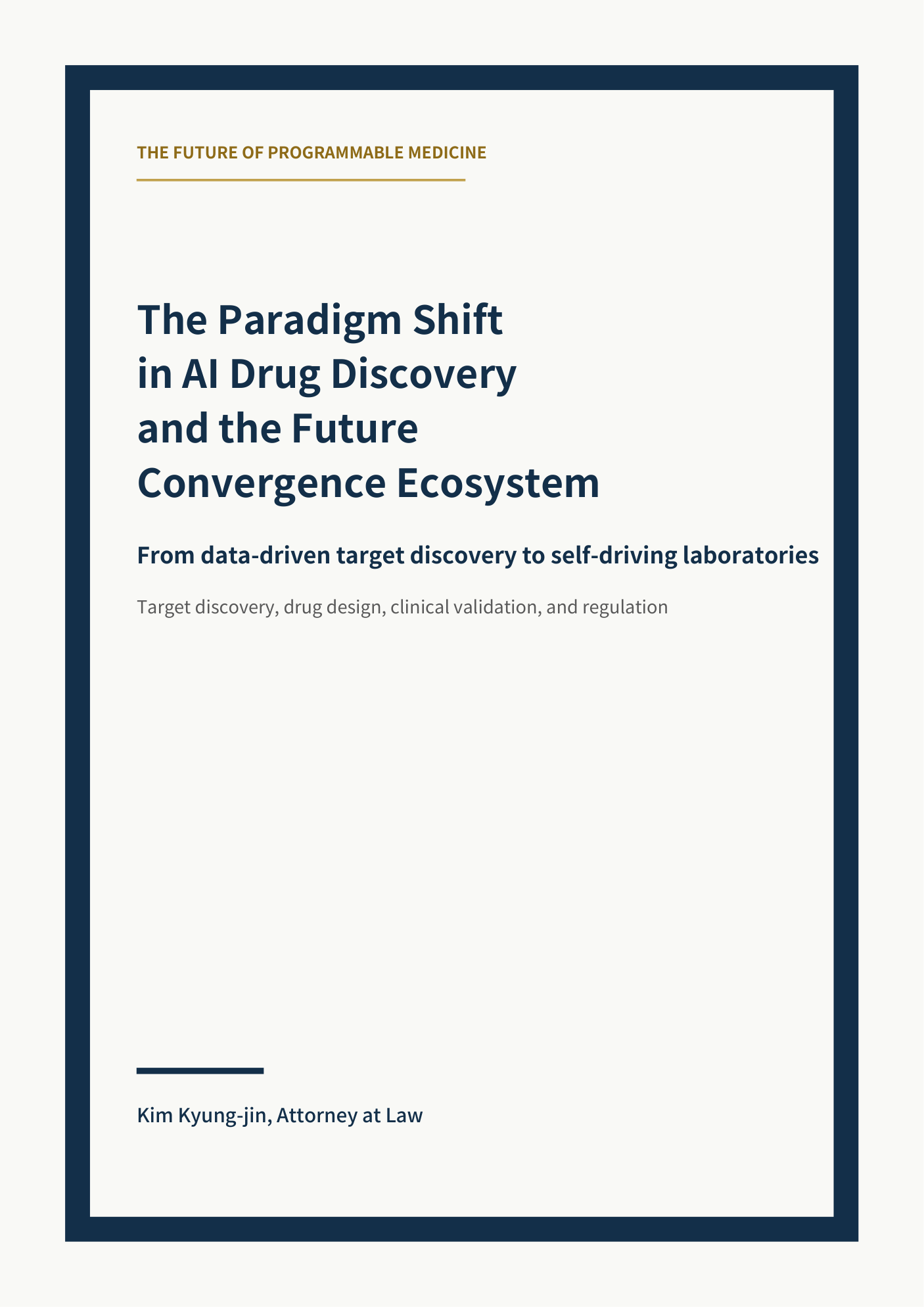

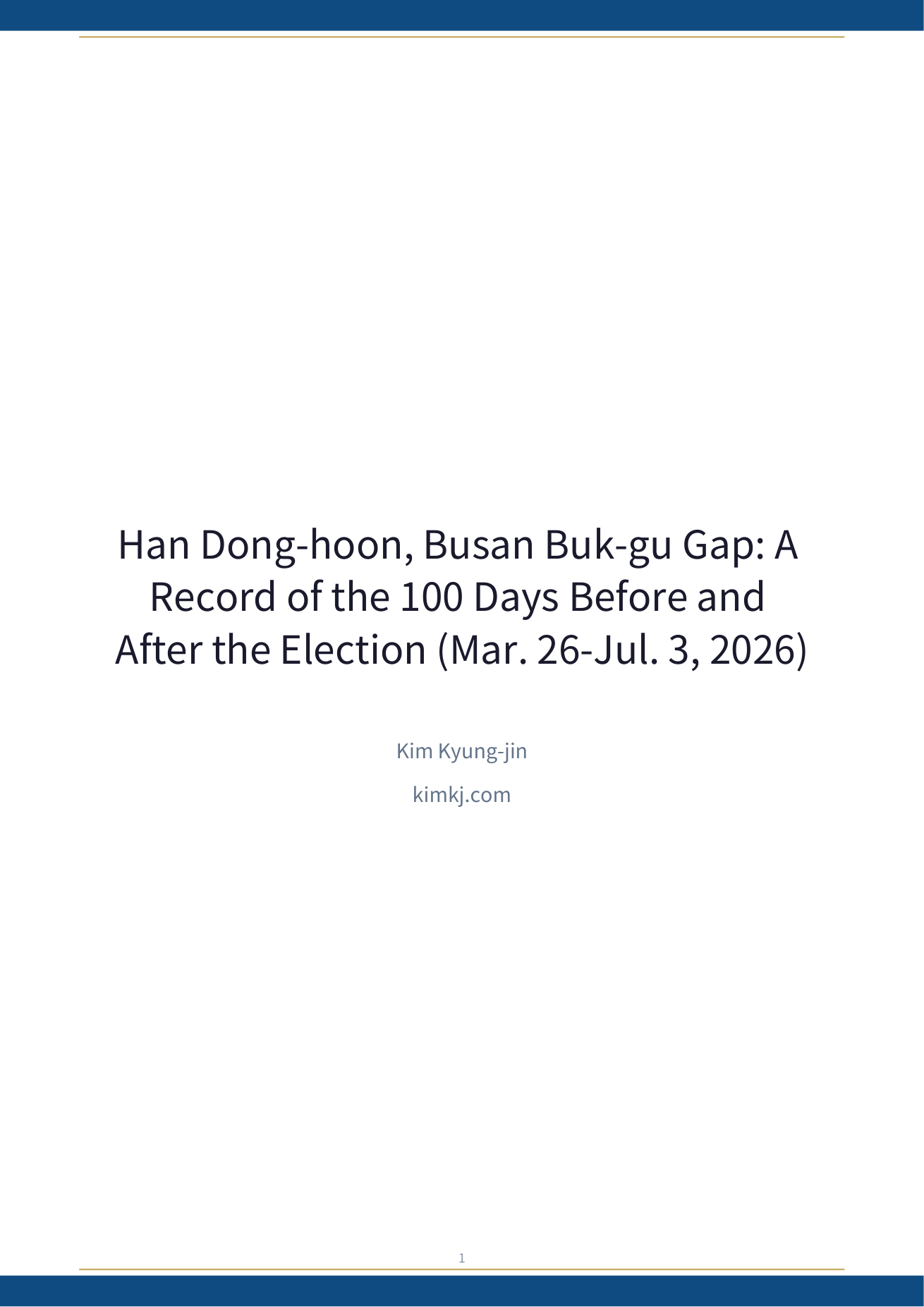
Table of Contents
Han Dong-hoon, Busan Buk-gu Gap: A Record of the 100 Days Before and After the Election (Mar. 26-Jul. 3, 2026)
Kim Kyung-jin
Table of Contents and 13 sections
From March 26 to July 3, 2026, this record follows the spring after expulsion, the Busan Buk-gu Gap by-election, victory as an independent, and the first bill submitted in the National Assembly.
Table of Contents
Artificial Intelligence and Medicine
Kim Kyung-jin, Attorney at Law
AI in clinical care, hospitals, education, and research
AI in medical imaging, risk prediction, treatment planning, hospital operations, education, and research, with patient safety, privacy, and accountability.





































[AI Library] Chapter 31. The Politician Sanae Takaichi — A Comprehensive Evaluation
Beyond the Glass Ceiling
Part 6. Reflection — What is Japan?
Chapter 31. The Politician Sanae Takaichi — A Comprehensive Evaluation
Kim Kyung-jin
This chapter is difficult.
Evaluating a living, incumbent Prime Minister is always a challenge. Her term is not yet over, and history's verdict remains incomplete. A decision that appears wise today may be revealed as a mistake tomorrow, while a seemingly poor choice today might later be recognized as foresight. This is the inherent difficulty of assessing a politician in real-time.
Nevertheless, this chapter is necessary as an attempt to synthesize and organize the 32-year trajectory described thus far. It is neither simple praise nor simple criticism, but an evaluation viewed from as many angles as possible.
It begins with three key strengths.
Strength 1: Consistency
If I had to choose a single word that best defines Sanae Takaichi, I would choose "consistency."
In 1993, she was thirty-two years old. Running as an independent candidate with no backing in Nara Prefecture, she was elected with the highest number of votes. From that moment until becoming Prime Minister in 2025, her political positions have remained remarkably steadfast. A strong Japanese defense. Prioritizing economic growth. Constitutional amendment. Visiting the Yasukuni Shrine. A conservative historical perspective. these core directions have been maintained for over 32 years.
To understand why this is a strength, one must understand the nature of Japanese politics. In the Japanese political arena, numerous factors—factional logic, supporter demands, electoral strategy, and party leadership pressure—constantly pull a politician in different directions. Maintaining one's position amidst such pressure is no easy feat. Many politicians shift their rhetoric to gain votes or abandon their convictions for personal interest.
Takaichi was different. She did not change even after losing an election. She did not change after losing two LDP presidential races. She did not change even when her powerful patron, Shinzo Abe, was gone. On the contrary, she refused to take a key post in the Shigeru Ishiba cabinet, choosing instead to uphold her principles.
This is one of the primary reasons her supporters trust her. She is predictable. One knows what she believes and what she intends to do. There is a deep-seated belief that she will not say something different just to secure votes—a trust forged over more than 30 years.
Of course, consistency has its drawbacks. The world changes. International environments shift, domestic circumstances evolve, and the demands of the public fluctuate. Failing to respond flexibly can lead to being left behind by changing realities. Whether her consistency is a strength or a form of rigidity depends ultimately on the results it produces.
Strength 2: Independence
Takaichi is not a politician who acts for the sake of "her own side." She is a politician who acts for what she judges to be right.
Several instances illustrate this distinction.
In 1993, the New Party Sakigake recruited her after her election as an independent, demanding she follow their policy line. She judged that their platform did not align with her convictions and eventually left the party to join the Liberal Democratic Party (LDP). She chose principle over political convenience.
In 2007, while serving as a cabinet minister, she visited the Yasukuni Shrine alone. At the time, Prime Minister Abe had deferred his visit out of concern for diplomatic fallout. Nevertheless, she went. Knowing it could be a burden to the Prime Minister, she did it because she believed it was the right thing to do.
In 2011, she withdrew from the Machimura faction (町村派) to which she belonged. Factions are core networks in Japanese politics through which resources, information, and support flow. Leaving a faction is a decision that carries a very high political cost. Yet, her choice to withdraw was a signal that she would not tolerate factional logic overriding her own judgment.
After losing the 2024 presidential election, she was offered a key post by the Ishiba cabinet but refused. It might not have been a politically shrewd choice; staying in a position of power to maintain influence might have been better for her future. However, she chose not to enter a government headed in a direction she did not deem appropriate.
Unlike hereditary politicians who rely on their parents' support base and party organization to sustain their political lives, Takaichi had to stand on her own feet from start to finish. This is one of the factors that distinguishes her from many other politicians. Someone who has grown up in an environment without reinforcements has nothing to trust but their own judgment. That environment fostered her independence.
Strength 3: Expertise
Takaichi is a politician who studies.
She is an alumna of the Matsushita Institute of Government and Management (松下政経塾). Founded by Konosuke Matsushita, the founder of Panasonic, this institution is a school for nurturing future political leaders. It is not just a place to learn election techniques, but a place to deeply study the nation, the economy, and history. Several Prime Ministers have emerged from its ranks.
During her time out of office, she lectured at Kinki University. She filled the gaps in her political career with academic activities. She published books in the field of economic security. Instead of merely expressing positions, she chose to present her arguments with rigorous evidence and logic.
During her tenure as Minister of Internal Affairs and Communications, she delved into the minutiae of broadcasting and telecommunications policy. There are scenes of her answering questions in the Diet regarding the interpretation of the Broadcasting Act, citing legal provisions and administrative interpretations in exhaustive detail. There were signs of deep study that even professional bureaucrats acknowledged.
As Minister in charge of Economic Security, she led technically complex areas such as semiconductor supply chains, cybersecurity, and the military application of advanced technology. This is a field that even experts find daunting. She recognized the vulnerabilities Japan faced in this area earlier and more deeply than anyone else. When the Economic Security Promotion Act was passed, many belatedly recognized its importance, but Takaichi had been monitoring this issue much earlier.
This expertise is her political asset. The ability to understand and lead practical affairs, rather than just following ideology, serves as the foundation for her crisis management and policy leadership as Prime Minister.
What, then, are the limitations and challenges?
Challenge 1: Diplomatic Costs
Takaichi's hardline conservative stance is the other side of the same coin as her strength of consistency. That consistency has created costs in diplomacy.
The issue of visiting the Yasukuni Shrine is a prime example. Yasukuni is a shrine that enshrines Japan's war dead. To Japanese conservative forces, it is a natural act to honor those who sacrificed themselves for the country. However, for Korea and China, a Japanese national leader visiting a shrine where Class-A war criminals are enshrined is seen as a rejection of reflection on past history.
Takaichi has consistently visited Yasukuni according to her beliefs. This was true both before and after she became Prime Minister. This acts as a source of tension in relations with China and Korea. The Japan-China diplomatic crisis was one of the results.
Exactly how great the diplomatic costs are will only become clearer over time. In the short term, the losses in relations with China and Korea are evident. However, whether paying this cost is a wrong choice in the long run ultimately depends on how those relationships develop. For her domestic support base, this is accepted not as a cost, but as the maintenance of principle. This is why completely different evaluations emerge for the same action.
After taking office, Takaichi also showed diplomatic pragmatism. She was evaluated to have demonstrated practical negotiating skills during her meeting with President Trump. She also held a summit in Nara with the South Korean President. There is a difference between the symbolic issue of Yasukuni and actual diplomatic actions. How she manages that difference is a future challenge.
Challenge 2: The Paradox of Gender Politics
Takaichi is Japan's first female Prime Minister. This is a historical fact. That alone carries significant symbolic meaning. In hundreds of years of Japanese political history, this is the first time a woman has reached this position. This has created a new reality.
However, looking at her through the lens of gender politics makes the situation complex.
Takaichi has opposed the introduction of the optional separate surnames for married couples (夫婦別姓) system. This system allows each spouse to maintain their own surname after marriage, something many Japanese women desire for social advancement and identity preservation. Current Japanese law mandates that one spouse take the other's surname upon marriage, and in reality, most women take the man's surname. Feminists have long pointed out the impact this has on women's identity and professional continuity.
Her hardline remarks on broadcasting and telecommunications policy have also been criticized from the perspective of press freedom. A representative example is her 2016 statement as Minister of Internal Affairs and Communications that "if a broadcasting station broadcasts politically biased content, an order to suspend radio waves can be issued." From the conservative perspective, this is a principled interpretation of the law, but from the perspective of press freedom, it is seen as an attempt by power to control the media.
Her historical perception clashes not only with Korea and China but also with progressive forces within Japan. Her position on the "comfort women" issue and her views on war responsibility are difficult for Japanese progressives to accept.
Therefore, the progressive camp in Japan says this: a woman has become Prime Minister, but it does not mean the birth of a Prime Minister for women. A woman who broke the glass ceiling will not necessarily dismantle the glass ceiling for other women.
Opinions differ on whether this criticism is valid. There is no law that a female Prime Minister must have a specific direction for women's policies. Male Prime Ministers have each had different gender-related policies, and no specific women's policies were mandated for them. However, it is a reality that higher expectations follow the first female Prime Minister. The tension created by the gap between those expectations and reality is one of the challenges Takaichi must navigate.
Challenge 3: What Follows the Glass Ceiling
Takaichi becoming Prime Minister does not mean the glass ceiling has completely vanished in Japan.
The glass ceiling refers to an invisible barrier that prevents people from rising above a certain level because they are women, even if they have the ability. Takaichi broke it. However, one person reaching the top spot does not mean the barrier has disappeared for all women.
The proportion of female members in the Japanese Diet remains low, ranking near the bottom among OECD countries. Women are also a minority in senior corporate positions. This structural reality does not change overnight.
Therefore, "after the glass ceiling" in its true sense must lead to structural change, not just the success of one individual like Takaichi. An environment where more women can exercise leadership in politics, business, and academia is necessary. Creating that is also a task for the Takaichi cabinet.
Takaichi increased the number of female ministers in her cabinet. That is a start. However, for a change in symbolic numbers to lead to real structural change, much more is needed.
Evaluation from Three Perspectives
From the perspective of a supporter, Sanae Takaichi is this kind of politician: A leader who opened the way for Japan to move toward becoming a "normal country" that can defend itself, shedding the shackles of the postwar regime. A politician who upheld the same principles without wavering for over 30 years. A woman who proved through her own life that any woman can reach Japan's highest office if she possesses the ability.
From the perspective of a critic, Sanae Takaichi is this kind of politician: A symbol of conservative politics that rejects reflection on past history and strengthens Japanese historical revisionism. A politician who implements policies that go against press freedom and women's rights. A paradoxical figure who wears a woman's face but does not practice politics for women.
From the perspective of a foreigner, especially a Korean, this evaluation is possible: An indicator showing which direction Japan is headed. A signal predicting that conflicts surrounding history will not be easily resolved. But at the same time, the significance of the fact that the first female head of state among the G7 nations in Asia has been born. Evidence that Japanese society is changing even while remaining conservative.
Which of these three perspectives is correct? Perhaps all three are partially correct. Compressing a complex human being into a single narrative inevitably creates distortion. Sanae Takaichi cannot be fully explained by any simple narrative.
What did she prove?
This question is the point where this chapter, and this entire book, arrives.
Sanae Takaichi proved that in Japan, a woman can reach the highest seat of power entirely on her own strength, without being a hereditary politician or having factional sponsorship. She proved that if one does not stop despite three challenges, decades of waiting, two election losses, and numerous oppositions, one can eventually reach that position.
Regardless of the political direction or policies, that fact itself remains unchanged.
But at the same time, there are things she has not yet proven. That one woman's success leads to expanded opportunities for all women. That the person who broke the glass ceiling also breaks other glass ceilings. This remains to be seen. Proving it will require more time, more policies, and more profound change.
Sanae Takaichi is alive and in office.
At the time this book is published, her story is not yet over. Whether Sanaenomics will revive the economy, whether constitutional amendment will take place, whether Japan-China relations will be restored, and whether women's political participation in Japanese society will substantially increase—when the answers to these questions emerge, history's evaluation of Sanae Takaichi will become a little clearer.
Until then, this book is a record of what is known so far: the path by which a child born to a father in machinery sales and a police-officer mother in Nara Prefecture became the first female Prime Minister in Japanese history.
What that path shows is one thing.
It was not a straight line. It was a position she would not have reached if she hadn't taken the long way around.
References
- Sanae Takaichi Wikipedia (日本語): https://ja.wikipedia.org/wiki/%E9%AB%98%E5%B8%82%E6%97%A9%E8%8B%97 - Sanae Takaichi Policy Analysis (Japan In-depth): https://japan-indepth.jp/?p=84350 - Prime Minister Takaichi's Approval Rating and Personality (Diamond): https://diamond.jp/articles/-/376463 - Sanae Takaichi Policy List (Boueki.com): https://boueki.standage.co.jp/policy-overview-of-sanae-takaichi/ - Japan first female prime minister international reaction: https://www.nippon.com/ja/in-depth/d01210/