AI Library
The Age of Autonomous Scientific Discovery
Kim Kyung-jin, Attorney at Law
AI Scientists and Self-Driving Labs
This book follows how AI scientists and self-driving labs are changing the way science generates and verifies claims. It covers literature-based discovery, natural-language protocols translated into robot commands, multi-agent research systems, closed-loop laboratories, materials search, the verification gap, chains of evidence, research harnesses, journal ethics, and legal responsibility.
AI Library
A New Era of Life Sciences Opened by Artificial Intelligence
Structural Proteomics, Genomic Foundation Models, Autonomous Laboratories, and Global Governance
Kim Kyung-jin, Attorney at Law
This book is a research volume compiled with artificial intelligence. A human selected the materials and structured the work, while AI models drafted the sentences and cross-checked the facts.

AI Library
The Double Structure of Digital Sovereignty
Europe’s Departure from Palantir and the Chains of American Big Tech
Kim Kyung-jin, Attorney at Law
This is a record of 2026, when European intelligence agencies and defense ministries began removing analytics tools from America’s Palantir. It covers the replacement decisions made by France’s General Directorate for Internal Security (DGSI), Germany’s Federal Office for the Protection of the Constitution (BfV), and the Netherlands Ministry of Defense; the incident in which US export controls severed an ally’s ac…
New English Edition
Artificial Intelligence in Horticulture
Kim Kyung-jin, Attorney at Law
Across five chapters and ten sections, this book examines computer vision for crop diagnosis, harvesting robots and autonomous field systems, smart greenhouses and digital twins, precision irrigation and supply-chain quality control, high-throughput phenotyping, and predictive breeding.
New English Edition
Artificial Intelligence in Food Crop Agriculture
Kim Kyung-jin, Attorney at Law
Across six chapters and eighteen sections, the book examines digital agricultural infrastructure, remote sensing, crop diagnosis, yield forecasting, precision irrigation, genomics, molecular breeding, agricultural robotics, climate-smart agriculture, and global food security.
New English Edition
The Future of Forestry and Agroforestry
Kim Kyung-jin, Attorney at Law
Driven by Artificial Intelligence and Digital Innovation
Across five chapters and fifteen sections, the book follows satellites, drones, LiDAR, digital twins, forest-specific language models, wildfire and pest forecasting, forestry robotics, agroforestry, timber traceability, and forest carbon markets.
New English Edition
Smart Livestock Farming: AI Enters the Barn
Kim Kyung-jin, Attorney at Law
Sensors listen, cameras watch, and artificial intelligence helps farmers decide.
Across five chapters and fifteen sections, the book follows precision livestock farming from animal health and reproduction to robotic milking, virtual fencing, digital twins, methane reduction, welfare, and data ownership.

Table of Contents
Han Dong-hoon, Busan Buk-gu Gap: A Record of the 100 Days Before and After the Election (Mar. 26-Jul. 3, 2026)
Kim Kyung-jin
Table of Contents and 13 sections
From March 26 to July 3, 2026, this record follows the spring after expulsion, the Busan Buk-gu Gap by-election, victory as an independent, and the first bill submitted in the National Assembly.
Table of Contents
Artificial Intelligence and Medicine
Kim Kyung-jin, Attorney at Law
AI in clinical care, hospitals, education, and research
AI in medical imaging, risk prediction, treatment planning, hospital operations, education, and research, with patient safety, privacy, and accountability.


























[AI Library] China's Robotics Industry 2026: The Age of Mass Production and Real-World Deployment - Table of Contents
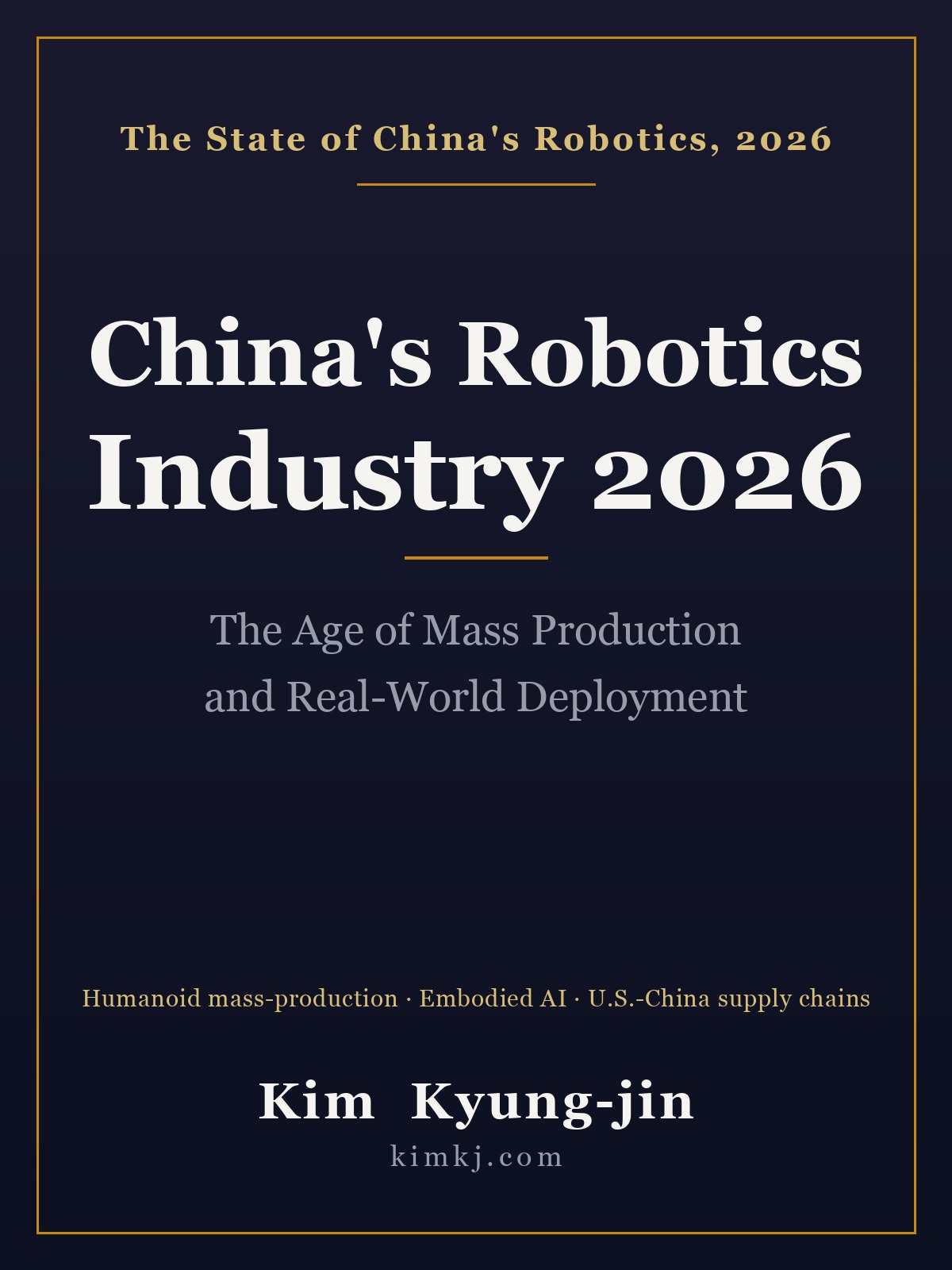
China's Robotics Industry 2026: The Age of Mass Production and Real-World Deployment
From the humanoid mass-production race to U.S.-China hegemony: the state of China's robotics industry in 2026
Kim Kyung-jin
China's Robotics Industry 2026: The Age of Mass Production and Real-World Deployment
Between 2025 and 2026, China's robots turned from showroom prototypes into mass-produced factory output. Across 7 parts and 23 chapters, the book follows the monopoly on global shipments, the sub-100,000-yuan price war, the embodied-AI (VLA) path, the harmonic-reducer and roller-screw supply chain, the 10-billion-yuan cluster funds, and real-world deployment sites.
Keywords: China robotics industry, humanoid, Unitree, UBTECH, Optimus, embodied AI, VLA, real-scene training, harmonic reducer, roller screw, RV reducer, supply chain, cluster funds, U.S.-China hegemony, export controls, Korea robotics, Kim Kyung-jin, AI Library
Part 1. The Rise of Humanoids: Companies, Products, and the Market Landscape
Chapter 1. The Real Story Behind the Monopoly on Global Shipments, and the Front-Runners
Chapter 2. From Technology to Market: The Ultra-Low-Cost Era Below 100,000 Yuan
Chapter 3. The Inflow of Mobility and Big-Tech Capital, and the Robotization of the Factory
Part 2. Embodied AI and the Software Ecosystem
Chapter 1. The Fusion of Cerebrum and Cerebellum: China's VLA Model Path
Chapter 2. Data Infrastructure and the Acceleration of Robot Training
Chapter 3. Open-Source OS and the State-Led Innovation Platform
Part 3. The Supply Chain and the Localization of Core Components
Chapter 1. The Cost Structure of Robot Hardware (BOM) and the Optimus Supply Chain
Chapter 2. Localizing the High-End Components: Harmonics and Sensors
Chapter 3. The Achilles' Heel of the Supply Chain: Roller Screws and RV Reducers
Part 4. State Capital and the Policy Framework
Chapter 1. From the MIIT Guiding Opinions to the 15th Five-Year Plan
Chapter 2. The Local Governments' War of 10-Billion-Yuan Cluster Funds
Chapter 3. Domesticating the Computing Infrastructure and the Capital-Market IPO Rush
Part 5. Robots in Real-World Deployment
Chapter 1. The Real-Scene, Real-Task Training (实景实训) Program and High-Load Manufacturing Floors
Chapter 2. Unmanning the Special and Hazardous Environments
Chapter 3. Evolution Toward the Consumer Goods and Medical-Rehabilitation Markets
Part 6. U.S.-China Tech Hegemony and Korea's Opportunities and Risks
Chapter 1. The Global Standards War and the Paradox of U.S. Export Controls
Chapter 2. The Weaponization of Critical Minerals and Supply Chain Risk
Part 7. A Panorama of China's Robotics Industry Ecosystem
Chapter 1. Companies That Manufacture and Design the Robot Body (Finished Units)
Chapter 2. The Hardware Supply Chain and the Core Component Makers
Chapter 3. The Cerebrum and Cerebellum of Embodied AI (EAI), and the Chipset Companies
Chapter 4. Innovation Alliances and Standard-Setting Institutions
Chapter 5. Capital and Core Funds in the Robotics Industry
Closing
Kim Kyung-jin
Attorney, former member of the National Assembly, AI policy researcher
© 2026 Kim Kyung-jin. All rights reserved.