AI Library
The Age of Autonomous Scientific Discovery
Kim Kyung-jin, Attorney at Law
AI Scientists and Self-Driving Labs
This book follows how AI scientists and self-driving labs are changing the way science generates and verifies claims. It covers literature-based discovery, natural-language protocols translated into robot commands, multi-agent research systems, closed-loop laboratories, materials search, the verification gap, chains of evidence, research harnesses, journal ethics, and legal responsibility.
AI Library
A New Era of Life Sciences Opened by Artificial Intelligence
Structural Proteomics, Genomic Foundation Models, Autonomous Laboratories, and Global Governance
Kim Kyung-jin, Attorney at Law
This book is a research volume compiled with artificial intelligence. A human selected the materials and structured the work, while AI models drafted the sentences and cross-checked the facts.
AI Library
The Double Structure of Digital Sovereignty
Europe’s Departure from Palantir and the Chains of American Big Tech
Kim Kyung-jin, Attorney at Law
This is a record of 2026, when European intelligence agencies and defense ministries began removing analytics tools from America’s Palantir. It covers the replacement decisions made by France’s General Directorate for Internal Security (DGSI), Germany’s Federal Office for the Protection of the Constitution (BfV), and the Netherlands Ministry of Defense; the incident in which US export controls severed an ally’s ac…
New English Edition
Artificial Intelligence in Horticulture
Kim Kyung-jin, Attorney at Law
Across five chapters and ten sections, this book examines computer vision for crop diagnosis, harvesting robots and autonomous field systems, smart greenhouses and digital twins, precision irrigation and supply-chain quality control, high-throughput phenotyping, and predictive breeding.
New English Edition
Artificial Intelligence in Food Crop Agriculture
Kim Kyung-jin, Attorney at Law
Across six chapters and eighteen sections, the book examines digital agricultural infrastructure, remote sensing, crop diagnosis, yield forecasting, precision irrigation, genomics, molecular breeding, agricultural robotics, climate-smart agriculture, and global food security.
New English Edition
The Future of Forestry and Agroforestry
Kim Kyung-jin, Attorney at Law
Driven by Artificial Intelligence and Digital Innovation
Across five chapters and fifteen sections, the book follows satellites, drones, LiDAR, digital twins, forest-specific language models, wildfire and pest forecasting, forestry robotics, agroforestry, timber traceability, and forest carbon markets.
New English Edition
Smart Livestock Farming: AI Enters the Barn
Kim Kyung-jin, Attorney at Law
Sensors listen, cameras watch, and artificial intelligence helps farmers decide.
Across five chapters and fifteen sections, the book follows precision livestock farming from animal health and reproduction to robotic milking, virtual fencing, digital twins, methane reduction, welfare, and data ownership.
Table of Contents
Han Dong-hoon, Busan Buk-gu Gap: A Record of the 100 Days Before and After the Election (Mar. 26-Jul. 3, 2026)
Kim Kyung-jin
Table of Contents and 13 sections
From March 26 to July 3, 2026, this record follows the spring after expulsion, the Busan Buk-gu Gap by-election, victory as an independent, and the first bill submitted in the National Assembly.
Table of Contents
Artificial Intelligence and Medicine
Kim Kyung-jin, Attorney at Law
AI in clinical care, hospitals, education, and research
AI in medical imaging, risk prediction, treatment planning, hospital operations, education, and research, with patient safety, privacy, and accountability.
















[AI Library] Epilogue: Waiting for a New Renaissance
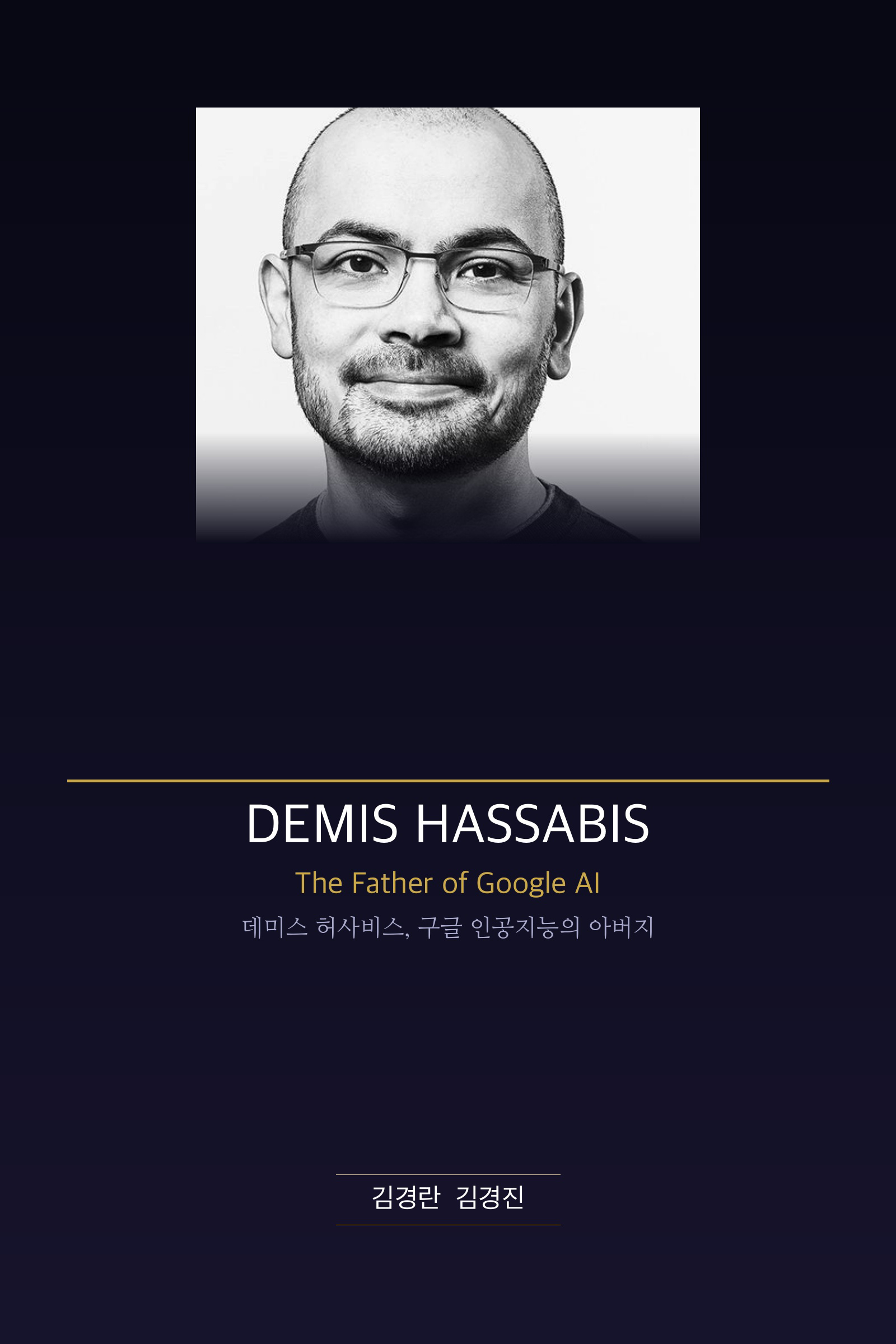
Demis Hassabis, Father of Google's Artificial Intelligence
Epilogue: Waiting for a New Renaissance
Kim Kyung-ran, Kim Kyung-jin
Demis Hassabis stepped onto the Nobel Chemistry Prize lecture stage and displayed a single slide. The title was "Thinking about Thinking." It was the place a boy who first held a chess piece at age four had arrived at, just short of his fiftieth birthday.
The question that began in front of his father's and uncle's chessboard, the doubt that arose after a ten-hour match in Liechtenstein, the hypothesis refined in laboratories at Cambridge and UCL had met the milestone of a Nobel Prize after half a century. But what Hassabis wanted to convey to the audience that day was not past achievements. What he wanted to show them was a door that had only just begun to open.
What is intelligence? This question is one of the oldest riddles of human civilization. Ancient Greek philosophers called it Logos, Eastern thinkers expressed it as wisdom, and modern scientists tried to capture it with the term Cognition. Yet no one has clearly defined what intelligence actually is.
Hassabis approached this question in a distinctive way. Rather than defining intelligence, he proposed recreating what intelligence does. From chess to Go, from Go to proteins, from proteins to weather, mathematics, and drug design. Each time AI succeeded in a new domain, another piece of intelligence was revealed.
The ability to recognize patterns, the ability to imagine unseen situations, the ability to plan for long-term outcomes, the ability to self-correct from mistakes. Hassabis's entire career was a puzzle of fitting these pieces together. So what future awaits a humanity that understands the essence of intelligence? The picture Hassabis paints is specific. Medicine changes. AlphaFold predicting the structures of over 200 million proteins was only the beginning.
Isomorphic Labs announced it would bring AI-designed anticancer drugs into clinical trials by 2026. Where traditional drug development required an average of ten years and a 90 percent failure rate, AI-based simulation can make this process more than a thousand times more efficient, Hassabis claims. Energy changes. The DeepMind team has already applied AI to plasma control in the tokamak fusion reactor,
achieving substantive results. If solar energy, battery technology, and nuclear fusion find breakthroughs through AI acceleration, energy could become an abundant resource for the first time in human history rather than a scarce one. The speed of scientific discovery itself changes. A multi-agent system called AI Co-Scientist has begun automating the process of forming hypotheses, designing experiments, and analyzing data.
The world's first automated research laboratory is scheduled to open in Britain in 2026. At the heart of all these changes lies a premise. Understanding intelligence means holding a universal key to problem-solving.
When Hassabis founded DeepMind in 2010, the mission he put forward was "Solve intelligence, and then use that to solve everything else." At first it sounded like megalomania. Fifteen years later, that sentence is closer to a work plan than delusion. Skeptical views, of course, persist.
Current large language models show serious limitations in planning, memory, and physical understanding. Hassabis himself calls this "Jagged Intelligence." In some domains it overwhelms humans while in others it makes mistakes worse than an elementary school student. One or two more breakthroughs on the scale of the Transformer are needed before AGI, according to Hassabis's honest assessment. But the direction is set.
With each step closer to the essence of intelligence, the range of problems humanity can solve expands exponentially. What Hassabis showed on the final slide of his Nobel lecture was not an AlphaFold structure diagram. It was a photograph of the universe. He said:
We still do not know why the universe exists, what consciousness is, or what the nature of time is. But we have now begun building tools to answer those questions. The future awaiting a humanity that understands the essence of intelligence is not a future that holds answers, but a future in which the ability to ask questions has expanded by leaps and bounds. That is what Hassabis has been pursuing for forty years, moving between chessboards, laboratories, and server rooms.
"We are entering a golden era of discovery." In February 2026, Hassabis said this in an interview with Fortune magazine. "In ten to fifteen years, we will enter a golden era of new discovery. A kind of new Renaissance."
This statement was not momentary optimism. It was a declaration condensed from decades of research and experience, and from the policy influence that expanded rapidly after the 2024 Nobel Prize.
The Renaissance metaphor was something Hassabis chose deliberately. The European Renaissance of the fourteenth century was a cultural transformation that exploded from the combination of a technological innovation called the printing press and the rediscovery of classical knowledge. Hassabis believes AI will play exactly that role.
If the printing press lowered the cost of replicating knowledge to near zero, AI is lowering the cost of producing knowledge to near zero. AlphaFold predicts in seconds a protein structure that a single scientist would need a lifetime to research. WeatherNext processes in minutes meteorological data that a team would need months to analyze.
AlphaProof solves problems at the level of the International Mathematical Olympiad. This is not an improvement of tools. It is the speed of discovery itself that is changing. There are specific areas Hassabis points to. In medicine, personalized treatment becomes reality.
It is an era in which AI integrates a patient's genomic information and protein structure data to design drugs effective for that person alone. Isomorphic Labs is already running seventeen drug development programs simultaneously, with preclinical trials for anticancer drugs underway. In Hassabis's words, "Medicine will look completely different from what it is today."
In the energy sector, the practical realization of nuclear fusion moves one step closer. The efficiency of solar and battery technology is rising dramatically through AI optimization. Hassabis calls the point at which energy becomes virtually infinite "the inflection point where everything changes." When energy becomes abundant, the cost structures of food production, desalination, and manufacturing change fundamentally. A world in which the price of physical goods drops dramatically, a state Hassabis has named "Radical Abundance," becomes theoretically possible. AI's role expands in space exploration as well. In the Fortune interview, Hassabis made a remark to the effect that "everything else includes the stars."
If AI is applied to simulation of space environments, spacecraft trajectory optimization, and exoplanet atmospheric analysis, the scope of human activity can expand beyond Earth. But Hassabis makes clear that this golden era will not come by itself. He warns that a shakeout period of ten to fifteen years is unavoidable before reaching the golden era.
During this period, industrial structures will be reorganized, the shape of jobs will change, and social institutions will have to adapt to a new reality. Google DeepMind, which Hassabis himself leads, is also not free from this
upheaval. The shock of 2023 triggered by OpenAI's ChatGPT caused a "Code Red" inside Google and led to the major surgery of merging DeepMind and Google Brain. "If we don't disrupt ourselves, someone else will," Hassabis said. This is the language of corporate strategy and simultaneously a confession of an awareness of the times.
What is interesting is that Hassabis views this period of upheaval not with fear but with excitement. He compared Google DeepMind to "a nuclear power plant." This engine is connected to the massive ecosystem of Search, YouTube, Chrome, and the Gemini app, and the energy this combination produces is the fuel that opens the golden era. Alphabet's stock price rising approximately 65 percent by the end of 2025 was the market responding to this vision.
Hassabis's golden era prediction is a scientist's forecast, a businessman's promise, and a dreamer's vision all at once. The reason he repeats the phrase "golden era of discovery" is that it is not marketing language for the AI industry but a conviction that has run through his entire life. The boy who sat before a chessboard at age four was captivated by the puzzle of intelligence, and the scientist who received the Nobel Prize at fifty is certain that completing that puzzle will open a new chapter of human civilization.
History will judge whether his conviction was right or wrong. But at least one thing is clear. Almost no one has wagered everything on this vision for as long, and as concretely, as Hassabis has.
The world Demis Hassabis dreams of: an era in which AI and humans co-evolve. There is one distinctive feature of Hassabis's vision. He does not dream of a future where AI replaces humans. He dreams of a future where AI and humans evolve together. This difference may seem subtle, but it is fundamental.
Many technology leaders in Silicon Valley explain the future of AI through the metaphor of a race. Humans and machines are running on the same track, and someday the moment will come when machines overtake humans. In this narrative, humans are the ones who fall behind. Hassabis's narrative is different. He often compares AI to a telescope.
When Galileo discovered the moons of Jupiter through a telescope, the telescope did not replace Galileo. It simply allowed human eyes to see what they could not see. The same is true of AI. It is a tool that extends human understanding in domains beyond the reach of human intelligence, domains like the structures of 200 million
proteins or the number of possible Go positions exceeding the number of atoms in the universe. This perspective originates from Hassabis's neuroscience background. The subject he studied while earning his doctoral degree at UCL was the hippocampus.
The hippocampus is a brain region at the intersection of memory and imagination. Hassabis revealed that the neural mechanism for recalling memories and the neural mechanism for imagining the future are identical. This discovery was not merely an academic achievement.
It was the insight that the core of intelligence lies not in information storage but in the recombination of information, the ability to simulate situations never experienced based on prior experience. This insight is deeply inscribed in DeepMind's AI architecture. When AlphaGo played move 37, it was not finding an answer from a database but imagining new possibilities from experience.
The co-evolution Hassabis dreams of looks like this. AI proposes new hypotheses to scientists. Scientists interpret the meaning of those hypotheses, make ethical judgments, and decide the direction of research.
AI then learns from those decisions and offers more precise suggestions. When this cycle repeats, both AI advances and human understanding deepens. AlphaFold is a good example. When AI predicted protein structures, more than two million researchers in 190 countries used that data to make new discoveries in their own fields, including malaria vaccines, plastic-degrading enzymes, and antibiotic resistance research.
AI did not do all of this alone. Human researchers read, interpreted, and applied to their own questions the map that AI provided. Project Astra is the consumer version of this co-evolution vision. The general-purpose AI assistant Hassabis envisions understands the user's context, remembers it, and helps with daily life across various devices.
A conversation started on a smartphone continues on smart glasses, and a browser-based agent called Project Mariner handles complex online tasks. Hassabis emphasizes that this assistant must be "a tool that augments human capabilities." The goal is not to turn humans into passive consumers but to enable them to do more.
Risks are inherent in this vision. If co-evolution fails, it becomes codependence. A scenario in which humans become overly reliant on AI and lose the ability to think for themselves.
Hassabis is aware of this risk. It is one of the reasons he invests enormous resources in AI safety and alignment research.
The Frontier Safety Framework is a technical mechanism to ensure AI systems do not deviate from human values and intentions. Hassabis signing the AI extinction risk statement in 2023, advocating for an international AI governance body modeled on the IPCC, and publicly warning about the danger of "Deceptive Alignment" are all in the same context. For co-evolution to be possible, AI must remain within the bounds of human control. Hassabis believes in humanity's infinite adaptability.
In an interview with CBS he said: "Look at how naturally we adapted to smartphones and digital devices. AI will be one of those kinds of changes." This statement is optimistic but not irresponsibly so. Within it lies the recognition that just as the smartphone fundamentally changed how humanity communicates, consumes information, and maintains social relationships, AI will fundamentally change how humanity thinks, works, and understands the meaning of existence.
But Hassabis wants that change to be evolution rather than destruction. An era in which AI and humans do not push each other away but complement each other's limitations and grow together. That is the ultimate shape of the dream Demis Hassabis has pursued for forty years since sitting before a chessboard at age four. A message for future generations: "Learning to Learn." September 12, 2025, Athens. At the Odeon of Herodes Atticus, an amphitheater situated below the Acropolis, Hassabis stood before an audience.
This semicircular theater built in the Roman era was a place where people gathered to share knowledge and art two thousand years ago. On that ancient stage, the Nobel laureate left one piece of advice for future generations: "Learning how to learn. That is the most important ability the next generation will need."
To understand the context of this statement, you need to look again at Hassabis's own trajectory. He was not a specialist in a single field. He was a chess prodigy, a game developer, a neuroscientist, and an AI researcher and entrepreneur.
At each stage of this career he had to learn a new field from scratch. At seventeen he taught himself programming and game design while working at Bullfrog Productions. He learned management by founding and running Elixir Studios. At twenty-nine he entered UCL's doctoral program and learned neuroscience.
And at thirty-four, by founding DeepMind, he learned how to build a new kind of organization at the intersection of scholarship, business, and technology. Hassabis's trajectory itself is a living example of what it means to "learn how to learn." The meta-skill he emphasized in Athens means not specific knowledge or skills but the methodology of rapidly acquiring new knowledge and skills.
Understanding one's own learning style, connecting ideas from different fields, adapting continuously throughout a lifetime. Hassabis argued that these abilities should become central to education alongside traditional subjects like mathematics, science, and the humanities. The urgency of this advice comes from the speed of AI's advancement. At the Athens lecture, Hassabis said: "Even in normal times, it is difficult to predict ten years ahead.
In today's world, where AI is changing week by week, it is even harder. The only thing I can say with certainty is that enormous change is coming." The half-life of technical knowledge is shrinking rapidly.
A programming language learned in university may be obsolete by graduation. Skills trained for a specific job may be automated by AI within five years. The way to survive in this environment is not to depend on a single skill but to possess the fundamental capacity to learn whatever skill is needed when it is needed. Hassabis's advice is informed by his chess experience.
To reach the highest level in chess, memorizing individual moves is not enough. You need the meta-abilities of recognizing patterns, reading your opponent's strategy, looking several moves ahead, and flexibly revising your plan when the position turns unfavorable. When twelve-year-old Hassabis asked after a ten-hour match at the Liechtenstein tournament, "What if these brains could be used for cancer treatment or climate problems?", what he discovered was not the limits of the game of chess but the transferability of learning itself. The realization that thinking skills cultivated in one field can transfer to another. That insight was the driving force that turned a chess prodigy into an AI pioneer.
Greek Prime Minister Kyriakos Mitsotakis added a warning from a different angle at the same event. If the benefits of AI become concentrated in a handful of giant corporations and the majority of people do not feel those benefits, serious social unrest will follow. Hassabis's advice to "learn how to learn" takes on greater meaning in this context.
It is both a survival strategy for individuals who do not want to become obsolete in the AI era and the educational infrastructure foundation for society as a whole to share the benefits of AI equitably. Hassabis believes AI can revolutionize education itself. Through a comprehensive research partnership with the UK government in 2025, Google DeepMind agreed to develop an AI teacher-support system customized to England's national curriculum.
If AI identifies each student's learning pace, strengths, and weaknesses and provides tailored education, the process of "learning how to learn" can itself be accelerated by AI. This looks like a paradox, but for Hassabis it is a natural cycle. AI raises human learning capacity, and humans with higher learning capacity build better AI. It is the educational version of co-evolution. In the final portion of the Athens lecture, Hassabis said:
"What is certain is that you will have to keep learning continuously throughout your lives." This sentence is humble. A scientist who won the Nobel Prize, a CEO who leads the world's most powerful AI, is confessing that he cannot predict the future precisely.
What he can offer is not answers but methodology. Answers change, but a person who knows how to find answers can respond to any change. That is the message the life of one person, who learned chess at four, bought a computer at eight, joined a game company at seventeen, and entered a doctoral program at twenty-nine, leaves for future generations.
What the age of intelligence requires: a smarter model, or a more mature human? This biography began with the story of one human being named Demis Hassabis. A boy raised in a modest multicultural household in north London. The eldest son born to Costas, a Greek Cypriot father, and Angela, a Chinese Singaporean mother. A child captivated by the nature of thought on a chessboard, self-teaching programming in front of a ZX Spectrum 48K computer, drawn more to the fundamental laws of the universe than to school report cards. This biography has followed the story of that child pushing his question to the end over forty years. And now, at the end of this story, we have arrived at a point where the questions Hassabis left behind become more important than the things he built.
In 2025, TIME magazine jointly named Hassabis "Person of the Year" with the cover headline "Architects of AI." The same year, the British Crown conferred upon him a Knight Bachelor. The Lasker Award for Medical Research, the Canada Gairdner International Award, and the Breakthrough Prize followed in succession. Honorary doctoral degrees were given by Oxford, Cambridge, UCL, and Imperial Col
lege. He became a Fellow of the Royal Society (FRS) and the Royal Academy of Engineering (FREng). The world has recognized Hassabis as one of the most influential scientists of our time.
Yet Hassabis himself remains uneasy. That unease is not a fear of failure but a fear of success. If AGI truly arrives within five to ten years, is humanity prepared to handle it? Hassabis does not dodge this question.
His signing of the AI extinction risk statement, his public declaration that "society is not prepared for AGI," and his proposal to establish an international AI governance body modeled on CERN all stem from the same unease. At the core of this unease lies a contradiction. Hassabis is a technological optimist and simultaneously a safety advocate.
He believes AI will be the most beneficial technology in human history, while warning that mishandled, it could threaten humanity's very existence. These two beliefs appear contradictory, but for Hassabis they are two sides of the same coin. Just as nuclear energy can illuminate a city or destroy one, the greater AI's power, the more decisive human maturity becomes as a variable.
Building "smarter models" is what Hassabis and Google DeepMind's 2,000 researchers do every day. The Gemini series has progressed from 1.0 through 2.5 Pro to Gemini 3, securing 650 million monthly active users. The models' reasoning ability, multimodal comprehension, and agent capabilities are leaping forward year after year.
Hassabis says this progress has "crossed a watershed moment," meaning AI models have now matured enough to serve as high-level research assistants. But building "more mature humans" is a problem of a different order.
It cannot be written in code, published in a paper, or solved by adding more servers. What is a mature human? A person who does not blindly trust the answers AI offers and maintains their own judgment. A person who can find meaning in life amid the abundance AI brings. A person who guards their role in domains AI cannot replace: empathy, ethics, creativity, and responsibility.
Imagine the world of "Radical Abundance" Hassabis described in the Fortune interview. A world where energy is virtually infinite, where the production cost of physical goods drops dramatically, where most diseases become treatable. In a world where resource constraints have vanished, what will humans
do? Hassabis himself has posed this question. "If you won the lottery, what percentage of people would go back to work?" Within this question lies a challenge that is existential rather than merely economic, a problem of human purpose and meaning in the face of change ten times larger and ten times faster than the Industrial Revolution.
While writing this biography, I kept returning to one scene. 1988, Liechtenstein. Twelve-year-old Demis Hassabis finishes a ten-hour chess match and walks out of the playing hall. Teenage chess players from across Europe had been straining their minds all day. At that moment a question arose in the boy's mind.
"What if these brains could be used for cancer treatment or climate problems?" This question came from the imagination of a boy who saw beyond the chessboard. Chess was beautiful, but the intelligence of chess was trapped inside the board.
The boy wanted a world where intelligence was not trapped. Demis Hassabis's life is still in progress. Immediately after receiving the 2024 Nobel Prize, Hassabis said:
"AI will be the most beneficial technology humanity has ever created. But that is true only if we build it the right way and use it the right way." "Only if."
The weight of this book rests on that conditional. Hassabis himself calls AI "Jagged Intelligence." A technology that overwhelms humans in some domains while making mistakes worse than an elementary school student in others. This jaggedness is the incompleteness of the technology and also the incompleteness of the human civilization that wields it. Just as nuclear energy can illuminate a city or destroy one, the greater AI's power, the more decisive human maturity becomes as a variable.
1988, Liechtenstein. A twelve-year-old boy finishes a ten-hour chess match and walks out of the playing hall. "What if these brains could be used for cancer treatment or climate problems?" Thirty-six years later, that boy has realized a significant portion of his dream.
AlphaFold is proof of intelligence unconfined to a chessboard. But new questions have followed. In a world where intelligence is not trapped, can humans remain untrapped? In a world where AI provides all the answers, can humans still remain beings who know how to ask questions? The question that began with a four-year-old boy before a chessboard has not ended.
Appendix. Appendix 1. Demis Hassabis Timeline. 1976: Born July 27 in London, England. Eldest son of a Greek Cypriot father and a Chinese Singaporean mother. 1980: Introduced to chess at age 4. Demonstrated prodigious talent by beating his father within two weeks. 1989: Achieved chess Master rating (Elo 2300) at age 13. Reached world junior ranking of second. 1991: Graduated high school (A-levels) at 15. Joined computer game company Bullfrog Productions. 1994: Released the million-selling game Theme Park. Participated as lead programmer. 1994: Entered Queens' College, Cambridge University. Majored in computer science. 1997: Received bachelor's degree from Cambridge (with highest honors). 1998: Founded game studio Elixir Studios. Developed Republic and other titles. 2005: Entered UCL doctoral program. Specialized in cognitive neuroscience. 2007: Published paper on the neural structural connection between imagination and memory. Selected as one of Science magazine's top ten breakthroughs. 2009: Received PhD in cognitive neuroscience from UCL. 2010: Co-founded DeepMind with Shane Legg and Mustafa Suleyman. 2014: Google acquired DeepMind for approximately 400 million pounds. 2016: Developed Go AI AlphaGo. Defeated Lee Sedol 9-dan in Seoul (4-1). 2018: First unveiled protein structure prediction AI AlphaFold at the CASP13 competition. 2020: Announced AlphaFold 2. Declared a fifty-year biology grand challenge solved. 2021: Founded sister company Isomorphic Labs specializing in drug development; served as concurrent CEO. 2023: Assumed role of CEO of Google DeepMind, the merged entity of Google Brain and DeepMind. 2024: Conferred knighthood (Sir) by the British Crown for contributions to artificial intelligence. 2024: Awarded the Nobel Prize in Chemistry (for contributions to protein structure prediction).
Appendix 2. Reading Guide to Key Papers and Projects. Deep Q-Network (DQN, 2015): A paper documenting the process by which AI taught itself to master Atari games without human intervention. It is the starting point of modern AI combining reinforcement learning and deep learning. AlphaGo Series (2016-2017): Papers published in Nature explaining the evolution from the version that learned from human game records (Lee) to the version that learned by playing against itself (Zero).
AlphaFold 2 (2021): Introduces an innovative architecture that predicts the three-dimensional structure of a protein from its amino acid sequence alone. A paper that changed the paradigm of biological research. Gemini (2023-2024): A multimodal model project that simultaneously understands text, images, and video.
If previous AI was a person who could only read text, Gemini is closer to a person who reads text, sees photos, and understands video. It represents DeepMind's latest move toward an everyday general-purpose assistant AI. AlphaProof and AlphaGeometry (2024): AI projects that reached human expert levels in mathematical reasoning and geometry problem-solving, demonstrating AI's logical thinking capabilities.
Appendix 3. Key Figures. Shane Legg: Co-founder of DeepMind and Chief Scientist. Popularized the term "AGI" and provided the philosophical foundation for defining intelligence. Mustafa Suleyman: Co-founder of DeepMind. Emphasized the ethical dimensions and social impact of AI; currently serves as Microsoft AI CEO. David Silver: Leader of the AlphaGo project. A Cambridge classmate of Hassabis and the world's foremost authority on reinforcement learning.
John Jumper: Core architect of the AlphaFold project. A brilliant researcher who co-received the 2024 Nobel Prize in Chemistry with Hassabis.
Sundar Pichai: CEO of Google and Alphabet. A steadfast supporter who enables Hassabis to maintain autonomy and focus on research within Google. Appendix 4. Hassabis's Recommended Reading List. The Fabric of Reality by David Deutsch: A book on physics, quantum mechanics, and the growth of knowledge that has had the greatest influence on Hassabis's worldview. Permutation City by Greg Egan: A science fiction novel about simulating consciousness on computers, which inspired thinking about digital intelligence.
Godel, Escher, Bach by Douglas Hofstadter: A classic exploring the nature of intelligence and consciousness through mathematics, art, and music. Sapiens by Yuval Noah Harari: A book that enabled a macroscopic view of humanity's history and future. Foundation series by Isaac Asimov: A science fiction epic about the attempt to predict the future through mathematical calculation.
Appendix 5. Recommended Videos. AlphaGo (2017): A documentary capturing the match between Lee Sedol 9-dan and AlphaGo. It reveals the human anguish and drama hidden behind a technological achievement. The Thinking Game (2024): The latest documentary covering Hassabis's life and DeepMind's challenge to predict protein structures with AlphaFold. Lex Fridman Podcast: Interview episodes in which Hassabis discusses the future of AGI, the nature of consciousness, and physics in depth. Nobel Lecture (2024): A lecture video from December 8, 2024, in Stockholm, in which Hassabis personally presents his research achievements and future vision.
TED Talk - How AI Could Unlock the Secrets of Nature and the Universe (2024): A lecture explaining how AI can change the world as a tool of science, going beyond mere chatbots.
Demis Hassabis, Father of Google's Artificial Intelligence. E-book published April 20, 2026. Authors: Kim Kyung-ran, Kim Kyung-jin. Publisher: Attorney Kim Kyung-jin Publishing. Publisher registration: March 10, 2025 (No. 2025-000015). Address: Room 304, Baekil Building, 91 Jeonnong-ro, Dongdaemun-gu, Seoul. Phone: 02-6338-1905. Email: kimkj008@gmail.com. (C) Kim Kyung-ran, Kim Kyung-jin 2026. This book is the intellectual property of its authors. Unauthorized reproduction or duplication is prohibited.
Kim Kyung-jin
Attorney · Former Member of the National Assembly · AI Policy Researcher
© 2026 Kim Kyung-jin. All rights reserved.