AI Library
The Age of Autonomous Scientific Discovery
Kim Kyung-jin, Attorney at Law
AI Scientists and Self-Driving Labs
This book follows how AI scientists and self-driving labs are changing the way science generates and verifies claims. It covers literature-based discovery, natural-language protocols translated into robot commands, multi-agent research systems, closed-loop laboratories, materials search, the verification gap, chains of evidence, research harnesses, journal ethics, and legal responsibility.
AI Library
A New Era of Life Sciences Opened by Artificial Intelligence
Structural Proteomics, Genomic Foundation Models, Autonomous Laboratories, and Global Governance
Kim Kyung-jin, Attorney at Law
This book is a research volume compiled with artificial intelligence. A human selected the materials and structured the work, while AI models drafted the sentences and cross-checked the facts.
AI Library
The Double Structure of Digital Sovereignty
Europe’s Departure from Palantir and the Chains of American Big Tech
Kim Kyung-jin, Attorney at Law
This is a record of 2026, when European intelligence agencies and defense ministries began removing analytics tools from America’s Palantir. It covers the replacement decisions made by France’s General Directorate for Internal Security (DGSI), Germany’s Federal Office for the Protection of the Constitution (BfV), and the Netherlands Ministry of Defense; the incident in which US export controls severed an ally’s ac…
New English Edition
Artificial Intelligence in Horticulture
Kim Kyung-jin, Attorney at Law
Across five chapters and ten sections, this book examines computer vision for crop diagnosis, harvesting robots and autonomous field systems, smart greenhouses and digital twins, precision irrigation and supply-chain quality control, high-throughput phenotyping, and predictive breeding.

New English Edition
Artificial Intelligence in Food Crop Agriculture
Kim Kyung-jin, Attorney at Law
Across six chapters and eighteen sections, the book examines digital agricultural infrastructure, remote sensing, crop diagnosis, yield forecasting, precision irrigation, genomics, molecular breeding, agricultural robotics, climate-smart agriculture, and global food security.
New English Edition
The Future of Forestry and Agroforestry
Kim Kyung-jin, Attorney at Law
Driven by Artificial Intelligence and Digital Innovation
Across five chapters and fifteen sections, the book follows satellites, drones, LiDAR, digital twins, forest-specific language models, wildfire and pest forecasting, forestry robotics, agroforestry, timber traceability, and forest carbon markets.
New English Edition
Smart Livestock Farming: AI Enters the Barn
Kim Kyung-jin, Attorney at Law
Sensors listen, cameras watch, and artificial intelligence helps farmers decide.
Across five chapters and fifteen sections, the book follows precision livestock farming from animal health and reproduction to robotic milking, virtual fencing, digital twins, methane reduction, welfare, and data ownership.

Table of Contents
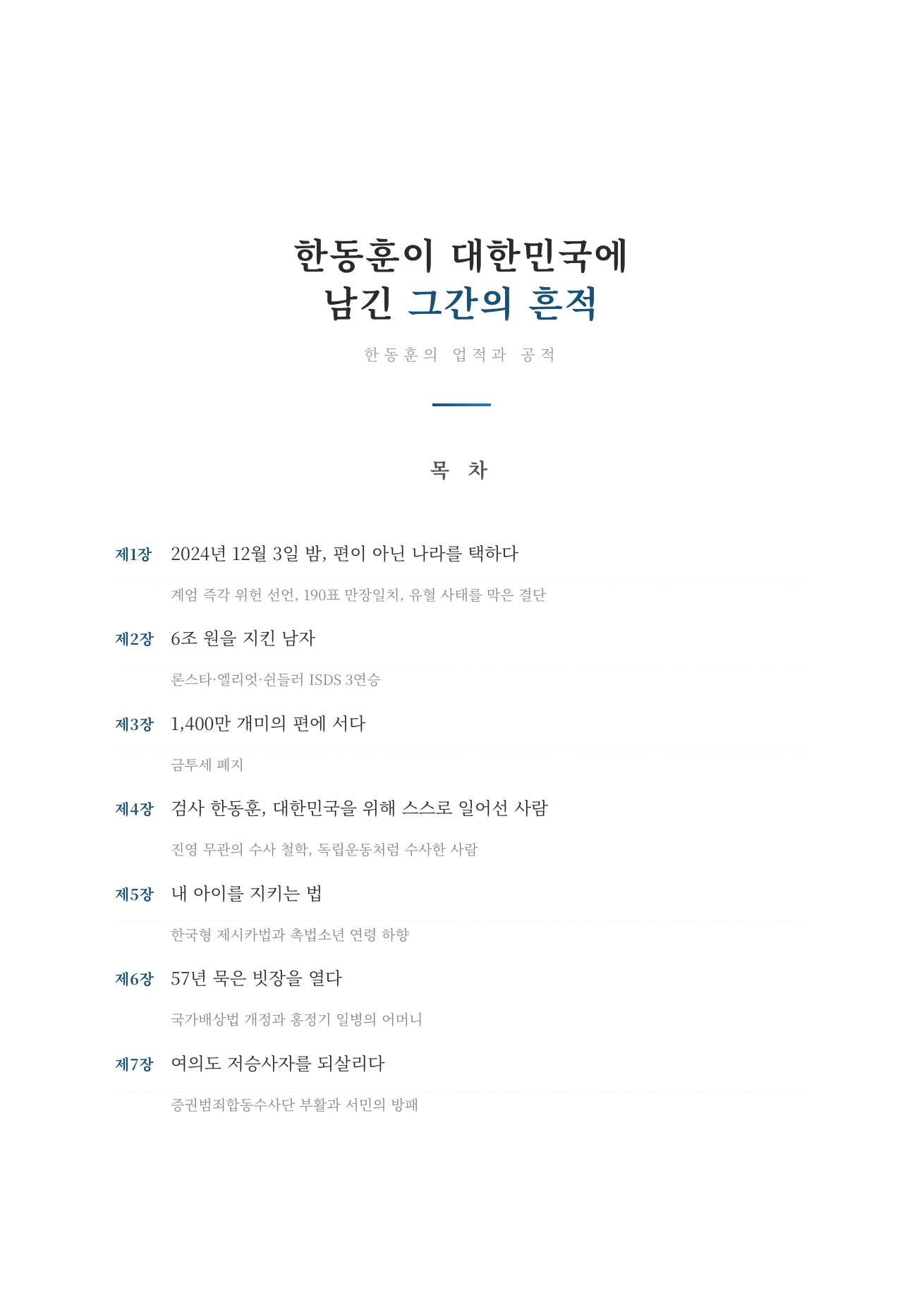
Han Dong-hoon, Busan Buk-gu Gap: A Record of the 100 Days Before and After the Election (Mar. 26-Jul. 3, 2026)
Kim Kyung-jin
Table of Contents and 13 sections
From March 26 to July 3, 2026, this record follows the spring after expulsion, the Busan Buk-gu Gap by-election, victory as an independent, and the first bill submitted in the National Assembly.
Table of Contents
Artificial Intelligence and Medicine
Kim Kyung-jin, Attorney at Law
AI in clinical care, hospitals, education, and research
AI in medical imaging, risk prediction, treatment planning, hospital operations, education, and research, with patient safety, privacy, and accountability.

























[AI Library] Chapter 20. A Synthesis of the Main Legal Issues
Artificial Intelligence on Trial
Part 6. The Future of AI Litigation and Legal Strategy
Chapter 20. A Synthesis of the Main Legal Issues
Attorney Kyungjin Kim
A. Copyright: Fair Use vs. Compensation for Training Data
On November 12, 2025, Judge Sidney Stein of the U.S. District Court for the Southern District of New York ordered OpenAI to produce 20 million ChatGPT conversation logs. OpenAI's lawyers objected, arguing that user privacy would be violated. The judge was unmoved. His reasoning was straightforward: ChatGPT users voluntarily typed their conversations into the system. They were not wiretapped.
This scene captures where the AI copyright war stands today. When the New York Times sued OpenAI in 2023, many viewed it as a simple dispute between a news organization and a tech company. But two years later, the lawsuit has become an earthquake shaking the legal foundations of the global AI industry. Sixteen copyright cases have been consolidated into a single multidistrict litigation (MDL). The New York Times, Chicago Tribune, New York Daily News, the Intercept. What are the plaintiffs' lawyers looking for? They want evidence of 'regurgitation.'
What is regurgitation? It is the phenomenon of an AI spitting back what it learned verbatim. A student who reads a book and summarizes it in their own words is fine. But a student who memorizes the entire book and copies it onto an exam is committing plagiarism. The New York Times' lawyers have already presented evidence that ChatGPT reproduced their articles nearly word for word. Texts identical down to a single word, a single comma. What they want is more evidence. Somewhere in those 20 million conversation logs, that evidence exists.
(1) The Pro-Corporate Tendency in U.S. Case Law
American courts have traditionally been generous toward technological innovation. The legal expression of that generosity is 'Fair Use.' To understand fair use, imagine a library. Borrowing a book from a library and reading it is legal. Quoting a paragraph from that book in a report is also legal. But photocopying the entire book and selling it is illegal. Fair use is the legal doctrine that draws this boundary line.
OpenAI's argument goes like this: we read the book; we did not copy it. Just as a human writer reads thousands of books and develops their own style, AI 'learns' from data and creates something new. This is 'Transformative Use.' When Google scanned books from libraries around the world, the court allowed it. The Google Books ruling. The precedent AI companies hold up as their shield. But the courtroom landscape in 2025 looks different. On April 4, 2025, Judge Stein denied most of OpenAI's motion to dismiss. Claims for direct infringement, contributory infringement, and trademark dilution all survived to go to trial. The judge's message was clear: 'Whether fair use applies is a question for trial.' This is not a ruling favorable to the companies. It is a ruling that says 'we don't know yet.'
A more significant precedent exists. The Thomson Reuters v. ROSS Intelligence case. ROSS was a legal AI startup. They trained a competing product on Westlaw's legal database. In February 2025, a federal court in Delaware rejected ROSS's fair use defense. The judge's logic was simple: you used a competitor's data to build a competing product. This is not transformative use. This is market substitution.
Market substitution. The most important of the four fair use factors. Does the AI replace the original work? This is the core of the New York Times' argument. People now ask ChatGPT instead of going to the New York Times website. 'What's in the news today?' ChatGPT answers based on New York Times articles. The collapse of the paid subscription model. That is market substitution.
(2) Europe's Tendency Toward Protecting Rights Holders
The atmosphere across the Atlantic is markedly different. In August 2024, the European Union enacted the world's first comprehensive AI regulation, the EU AI Act. This law requires providers of general-purpose AI models to publish detailed summaries of the data used for training. A transparency obligation. The United States has no such law.
The GEMA v. OpenAI ruling from the Munich Regional Court in Germany symbolizes Europe's direction. GEMA is Germany's music rights collecting society. In late 2024, the court held that OpenAI violated German copyright law in its chatbot training process. The central issue was the 'Text and Data Mining (TDM)' exception. The EU Digital Single Market Copyright Directive permits TDM for research purposes. But for commercial TDM, rights holders can exercise an 'opt-out' right. The court found that OpenAI's activities were commercial in purpose and that rights holders had explicitly expressed their objection.
The Getty Images v. Stability AI case proceeding in England also deserves attention. Getty Images is the world's largest photo agency. They claim that Stability AI's image-generation model, Stable Diffusion, trained on 12 million of their photographs without authorization. There is a telling piece of evidence: AI-generated images contained distorted versions of the Getty Images watermark. The AI had 'learned' the watermark itself. This could constitute direct evidence of copying.
Chinese courts are also active in protecting copyright holders. In 2024, the Guangzhou Internet Court held an AI service provider directly liable for infringement in the 'Ultraman' ruling. The Hangzhou Internet Court's LoRA model decision ordered 30,000 yuan in damages. The message from Chinese courts is clear: AI platforms are not mere tool providers. They must take affirmative steps to prevent users from infringing others' copyrights.
(3) The Rise of the Licensing Negotiation Model
On December 11, 2025, Walt Disney invested $1 billion in OpenAI. At the same time, Disney licensed more than 200 of its characters to OpenAI's video-generation platform 'Sora.' Mickey Mouse, Cinderella, Darth Vader, Yoda. It was an ironic scene. Just six months earlier, Disney and Universal had sued Midjourney for copyright infringement. Now they were paying an AI company.
What happened? Disney CEO Bob Iger's words offer a clue: 'No generation has ever managed to stop technological progress. We don't intend to either. If change is going to happen, it's better to ride it.' This is not surrender. It is a deal.
The core of the licensing agreement is 'control.' Disney gained the right to determine how its characters are used on the Sora platform. Violence, politics, and adult content are prohibited. Actors' likenesses and voices are also excluded. Disney and OpenAI formed a joint oversight committee to monitor user content. The calculation: controlled, paid use is better than uncontrolled, unauthorized use.
OpenAI has already signed licensing deals with multiple media companies. The Associated Press, Axel Springer (parent of Politico and Bild), News Corporation (parent of the Wall Street Journal and The Times), Conde Nast (The New Yorker, Vogue, Wired), and Reddit. The total runs into hundreds of millions of dollars. Meanwhile, the New York Times, Chicago Tribune, and others continue their lawsuits. The media industry has split into two camps: the 'deal camp' and the 'lawsuit camp.'
This split has an economic logic. Litigation is a gamble. It could take years, and even a win leaves the damages amount uncertain. A licensing deal, by contrast, is guaranteed cash. Legal risk disappears. But licensing agreements have a catch. Large media companies can sit at the negotiating table; individual writers and unknown artists cannot. The value of data is proportional to how much you hold. Small creators risk being left out of this new economic order.
Ultimately, the future of AI copyright divides into two paths: the fight in courtrooms and the deal at the negotiating table. Both try to answer the same question. When machines create value from human-made data, who does that value belong to? Until an answer emerges, the copyright war will continue.
B. Employment: The Spread of AI Agent Liability
Derek Mobley applied to more than 100 companies. He did not get a single interview.
He was Black. He was in his 40s. He had been diagnosed with anxiety disorder. One day, he noticed a strange pattern. Every company he had applied to used a human resources software platform called 'Workday.' The timing of rejection emails was also odd. 1:50 a.m. Less than an hour after he submitted his application. No human was reviewing resumes at that hour.
Mobley realized: it was not a human who rejected him. It was an algorithm.
In February 2023, Mobley sued Workday in the U.S. District Court for the Northern District of California. The charges: discrimination based on race, age, and disability. The lawsuit became the world's first large-scale legal test of AI employment discrimination.
(1) The Global Spread of Vendor Liability
Workday's first line of defense was simple: 'We are not the employer.' Under traditional employment law, the duty not to discriminate falls on the employer. Just as you would not sue Microsoft because a document written in Microsoft Word contained a problem, suing the company that made recruiting software was logically unsound, they argued.
Judge Rita Lin rejected this logic. In July 2024, she denied Workday's motion to dismiss and issued a significant ruling. Workday is not a mere 'tool.' Workday's software does not mechanically apply criteria set by the employer; it independently evaluates, recommends, and eliminates applicants. This constitutes substantive participation in decision-making. Workday can therefore be held liable under federal civil rights law as the employer's 'agent.'
Agent. That word is the key. In law, an agent is someone who acts on behalf of a principal. A lawyer is the agent of their client. A real estate broker is the agent of the property owner. Now AI hiring software can also be an employer's agent. Just as a principal bears liability for an agent's acts, the agent itself can also bear liability.
On May 16, 2025, Judge Lin certified the class in the Mobley lawsuit. The case now represents all applicants aged 40 or older who applied through the Workday system and were rejected after September 24, 2020. Workday's attorneys mentioned a staggering number in court: the total number of applications rejected through the Workday system during that period was approximately 1.1 billion. The potential class could number in the hundreds of millions.
Judge Lin's ruling sent a warning to AI vendors worldwide. The U.S. Equal Employment Opportunity Commission (EEOC) intervened as amicus curiae in support of Mobley. The EEOC's position is clear: employers must be held responsible for discrimination caused by AI tools, and the vendors who developed the AI can also be held liable. If a vendor falsely advertises that 'our algorithm is free of bias,' or fails to provide employers with information to verify bias, product liability principles may apply.
In August 2023, the EEOC reached a settlement with iTutorGroup. This was the first time a federal agency imposed sanctions for AI hiring discrimination. iTutorGroup's recruitment software automatically rejected applicants based on age. If an applicant was over a certain age, the system automatically sent a rejection email. This was not intentional discrimination but 'hard-coded bias.' The EEOC signaled strict enforcement against this type of discrimination as well.
(2) The Trend Toward Mandatory Bias Audits
New York City's 'Local Law 144' is a pioneer in AI hiring regulation. Enacted in 2023, this law mandates 'bias audits' for Automated Employment Decision Tools (AEDTs). To use an AI hiring tool in New York City, a company must have an independent auditor verify annually that the tool does not exhibit bias based on race or gender. The results must be published on the company's website.
What is a bias audit? Just as an accountant audits a company's financial statements, data scientists and legal experts audit AI algorithms. They examine what data the algorithm uses, whether that data contains bias, and whether the outputs disadvantage particular groups.
In May 2024, Colorado enacted the first comprehensive state-level AI employment discrimination law in the United States. This law imposes 'algorithmic discrimination prevention duties' not only on employers but also on AI developers. It requires impact assessments for high-risk AI systems and mandates immediate corrective action when bias is discovered. California also introduced new regulations taking effect in October 2025 that define AI vendors as 'agents' and require employers to obtain bias-testing results from their vendors.
But despite the spread of regulation, a fundamental problem remains: there is no consensus on the question 'what is bias?' For example, if ten times more men than women apply for a certain job, is a higher male acceptance rate bias, or simply a reflection of statistical reality? AI learns from historical data. If a certain group was discriminated against in the past, the AI recognizes that discrimination as 'the pattern of success' and reproduces it. De-biasing techniques designed to correct historical inequality could themselves produce reverse discrimination.
In April 2025, President Trump signed an executive order directing federal agencies to stop enforcement based on 'disparate impact' theory. Disparate impact theory holds that practices can be deemed discriminatory if they disproportionately harm a particular group, even without discriminatory intent. This executive order could weaken EEOC and DOJ enforcement in AI cases. But it does not affect private lawsuits like Mobley v. Workday. If anything, reduced federal enforcement makes it likely that state governments and private attorneys will fill the gap.
Right now, two documents sit on the desks of corporate HR directors. One is an efficiency report on AI hiring tools. The other is a risk assessment from the legal department. The AI adopted for efficiency could come back as a class action complaint worth hundreds of millions of dollars. Mobley v. Workday has not yet reached a verdict. But regardless of the outcome, legal liability for AI employment systems is already expanding. The excuse 'the algorithm did it' no longer works.
C. Regulation: America's State-by-State Patchwork vs. the EU's Unified Framework
On February 2, 2025, the first obligations under the European Union's AI Act took effect. From that day forward, certain AI practices were banned outright within the EU. Indiscriminately scraping facial images from the internet or CCTV to build facial recognition databases. Using emotion recognition technology in workplaces or schools. Real-time biometric identification for law enforcement purposes. Social credit scoring systems.
On the same day, nothing happened in the United States.
This is the current state of AI regulation. Europe is implementing the world's first comprehensive AI framework law, while the U.S. Congress has still failed to pass any legislation. As a result, global AI companies must operate in two completely different legal worlds.
(1) The Possibility of Regulatory Convergence
The EU AI Act adopts a classification system based on risk levels: prohibited, high-risk, limited risk, and minimal risk. AI used in healthcare, hiring, education, law enforcement, and credit scoring is classified as 'high-risk' and subject to the strictest regulations. Providers of high-risk AI systems must prepare technical documentation, establish quality management systems, ensure human oversight, and meet requirements for accuracy, resilience, and cybersecurity.
Starting August 2, 2025, obligations for general-purpose AI models (GPAI) also took effect. Providers of large language models like ChatGPT or Claude must maintain technical documentation that traces the model's development, training, and evaluation processes. They must also produce transparency reports describing the model's capabilities, limitations, and potential risks. Larger models that may pose systemic risks face additional risk assessment and mitigation requirements.
The fines are substantial. Violations of prohibited AI practices carry penalties of 7% of global annual revenue or 35 million euros, whichever is higher. Other obligation violations draw 3% or 15 million euros; providing false information triggers 1% or 7.5 million euros. These figures mirror GDPR's penalty structure. For global corporations, they represent a threat impossible to ignore.
The United States has no equivalent unified regulation. But the underlying philosophy of a 'risk-based approach' is shared. Both the Biden administration's AI Executive Order and NIST's AI Risk Management Framework support differentiated regulation for high-risk AI. International bodies including the OECD AI Principles and the G7 Hiroshima Process are building consensus in the same direction.
There is a concept called the 'Brussels Effect.' It describes how EU regulations become de facto global standards. GDPR did exactly this. Global companies that cannot abandon the EU market design their products to meet the strictest standard, which is EU regulation. Those products are then sold worldwide. The result: EU regulation becomes the global standard.
The same phenomenon may occur with AI regulation. OpenAI, Google, Meta, and Microsoft all operate in the EU market. The transparency tools, risk assessment procedures, and human oversight mechanisms they develop to comply with the EU AI Act will likely be applied in the United States as well. Following one high standard is more cost-effective than navigating different rules in each state.
(2) The Possibility of Continued Divergence
Complete regulatory unification, however, remains a distant prospect. The U.S. Congress, paralyzed by political polarization, has failed to enact a federal AI law. Filling that vacuum are independent state legislatures. The Colorado AI Act, California's SB 1047 (vetoed by the governor), Tennessee's ELVIS Act, New York City's Local Law 144. Each state with different definitions, different obligations, different penalty structures. This is called 'patchwork' regulation. A regulatory environment stitched together like a quilt of mismatched fabric.
The Trump administration's inauguration is a variable that may accelerate this fragmentation. The Biden administration's AI safety executive order has been revoked. 'Innovation and autonomy' is emphasized over 'disparate impact.' Federal deregulation is expected. But Democratic-leaning states like California and New York will strengthen their own regulations. The regulatory gap between federal and state, and between state and state, widens.
China takes yet another path. The 'Interim Measures for the Management of Generative AI Services,' effective August 2023, represents the world's first generative AI regulation. But its purpose differs from the EU's. Compliance with 'core socialist values' takes priority over protecting individual rights. All AI services in China must register with the Cyberspace Administration of China (CAC). Over 1,400 AI apps and 450 large language models have been registered. A data blacklist system is also in operation. Foreign AI's entry into the Chinese market is effectively blocked.
The global AI regulatory landscape is splitting into three blocs. The EU's 'rights-centered unified regulation,' America's 'state-by-state patchwork and private litigation,' and China's 'national security-centered control.' The era when a single AI model could operate identically worldwide is over. Companies must build separate models, separate datasets, and separate compliance frameworks for each market.
Who benefits most from this confusion? Ironically, it is lawyers and consultants. The more complex the regulation, the higher the market value of specialists who hold a monopoly on interpreting it. Companies will end up spending as much on proving their AI is legal as they spend on developing it.
D. Transparency: The AI Black Box and Explainability
A doctor tells a patient: "There is an 87% probability it is cancer. Let's operate."
The patient asks: "Why? Based on what symptoms?"
The doctor answers: "I don't know. The AI said so."
This is not a hypothetical scenario. In 2024, a class action lawsuit was filed against UnitedHealth Group. According to the plaintiffs, UnitedHealth's AI algorithm 'nH Predict' disregarded patients' individual conditions and recommended termination of care based solely on statistical data. Doctors spent an average of 1.2 seconds reviewing the AI's decisions. According to the complaint, the insurance denial rate more than doubled, from 10.9% in 2020 to 22.7% in 2023.
The core problem is the 'black box.' No one can explain why the AI made a particular decision. Or rather, no one is able to.
(1) Legislative Trends Toward Mandating Explanations
Law, by its nature, asks 'why.' A court judgment must contain not only a conclusion but the reasoning that led to it. Otherwise, how would anyone decide whether to appeal or accept? Yet modern AI based on deep learning delivers conclusions without revealing the process. Billions of parameters are intertwined in such complexity that even developers cannot precisely explain 'why the AI classified this patient as high-risk.'
The EU's GDPR was the first to apply legal norms to this problem. Article 22 grants individuals subject to 'automated decision-making' the right to receive 'meaningful information about the logic involved.' Article 15 guarantees data subjects the right to know how their data is being processed. This is the so-called 'Right to Explanation.'
In 2023, the Court of Justice of the European Union (CJEU) issued an important interpretation in the SCHUFA ruling. SCHUFA is a German credit reporting agency. The court held that the 'score' itself produced by a credit agency constitutes automated decision-making, and that data subjects may demand an explanation of how that score was calculated. This means financial institutions cannot simply notify applicants that 'the AI said you are ineligible for a loan'; they must explain the specific variables and weightings involved.
Legislation mandating explanations is also advancing in the United States. California's SB 1120 requires that when a health insurer uses AI to deny coverage, a human must intervene to review the decision and explain the reasoning. Colorado's AI Act also includes transparency requirements for high-risk AI systems. At the federal level, the Federal Trade Commission (FTC) is applying existing statutes, the Fair Credit Reporting Act (FCRA) and the Equal Credit Opportunity Act (ECOA), to AI. When a financial institution uses AI to deny a loan, notifying the applicant that 'your AI score was too low' is illegal. The institution must specify which factors had a negative impact.
In 2024, a Canadian civil resolution tribunal ruled in the 'Air Canada Chatbot Case' that a company must bear responsibility for its AI chatbot's errors. Air Canada's chatbot gave a customer incorrect refund policy information. The company argued that 'the chatbot is a separate legal entity.' The tribunal dismissed this outright: 'The chatbot is Air Canada's agent, and the company is responsible for its actions.' This ruling confirmed that AI's opacity cannot serve as grounds for corporate immunity.
(2) The Gap Between Technical Limitations and Legal Demands
The problem is that current AI technology struggles to provide the clear explanations the law demands. State-of-the-art large language models consist of hundreds of billions of parameters. It is possible to trace mathematically why a particular output emerged. But converting that trace into a natural-language causal explanation that humans can understand is nearly impossible.
Courts want clear causation: 'B happened because of A.' AI can only offer correlational answers: 'A was probable, so B was selected.' This gap is the seed of legal disputes.
'Explainable AI (XAI)' techniques are under development. Methods like LIME and SHAP extract the key variables that influenced an AI's decision. They can generate explanations such as: 'This loan was denied due to: credit score (40%), debt-to-income ratio (30%), length of employment (20%), other factors (10%).' But there is a trap here.
First, such explanations are 'post-hoc rationalizations.' They do not show how the AI actually reached its decision; they reverse-engineer plausible reasons after the fact. It is difficult to distinguish whether this reflects the AI's genuine 'reasoning' or is merely a reassuring excuse manufactured for human consumption.
Second, there is a trade-off between explainability and performance. The most accurate AI models have the most complex architectures and are therefore the hardest to explain. Simpler models that are easy to explain sacrifice accuracy. The law demands 'explainable transparency'; the market wants 'inexplicable high performance.'
Mata v. Avianca is an extreme case of this problem. In 2023, New York attorney Steven Schwartz used ChatGPT to draft court filings. ChatGPT cited cases that did not exist. Schwartz submitted them to the court without verification. When the judge pointed out that the cited cases could not be found, Schwartz asked ChatGPT again: 'Do these cases really exist?' ChatGPT answered: 'Yes, they do.' Schwartz believed it. He was ultimately sanctioned.
This is the problem of AI 'hallucination.' AI asserts the existence of things that do not exist. And when asked to explain those assertions, it generates convincing but false explanations. Humans lack the ability to verify these explanations, or the time, or the willingness.
AI transparency is ultimately a human problem as much as a technical one. Doctors reviewing AI decisions in 1.2 seconds do so not because of technological limitations but because of time pressure. The lawyer who failed to verify ChatGPT's citations did so not because the AI could not explain itself but because the lawyer wanted to believe. Courts have begun asking: 'Can we trust what we cannot understand?' And: 'When something we cannot understand causes harm, whose responsibility is it?' Transparency is not a mere technical feature. It is the most expensive admission ticket AI must pay to be accepted as a member of our society. The fight over who pays that ticket, and how much, is playing out in courtrooms right now.
Kim Kyung-jin
Attorney · Former Member of the National Assembly · AI Policy Researcher
© 2026 Kim Kyung-jin. All rights reserved.