AI Library
The Age of Autonomous Scientific Discovery
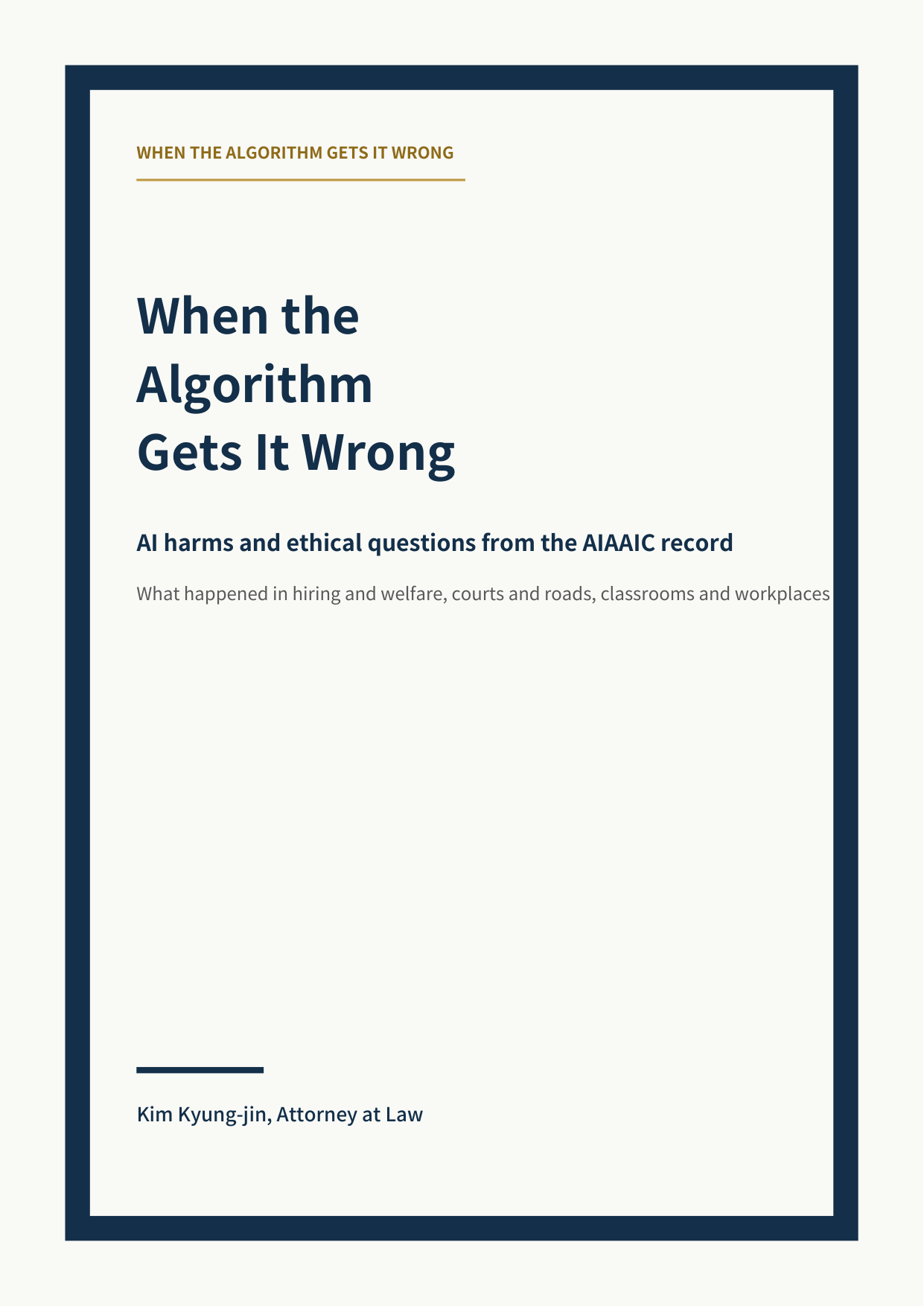
Kim Kyung-jin, Attorney at Law
AI Scientists and Self-Driving Labs
This book follows how AI scientists and self-driving labs are changing the way science generates and verifies claims. It covers literature-based discovery, natural-language protocols translated into robot commands, multi-agent research systems, closed-loop laboratories, materials search, the verification gap, chains of evidence, research harnesses, journal ethics, and legal responsibility.
AI Library
A New Era of Life Sciences Opened by Artificial Intelligence
Structural Proteomics, Genomic Foundation Models, Autonomous Laboratories, and Global Governance
Kim Kyung-jin, Attorney at Law
This book is a research volume compiled with artificial intelligence. A human selected the materials and structured the work, while AI models drafted the sentences and cross-checked the facts.

AI Library
The Double Structure of Digital Sovereignty
Europe’s Departure from Palantir and the Chains of American Big Tech
Kim Kyung-jin, Attorney at Law
This is a record of 2026, when European intelligence agencies and defense ministries began removing analytics tools from America’s Palantir. It covers the replacement decisions made by France’s General Directorate for Internal Security (DGSI), Germany’s Federal Office for the Protection of the Constitution (BfV), and the Netherlands Ministry of Defense; the incident in which US export controls severed an ally’s ac…
New English Edition
Artificial Intelligence in Horticulture
Kim Kyung-jin, Attorney at Law
Across five chapters and ten sections, this book examines computer vision for crop diagnosis, harvesting robots and autonomous field systems, smart greenhouses and digital twins, precision irrigation and supply-chain quality control, high-throughput phenotyping, and predictive breeding.
New English Edition
Artificial Intelligence in Food Crop Agriculture
Kim Kyung-jin, Attorney at Law
Across six chapters and eighteen sections, the book examines digital agricultural infrastructure, remote sensing, crop diagnosis, yield forecasting, precision irrigation, genomics, molecular breeding, agricultural robotics, climate-smart agriculture, and global food security.
New English Edition
The Future of Forestry and Agroforestry
Kim Kyung-jin, Attorney at Law
Driven by Artificial Intelligence and Digital Innovation
Across five chapters and fifteen sections, the book follows satellites, drones, LiDAR, digital twins, forest-specific language models, wildfire and pest forecasting, forestry robotics, agroforestry, timber traceability, and forest carbon markets.
New English Edition
Smart Livestock Farming: AI Enters the Barn
Kim Kyung-jin, Attorney at Law
Sensors listen, cameras watch, and artificial intelligence helps farmers decide.
Across five chapters and fifteen sections, the book follows precision livestock farming from animal health and reproduction to robotic milking, virtual fencing, digital twins, methane reduction, welfare, and data ownership.

Table of Contents
Han Dong-hoon, Busan Buk-gu Gap: A Record of the 100 Days Before and After the Election (Mar. 26-Jul. 3, 2026)
Kim Kyung-jin
Table of Contents and 13 sections
From March 26 to July 3, 2026, this record follows the spring after expulsion, the Busan Buk-gu Gap by-election, victory as an independent, and the first bill submitted in the National Assembly.
Table of Contents
Artificial Intelligence and Medicine
Kim Kyung-jin, Attorney at Law
AI in clinical care, hospitals, education, and research
AI in medical imaging, risk prediction, treatment planning, hospital operations, education, and research, with patient safety, privacy, and accountability.




























[AI Library] Chapter 24. South Korea: KF-21 Boramae and the NACS Next-Generation Air Combat System
Chapter 24. South Korea: KF-21 Boramae and the NACS Next-Generation Air Combat System
South Korea: KF-21 Boramae and NACS Next Generation Air Combat System 1991 Operation Desert Storm. I flew an F-16CG into Iraq's air defenses. The radar warning receiver let out an ear-piercing scream, and the lights on the instrument panel blinked frantically. At that time, I had a wingman next to me. It was a person. No one was sure whether the friend would come back alive. Now, 30 years later, a different type of airplane is warming up its engines on the runway in Sacheon, Gyeongsangnam-do. KF-21 Boramae. It is a supersonic fighter developed independently by Korea.
And soon, there will be machines, not people, sitting next to these fighter jets. Korea's story begins with cursed geopolitics. You can find out by unfolding the map. Giants surrounding a narrow peninsula. China to the west, Russia and North Korea to the north, and Japan to the east. To survive in this narrow land, you needed your own claws. This is not a knife borrowed from someone, but a blade that you forge yourself. In 2001, President Kim Dae-jung made the declaration at the Air Force Academy graduation ceremony. We will produce domestically produced fighter jets by 2015. Many people laughed at the time.
Even the United States has to spend decades and an astronomical amount of money to build a fighter jet, but Korea is doing it? They did not know the desperation of Koreans. July 19, 2022. Boramae cleared the runway at Sacheon Airport and took to the sky for the first time. And in January 2026, 1,600 flight tests were completed without a single accident. At the same time, Turkiye's KAAN, which was developing a fighter aircraft, only made two flights, and India's AMCA has not even flown a prototype yet. Korea did it. The real story of the KF-21 is not the aircraft itself. The future Korea envisions is bigger and scarier. NACS.
Next Air Combat System. The name may be complex, but the core is simple. The idea is to combine human-powered airplanes and AI-controlled drones into one team. KF-21 becomes the brains of this massive system. Pilots become commanders, and drones become loyal hounds. In July 2025, Korea Aerospace Industries (KAI) released a definitive video. A KF-21 flies in formation with four stealth drones. Pilots command drones through helmet displays
Lower it. You scout, you disrupt, you two strike with me. Drones go deep into enemy territory to neutralize air defenses, while manned aircraft launch long-range missiles from a safe distance. It's not just a simulation. This is a technology that is actually being developed. South Korea is developing a stealth drone called Stingray-X1. This drone, which is shaped like a wing without tail fins, is almost undetectable by enemy radar. Flight tests are scheduled to begin at the end of 2025, and a joint flight with the KF-21 is scheduled for early 2026. If all goes according to schedule, operational deployment will be completed by 2030.
There is a reason why Korea is so crazy about AI and drones. Population. The lowest birth rate in the world. The number of young people being sent to the military is decreasing every year. If there is a shortage of people, they must be filled with machines. This is not a matter of choice, but of survival. In June 2025, KAI pulled out another card. K-On Device AI Semiconductor. Even if an enemy disrupts communications, this semiconductor independently detects and determines the threat. Think of it as a tiny pilot inside a silicon chip. No fatigue, no fear.
Even in situations where a human pilot would lose his mind fighting G-forces, this AI coolly performs evasive maneuvers. The KF-21 will evolve into three versions. Block 1 is an early mass production type for air superiority missions. Block 2 is an improved ability that adds ground strike capabilities. And Block 3, aka KF-21EX, is a complete stealth aircraft equipped with an internal weapons bay. Materials that reduce the radar reflection area are applied and the ability to link with unmanned aerial vehicles is completed. The goal is 2039. There is one thing to point out here. Korea is making all of this with its own hands.
When the United States refused to transfer four key technologies, including AESA radar, infrared search and track, electro-optical targeting pod, and radio frequency jammer, Korea chose to develop its own. And I did it. Hanwha Systems created the AESA radar, and LIG Nex1 is responsible for the missile defense system. In May 2024, a live fire of the Me Tier long-range air-to-air missile was successfully conducted. The export outlook is also bright. The price per unit of KF-21 is approximately 80 million dollars. It's half the size of the F-35. Maintenance costs are also cheaper than Western competitors at $14,000 per hour.
The Philippines, Poland, United Arab Emirates and Saudi Arabia are already showing interest. Indonesia participated as a joint development partner, and the UAE conducted test flights in Sacheon in 2025.
What Korea is selling is not just a fighter jet. It is a platform for future warfare. It is a complete ecosystem that combines fighter jets, unmanned aerial vehicles, AI semiconductors, and data links. Instead of having to buy and assemble parts from multiple countries, you can get them all from one country. This is Korea’s competitiveness. Of course, there are challenges. The engine is still produced under license from GE in the United States, F414. Aero engines are the most difficult area in fighter aircraft development. Korea has begun developing its own engine, but there is a long way to go.
The reliability of AI algorithms, communication security between manned aircraft and unmanned aerial vehicles, and verification of autonomous judgment in a real-world environment are also issues that need to be solved. But something is clear. Korea no longer waits for technology from other countries. Boramae is not just a 4.5 generation fighter. It is the center of a huge combat ecosystem called NACS and is a game changer for the Northeast Asian skies in the 2030s. If a conflict occurs with North Korea or China, there will be dozens of AI drones flying behind the KF-21 in the sky, overwhelming the enemy's air defense network.
Like the gladius of ancient Rome or the longbow of the Middle Ages, weapons evolve with the times. KF-21 and NACS are 21st century swords forged on the Korean Peninsula. This is the heavy breathing of a country that has depended on the wings of other countries for over half a century. It is the roar of a beast that seeks to regain sovereignty over the sky.
Kim Kyung-jin
Attorney · Former Member of the National Assembly · AI Policy Researcher
© 2026 Kim Kyung-jin. All rights reserved.