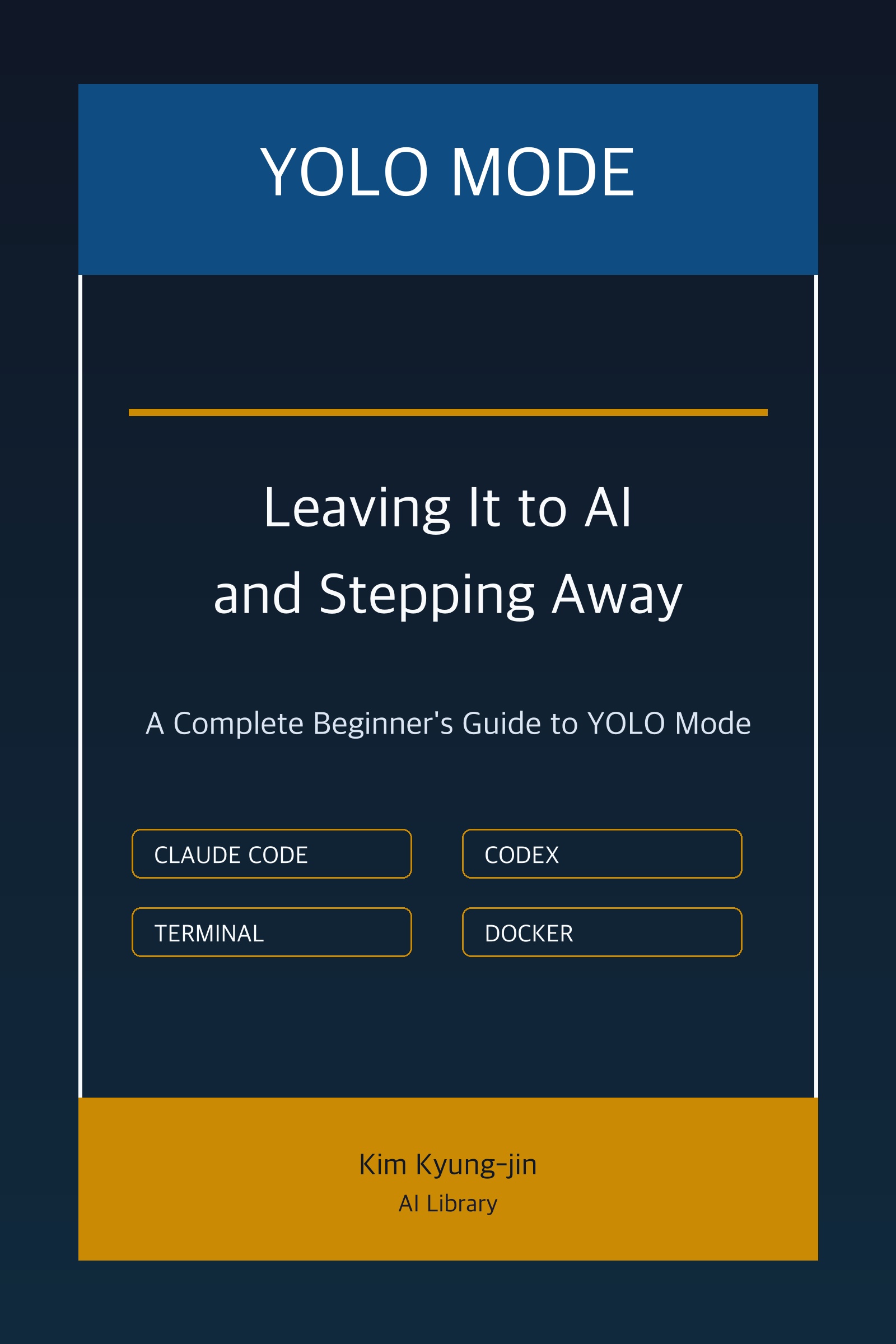
AI Library
The Age of Autonomous Scientific Discovery
Kim Kyung-jin, Attorney at Law
AI Scientists and Self-Driving Labs
This book follows how AI scientists and self-driving labs are changing the way science generates and verifies claims. It covers literature-based discovery, natural-language protocols translated into robot commands, multi-agent research systems, closed-loop laboratories, materials search, the verification gap, chains of evidence, research harnesses, journal ethics, and legal responsibility.
AI Library
A New Era of Life Sciences Opened by Artificial Intelligence
Structural Proteomics, Genomic Foundation Models, Autonomous Laboratories, and Global Governance
Kim Kyung-jin, Attorney at Law
This book is a research volume compiled with artificial intelligence. A human selected the materials and structured the work, while AI models drafted the sentences and cross-checked the facts.
AI Library
The Double Structure of Digital Sovereignty
Europe’s Departure from Palantir and the Chains of American Big Tech
Kim Kyung-jin, Attorney at Law
This is a record of 2026, when European intelligence agencies and defense ministries began removing analytics tools from America’s Palantir. It covers the replacement decisions made by France’s General Directorate for Internal Security (DGSI), Germany’s Federal Office for the Protection of the Constitution (BfV), and the Netherlands Ministry of Defense; the incident in which US export controls severed an ally’s ac…
New English Edition
Artificial Intelligence in Horticulture
Kim Kyung-jin, Attorney at Law
Across five chapters and ten sections, this book examines computer vision for crop diagnosis, harvesting robots and autonomous field systems, smart greenhouses and digital twins, precision irrigation and supply-chain quality control, high-throughput phenotyping, and predictive breeding.
New English Edition
Artificial Intelligence in Food Crop Agriculture
Kim Kyung-jin, Attorney at Law
Across six chapters and eighteen sections, the book examines digital agricultural infrastructure, remote sensing, crop diagnosis, yield forecasting, precision irrigation, genomics, molecular breeding, agricultural robotics, climate-smart agriculture, and global food security.
New English Edition
The Future of Forestry and Agroforestry
Kim Kyung-jin, Attorney at Law
Driven by Artificial Intelligence and Digital Innovation
Across five chapters and fifteen sections, the book follows satellites, drones, LiDAR, digital twins, forest-specific language models, wildfire and pest forecasting, forestry robotics, agroforestry, timber traceability, and forest carbon markets.
New English Edition
Smart Livestock Farming: AI Enters the Barn
Kim Kyung-jin, Attorney at Law
Sensors listen, cameras watch, and artificial intelligence helps farmers decide.
Across five chapters and fifteen sections, the book follows precision livestock farming from animal health and reproduction to robotic milking, virtual fencing, digital twins, methane reduction, welfare, and data ownership.

Table of Contents
Han Dong-hoon, Busan Buk-gu Gap: A Record of the 100 Days Before and After the Election (Mar. 26-Jul. 3, 2026)
Kim Kyung-jin
Table of Contents and 13 sections
From March 26 to July 3, 2026, this record follows the spring after expulsion, the Busan Buk-gu Gap by-election, victory as an independent, and the first bill submitted in the National Assembly.
Table of Contents
Artificial Intelligence and Medicine
Kim Kyung-jin, Attorney at Law
AI in clinical care, hospitals, education, and research
AI in medical imaging, risk prediction, treatment planning, hospital operations, education, and research, with patient safety, privacy, and accountability.





















[AI Library] Epilogue
Artificial Intelligence and the Reshaping of Society
Epilogue
Kim Kyung-jin
Fear never left my fingertips while I wrote these thirteen chapters. The speed at which jobs vanish, the angle at which inequality deepens, the path along which democracy erodes, the concentration at which human bonds dissolve. None of it was light. When I laid out all fifty-two subtopics together, I realized they were not separate crises but a single massive tectonic shift.
Still, as this book comes to a close, there is one thing I want to say.
Humanity has always stood at moments like this. When fire first came into human hands, some burned forests while others cooked food. When the printing press spread, it became a tool of propaganda, yet it also opened the democratization of knowledge. When we unlocked the principle of nuclear fission, there was Hiroshima, but there were also nuclear power plants. Technology itself has no direction. Setting that direction has always been the human task.
The age of AI is no different. The fact that we can see the cracks means we still have time to repair them. As CEO Kim Seojun wrote, "Wherever a fracture appears, a window of opportunity inevitably opens on the other side." Finding new coordinates atop the rubble of a collapsing order is the work that lies before us.
There is no perfect blueprint. There never can be. But we can set a direction. A direction that embraces technology's productivity while preserving the dignity of labor. A direction that lets go of outdated formats while keeping the essence of education intact. A direction that pursues efficiency without surrendering human contact and connection. Moving one step at a time toward that direction, failing, correcting course, and moving again. That is what humanity has done for tens of thousands of years, and what it must continue to do.
The fifty-two challenges recorded in this book are not assignments. They are coordinates. A map that tells us where we stand. Where you walk with that map in hand is your choice, the reader who has finished this book.
May 2026, Kim Kyungjin
Kim Kyung-jin
Attorney · Former Member of the National Assembly · AI Policy Researcher
© 2026 Kim Kyung-jin. All rights reserved.