AI Library

AI Library

Books for Reading AI

Choose a book, then read it in order from the table of contents.

Uzbekistan Beyond the Blue Domes cover

Table of Contents

Uzbekistan Beyond the Blue Domes

Kim Kyung-jin, Attorney at Law

From Memories of the Silk Road to 2026 Changes and Practical Travel Logistics

An 18-chapter non-fiction book that explains Uzbekistan's history, society, economy, environment, and 2026 travel logistics, linking them to 142 official sources.

The People Who Changed Science with Artificial Intelligence cover

Table of Contents

The People Who Changed Science with Artificial Intelligence

Kim Kyung-jin, Attorney at Law

The Journey from Data to Nobel Prizes

This book follows eleven scientists who moved artificial intelligence into the heart of scientific discovery, from protein folding and new drug discovery to self-driving laboratories, machine scientists, automated paper reading, and the legal question of who owns a discovery made by a machine.

The Age of Autonomous Scientific Discovery cover

AI Library

The Age of Autonomous Scientific Discovery

Kim Kyung-jin, Attorney at Law

AI Scientists and Self-Driving Labs

This book follows how AI scientists and self-driving labs are changing the way science generates and verifies claims. It covers literature-based discovery, natural-language protocols translated into robot commands, multi-agent research systems, closed-loop laboratories, materials search, the verification gap, chains of evidence, research harnesses, journal ethics, and legal responsibility.
A New Era of Life Sciences Opened by Artificial Intelligence cover

AI Library

A New Era of Life Sciences Opened by Artificial Intelligence

Structural Proteomics, Genomic Foundation Models, Autonomous Laboratories, and Global Governance

Kim Kyung-jin, Attorney at Law

This book is a research volume compiled with artificial intelligence. A human selected the materials and structured the work, while AI models drafted the sentences and cross-checked the facts.

Get 1,000% More from Your Computer with AI Agents cover

Table of Contents

Get 1,000% More from Your Computer with AI Agents

Kim Kyung-jin

Twenty-four practical ways to change daily life and work with AI agents

This book shows how to get past the moments when a computer becomes difficult by working with an AI agent. It guides readers through installation and a first conversation, safe delegation, file organization and automatic backup, photo, PDF and video work, shortcuts and monitoring tools, diagnosing a slow computer, reviving an older PC, reading error messages, and putting a work environment in order.

The Double Structure of Digital Sovereignty cover

AI Library

The Double Structure of Digital Sovereignty

Europe’s Departure from Palantir and the Chains of American Big Tech

Kim Kyung-jin, Attorney at Law

This is a record of 2026, when European intelligence agencies and defense ministries began removing analytics tools from America’s Palantir. It covers the replacement decisions made by France’s General Directorate for Internal Security (DGSI), Germany’s Federal Office for the Protection of the Constitution (BfV), and the Netherlands Ministry of Defense; the incident in which US export controls severed an ally’s ac…
Artificial Intelligence in Horticulture cover

New English Edition

Artificial Intelligence in Horticulture

Kim Kyung-jin, Attorney at Law

Across five chapters and ten sections, this book examines computer vision for crop diagnosis, harvesting robots and autonomous field systems, smart greenhouses and digital twins, precision irrigation and supply-chain quality control, high-throughput phenotyping, and predictive breeding.

Artificial Intelligence in Food Crop Agriculture cover

New English Edition

Artificial Intelligence in Food Crop Agriculture

Kim Kyung-jin, Attorney at Law

Across six chapters and eighteen sections, the book examines digital agricultural infrastructure, remote sensing, crop diagnosis, yield forecasting, precision irrigation, genomics, molecular breeding, agricultural robotics, climate-smart agriculture, and global food security.
The Future of Forestry and Agroforestry cover

New English Edition

The Future of Forestry and Agroforestry

Kim Kyung-jin, Attorney at Law

Driven by Artificial Intelligence and Digital Innovation

Across five chapters and fifteen sections, the book follows satellites, drones, LiDAR, digital twins, forest-specific language models, wildfire and pest forecasting, forestry robotics, agroforestry, timber traceability, and forest carbon markets.

Smart Livestock Farming cover

New English Edition

Smart Livestock Farming: AI Enters the Barn

Kim Kyung-jin, Attorney at Law

Sensors listen, cameras watch, and artificial intelligence helps farmers decide.

Across five chapters and fifteen sections, the book follows precision livestock farming from animal health and reproduction to robotic milking, virtual fencing, digital twins, methane reduction, welfare, and data ownership.

The Paradigm Shift in AI Drug Discovery cover

Table of Contents

The Paradigm Shift in AI Drug Discovery and the Future Convergence Ecosystem

Kim Kyung-jin

From data-driven target discovery to self-driving laboratories

From finding the protein behind a disease and drawing the molecule, to screening out toxicity, replacing animal testing with organ chips, running trials on virtual patients, and settling who is liable when an AI-designed drug goes wrong. Fifteen sections across five parts, written so that no background in biology or chemistry is needed.

The Shaking Archipelago, The People Who Remember cover

Table of Contents

The Shaking Archipelago, The People Who Remember

Kim Kyung-jin

Japan's Earthquakes, Tsunamis, and Disaster Preparedness

This book follows the Nankai Trough, the 2011 Tohoku earthquake and tsunami, Mount Fuji's eruption risk, seismic observation networks, historical documents, tsunami deposits, the lesson of Onagawa Nuclear Power Station, and evacuation challenges in an aging society.

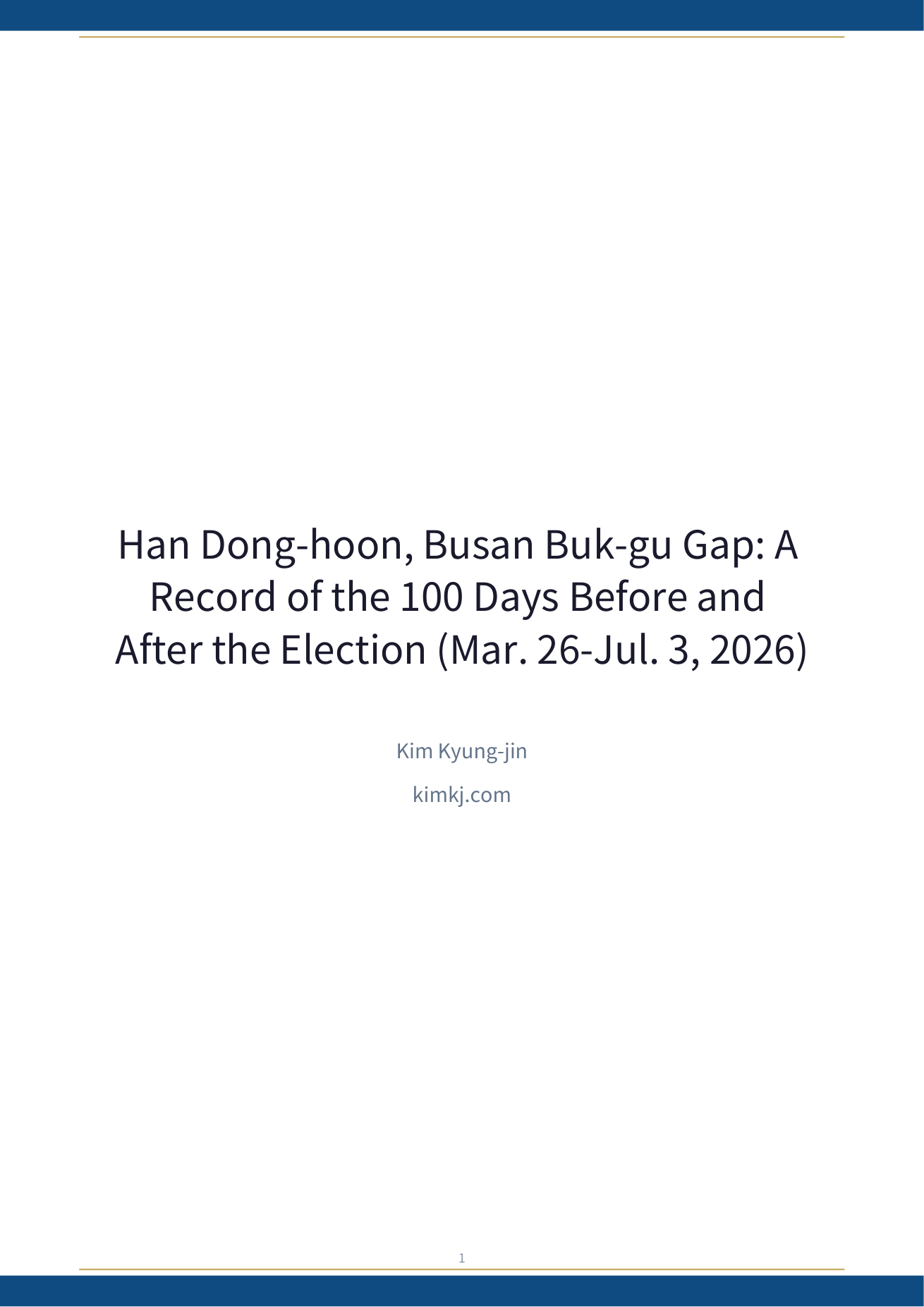
Han Dong-hoon, Busan Buk-gu Gap: A Record of the 100 Days Before and After the Election (Mar. 26-Jul. 3, 2026) cover

Table of Contents

Han Dong-hoon, Busan Buk-gu Gap: A Record of the 100 Days Before and After the Election (Mar. 26-Jul. 3, 2026)

Kim Kyung-jin

Table of Contents and 13 sections

From March 26 to July 3, 2026, this record follows the spring after expulsion, the Busan Buk-gu Gap by-election, victory as an independent, and the first bill submitted in the National Assembly.
Artificial Intelligence and Medicine cover

Table of Contents

Artificial Intelligence and Medicine

Kim Kyung-jin, Attorney at Law

AI in clinical care, hospitals, education, and research

AI in medical imaging, risk prediction, treatment planning, hospital operations, education, and research, with patient safety, privacy, and accountability.

The EU AI Act cover

Table of Contents

The EU AI Act

Kim Kyung-jin, Attorney at Law

A Practitioner’s Guide for Korean Companies

From August 2, 2026, a game company’s chatbot in Pangyo and a medical-device reading software in Busan fall under Article 50 of the EU AI Act, even without a single office in Europe. Rather than summarizing the provisions, this book reads them from the enforcement authority’s point of view: extraterritorial reach, transparency duties, general-purpose AI models, high-risk systems, and the double regulation that overlaps with Korea’s AI Framework Act. It is a field guide to what a Seoul-headquartered company must prepare, when, and how.

South Korea's AI Basic Act: A Practical Guide for Business Operators cover

Contents

South Korea’s AI Basic Act: A Practical Guide for Business Operators

Kim Kyung-jin, Attorney at Law

Compliance, Obligations, and Opportunities under Korea’s AI Regulation

On January 22, 2026, the AI Basic Act came into effect in the Republic of Korea. This book was written by an attorney for business operators. It answers questions such as “Is our service high-impact AI?”, “How should prior notification be conducted?”, and “What preparations are needed when expanding into the EU?”

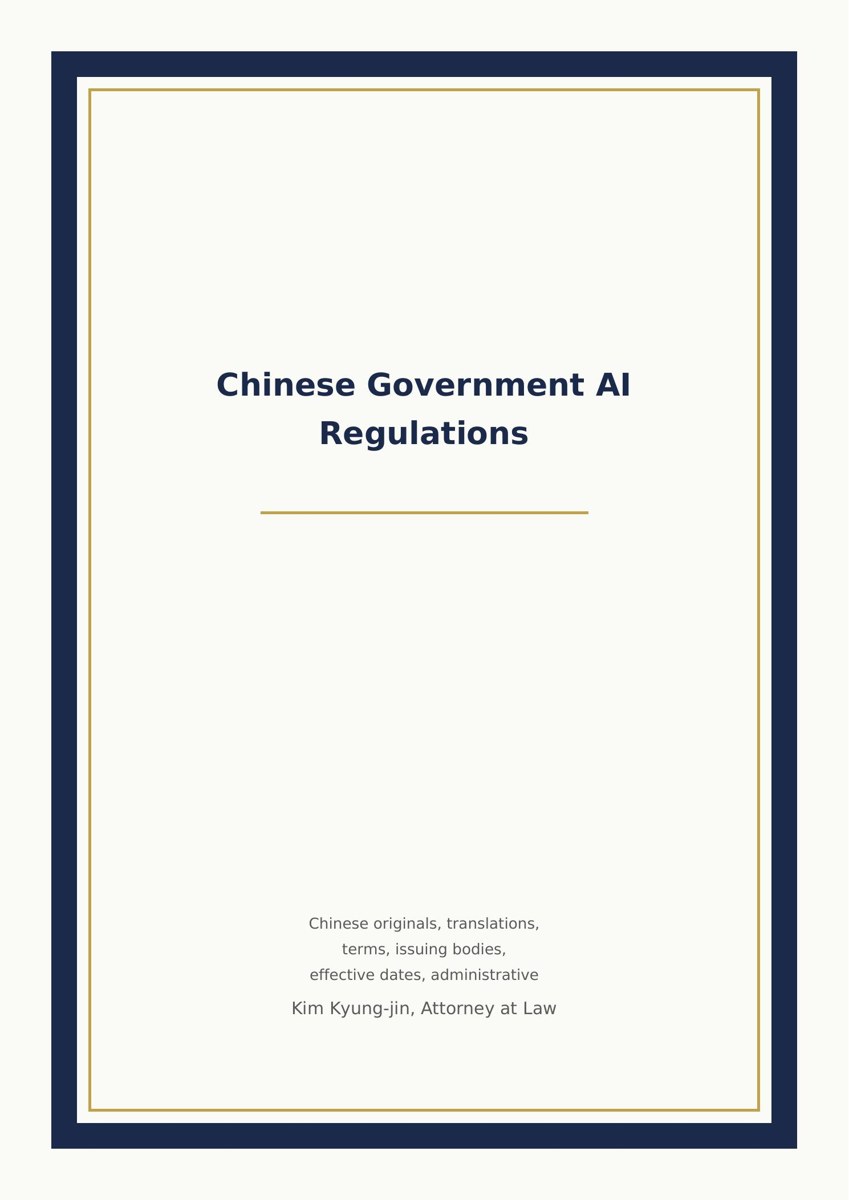
Chinese Government AI Regulations cover

Contents

Chinese Government AI Regulations

Kim Kyung-jin, Attorney at Law

Chinese originals, translations, terms, issuing bodies, effective dates, administrative interpretations, and judicial materials

This edition orders Chinese AI-related laws, administrative regulations, military regulations, departmental rules, policy documents, and national standards by legal force. Each entry keeps the Chinese original text and adds an English translation or explanation, legal terms, issuing body, effective date, administrative interpretations, and judicial materials where available.

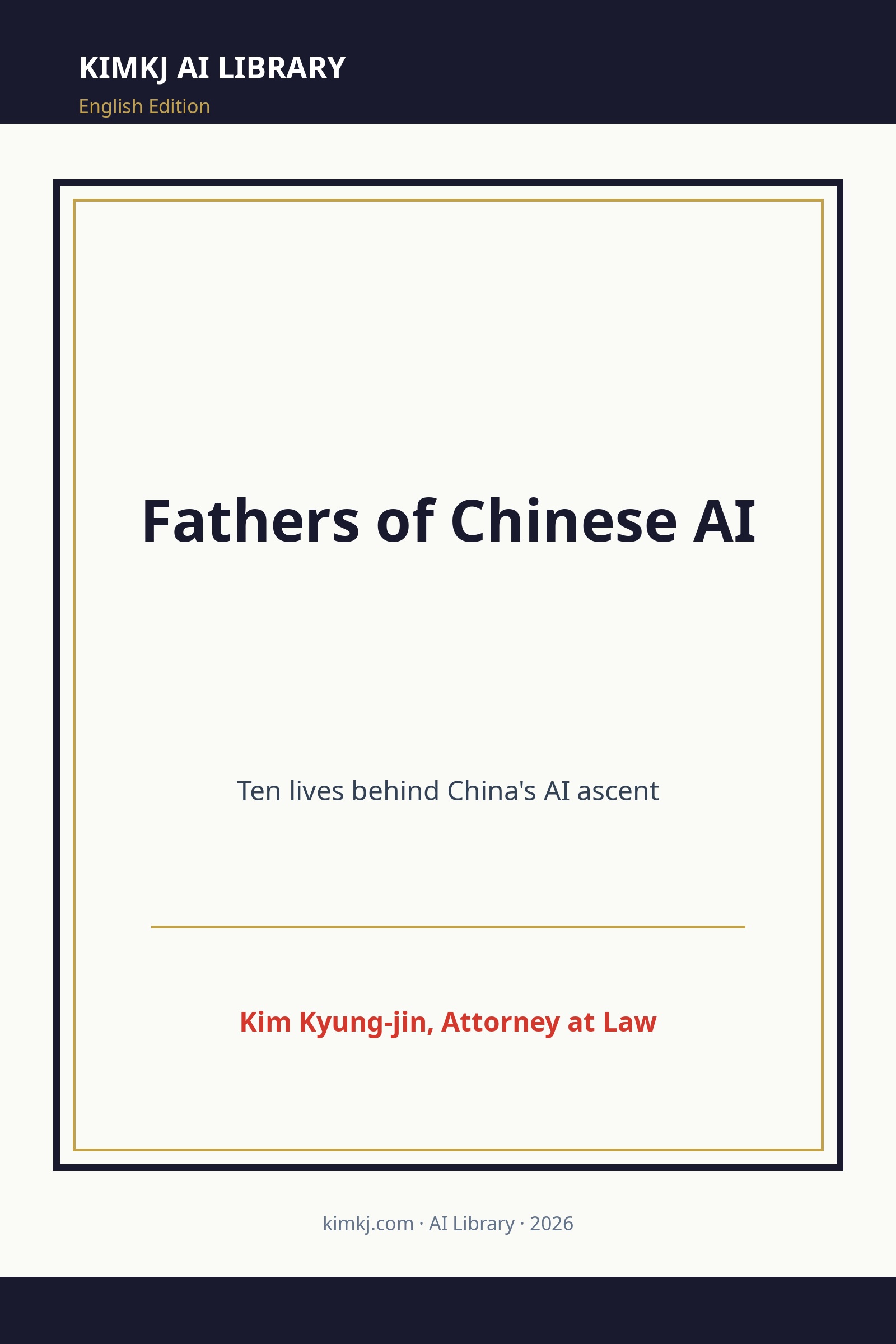
Fathers of Chinese AI cover

Table of Contents

Fathers of Chinese AI

Kim Kyung-jin, Attorney at Law

Ten lives behind China's AI ascent

This book follows Kai-Fu Lee, Robin Li, Jie Tang, Liang Wenfeng, Yang Zhilin, Yan Junjie, Wang Xiaochuan, Jingren Zhou, Shunyu Yao, and Yonghui Wu through the laboratories, companies, models, and policy environment that shaped Chinese AI.

How Far Has AI Entered Chinese Hospitals? cover

Table of Contents

How Far Has AI Entered Chinese Hospitals?

Kim Kyung-jin, Attorney at Law

A quiet shift in clinics, imaging rooms, and hospital administration

This book follows how artificial intelligence has entered Chinese hospitals, using Chinese and English materials together with original Chinese policy texts. It covers national policy, medical foundation models, clinical decision support, image reading, hospital information departments, traditional Chinese medicine, AI-native hospitals, the patient experience, hallucination and responsibility, regulation, and money. The final chapters collect major Chinese guidelines and the 84 health-sector AI application scenarios, with translated text and summaries.

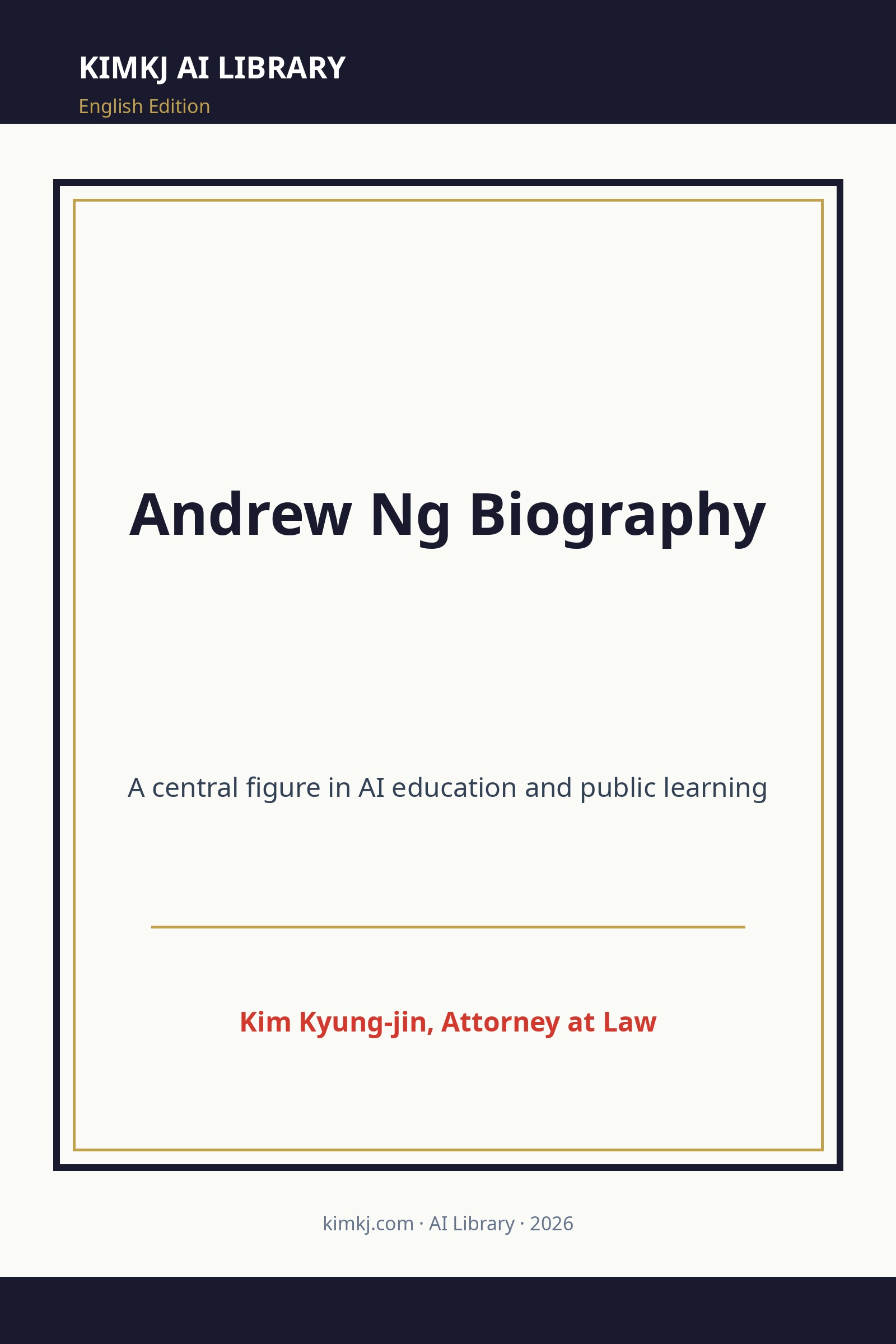
Andrew Ng Biography cover

Table of Contents

Andrew Ng Biography

Kim Kyung-jin, Attorney at Law

A central figure in AI education and public learning

This book follows Andrew Ng from London, Hong Kong, Singapore, Carnegie Mellon, MIT, Berkeley, and Stanford to Google Brain, Coursera, Baidu, DeepLearning.AI, Landing AI, AI Fund, and Amazon. It reads his career through research, teaching, company building, and his practical view of AI.

Mykhailo Fedorov, Leading Figure of Ukraine's Drone War cover

Table of Contents

Mykhailo Fedorov, Leading Figure of Ukraine's Drone War

Kim Kyung-jin

From the State in a Smartphone to the Defense Ministry of the Drone War

This book follows Diia, IT Army, Starlink, UNITED24, Brave1, the Unmanned Systems Forces, drone procurement, and battlefield data to explain how Mykhailo Fedorov tied technology to state power in wartime Ukraine.

China’s Leading AI Firms and Government Agencies cover

Table of Contents

China’s Leading AI Firms and Government Agencies

Kim Kyung-jin

Policy, Companies, Data, and Hardware in China’s Intelligent Economy

This book follows China’s AI policy arc from the 2017 next-generation AI plan to AI+ and the 15th Five-Year Plan. It maps the roles of the State Council, NDRC, CAC, MIIT, and SAC, then reads DeepSeek, the AI Tigers, Alibaba, Tencent, Baidu, ByteDance, iFLYTEK, Huawei Ascend, East Data West Computing, manufacturing, education, consumption, and humanoid robotics as one connected system.

U.S. Department of War CDAO (Chief Digital and AI Officer) cover

Table of Contents

U.S. Department of War CDAO (Chief Digital and AI Officer)

Kim Kyung-jin, Attorney at Law

How the Military’s Brain Is Being Redesigned

From the moment in January 2026 when the U.S. Department of War declared data hoarding a national security threat, this book follows the birth of the CDAO (Chief Digital and Artificial Intelligence Office) and the five organizations it absorbed, Advana and the War Department Data Platform, the Open DAGIR procurement experiment, Project Maven and CJADC2 on the battlefield, and Responsible AI, allies, and critics — the story of how America is redesigning its military’s brain.

Science and Technology Commission of the CMC of the Communist Party of China cover

Table of Contents

Science and Technology Commission of the CMC of the Communist Party of China

Kim Kyung-jin

STC, Military-Civil Fusion, and China’s Military Technology Innovation

This English AI Library edition follows the CMC Science and Technology Commission, the Equipment Development Department, military-civil fusion, intelligentized warfare, emerging technology competition, and the institutional limits of China’s military innovation system.

The Chinese Communist Party School cover

Table of Contents

The Chinese Communist Party School

Kim Kyung-jin

Where Power Is Trained

This book follows the Chinese Communist Party school system from Ruijin and Yan'an to the Central Party School, the National Academy of Governance, provincial and county schools, young-official training classes, Cai Qi's leadership, and the Mwalimu Julius Nyerere Leadership School.

DARPA, America’s Defense Research Lab cover

Table of Contents

DARPA, America’s Defense Research Lab

Kim Kyung-jin

This book follows DARPA through its 2026 office reorganization, budget signals, AIxCC, AI Forge, RACER, LongShot, quantum computing, space robotics, battlefield medicine, and strategic-material programs, using official sources as the main trail.

AI and the Classroom cover

Table of Contents

AI and the Classroom

Kim Kyung-jin

The AI Teacher That Does Not Give Answers

From Estonia's AI Leap and Khanmigo to answer leakage, Korean AI digital textbooks, and teacher-in-the-loop classrooms, this book asks how AI can protect thinking instead of replacing it.

Spiderweb cover

Table of Contents

Spiderweb

Kim Kyung-jin

Ukraine's drone revolution that changed the map of war

A narrative account of Operation Spiderweb on June 1, 2025, and how Ukraine's drones reached deep inside Russia and changed military planning, intelligence work, and security assumptions.

A Map of the 2026 U.S.-China Collision cover

Table of Contents

A Map of the 2026 U.S.-China Collision

Kim Kyung-jin

The year tied in Busan and left unsolved in Beijing

A one-year map of tariffs, chips, rare earths, Taiwan, sea lanes, and Korea's choices between Washington and Beijing.

China's 2026 Power Map cover

Table of Contents

China's 2026 Power Map

Kim Kyung-jin

The completion of one-man rule, and the empty seat that follows

A map of Xi Jinping's power system, the military purge, the blocked succession path, and the economic-security dilemma.

The Architect of Contradictions cover

Table of Contents

The Architect of Contradictions

Kim Kyung-jin

Peter Thiel and the empire built by a man who hated competition

Peter Thiel, from a South African childhood to PayPal, Facebook, Palantir, politics, and the dream of defeating death.

Claude, GPT, Palantir, and the 2026 World War cover

8 readings

Claude, GPT, Palantir, and the 2026 World War

Kim Kyung-jin

How Artificial Intelligence Came to Pull the Trigger of War. Prologue, 3 Parts / 6 Chapters, Epilogue

A single name sits on the screen. An intelligence officer looks at it for twenty seconds, confirms only that it is a man, and moves on. Inside those twenty seconds a person dies, and the responsibility for deciding to kill him disappears. From Lavender over Gaza to Maven in Ukraine, Epic Furies over Iran, and target selection in the skies of Venezuela, this book follows the hand that chooses targets as it passes from human to machine in the wars of 2026.

China's Robotics Industry 2026: The Age of Mass Production and Real-World Deployment cover

25 readings

China's Robotics Industry 2026: The Age of Mass Production and Real-World Deployment

Kim Kyung-jin

From the humanoid mass-production race to U.S.-China hegemony: the state of China's robotics industry in 2026. Table of Contents, Preface, 7 Parts / 23 Chapters, Epilogue

In a factory in Shenzhen, hundreds of humanoid robots repeat the same motion. This book traces the mass-production race between Unitree and UBTECH, the Optimus supply chain, real-world deployment sites, and where Korea stands amid the U.S.-China tech hegemony.

Crossing the Adolescence of Technology Cover

15 Parts in Total

Crossing the Adolescence of Technology

Kim Kyung-jin

Dario Amodei, Anthropic, and the Struggle Toward Controllable Intelligence. Table of Contents, Preface, Prologue, 12 Chapters, Epilogue

The struggle of a physicist who lost his father to create controllable artificial intelligence. The story of Dario Amodei and Anthropic clashing with the Pentagon and the White House, shaking the era with the scaling law and Constitutional AI.

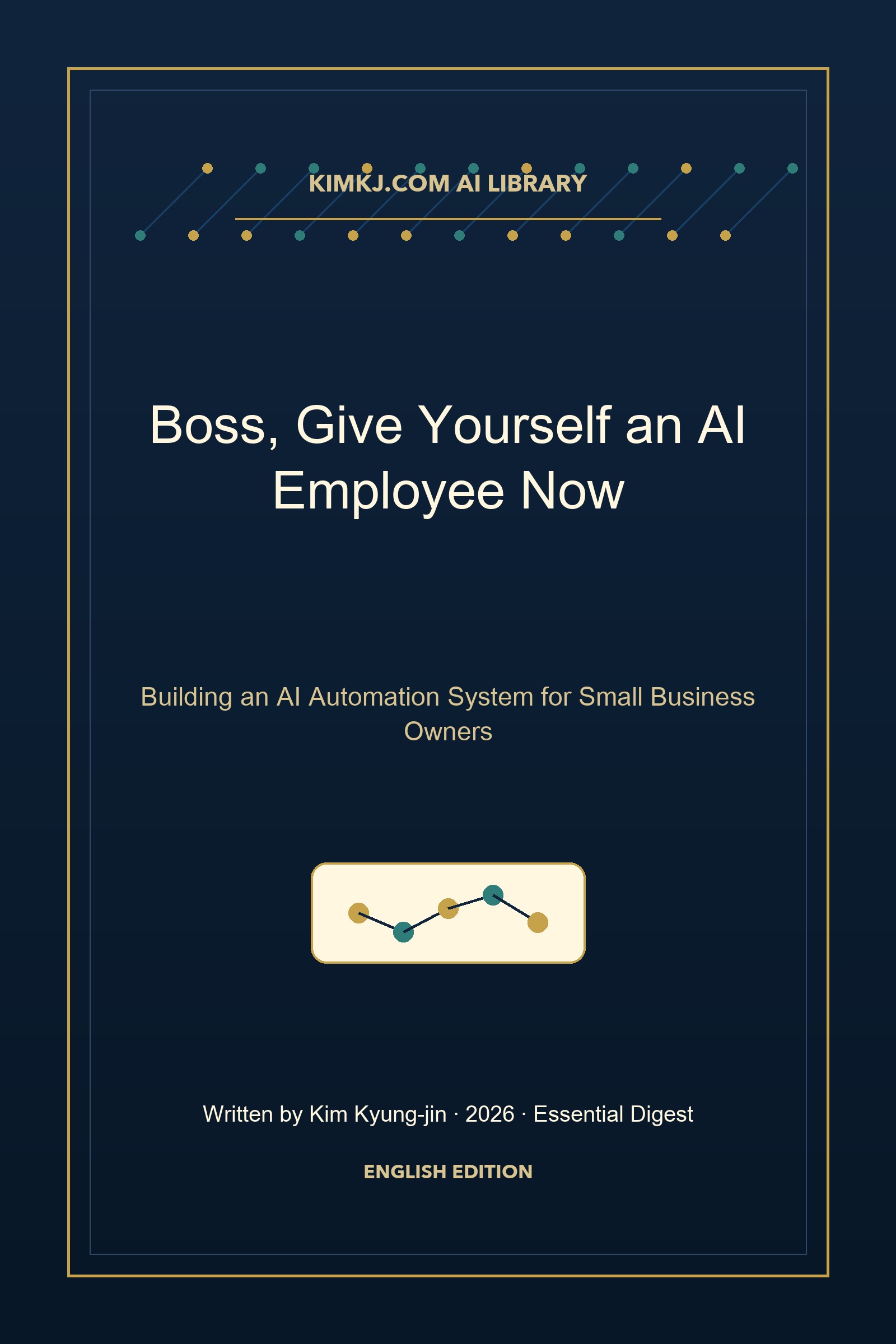
Boss, Give Yourself an AI Employee Now

Table of Contents, 43 Chapters, 11 Appendices, Epilogue

Boss, Give Yourself an AI Employee Now

Written by Kim Kyung-jin

Building an AI Automation System for Small Business Owners

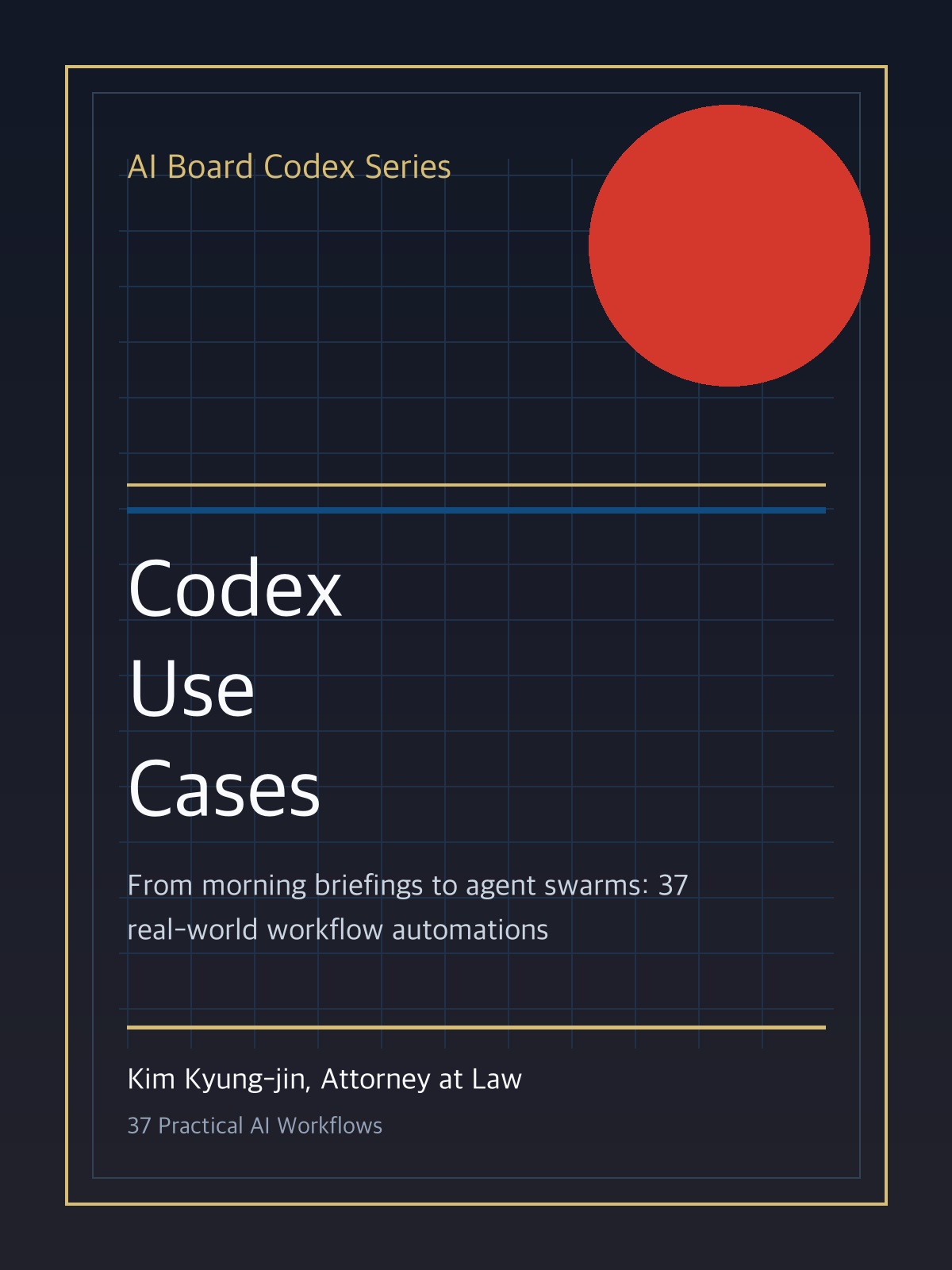
37 Concrete Codex Use Cases cover

Book-style reading

37 Concrete Codex Use Cases

Kim Kyung-jin

From morning briefings to agent swarms: 37 real-world workflow automations

This guide gathers 37 ways to connect Codex and AI agents to real work: personal routines, data processing, marketing, sales, documents, development, and browser control.

2026 Beijing: The Dangerous Dance of Two Giants book cover

16 posts available

2026 Beijing: The Dangerous Dance of Two Giants

Kim Kyung-jin

Table of Contents, Introduction, 13 Chapters, Epilogue

This book reads the Beijing summit through Hormuz, rare earths, Taiwan, Boeing, soybeans, AI chips, and Korea’s exposure to the U.S.-China bargain.

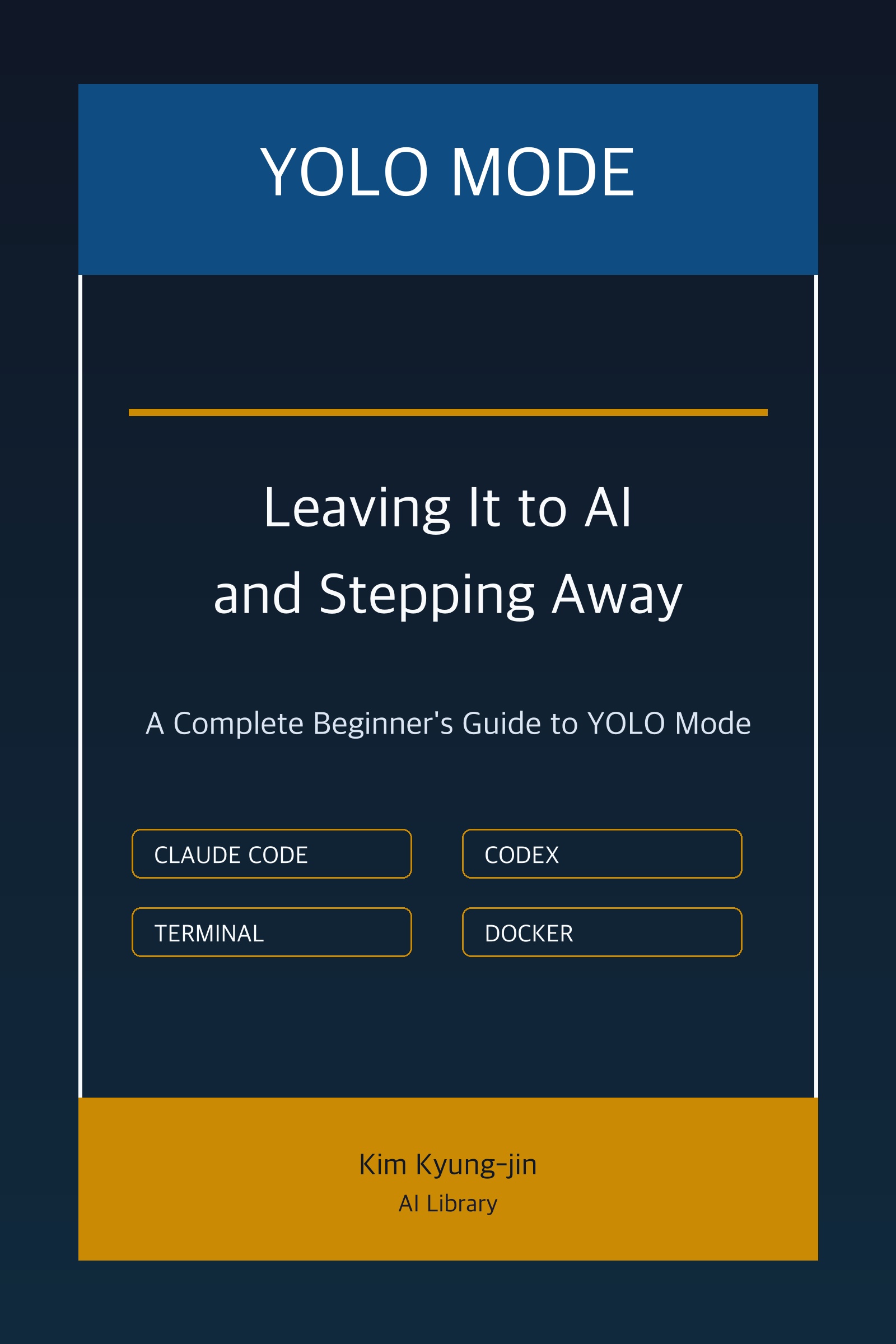
Leaving It to AI and Stepping Away cover

27 posts

Leaving It to AI and Stepping Away

Kim Kyung-jin

A Complete Beginner’s Guide to YOLO Mode. Table of contents and 26 chapters

A beginner-friendly online book on YOLO mode in Claude Code and Codex. It explains how to let AI read files, write code, run commands, and finish work while keeping rollback, Docker sandboxing, and safety checks close at hand.

Artificial Intelligence Fighter, Artificial Intelligence Air Force book cover

43 posts available

Artificial Intelligence Fighter, Artificial Intelligence Air Force

Kim Kyung-jin

Table of Contents, Preface, 40 Chapters, Epilogue

Artificial Intelligence Fighter, Artificial Intelligence Air Force is an online AI Library book by Kim Kyung-jin. It covers AI fighters, autonomous air power, unmanned combat aircraft, CCA, MUM-T, sixth-generation fighters and is organized as Table of Contents, Preface, 40 Chapters, Epilogue.

Artificial Intelligence on Trial book cover

26 posts available

Artificial Intelligence on Trial

Attorney Kyungjin Kim

Table of Contents, Preface, 21 Chapters, 3 Appendices

Artificial Intelligence on Trial is an online AI Library book by Attorney Kyungjin Kim. It covers artificial intelligence and law, AI liability, algorithmic judgment, courts and technology and is organized as Table of Contents, Preface, 21 Chapters, 3 Appendices.

PALANTIR book cover

16 posts available

PALANTIR: War, Surveillance, Artificial Intelligence

Attorney Kyungjin Kim

Table of Contents, Preface, 14 Chapters

PALANTIR: War, Surveillance, Artificial Intelligence is an online AI Library book by Attorney Kyungjin Kim. It covers Palantir, war, surveillance, artificial intelligence, data analytics, national security and is organized as Table of Contents, Preface, 14 Chapters.

Brain Readers: Neuralink and the Final Human Revolution book cover

21 posts available

Brain Readers: Neuralink and the Final Human Revolution

Kim Kyung-jin

Table of Contents, Prologue, 18 Chapters, Epilogue

Brain Readers: Neuralink and the Final Human Revolution is an online AI Library book by Kim Kyung-jin. It follows Neuralink, brain-computer interfaces, brain data, medicine, neurorights, and the future of human enhancement.

Artificial Intelligence and the Reshaping of Society book cover

16 posts available

Artificial Intelligence and the Reshaping of Society

Kim Kyung-jin

Table of Contents, Preface, 13 Chapters, Epilogue

Artificial Intelligence and the Reshaping of Society is an online AI Library book by Kim Kyung-jin. It follows how artificial intelligence changes work, education, inequality, cities, democracy, and human relationships.

The Jensen Huang Story book cover

16 posts available

The Jensen Huang Story

Kim Kyung-jin

Table of Contents, Preface, 13 Chapters, Epilogue

The Jensen Huang Story is an online AI Library book by Kim Kyung-jin. It covers Jensen Huang, NVIDIA, GPUs, AI chips, and the AI industry.

Ten Questions AI Poses to Humanity book cover

12 posts available

Ten Questions AI Poses to Humanity

Kim Kyung-jin

Table of Contents, Preface, 10 Chapters

Ten Questions AI Poses to Humanity is an online AI Library book by Kim Kyung-jin. It asks how artificial intelligence changes truth, weapons, work, data, identity, and human control.

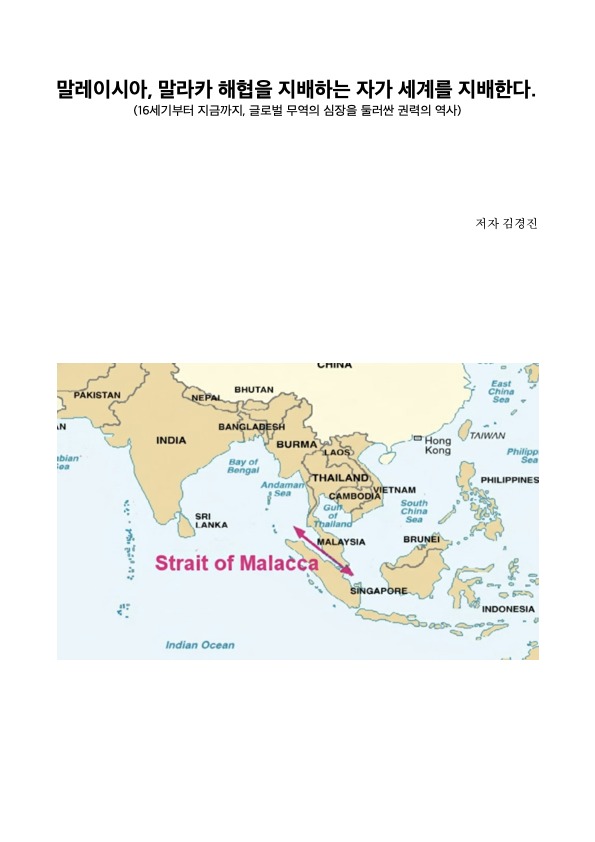
Malaysia and the Malacca Strait book cover

23 posts available

Malaysia and the Malacca Strait: Whoever Controls It Controls the World

Kim Kyung-jin

Table of Contents, Preface, 20 Chapters, Epilogue

Malaysia and the Malacca Strait is an online AI Library book by Kim Kyung-jin. It covers Malaysia, the Malacca Strait, maritime logistics, geopolitics, global trade, and Southeast Asia’s strategic future.

Georgia history and culture travel book cover

24 posts available

A Journey Through Georgia’s History and Culture

Kim Kyung-jin

Table of Contents, Preface, 17 Chapters, 4 Appendices, Epilogue

A Journey Through Georgia’s History and Culture is an online AI Library book by Kim Kyung-jin. It covers Georgia’s history, culture, religion, politics, travel, and the Caucasus crossroads between Europe and Asia.

Reading Armenia book cover

13 posts available

Reading Armenia: A Thousand Prayers, One Mountain

Kim Kyung-jin

Table of Contents, Preface, 10 Chapters, Epilogue

Reading Armenia: A Thousand Prayers, One Mountain is an online AI Library book by Kim Kyung-jin. It covers Armenian history, faith, Mount Ararat, cultural memory, travel, and the endurance of a small nation.

Mastering Claude Code book cover

41 posts available

Mastering Claude Code

Kim Kyung-jin

Table of Contents, Preface, Chapters, Appendices

Mastering Claude Code is an online AI Library book by Kim Kyung-jin. It covers Claude Code setup, commands, workflows, automation, agents, and practical methods for using Claude Code in real work.

Claude Cowork and Agent manual book cover

11 posts available

Claude Cowork and Agent Utilization Manual

Kim Kyung-jin

Table of Contents, Preface, 8 Chapters, Closing Note

Claude Cowork and Agent Utilization Manual is an online AI Library book by Kim Kyung-jin. It covers Claude Code, AI agents, coding automation, work automation, and practical agent-based collaboration.

2026 U.S.-Iran War and the Global Energy Crisis book cover

39 posts available

The 2026 U.S.-Iran War and the Global Energy Crisis

Kim Kyung-jin

Table of Contents, Preface, Chapters and Appendices

The 2026 U.S.-Iran War and the Global Energy Crisis is an online AI Library book by Kim Kyung-jin. It covers war, oil, the Strait of Hormuz, maritime security, energy markets, and the global consequences of conflict.

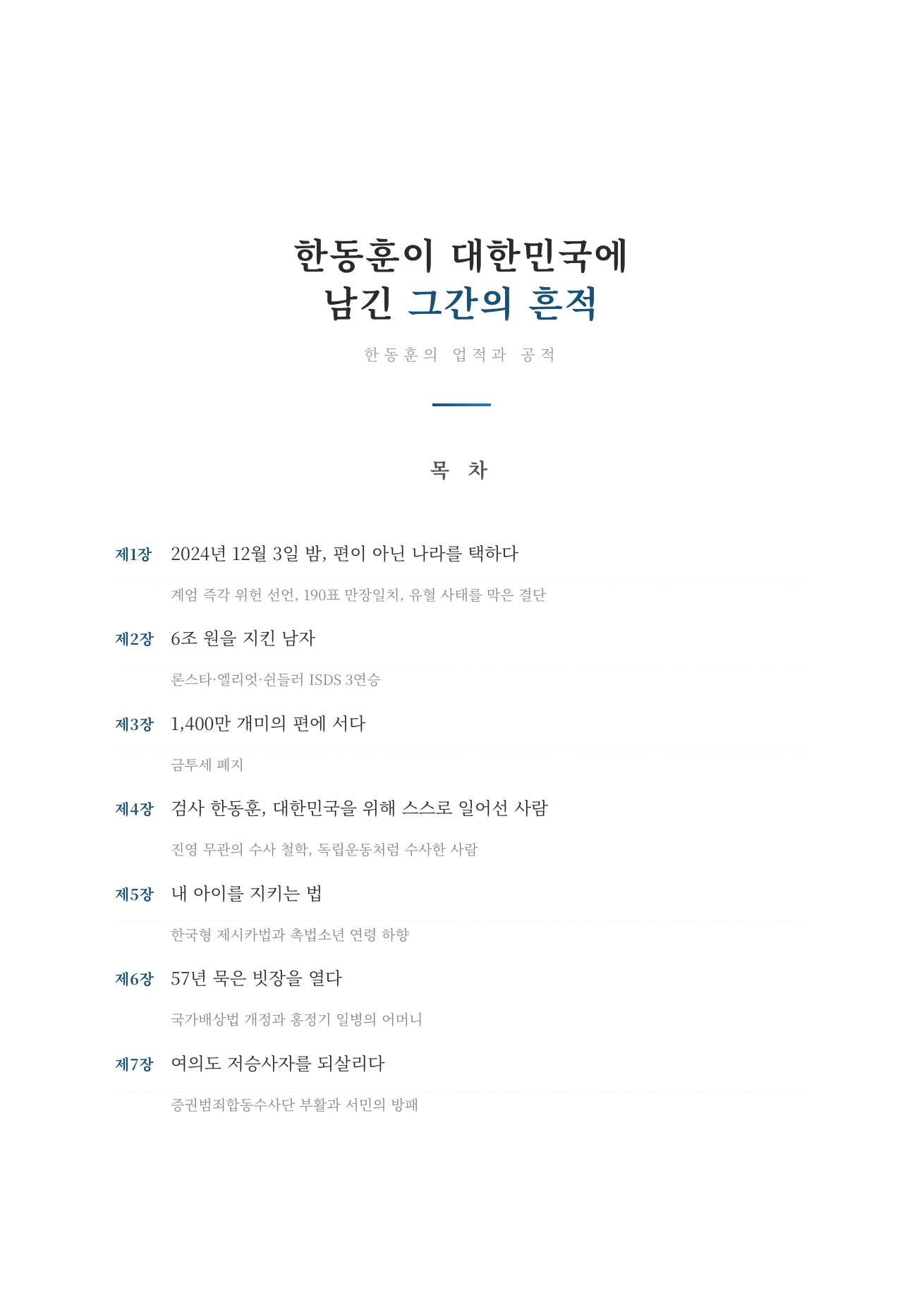
The Traces Han Dong-hoon Left on South Korea book cover

13 posts available

The Traces Han Dong-hoon Left on South Korea

Kim Kyung-jin

Table of Contents, Prologue, Chapters, Epilogue

The Traces Han Dong-hoon Left on South Korea is an online AI Library book by Kim Kyung-jin. It examines his record in justice policy, immigration reform, public institutions, and the structural questions facing South Korea.

The Han Dong-hoon Story book cover

39 posts available

The Han Dong-hoon Story

Kim Kyung-jin

Table of Contents, Prologue, Chapters, Epilogue

The Han Dong-hoon Story is an online AI Library book by Kim Kyung-jin. It traces Han Dong-hoon’s life, public career, political choices, and the changing landscape of South Korean conservative politics.

Beyond the Glass Ceiling cover

39 entries

Beyond the Glass Ceiling

Kim Kyung-jin

Table of contents, prologue, 31 chapters, epilogue, 5 appendices

A political biography tracing Sanae Takaichi’s rise from Nara to Japan’s premiership, through party struggles, security policy, diplomacy, and the meaning of Japan’s first female prime minister.

AI Hegemony War book cover

8 posts available

AI Hegemony War

Kim Kyung-jin

Table of Contents, 7 Chapters

An online AI Library book by Kim Kyung-jin on AI superintelligence, the U.S.-China technology race, Europe and Korea’s AI laws, and international AI governance.

Sam Altman Biography: Pioneer of the AI Revolution cover

22 posts

Sam Altman Biography: Pioneer of the AI Revolution

Kim Kyung-jin, Kim Kyung-ran

Table of contents, preface, 7 parts, 20 chapters

An online biography following Sam Altman’s childhood, startups, Y Combinator, OpenAI, ChatGPT, the 2023 board crisis, and his sense of responsibility in the AI era.

From Chaiwala to Prime Minister cover

13 entries

From Chaiwala to Prime Minister

Kim Kyung-jin

Table of contents, preface, 10 chapters, epilogue

A political biography tracing Narendra Modi from a chai-selling boy in Vadnagar to RSS organizer, Gujarat chief minister, and three-term prime minister, while reading modern India, Korea-India relations, and the risks of a rising power.

AI Classroom: Your Grades Will Change book cover

26 posts available

AI Classroom: Your Grades Will Change

Kim Kyung-jin

Table of Contents, Preface, 24 Sections

An online AI Library book by Kim Kyung-jin on how AI can support elementary, middle, and high school learning, teaching, assessment, and educational equity.

Military Artificial Intelligence cover

17 entries

Military Artificial Intelligence

Kim Kyung-jin and Kim Won-tae

Table of contents, preface, 14 chapters, epilogue

A full-length study of military artificial intelligence, from autonomous weapons, drones, command systems, logistics, and cyber defense to the strategies of the United States, China, Israel, Korea, and global defense AI companies.

Global Case Studies in Introducing AI into Public Administration book cover

25 posts available

Global Case Studies in Introducing AI into Public Administration

Kim Kyung-jin

Table of Contents, 23 Chapters, Epilogue

An online AI Library book by Kim Kyung-jin on public-sector AI adoption, national strategies, administrative services, governance, and future policy tasks.

Seven Misunderstandings About the Arctic Route book cover

10 posts available

Seven Misunderstandings About the Arctic Route

Kim Kyung-jin

Table of Contents, Preface, 7 Chapters, Epilogue

An online AI Library book by Kim Kyung-jin on seven common misunderstandings about the Arctic Route, including speed, liner service, insurance, safety rules, year-round access, carbon impact, and infrastructure.

Artificial Intelligence Election cover

14 posts

Artificial Intelligence Election

Kim Kyung-jin

Table of contents, author preface, 11 chapters, closing essay

An online book on campaign messaging, publicity materials, digital campaigning, data analysis, campaign operations, disinformation defense, legal risk, and ready-to-use prompts.

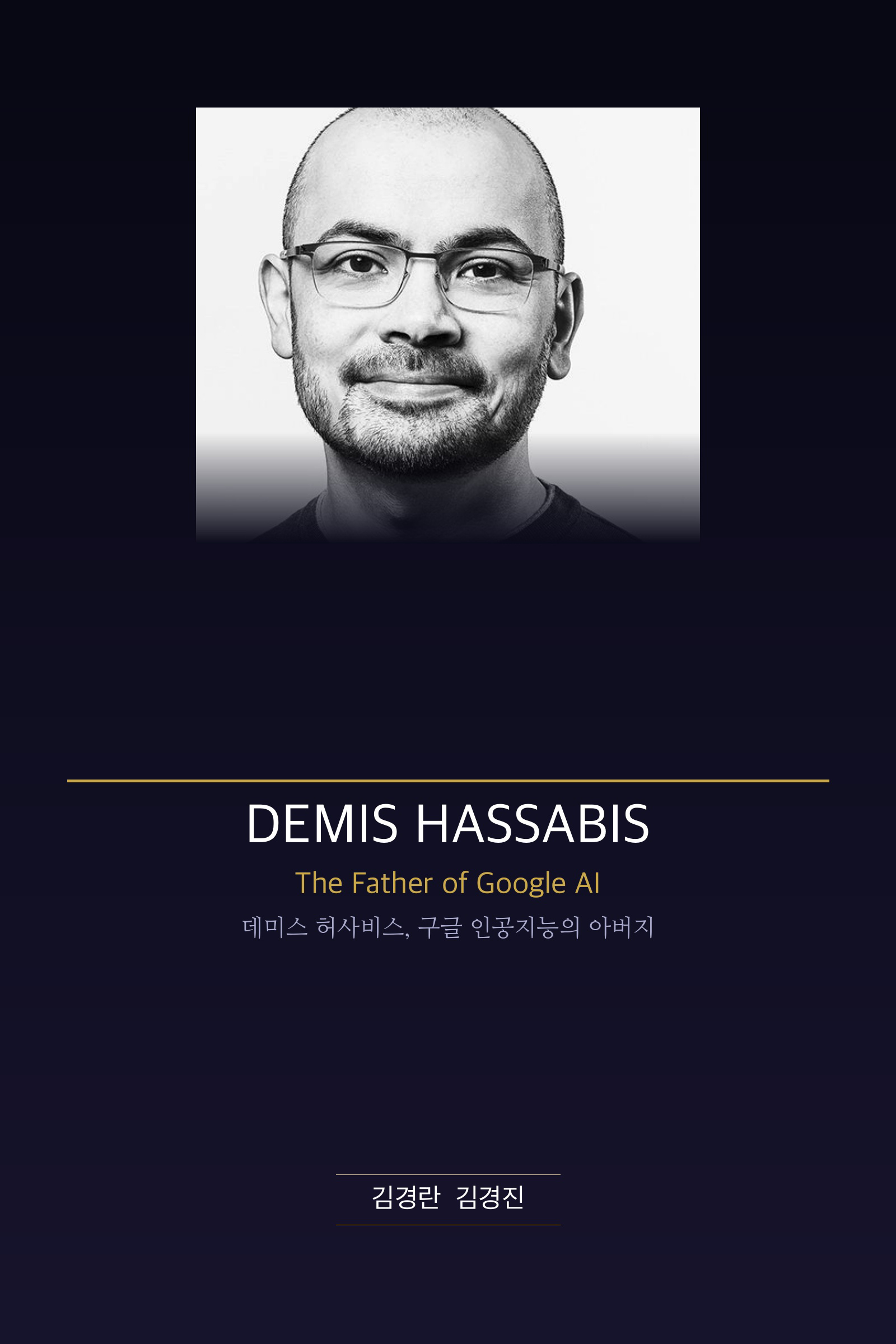
Demis Hassabis book cover

34 posts available

Demis Hassabis, Father of Google’s Artificial Intelligence

Kim Kyung-ran, Kim Kyung-jin

Table of Contents, Author’s Preface, 31 Chapters, Epilogue

Demis Hassabis, Father of Google’s Artificial Intelligence is an online AI Library book by Kim Kyung-ran, Kim Kyung-jin. It covers Demis Hassabis, Google DeepMind, artificial intelligence, AlphaGo, AI research and is organized as Table of Contents, Author’s Preface, 31 Chapters, Epilogue.

The Dhammapada 423 Verses book cover

28 posts available

The Dhammapada: 423 Verses

Kim Kyung-jin

Table of Contents, Editor’s Note, 26 Chapters, 423 Verses

An online AI Library book by Kim Kyung-jin. This edition arranges all 423 verses of the Dhammapada into 26 chapters for slow, poetic reading.

Nano Banana Pro Practical Prompt Book cover

24 posts

Nano Banana Pro Practical Prompt Book

Kim Kyung-jin

6 parts, 22 chapters, classroom prompt appendix

An online book for using Nano Banana Pro in classes and real work, covering image generation, editing, text rendering, character consistency, business use cases, and monetization.

Liberal Arts AI for College Students book cover

16 posts available

Liberal Arts AI for College Students

Kim Kyung-jin

Table of Contents, Preface, 13 Chapters, Closing Essay

An online AI Library textbook for college students. It introduces AI history, daily use, document work, research, images, presentations, video, productivity, learning, careers, copyright, and governance.

Legal Practice and Artificial Intelligence book cover

16 posts available

Legal Practice and Artificial Intelligence

Kim Kyung-jin

Table of Contents, Preface, 14 Parts

An online AI Library book by Kim Kyung-jin on legal research, drafting, evidence analysis, contract review, NotebookLM, and practical generative AI workflows for legal practice.

Hello, I Am Kim Kyung-jin book cover

10 posts available

Hello, I Am Kim Kyung-jin

Kim Kyung-jin

Table of Contents, Preface, Recommendations, 6 Chapters, Closing

An online AI Library book on Kim Kyung-jin’s life, science and technology policy, parliamentary diplomacy, legislative battles, Dongdaemun vision, and proposals for Korea’s demographic future.

Politics and People book cover

25 posts available

Politics and People

Kim Kyung-jin

Table of Contents, Prologue, 22 Chapters, Epilogue

An online AI Library book by Kim Kyung-jin on how politics begins with reading people, winning trust, keeping relationships, and enduring seasons of crisis.

When the Algorithm Gets It Wrong: AI Harms and Ethical Questions from the AIAAIC Record cover

Table of Contents

When the Algorithm Gets It Wrong: AI Harms and Ethical Questions from the AIAAIC Record

Kim Kyung-jin

What happened in hiring and welfare, courts and roads, classrooms and workplaces

AIAAIC is an international database that collects AI and algorithmic incidents from around the world. This book picks eighteen subjects from that record and follows what actually happened and why. Rejection emails that arrive at three in the morning. Debt notices for money never owed. Handcuffs in front of two small daughters. A summer reading list of books that do not exist. A driverless car that hit a child near a school. A robot arm that read a man as a box. Technical terms are explained in plain words the moment they appear, so no computing background is needed. The incidents in this book took place between 2020 and 2025. Artificial intelligence has been moving faster every day, so by today’s standards some of these cases will feel dated and even a little jarring. Nothing here is inaccurate, but please read it with that time gap in mind.

[AI Library] Chapter 17: Practical Travel Information

Malaysia and the Malacca Strait
Author
Kim Kyung-jin
Date
2026-05-05 23:54
Views
1053

Malaysia and the Malacca Strait: Whoever Controls It Controls the World

Chapter 17: Practical Travel Information

Kim Kyung-jin

Part IV: Major Cities and Tourism

Using the Transportation System

Malaysia has relatively developed transportation infrastructure, allowing travelers to visit diverse destinations easily. From moving within major cities to long-distance travel between cities, Malaysia's transportation system offers various options.

Kuala Lumpur has the most developed public transportation system in Malaysia. The system consists primarily of the LRT (light rail transit), MRT (mass rapid transit), monorail, KTM Commuter (suburban train), and buses. For travelers to use Kuala Lumpur's public transportation efficiently, it is recommended to purchase a 'Touch 'n Go' card or 'MyKad' (My Card). This prepaid card can be used on most public transportation and offers convenience and discounts compared to buying individual tickets with cash.

Rachel Lee, a travel blogger from Singapore, offers this advice on her blog "Malaysian Adventures": "The most useful public transportation line in Kuala Lumpur is the Kelana Jaya LRT line, which connects major tourist attractions such as KLCC (Petronas Twin Towers), Pasar Seni (near Chinatown), and KL Sentral (the main transportation hub). KL Sentral is the point where all city rail lines meet and also serves as the departure point for long-distance buses and trains to other cities in Malaysia."

Another useful transportation option for travelers visiting Kuala Lumpur and surrounding areas is ride-hailing services such as Grab. Often described as Southeast Asia's version of Uber, Grab offers convenient transportation at reasonable prices through an easy-to-use app. It is useful for visiting destinations not served by public transportation, traveling late at night, or when carrying multiple bags.

Travel between cities on the Malaysian peninsula is mainly done by bus, train, or domestic air service. Long-distance buses are the most economical option and have an extensive network connecting most cities and towns. Major bus companies include Transnational, PLUS Liner, and Nice Imperial, and tickets can be reserved in advance through online booking platforms such as Easybook or CatchThatBus.

Travelers who prefer train travel can use the services of KTM (Keretapi Tanah Melayu), Malaysia's national railway company. KTM operates a route that starts in Singapore and extends along the Malaysian peninsula to the Thai border. KTM's ETS (Electric Train Service) is a fast and comfortable way to travel from Kuala Lumpur to northern cities such as Ipoh, Penang, and Padang Besar.

When traveling to the states of Sabah and Sarawak on the island of Borneo, domestic air service is the most efficient means of transportation. Malaysia Airlines and AirAsia operate regular flights from Kuala Lumpur to major cities on Borneo such as Kota Kinabalu, Kuching, Miri, and Sibu. Pre-booking online often makes special discount fares available.

Malaysian travel writer Azman Ghani provides the following advice in his book "Backpacking Malaysia": "AirAsia, a major domestic airline, often has prices cheaper than long-distance buses or trains, so always compare prices among various transportation options. Also, since transportation prices and availability can vary significantly depending on the tourist season in Malaysia, it is advisable to book transportation at least a few weeks in advance during major holidays such as Hari Raya festivals and Chinese New Year."

Ferry and boat services are important means of transportation for travelers visiting island regions. Popular islands such as Langkawi, Penang, Tioman, and Perhentian are connected from the mainland by regular ferry service. For example, Langkawi is connected to Penang and Satun (Thailand) through the Kuah ferry terminal, and Penang is regularly connected to Butterworth.

It is also possible to rent a car in Malaysia, though it is primarily available at major tourist destinations such as Kuala Lumpur, Penang, and Langkawi. When driving in Malaysia, remember that traffic moves on the left side of the road and an international driver's license is required. Additionally, traffic congestion can be severe in urban areas, and road conditions can vary in rural areas, requiring caution.

British travel writer Simon Fletcher wrote on his blog about traveling in Malaysia: "While Malaysia's transportation system is generally efficient and easy to use, it is important to always plan with plenty of time. During monsoon season, weather-related delays can occur, and all forms of transportation can be very congested during major holidays. Also, since the development of public transportation varies by region in Malaysia, it is good to research transportation options for the regions you plan to visit in advance."

By using Malaysia's transportation system efficiently, travelers can explore various destinations in this diverse and attractive country easily and comfortably. By appropriately combining various transportation options,public transportation, ride-hailing services, long-distance buses and trains, domestic air service, and ferry service,travelers can create optimal travel plans suited to their individual travel style and budget.

Tips for Using Google Maps

Google Maps is a very useful tool in Malaysia travel, but using it efficiently according to local conditions requires a few special tips. Google Maps offers more than simple route-finding, providing public transportation information, restaurant and tourist attraction recommendations, and offline navigation functions.

The first thing to know when using Google Maps in Malaysia is that information about some remote areas or recently developed areas may not be completely updated. The accuracy of Google Maps can be lower in some areas of the island of Borneo or in rural areas of the Malaysian peninsula.

Jason Chen, an Australian travel blogger, offers this advice on his blog "Southeast Asia Travel Notes": "When using Google Maps in Malaysia, always update the app to get the latest information. It is also good to search using the place name in addition to the address to confirm that the destination is marked accurately. For example, to visit the Kek Lok Si temple in Penang, you can search for 'Kek Lok Si Temple' to confirm the exact location."

One useful Google Maps feature in Malaysia is public transportation information. In major cities such as Kuala Lumpur, Penang, and Johor Bahru, Google Maps provides routes and schedules for public transportation such as buses, trains, and light rail. After entering your destination and selecting the public transportation icon, it provides detailed guidance on various transportation options, estimated travel time, and walking routes.

If internet connection is unstable during your Malaysia trip or you are concerned about data roaming costs, it is good to use Google Maps' offline function. When connected to Wi-Fi at a hotel or cafe, downloading maps of areas you plan to visit in advance allows you to check your location through GPS and find routes without internet.

The method for downloading offline maps is simple. In the Google Maps app, tap your profile icon, select 'Offline Maps', and tap 'Select Your Own Map'. Then adjust the area you want to download on the screen and press the 'Download' button. Downloading maps by major city or tourist area in Malaysia can be very useful during travel.

Many cities in Malaysia have complex one-way streets and sudden road changes, so it is good to use Google Maps' 'Live Traffic Updates' feature. This function displays current traffic conditions in color (green for smooth, red for congested) to help select the most efficient route.

British travel writer Emma Wilson shares the following useful tip in her travel guide "Malaysia A Budget Traveler's Guide": "When using Google Maps in Malaysia, frequently check the 'Walking' option. Car routes often follow one-way streets or elevated highways, which can be impossible or very inefficient for walking. In Kuala Lumpur, walking routes often provide faster shortcuts and pleasant air-conditioned paths through shopping malls or pedestrian bridges."

Google Maps is also very helpful in discovering good restaurants and hidden food establishments in Malaysia. Using the 'Nearby' feature allows you to find restaurants, cafes, food stalls, and other establishments near your current location, and you can gauge quality and popularity through user reviews and ratings.

Malaysian local travel guide Nur Azizah offers this advice: "If you want to experience authentic Malaysian cuisine, search for local restaurants with high ratings on Google Maps. It is good to choose places with many reviews and many reviews from locals. Foreign tourists often focus only on restaurants near famous tourist sites, but venturing a little further through Google Maps allows you to discover more authentic and affordable local food establishments. In areas such as 'Old Town' in Ipoh or 'Georgetown' in Penang, Google Maps' recommendation feature is useful for finding hidden gem restaurants."

Another thing to be aware of when using Google Maps is that Malaysia's street names and building number systems may differ from Western countries. Sometimes locating places based on landmarks or well-known buildings can be more efficient than using exact addresses. For example, when finding a specific restaurant in Kuala Lumpur, searching for 'next to Petronas Twin Towers' or 'inside Suria KLCC mall' can yield more accurate results than using a precise address.

Michael Jordans, a digital nomad from Canada, shares this unique tip on his blog "Digital Traveler": "The secret to maximizing Google Maps in Malaysia is the 'Save Pin' function. Before your trip, save all the places you want to visit and classify them by color. For example, you can mark restaurants in red, shopping places in blue, and tourist attractions in green. This allows you to see at a glance what interesting places are nearby during your actual travel and helps you use time efficiently."

Considering Malaysia's tropical climate, it is important to keep in mind that Google Maps' distance and travel time estimates may not account for hot weather and sudden showers. Walking times may actually take longer, so it is good to plan with extra time.

Singapore travel blogger Tai Mei Ling offers this advice: "In Malaysia, always add 20-30% extra time to Google Maps' estimated walking times. In large cities like Kuala Lumpur, travel may take longer than expected due to waiting times at crosswalks, crowded sidewalks, and unexpected detours. Additionally, during the hottest hours between 2-4 p.m., you will walk more slowly, requiring more time."

In parts of Malaysia, particularly rural areas on the island of Borneo and national parks, GPS signals may be weak or absent. If you plan to visit such areas, it is good to prepare offline maps or paper maps in addition to Google Maps. It is also important to seek help from local guides or obtain information in advance from accommodation staff.

If you plan to visit religious facilities such as mosques or temples, it is good to check visiting hours and dress codes in advance. Google Maps' place information often includes these details, but current information may not always be reflected, so it is good to confirm with locals or check official websites.

Local Food Recommendations

Malaysia is known for rich and diverse cuisine influenced by Malay, Chinese, Indian, and various indigenous cultures. For travelers, experiencing local food is an important part of understanding Malaysian culture and an opportunity to feel the true flavors and aromas of this country.

Nasi Lemak

This is a dish you must taste. Featuring fragrant rice cooked in coconut milk served with sambal (spicy chili sauce), boiled eggs, roasted peanuts, anchovies (ikan bilis), and cucumber slices, this dish is popular for breakfast but can be enjoyed anytime during the day. Village Park in Kuala Lumpur and Ali Nasi Lemak in Penang are well-known places to taste authentic nasi lemak.

American food critic Anthony Bourdain once said about Malaysian cuisine: "Nasi lemak is not just a dish. It is cuisine that captures the soul of Malaysia. The fragrant rice soaked in coconut milk, with a touch of sweetness and saltiness, and the spiciness of sambal combine perfectly. And the most remarkable thing is that this dish can be enjoyed anywhere, from simple food stalls to upscale restaurants."

Rendang

This is a beef dish cooked slowly in coconut milk and spices. Though originally from the Minangkabau region of Sumatra in Indonesia, rendang is widely loved in Malaysia as well. It is a special dish often eaten during Hari Raya (the Islamic festival). Rendang, characterized by rich spices and tender meat, is served with nasi (rice) or ketupat (rice cake).

Malaysian local food expert Noraini Othman explains in her cookbook "Flavours of Malaysia": "Authentic rendang is cooked slowly for at least four hours or more. Through this process, the meat juices, coconut milk, and various spices blend perfectly to create a unique taste and texture. Good rendang should have the meat juices completely reduced and coating the meat, with a spicy flavor accompanied by subtle sweetness and rich aroma."

Laksa

This is a popular noodle soup enjoyed in different versions across various regions of Malaysia. The two most well-known varieties are Penang Asam Laksa and Sarawak Laksa. Penang Asam Laksa features thick rice noodles in a tangy fish-based broth, topped with mint, pineapple, onion, and chili. Sarawak Laksa, on the other hand, consists of thin rice noodles topped with shrimp, chicken, and egg in a broth made with coconut milk, sambal, galangal, and lemongrass.

Lee Chin Kee, a well-known food blogger in Penang, explains on his blog "Penang Food Safari": "Penang Asam Laksa is a harmonious blend of complex flavors. Sourness, saltiness, spiciness, and sweetness come together in a single bowl, accompanied by the aromas of mint and fish, creating a truly unique experience. The best asam laksa can be tasted at a food stall in Air Itam that has been making this dish the same way for decades."

Char Koay Teow

A popular stir-fried rice noodle dish from Penang, Malaysia. Wide rice noodles are quickly stir-fried in a high-heat wok with soy sauce, chili, and shrimp paste, then combined with Chinese sausage (lap cheong), shrimp, clams, bean sprouts, eggs, and more. The dish's distinctive flavor comes from what is called 'wok hei', a unique smoky taste that emerges when cooking at extremely high heat.

Satay

A skewered meat dish popular throughout Malaysia. Marinated small pieces of meat, primarily chicken, beef, or lamb, are threaded on skewers, grilled over charcoal, and served with peanut sauce. It is typically eaten with ketupuh (compressed rice cake), cucumber, and onions. Jalan Alor Street Food in Kuala Lumpur and the Kajang area are known for delicious satay.

Roti Canai

A signature breakfast dish in Malaysia, this is a thin, layered flatbread influenced by Indian cuisine. The bread is served with dhal (lentil curry) or various curries, and is eaten by tearing pieces off by hand and dipping them in sauce. Beyond the basic roti canai, there are many variations including egg (roti telur), onion (roti bombay), and banana (roti pisan).

Peranakan or Nyonya Cuisine

A distinctive fusion cuisine found in Malacca and Penang, Malaysia. Combining Chinese cooking methods with Malay and Indonesian spices and techniques, this cuisine forms an important part of Malaysia's food culture. Representative nyonya dishes include asam pedas (spicy shrimp or fish curry), ayam buah keluak (steamed pork or chicken dish), and nyonya bak wan (spinach and chili cooked in coconut milk).

Peranakan cuisine expert Linda Lee explains in her cookbook 'Secrets of Nyonya Flavours': "Peranakan cuisine is among the most complex and sophisticated cooking styles in Malaysian cuisine. Each dish demands a perfect balance of multiple spices and ingredients, and preparation often requires more than a day. These dishes are made from secret family recipes passed down through generations in Peranakan households, and each family takes pride in their unique version."

In Malaysia, street food and night markets, known locally as 'Pasar Malam', offer an unforgettable culinary experience. In these markets, you can taste a variety of local dishes at affordable prices, ranging from asam laksa and char koay teow to numerous snacks and desserts. Jalan Alor in Kuala Lumpur, Gurney Drive Hawker Centre in Penang, and Jonker Street Night Market in Malacca are must-visit food destinations.

For dessert, you can enjoy various local treats including cendol, ice kacang, and tau fu fah. Cendol is a cooling dessert made with coconut milk and palm sugar syrup (gula melaka) with green jelly noodles and ice, while ice kacang is a shaved ice dessert topped with various syrups, condensed milk, jelly, and fruit.

To experience local food to the fullest during your Malaysia trip, seek out restaurants and street stalls where locals gather. Consulting Google Maps reviews or local food blogs is helpful, as is asking hotel staff or local residents for recommendations. Joining a food tour allows you to discover hidden gems with a local guide and learn about each dish's history and cultural background.

Travel Precautions and Tips

Malaysia is generally a safe travel destination, but as with all overseas travel, keeping several precautions in mind helps ensure a safer and more enjoyable journey. Below are cultural, practical tips and safety information that travelers should know.

Malaysia is a country where Islam is the primary religion, so appropriate dress is important when visiting rural or conservative areas. Female travelers should wear clothing that covers shoulders and knees, and when visiting mosques or religious sites, it is wise to prepare a headscarf and long pants or a long skirt. Men should similarly wear long pants rather than shorts when visiting religious sites.

Malaysia travel expert Sarah Wilson advises in her guidebook 'Malaysia Travel Essentials': "Malaysia is a country where diverse cultures and religions coexist. In major cities like Kuala Lumpur and Penang, dress is relatively relaxed, but when visiting conservative states like Kelantan or Terengganu, more modest clothing is advisable. During Ramadan, refrain from eating or drinking in public places and show respect for local culture."

Malaysia's weather is hot and humid year-round, with sudden showers frequent. Travelers should always carry a small umbrella or rain jacket. It is also important to drink plenty of water to prevent dehydration from heat and humidity, and to apply sunscreen regularly.

Travel blogger Jason Lee from Australia wrote on his blog about Malaysia travel: "Adapting to Malaysia's tropical climate takes time. If planning outdoor activities, it is best to schedule them for early morning or late afternoon. From noon to 3 p.m. is the hottest and most humid time, so it is wise to plan indoor activities or rest during these hours. Also, do not forget to carry insect repellent at all times. In natural or rural areas, mosquito bites are quite likely."

In Malaysia, it is not recommended to drink tap water directly. It is best to purchase bottled water or drink filtered water provided by hotels. Regarding food, street food is often tasty and safe, but it is wise to check hygiene standards carefully and eat where many local people gather.

In terms of safety, Malaysia generally has a low crime rate, but in major cities, one should be cautious of pickpockets and motorcycle snatching. Keep valuables in a hotel safe, and carry a copy of your passport separately. Avoid walking alone late at night, and be especially careful in sparsely populated areas.

Ram Chandran, a former tourism police officer with Malaysia's police department, offers the following safety tips: "The most common crime targeting tourists in Malaysia is motorcycle snatching. When walking near the road, carry your handbag or bag on the side away from traffic, and be aware of your surroundings when using a smartphone. When using taxis, use official taxis or ride-hailing apps like Grab. And as with all travel, it is important to purchase travel insurance."

If you plan to visit any national parks or nature reserves, it is wise to check and prepare any required permits or entrance fees in advance. Some popular national parks limit visitor numbers, so advance booking is essential. In these areas, stay on designated trails and do not approach wildlife or feed them.

Maintaining cultural sensitivity during your trip is also important. When visiting mosques or temples, remove your shoes and avoid disturbing religious ceremonies or prayer times. Respect for Malaysia's diverse ethnic groups and religions is essential. It is best to avoid sensitive topics related to religion or politics.

Travel writer Lisa Tan from Singapore advises in her book 'Southeast Asian Travel Etiquette': "In Malaysia, always use your right hand when passing food or shaking hands. The left hand is traditionally considered the one used in the bathroom. Touching someone's head is also impolite, and pointing your feet at another person or placing them on furniture is considered disrespectful. Understanding and respecting these small cultural differences enables more meaningful interaction with local people."

There are also things to note when using transportation during your Malaysia trip. In major cities like Kuala Lumpur, traffic congestion can be heavy, so it is wise to plan travel time with flexibility. When using long-distance buses or trains, advance ticket booking is important, especially during holidays or weekends when early reservations are crucial.
While English is widely spoken in Malaysia, learning basic Malay greetings and expressions of gratitude helps with communication. It is good to know basic phrases such as 'Selamat pagi' (Good morning), 'Terima kasih' (Thank you), and 'Silakan' (Welcome).

Finally, before traveling to Malaysia, it is essential to purchase travel insurance, keep copies of your passport and important documents stored separately, and note emergency contact numbers (embassy, consulate, local police). It is also wise to pack basic medicines (digestants, pain relievers, anti-diarrhea medication, etc.) in case you are unaccustomed to local food and water.

Keeping these precautions and tips in mind during your travels will help ensure a safer and richer experience in Malaysia. Malaysia is a captivating country offering diverse culture, history, nature, and cuisine, and will leave travelers with unforgettable memories.

Kim Kyung-jin

Attorney · Former Member of the National Assembly · AI Policy Researcher

kimkj.com

© 2026 Kim Kyung-jin. All rights reserved.

#KimKyungjin #AILibrary #MalaysiaandtheMalaccaStrait
kimkj.com Home
Scroll to Top
kimkj.com Home kimkj.com Home