
AI Library
The Age of Autonomous Scientific Discovery
Kim Kyung-jin, Attorney at Law
AI Scientists and Self-Driving Labs
This book follows how AI scientists and self-driving labs are changing the way science generates and verifies claims. It covers literature-based discovery, natural-language protocols translated into robot commands, multi-agent research systems, closed-loop laboratories, materials search, the verification gap, chains of evidence, research harnesses, journal ethics, and legal responsibility.

AI Library
A New Era of Life Sciences Opened by Artificial Intelligence
Structural Proteomics, Genomic Foundation Models, Autonomous Laboratories, and Global Governance
Kim Kyung-jin, Attorney at Law
This book is a research volume compiled with artificial intelligence. A human selected the materials and structured the work, while AI models drafted the sentences and cross-checked the facts.

AI Library
The Double Structure of Digital Sovereignty
Europe’s Departure from Palantir and the Chains of American Big Tech
Kim Kyung-jin, Attorney at Law
This is a record of 2026, when European intelligence agencies and defense ministries began removing analytics tools from America’s Palantir. It covers the replacement decisions made by France’s General Directorate for Internal Security (DGSI), Germany’s Federal Office for the Protection of the Constitution (BfV), and the Netherlands Ministry of Defense; the incident in which US export controls severed an ally’s ac…
New English Edition
Artificial Intelligence in Horticulture
Kim Kyung-jin, Attorney at Law
Across five chapters and ten sections, this book examines computer vision for crop diagnosis, harvesting robots and autonomous field systems, smart greenhouses and digital twins, precision irrigation and supply-chain quality control, high-throughput phenotyping, and predictive breeding.
New English Edition
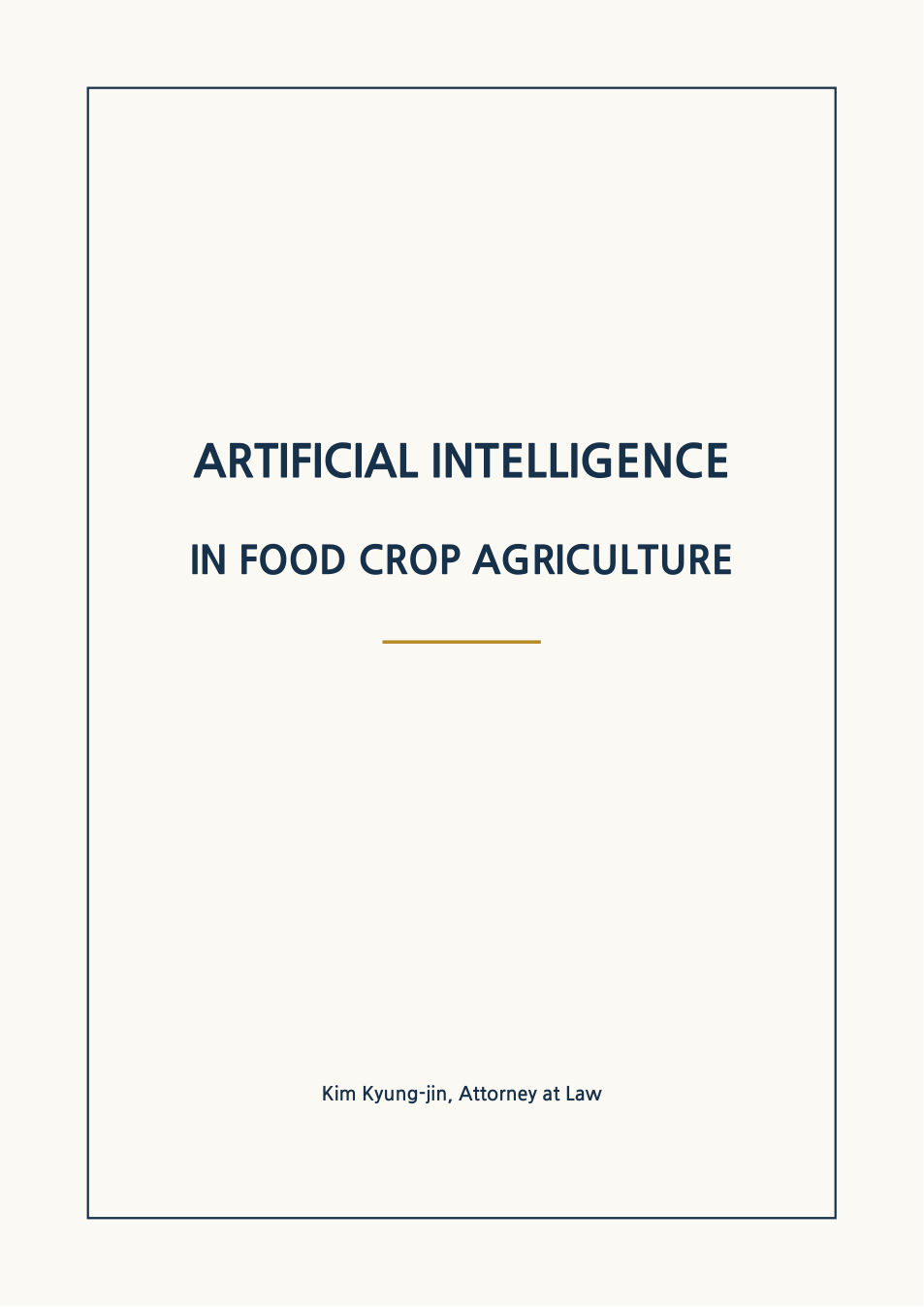
Artificial Intelligence in Food Crop Agriculture
Kim Kyung-jin, Attorney at Law
Across six chapters and eighteen sections, the book examines digital agricultural infrastructure, remote sensing, crop diagnosis, yield forecasting, precision irrigation, genomics, molecular breeding, agricultural robotics, climate-smart agriculture, and global food security.
New English Edition
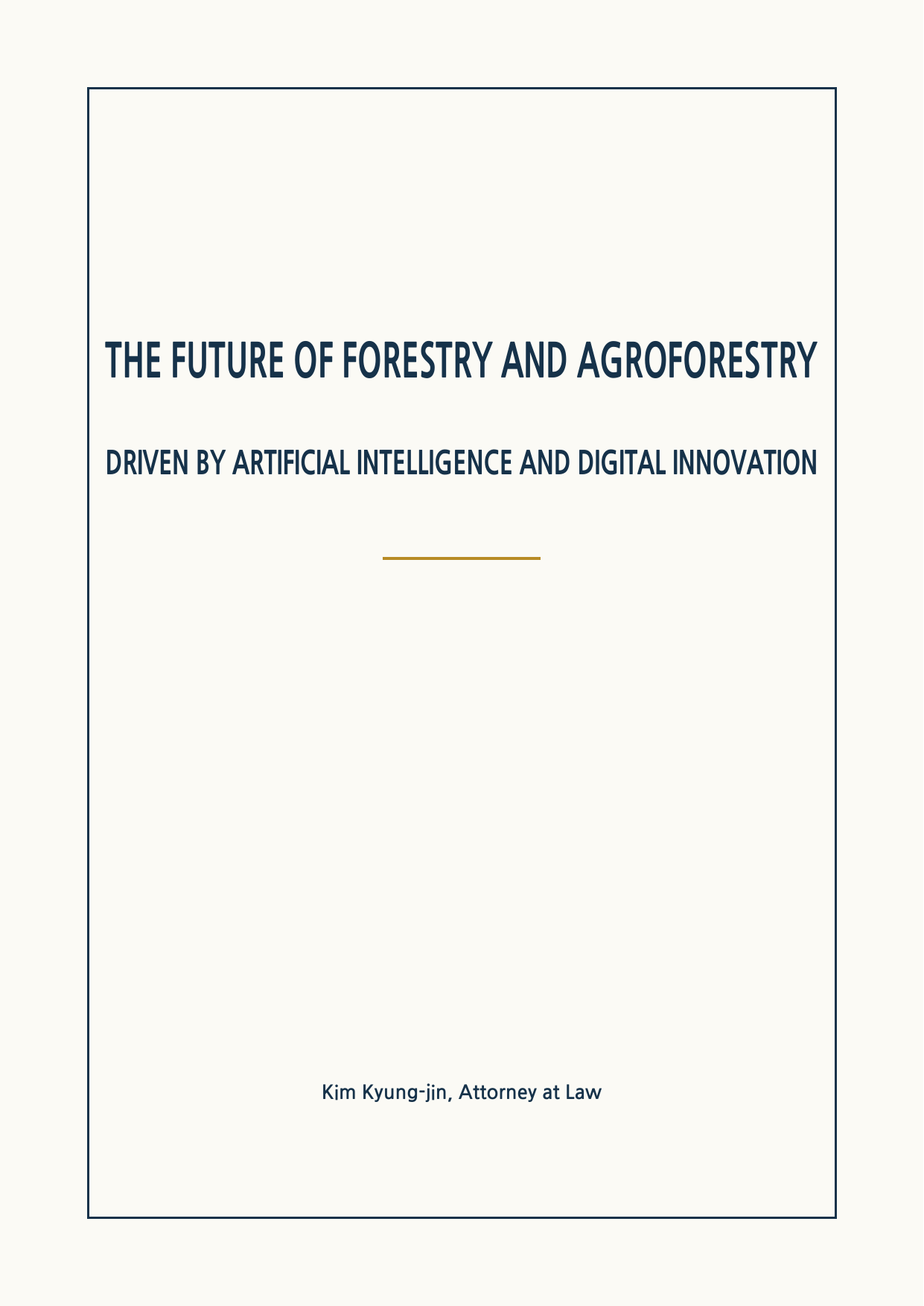
The Future of Forestry and Agroforestry
Kim Kyung-jin, Attorney at Law
Driven by Artificial Intelligence and Digital Innovation
Across five chapters and fifteen sections, the book follows satellites, drones, LiDAR, digital twins, forest-specific language models, wildfire and pest forecasting, forestry robotics, agroforestry, timber traceability, and forest carbon markets.

New English Edition
Smart Livestock Farming: AI Enters the Barn
Kim Kyung-jin, Attorney at Law
Sensors listen, cameras watch, and artificial intelligence helps farmers decide.
Across five chapters and fifteen sections, the book follows precision livestock farming from animal health and reproduction to robotic milking, virtual fencing, digital twins, methane reduction, welfare, and data ownership.
Table of Contents
Han Dong-hoon, Busan Buk-gu Gap: A Record of the 100 Days Before and After the Election (Mar. 26-Jul. 3, 2026)
Kim Kyung-jin
Table of Contents and 13 sections
From March 26 to July 3, 2026, this record follows the spring after expulsion, the Busan Buk-gu Gap by-election, victory as an independent, and the first bill submitted in the National Assembly.
Table of Contents
Artificial Intelligence and Medicine
Kim Kyung-jin, Attorney at Law
AI in clinical care, hospitals, education, and research
AI in medical imaging, risk prediction, treatment planning, hospital operations, education, and research, with patient safety, privacy, and accountability.







[AI Library] Chapter 13: Tightrope Walking Between Great Powers
A Journey Through Georgia's History and Culture
Chapter 13: Tightrope Walking Between Great Powers
Kim Kyung-jin
When you unfold Georgia's map, the weight of this small nation's geopolitical destiny becomes immediately apparent. To the north, Russia looms beyond the Caucasus Mountains. To the south, Turkey and Iran claim spheres of historical influence. Across the Black Sea to the west lies Europe, and beyond the Caspian Sea to the east await Central Asia and China. Georgia is a pawn placed in the center of this vast chessboard.
This is why a nation with 3.7 million people and a territory only two-thirds the size of South Korea has become a frequent subject of international news. Georgia's diplomacy is not merely a matter of policy choice. It is a daily tightrope walk with the nation's survival at stake.
A. Russia's Shadow and Energy Pipelines
(1) The Indelible Scars of War
In August 2008, Russian forces invaded Georgia. It was a brief but brutal five-day war. Russian tanks advanced to Gori, just forty kilometers from the capital, Tbilisi. Gori is also Stalin's birthplace. A historical irony.
The war's consequences were devastating. Russia recognized Abkhazia and South Ossetia as independent states and stationed troops there. Georgia lost effectively twenty percent of its internationally recognized territory. Only Russia and a handful of other nations such as Nicaragua, Venezuela, and Syria recognize the independence of these two regions. The rest of the international community considers them Russian illegal occupation.
There is a term called "Creeping Border." It refers to the slow encroachment of the border. The story is that Russian soldiers and South Ossetian security forces gradually move barbed wire toward Georgian territory overnight. An orchard is found within occupied territory one day. An ancestor's burial ground becomes unreachable. This is not a rumor. It is documented reality, recorded by the European Union Monitoring Mission (EUMM).
In 2015, there were reports that portions of the Baku-Supsa pipeline were incorporated into occupied territory. Energy infrastructure itself is not immune to the threat of this "creeping border."
(2) Strategic Value as an Energy Corridor
In this land shadowed heavily by Russia, the reason Georgia attracts international attention is paradoxically geographical. Georgia is the sole passage through which Caspian Sea energy can reach Europe while circumventing Russia.
The Baku-Tbilisi-Ceyhan (BTC) pipeline is the prime example. It runs 1,768 kilometers from Baku in Azerbaijan through Tbilisi in Georgia to Ceyhan on Turkey's Mediterranean coast. It carries roughly one million barrels of crude oil daily. It does not set foot on Russian territory. It is a strategic asset carefully built by the United States and Europe after the Cold War ended to secure energy independence.
There are also gas pipelines. The South Caucasus Pipeline (SCP) carries natural gas produced at Azerbaijan's Shah Deniz gas field through Georgia to Turkey. This gas then continues to Europe via the Trans-Anatolian Pipeline (TANAP) and Trans-Adriatic Pipeline (TAP). It is a crucial segment of the so-called Southern Gas Corridor.
According to International Energy Agency (IEA) data, Georgia's pipeline system connects to Russia, Azerbaijan, Armenia, and Turkey. Georgia itself is an energy-poor nation that produces little crude oil or natural gas. Yet its value as a transit country is enormous. It gains not only transit fee income but also the right to secure a certain volume of gas at discounted prices.
(3) The Shadow of Energy Weaponization
Russia has long used energy as a diplomatic weapon. The prime example is the January 2006 incident when Russian energy company Gazprom sharply raised the price of gas it was supplying to Georgia and cut off the supply. It was the
height of winter. All of Georgia froze. It was interpreted as retaliation against President Mikheil Saakashvili's pro-Western orientation.
This experience spurred Georgia to diversify its energy sources. It increased imports of Azerbaijani gas. It accelerated construction of the Baku-Tbilisi-Erzurum (BTE) pipeline. As a result, Georgia's dependence on Azerbaijani gas rose sharply.
However, complete independence from Russia did not materialize. According to a March 2025 report from the Foreign Policy Research Institute (FPRI), Georgia imports substantial quantities of liquefied petroleum gas (LPG) from Russia. Dependence on Russian refined products such as gasoline and diesel has risen again since 2021. In 2024, Georgia's imports of natural gas from Russia reached 145.7 million dollars.
According to a March 2025 analysis from the Jamestown Foundation, Georgia plans to import twice as much natural gas from Russia in 2025 compared to 2024. This is despite Azerbaijan's ability to fully meet Georgia's gas needs. This is interpreted as part of the ruling Georgian Dream government's effort to improve relations with Russia.
(4) The Middle Corridor and the Future of Green Energy
The Ukraine war has highlighted Georgia's strategic value once again. As the risks of the Northern Corridor through Russia became apparent, the Middle Corridor emerged as an alternative,a route that runs through Central Asia and the Caspian Sea, then through Georgia and Turkey to Europe.
Kazakhstan, Azerbaijan, and Georgia are the key nations of this corridor. According to the Asian Rail Alliance, freight traffic along the Middle Corridor in 2024 increased more than sixty percent from the previous year. It still accounts for only 7.8 percent of total China-Europe container traffic, but growth is steep.
In December 2022, four nations,Azerbaijan, Georgia, Romania, and Hungary,signed an agreement to build undersea power cables across the Black Sea. It is the Green Energy Corridor project to transmit electricity generated by wind and solar power along the Caspian coast to Europe. It is an initiative the EU is advancing to reduce its dependence on Russian fossil fuels.
Once completed, this project will allow Georgia to leap beyond being merely a transit country for oil and gas to become a hub supporting Europe's renewable energy security.
(5) Balance in Contradiction
Georgia's energy politics are full of contradictions. It contributes to Western security interests through pipelines that bypass Russia, while simultaneously importing gas and petroleum products from Russia. Though its territory is occupied by Russia and it has severed diplomatic relations, it welcomes 1.9 million Russian tourists as of 2024. Russia is Georgia's second-largest trade partner.
According to a 2025 Wilson Center analysis, bilateral Georgia-Russia trade in the first half of 2025 reached approximately 1.3 billion dollars, a seven percent increase from the previous year. However, remittances flowing from Russia into Georgia plummeted sixty-five percent in 2024 to just 540 million dollars.
There is even more troubling evidence. The Wilson Center report raises the possibility that Georgia is being used as a channel for Russia to circumvent international sanctions. The basis for this is statistics showing that Georgia, which has no oil resources, exported 99,000 tons of "Georgian oil" to Spain between 2023 and 2024. In 2024, the volume of yachts exported to Georgia reached record levels, a phenomenon difficult to explain for a country with below-average incomes.
Russia's shadow exists not only through military occupation. It permeates Georgian society in the forms of energy commerce, trade, finance, and information warfare. Between the West's need for energy security and Georgia's imperative for economic survival, this small nation maintains a precarious balance.
B. The Meaning of the U.S. USAID Support Suspension
(1) Cracks in a Thirty-Year Partnership
Immediately after the Soviet Union's dissolution in 1991, the United States became Georgia's most important patron. The U.S. Agency for International Development (USAID) began operations in Georgia in 1992. Over the subsequent thirty years, roughly 6 billion dollars was invested in this small nation. USAID's touch extended to nearly every field: building democratic institutions, police reform, modernizing the judicial system, agricultural technology transfer, fostering small and medium enterprises, education, and health.
On the road from Tbilisi airport into the city stands George W. Bush Street. It was named to commemorate President George W. Bush's 2005 visit to Georgia. Such was the depth of Georgia-U.S. relations.
In 2024, serious cracks appeared in this relationship.
(2) The Foreign Agent Law and Western Backlash
In May 2024, Georgia's parliament passed the Law on Transparency of Foreign Influence. It mandated that non-governmental organizations (NGOs) and media outlets receiving twenty percent or more of their funding from abroad register as "organizations pursuing foreign influence." Refusing registration incurs a fine of 25,000 lari, approximately 9,300 dollars.
Critics call this law the "Russian Law." This is because it is nearly identical to Russia's foreign agent law, which Russia has used since 2012 to suppress civil society and independent media. President Salome Zourabichvili exercised her veto, but parliament overrode it.
On Rustaveli Avenue in central Tbilisi, protests gathering tens of thousands of people continued day after day. EU flags and Georgian flags flew side by side. Police responded with tear gas and water cannons.
The United States responded forcefully. In July 2024, the U.S. State Department announced a freeze on 95 million dollars in aid to the Georgian government. A USAID spokesperson stated, "We will halt assistance that directly benefits the government, but we will continue programs that directly help the Georgian people." This meant that support for students, farmers, civil society, and independent media would continue.
(3) Trump Administration's USAID Cuts and Shockwaves
In January 2025, the situation deteriorated further. The Trump administration declared a ninety-day freeze on all foreign aid through executive order on its first day in office. The stated rationale was to review whether programs aligned with "America First" policy.
In February, Secretary of State Marco Rubio announced that after reviewing USAID's six thousand foreign aid programs, only five hundred would be maintained. This represented an eighty-three percent cut. USAID personnel shrank from more than eight thousand to fewer than three hundred. President Trump posted on social media, "CLOSE IT DOWN." Elon Musk called USAID a "criminal organization."
The impact on Georgia was immediate. According to Global Voices reporting in February 2025, Georgia's NGOs and international aid activities had "ground to a halt." Programs including the Constitutional Court's annual summer school and research projects at the Lugar Lab came to a standstill. The Lugar Lab is a U.S.-supported research institute against which Russia has long promoted conspiracy theories claiming it is a "biological weapons development facility."
(4) The Ruling Party's Welcome and Anti-Western Rhetoric
The ruling "Georgian Dream" government welcomed the U.S. reduction of USAID. Prime Minister Irakli Kobakhidze characterized this as "a defeat of the American deep state."
According to Jamestown Foundation analysis from February 2025, Prime Minister Kobakhidze himself served as a regional coordinator for USAID's public education project from 2000 to 2001. Georgia's official parliamentary website displays the text "This website was created with USAID support" alongside the USAID logo. This irony symbolically illustrates the sharp shift in Georgian politics.
The "Georgian Dream" government deploys increasingly hostile rhetoric toward the West. Government officials claim that the United States and EU seek to draw Georgia into war with Russia and open a "second front." Party founder Bidzina Ivanishvili stated in April 2024 that Russia's invasion of both Georgia and Ukraine was orchestrated by the West's "Global War Party."
These claims bear striking similarity to Kremlin propaganda. The FPRI report analyzes this as "narratives aligned with the Kremlin becoming internalized within Georgia's ruling circles."
(5) Civil Society's Survival Crisis
The most direct impact of halting USAID support falls on civil society.
A significant portion of Georgian civil society organizations depend heavily on overseas funding. Domestic philanthropic culture remains underdeveloped. USAID, the EU, embassies, and the National Endowment for Democracy (NED) were primary sources. These include the International Society for Fair Elections and Democracy (ISFED), investigative journalism outlets, and human rights monitoring organizations.
Following passage of the foreign agent law in 2024, more than 400 Georgian NGOs and media outlets declared "civil disobedience" by refusing to register. An open letter stated, "Russian law will not function in our country." But this resistance carries a cost.
According to RFE/RL reporting in August 2024, who would cover the fines became a critical issue. Western donors took the position that they would not pay fines. One Western diplomat stated, "We respect rule of law. Paying fines means acknowledging that law's legitimacy." Both USAID and the EU stated their grant agreements contain no provision for covering fines.
In April 2025, Georgia's parliament passed a new strengthened "Foreign Agents Registration Act." Refusal to register now carries criminal penalties. Human Rights Watch criticized this law for forcing activists and organizations into "false choices": accept the stigma of "foreign agent," go to prison, seek asylum, or cease operations entirely.
(6) Geopolitical Implications: Loss of Trust
The significance of halting USAID support extends beyond mere financial matters.
First, it signals a diplomatic warning that Georgia is no longer regarded as a "trustworthy democratic partner" of the West. The EU has already frozen defense support worth 30 million euros. Both the United States and EU are reviewing visa sanctions and asset freezes against senior Georgian officials.
Second, momentum for pro-Western forces within Georgia weakens. According to Eurobarometer surveys, Georgian public trust in the EU fell from 66% in spring 2024 to 49% in spring 2025. That is a 17 percentage point drop in one year. A sentiment that "the West will not protect us" spreads.
Third, Russia and China gain opportunity to fill the void. A February 2025 Just Security analysis notes that "previous administrations, whether Democratic or Republican, understood that supporting those fighting for freedom on the front lines was both American values and American interests." The critique continues: "In an era of democratic retreat worldwide, withdrawing and allowing friends of freedom to fall into darkness is the worst possible timing."
A traveler sipping free-spirited air in a trendy Tbilisi café may not perceive this. Behind that air runs a deep despair among young people about the door to the West, unsure when it will close.
C. The Dream of NATO Membership and Its Geopolitical Limits
(1) Aspiration Enshrined in the Constitution
Article 78 of the Georgian Constitution specifies that state institutions must "take all measures to guarantee complete integration into the European Union (EU) and the North Atlantic Treaty Organization (NATO)." Constitutions rarely mandate joining specific international organizations as an obligation. This reflects how deeply NATO and EU membership touches on national survival and identity for Georgians.
Polls are consistent. More than 80% of Georgians support EU membership. Support for NATO stands at similar levels. This expresses a powerful will to secure national safety from Russian threats and to join the Western democratic camp.
Walking through Tbilisi, you easily see EU flags hung alongside the Georgian flag. Government buildings, cafés, even taxis display EU flag stickers. Georgia is not yet an EU member. It is not a NATO member. Yet the flags already wave.
(2) The Bucharest Promise and Its Limits
In April 2008, the NATO summit in Bucharest, Romania, left a historic declaration: "Georgia and Ukraine will become members of NATO." For the first time in NATO history, a pledge of future membership came before even initiating a Membership Action Plan (MAP).
NATO Secretary General Jaap de Hoop Scheffer emphasized at the time, "There is no ambiguity that these countries will become NATO members." American strategist Zbigniew Brzezinski called it "a strategic victory for Ukraine, Georgia, and their North American and European supporters."
But "promise" and "realization" are different matters. The Bucharest declaration withheld the grant of MAP. Germany and France opposed it, fearing to provoke Russia.
Four months later, in August 2008, Russia invaded Georgia. This war confirmed to the world Russia's clear "red line": attempted NATO membership brings war.
(3) Territorial Dispute as a Structural Barrier
The greatest barrier to Georgia's NATO membership is unresolved territorial dispute.
Article 5 of the NATO treaty is a collective defense provision. It states that if one member is attacked, all members regard it as an attack on themselves and will respond. What happens if Georgia joins?
Russian forces are stationed in Abkhazia and South Ossetia. What becomes of those territories?
Theoretically, upon Georgia's admission, NATO could demand Russian forces withdraw. If Russia refuses, Article 5 could trigger full-scale war between NATO and Russia. No existing member wants this scenario.
NATO admission requires unanimous consent. If even one of 32 members objects, it fails. No member will accept a nation with territorial disputes and risk World War III.
(4) The Ruling Party's Dual Stance
Recent actions by the "Georgian Dream" government further complicate matters. While verbally respecting constitutional NATO integration obligations, it actually takes steps that worsen relations with the West.
In July 2024, Prime Minister Kobakhidze stated, "NATO currently has no agenda for expansion." The Georgian government spreads conspiracy theories that the West seeks to make Georgia a "second front" after the Ukraine war. It frames itself as a "peace guardian" and the West and opposition as "war forces."
According to a June 2025 Jamestown Foundation analysis, the "Georgian Dream" government announced it will shut down the "Information Center for NATO and the EU" effective July 1, 2025. Established by a pro-Western government in 2005, this center promoted NATO and EU values and built public awareness of membership.
Georgia's liaison office to NATO issued a brief statement reconfirming its commitment to the 2008 Bucharest summit's decision on Georgia's membership. That was all.
(5) Exclusion from the Summit
The deterioration in Georgia's relations with NATO shows in the numbers.
Then-Prime Minister Irakli Garibashvili was not invited to the July 2023 NATO summit in Vilnius. This came shortly after he made remarks indirectly criticizing NATO's support for Ukraine.
At the July 2024 NATO summit in Washington, Prime Minister Kobakhidze was not invited. It was NATO's 75th anniversary summit. According to an analysis by Geopolitics, Georgia was mentioned in only a single sentence in the 2024 Washington summit declaration. There was no reference to the 2008 Bucharest decision, nor any new cooperation initiatives. This was an unprecedented silence compared with all summit declarations since 2008.
In May 2025, Georgia's parliamentary delegation had its voting rights stripped at the NATO Parliamentary Assembly meeting in Dayton. This was the first time in Georgian parliamentary history.
In June 2025, the Georgian Dream confirmed that Prime Minister Kobakhidze was not invited to the NATO summit being held in The Hague.
(6) Contrast with Finland and Sweden
After Russia's invasion of Ukraine in 2022, Finland and Sweden decided to join NATO. Both had been long-standing neutral states. Finland became a full member in April 2023, and Sweden in March 2024. The accession process was exceptionally rapid.
Georgians watched this with mixed emotions. A blend of envy and resentment. Georgia had been pursuing NATO membership far longer than Finland or Sweden. It deployed more troops to Afghanistan from any non-member nation. It paid the heaviest price. It reformed its military systems to NATO standards. Yet the door remained closed.
A sentiment has taken hold: "We have done what we needed to do." This frustration with the West's double standards is being converted by the government into NATO skepticism. According to Geopolitics' 2024 analy
sis, while NATO determined that MAP was no longer necessary for Ukraine, it continues to insist that MAP remain "an essential part of the integration process" for Georgia. This is despite Georgia already implementing identical annual national programs fifteen times.
The dream of NATO membership is being steadily pushed to the background of practical politics. The void is being filled by what is termed strategic ambiguity, a form of pragmatic diplomacy.
C. Turkey, China, and Iran: Emerging Variables
(1) The Case for Diversification
As its relationship with the West strains, Georgia is pursuing a diversification strategy that breaks from its traditional Western orientation and strengthens ties with neighboring major powers. Turkey, China, and Iran are the primary targets.
According to a Carnegie Endowment analysis from August 2024, Georgia is undertaking a long-term Eurasian pivot amid deteriorating ties with the West. This includes a shift that encompasses the possibility of stabilizing relations with Russia.
(2) Turkey: An Economic Lifeline
Turkey is Georgia's economic lifeline. It is one of Georgia's largest trading partners and a NATO member with whom Georgia shares its southwestern border.
The capital of Ajara, Batumi, is essentially within Turkey's economic sphere. Many of the high-rise hotels and casinos that fill the skyline were built with Turkish capital. Batumi, just thirty minutes from the Turkish border, swells with tourists from Turkey, where gambling is prohibited, on weekends.
Turkey is equally vital for energy and logistics. The BTC oil pipeline and the South Caucasus gas pipeline terminate in Turkey. The Baku-Tbilisi-Kars railway links Azerbaijan, Georgia, and Turkey, transporting cargo from China to Europe. Georgia comprises the critical section of this corridor.
Turkish-Georgian-Azerbaijani trilateral cooperation also serves as a regional security axis that counterbalances Russia. In 2025, Georgian President Mikheil Kavelashvili met with Turkish President Recep Tayyip Erdoğan and reaffirmed their strategic partnership.
For Georgia, Turkey is also a model: a NATO member charting its own course. Turkey has not fully joined Western sanctions against Russia while retaining its NATO membership. It has acted as a mediator between Russia and the West in the Ukraine war. In 2024, there were reports that Turkey had applied for BRICS membership.
(3) China: A Strategic Hub of the Belt and Road Initiative
The most significant variable is China. For China, Georgia is a strategic hub of the Belt and Road Initiative. This is because Georgia occupies the bottleneck of the corridor linking the Caspian and Black Seas.
In 2023, Georgia and China established a strategic partnership. Georgia reaffirmed the One China principle and backed Beijing's positions on Taiwan, Xinjiang, and Tibet. China stated that it does not recognize the independence of Abkhazia and South Ossetia and supports Georgia's territorial integrity.
In May 2024, the Georgian government selected a Chinese consortium to develop the Anaklia deep-water port. The consortium is led by China Communications Construction Company (CCCC) and includes Singapore-based Qingdao Port International and the China Road and Bridge Corporation (CRBC). The first-phase investment alone totals 600 million dollars.
The Anaklia deep-water port is the largest infrastructure project in Georgian history. Situated on the Black Sea coast, this port is projected to become a critical logistics hub of the corridor. The Georgian government stated it would maintain management control through a 51 percent stake.
The United States raised strong objections. CCCC is on the US Commerce Department's blacklist. It had participated in constructing artificial islands for military purposes in the South China Sea. The China Road and Bridge Corporation has a record of being sanctioned by the World Bank for misconduct on a Philippines project.
In May 2025, the US Congress approved the MEGOBARI Act. The acronym stands for Mobilizing and Enabling Georgia's Accountability, Resilience, and Independence Act, with megobari meaning friend in Georgian. This law grants the president authority to impose sanctions on Georgian government officials who obstruct Euro-Atlantic integration. The intent to counter China's development of the Anaklia port is transparent.
(4) The Spread of Chinese Capital
China's presence in Georgia does not end with the Anaklia port.
The China Road and Bridge Corporation has been operating in Georgia since 2018, participating in the construction of the Ubisa-Shorapani section of the East-West Highway. A Chinese firm is also executing Georgia's largest tunnel project, the Kvesheti-Kobi tunnel. This tunnel is a vital section of the Georgian military road that leads to the Russian border.
According to a December 2024 analysis by FPRI, China is concentrating investment in Georgia's infrastructure and strategic projects, thereby deepening this country's economic footprint. These projects align with China's broader objectives to strengthen connectivity and influence across Eurasia.
China is now one of Georgia's major trading partners. It ranks third in imports and fourth in exports. As Georgia's Western ties weaken, its economic integration with China is accelerating.
There is debate about the character of Chinese investment. Western funding typically demands governance, transparency, and norm compliance. Chinese funding concentrates on project performance and collateral structures. It is difficult to declare one approach superior to the other. Yet the impact on Georgia's institutional character differs significantly.
(5) Iran: Opportunity Within Sanctions
Iran does not share a border with Georgia. However, it has historical ties dating back to the Persian Empire, when it ruled Georgia. Recently, signs of change have appeared in bilateral relations.
According to a Carnegie Foundation analysis, Prime Minister Kobakhidze visited Tehran twice following the death of Iranian President Ebrahim Raisi in a helicopter crash in May 2024. This represents a potential opening toward warmer ties than has been traditionally observable.
For Iran, Georgia is a gateway to Europe. The Western path, blocked by sanctions, can be bypassed through the Black Sea and the Caucasus. Under the rubric of the North-South Corridor, discussions are underway on creating a logistics network connecting the Persian Gulf to Georgia's Black Sea ports.
Russia, Iran, Turkey, Azerbaijan, Armenia, and Georgia participate in the 3+3 Platform. In this body led by Russia and Iran, Georgia's role is expanding.
However, strengthening ties with Iran carries risks because of US sanctions on Iran. Companies or financial institutions that transact with Iran risk exclusion from US markets. If Georgia broadens its economic cooperation with Iran, it risks becoming a conduit for circumventing Western sanctions.
A December 2024 analysis by FPRI notes that Russia, Iran, and China are forming a revisionist axis cooperating to avoid the US-led sanctions regime in energy, finance, and technology. Should Georgia be drawn into this axis, its relationship with the United States could reach an irreversible point.
(6) Survival in a Multipolar Age
Ultimately, Georgia stands at the center of a multidimensional equation that transcends the binary choice between Russia and the West.
The existential threat posed by Russia, the receding umbrella of NATO and America, strategic value as an energy corridor, Turkey's economic pragmatism filling the gap, China's vast capital and infrastructure ambitions, Iran's geopolitical interests. All these variables are at work simultaneously.
A December 2025 National Interest analysis summarizes the current landscape this way: "Armenia, long considered a Russian satellite state, now resists the Kremlin and participates in military exercises with the West. Azerbaijan is viewed as a pragmatic and trustworthy actor seeking to deepen trade and energy relations with the EU and the United States. At this moment, Georgia alone remains the sole anti-Western actor in the South Caucasus, sympathetic to the influence of revisionist powers."
Whether this analysis is exaggeration or an accurate diagnosis will be answered by what unfolds next.
The Georgian government continues its precarious balancing act between these great powers, seeking to maximize national interest and secure regime stability. Whether this constitutes "strategy" or "improvisation" only time will tell. Improvisation, after all, is usually the kind of partner great powers prefer.
The subtle tension a traveler feels while raising a glass of wine in Kakheti may be the fragrance of history forged by these great powers' rivalry.
Kim Kyung-jin
Attorney · Former Member of the National Assembly · AI Policy Researcher
© 2026 Kim Kyung-jin. All rights reserved.